P66 (Papyrus Bodmer II): John 13:1-14:3 (pages 96-103)
Introduction
P66 is a papyrus codex of the Gospel of John copied in Egypt around 200, the most complete early copy of John. Most of it is Papyrus Bodmer II in the Fondation Martin Bodmer, Cologny (Geneva); small pieces are in the Chester Beatty Library, Dublin, and the Institut für Altertumskunde, Cologne. The first five quires (John 1:1-14:26) survive as a bound book of numbered pages; later leaves, from John 14:29 to 21:9, are damaged and kept between glass. The scribe made many corrections, some of them his own; only the first hand is shown here.
Each section below is one page: the photograph, the NTVMR diplomatic transcription line by line, and the King James Version of every verse on the page. Pages of the bound book are shown on the photographic plates published by Victor Martin and J. W. B. Barns in 1962 (scanned by the Bodmer Lab), the glass-mounted leaves on colour photographs. Lost: John 6:12-34 (pages 35-38) and parts of chapters 14-21; the transcription ends at 21:9. Where P66 lacks a verse that the KJV has (John 5:4, the account of the adulteress at 7:53-8:11, 16:15), the section says so.
This entry covers pages 96-103 (John 13:1-14:3).
How was this verified? (Provenance)
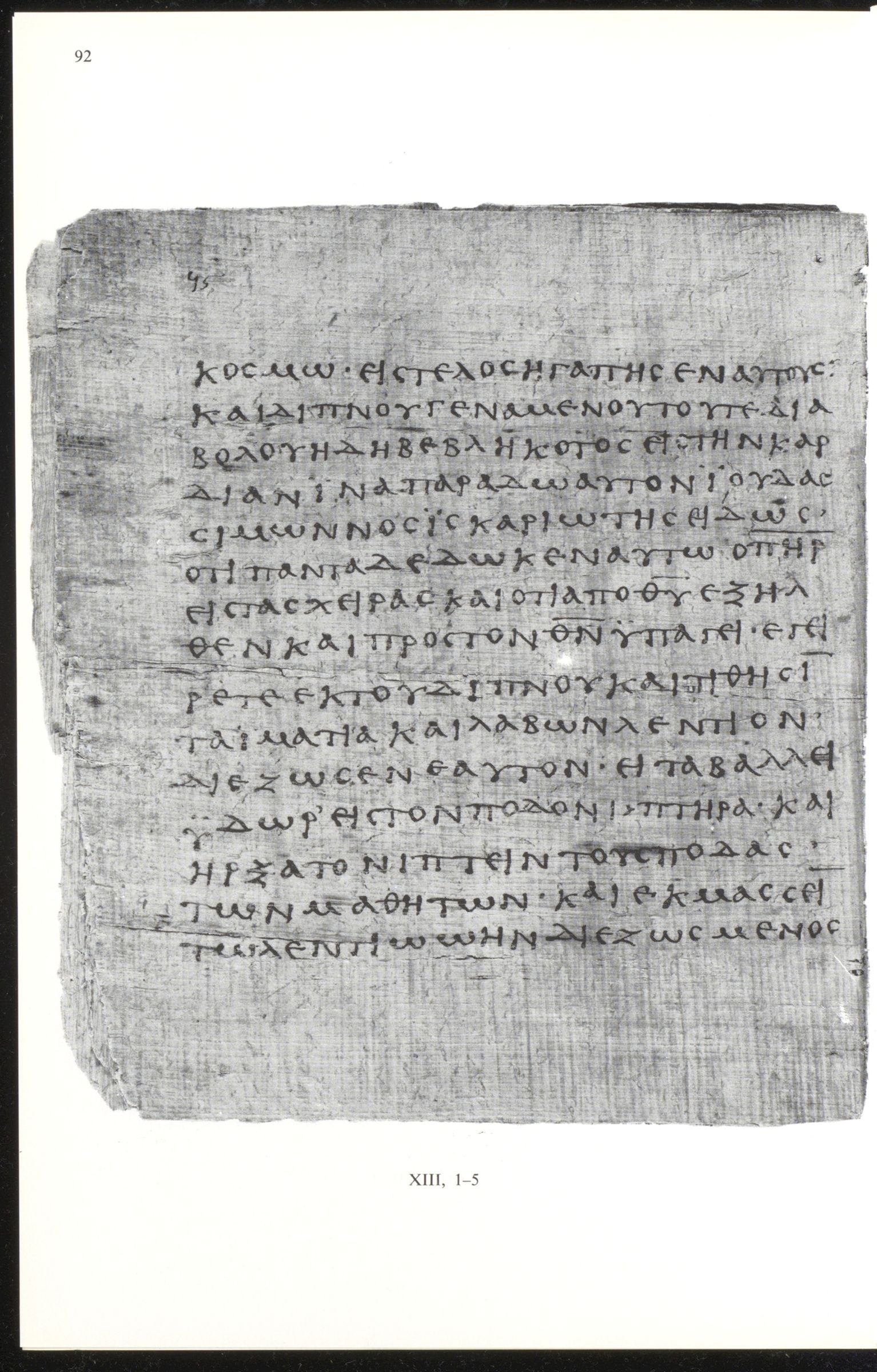
Where on the image
Fondation Martin Bodmer, Papyrus Bodmer II, Bodmer Lab image 1072205287_100 (https://bodmerlab.unige.ch/fr/constellations/papyri/mirador/1072205287), photographic plate of the 1962 Martin-Barns edition, shown whole. NTVMR page 920 (page 96) is linked to this image in NTVMR's page index. 13:1 begins on the previous page. Checked on the image: the printed caption reads ‹XIII, 1-5›.
13:1 κοσμω· εις τελος ηγαπησεν αυτους·
2 και διπνου γεναμενου του τε δια
βολου ηδη βεβληκοτος εις την καρ
διαν ινα παραδω αυτον ιουδας
σιμωννος ισκαριωτης 3 ειδως
οτι παντα δεδωκεν αυτω ο π̅η̅ρ̅
εις τας χειρας και οτι απο θ̅υ̅ εξηλ
θεν και προς τον θ̅ν̅ υπαγει· 4 εγει
ρετε εκ του διπνου και τιθησιν
τα ιματια και λαβων λεντιον
διεζωσεν εαυτον· 5 ειτα βαλλει
υδωρ εις τον ποδονιπτηρα· και
ηρξατο νιπτειν τους ποδας
των μαθητων· και εκμασσειν
τω λεντιω ω ην διεζωσμενος
13:1Now before the feast of the passover, when Jesus knew that his hour was come that he should depart out of this world unto the Father, having loved his own which were in the world, he loved them unto the end. 2And supper being ended, the devil having now put into the heart of Judas Iscariot, Simon’s son, to betray him; 3Jesus knowing that the Father had given all things into his hands, and that he was come from God, and went to God; 4He riseth from supper, and laid aside his garments; and took a towel, and girded himself. 5After that he poureth water into a bason, and began to wash the disciples’ feet, and to wipe them with the towel wherewith he was girded.
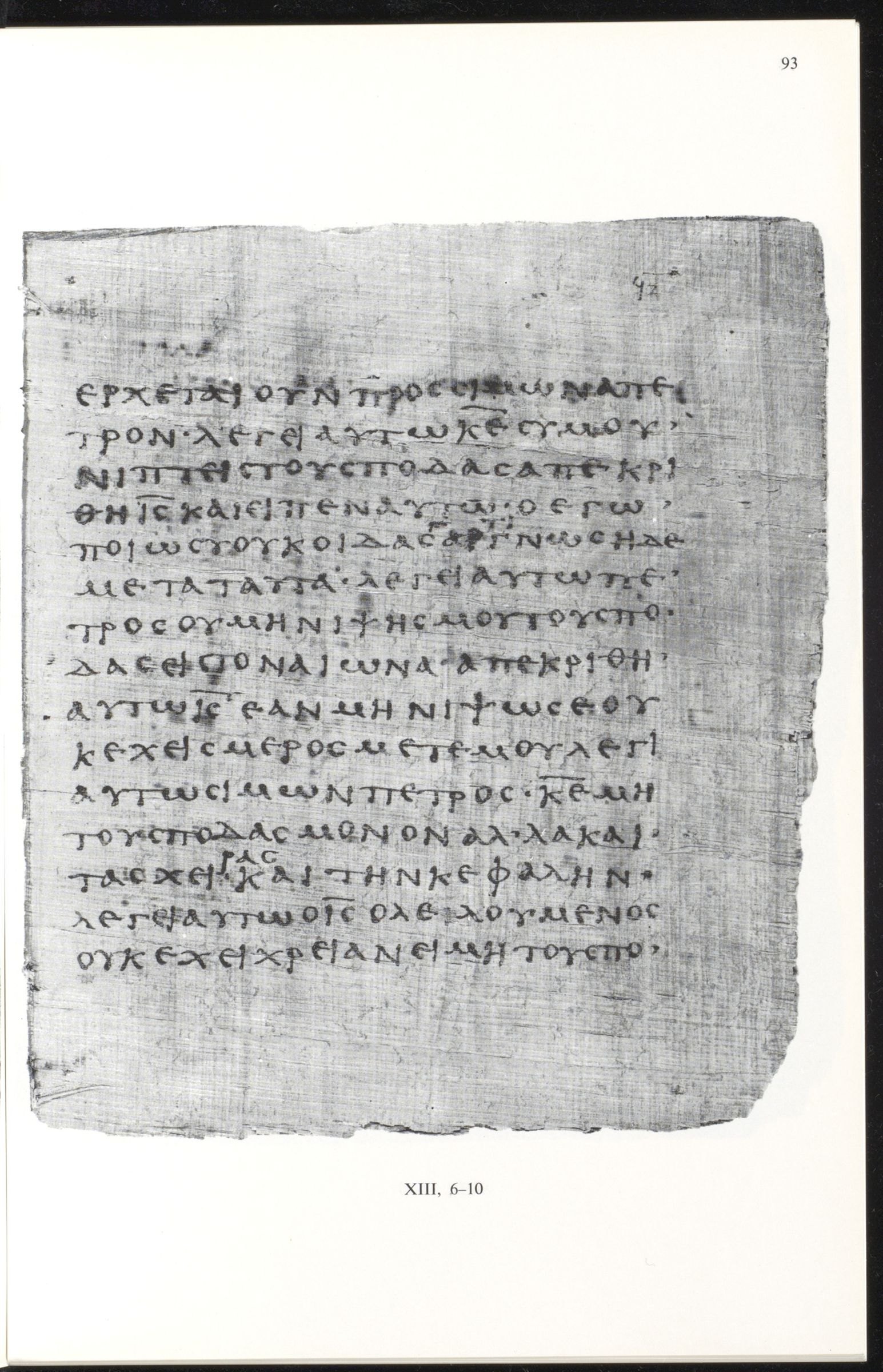
Where on the image
Fondation Martin Bodmer, Papyrus Bodmer II, Bodmer Lab image 1072205287_101 (https://bodmerlab.unige.ch/fr/constellations/papyri/mirador/1072205287), photographic plate of the 1962 Martin-Barns edition, shown whole. NTVMR page 930 (page 97) is linked to this image in NTVMR's page index. 13:10 continues on the next page. Checked on the image: the printed caption reads ‹XIII, 6-10›.
13:6 ερχεται ουν προς σιμωνα πε
τρον· λεγει αυτω κ̅ε̅ συ μου
νιπτεις τους ποδας 7 απεκρι
θη ι̅ς̅ και ειπεν αυτω· ο εγω
ποιω συ ουκ οιδας α[.] γνωση δε
μετα ταυτα· 8 λεγει αυτω πε
τρος ου μη νιψης μου τους πο
δας εις τον αιωνα· απεκριθη
αυτω ι̅ς̅ εαν μη νιψω σε ου
κ εχεις μερος μετ εμου 9 λεγι
αυτω σιμων πετρος· κ̅ε̅ μη
τους ποδας μονον αλλα και
τας χει· και την κεφαλην·
10 λεγει αυτω ο ι̅ς̅ ο λειλουμενος
ουκ εχει χρειαν ει μη τους πο
13:6Then cometh he to Simon Peter: and Peter saith unto him, Lord, dost thou wash my feet? 7Jesus answered and said unto him, What I do thou knowest not now; but thou shalt know hereafter. 8Peter saith unto him, Thou shalt never wash my feet. Jesus answered him, If I wash thee not, thou hast no part with me. 9Simon Peter saith unto him, Lord, not my feet only, but also my hands and my head. 10Jesus saith to him, He that is washed needeth not save to wash his feet, but is clean every whit: and ye are clean, but not all.
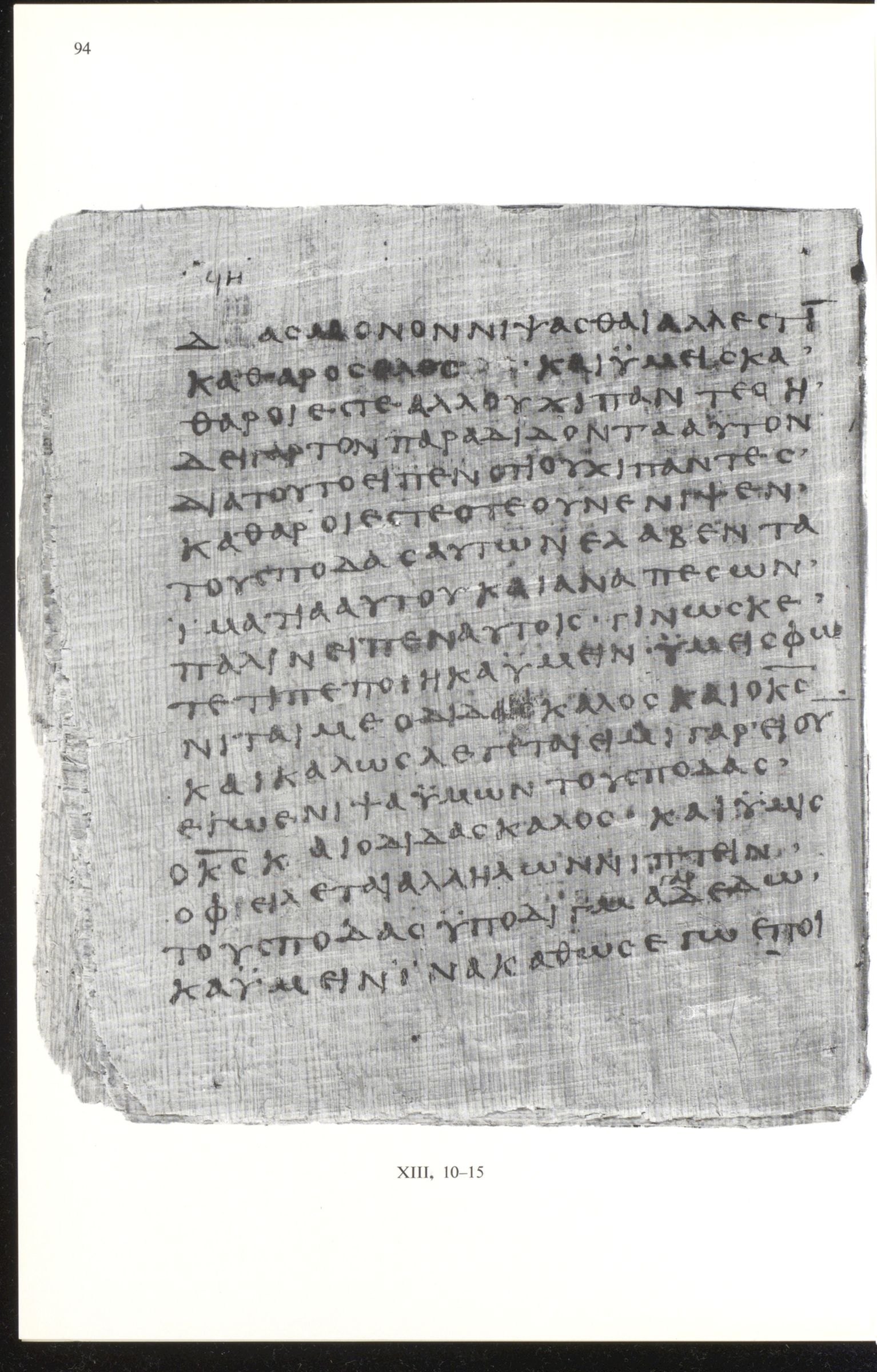
Where on the image
Fondation Martin Bodmer, Papyrus Bodmer II, Bodmer Lab image 1072205287_102 (https://bodmerlab.unige.ch/fr/constellations/papyri/mirador/1072205287), photographic plate of the 1962 Martin-Barns edition, shown whole. NTVMR page 940 (page 98) is linked to this image in NTVMR's page index. 13:10 begins on the previous page; 13:15 continues on the next page. Checked on the image: the printed caption reads ‹XIII, 10-15›.
13:10 δδ̣ας μονον νιψασθαι αλλ εστιν
καθαρος π̣ι̣σ̣τ̣ος· και υμεις κα
θαροι εστε αλλ ουχι παντες 11 η
δει γαρ τον παραδιδοντα αυτον
δια τουτο ειπεν οτι ουχι παντες
καθαροι εστε 12 οτε ουν ενιψεν
τους ποδας αυτων ελαβεν τα
ιματια αυτου και αναπεσων
παλιν ειπεν αυτοις· γινωσκε
τε τι πεποιηκα υμειν· 13 υμεις φω
νιται με ο διδασκαλος και ο κ̅ς̅
και καλως λεγεται ειμι γαρ 14 ει ουν
εγω ενιψα υμων τους ποδας
ο κ̅ς̅ και ο διδασκαλος· και υμις
οφιειλεται αλληλων νιπτειν
τους ποδας 15 υποδιγμα δεδω
κα υμειν ινα καθως εγω εποι
13:10Jesus saith to him, He that is washed needeth not save to wash his feet, but is clean every whit: and ye are clean, but not all. 11For he knew who should betray him; therefore said he, Ye are not all clean. 12So after he had washed their feet, and had taken his garments, and was set down again, he said unto them, Know ye what I have done to you? 13Ye call me Master and Lord: and ye say well; for so I am. 14If I then, your Lord and Master, have washed your feet; ye also ought to wash one another’s feet. 15For I have given you an example, that ye should do as I have done to you.
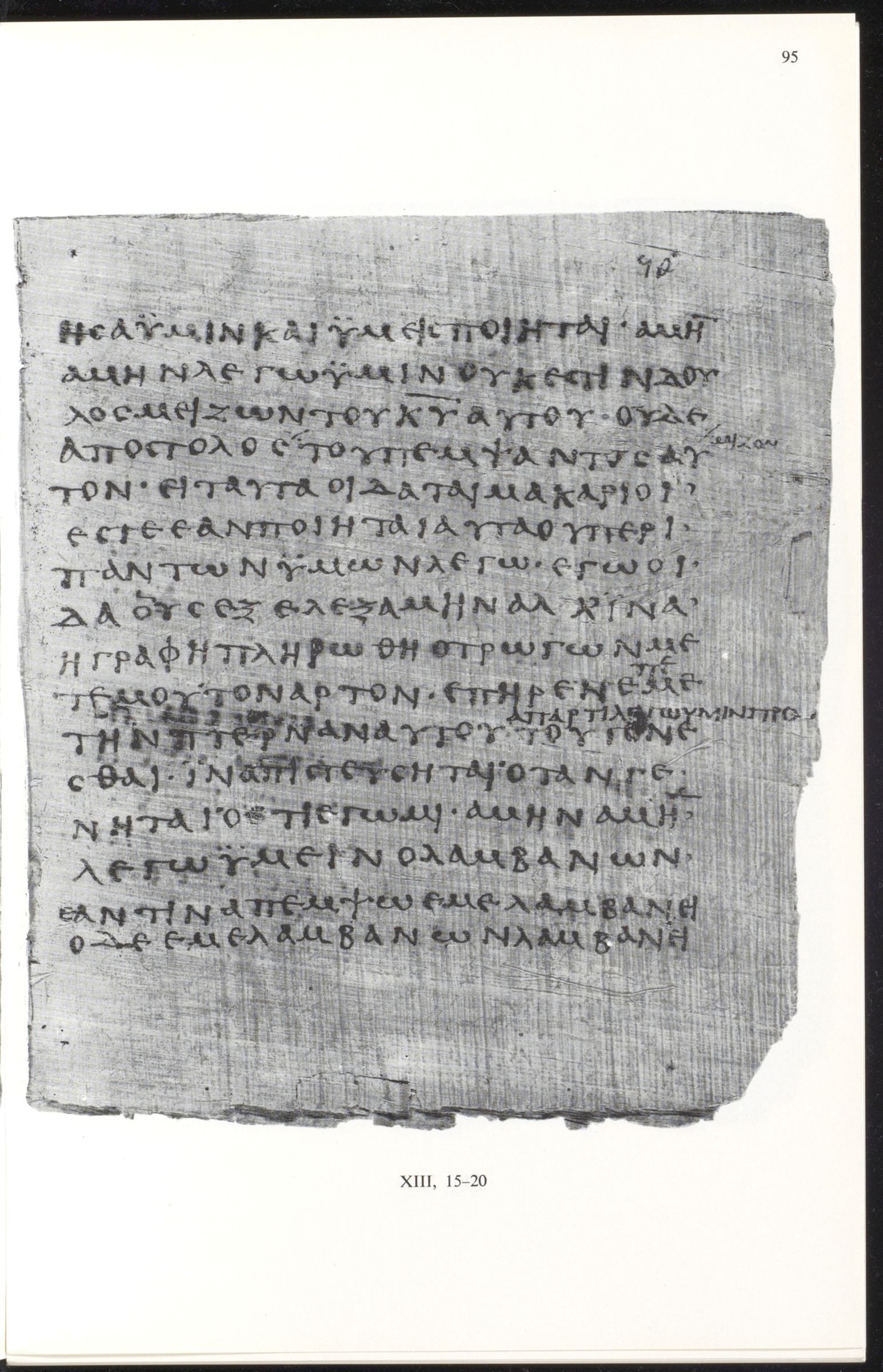
Where on the image
Fondation Martin Bodmer, Papyrus Bodmer II, Bodmer Lab image 1072205287_103 (https://bodmerlab.unige.ch/fr/constellations/papyri/mirador/1072205287), photographic plate of the 1962 Martin-Barns edition, shown whole. NTVMR page 950 (page 99) is linked to this image in NTVMR's page index. 13:15 begins on the previous page; 13:20 continues on the next page. Checked on the image: the printed caption reads ‹XIII, 15-20›.
13:15 ησα υμιν και υμεις ποιηται· 16 αμην
αμην λεγω υμιν ουκ εστιν δου
λος μειζων του κ̅υ̅ αυτου· ουδε
αποστολος του πεμψαντος αυ
τον· 17 ει ταυτα οιδαται μακαριοι
εστε εαν ποιηται αυτα 18 ου περι
παντων υμων λεγω· εγω οι
δα ους εξελεξαμην αλλ ινα
η γραφη πληρωθη ο τρωγων με
τ εμου τον αρτον· επηρεν εμε
την πτερναν αυτου· 19 του γενε
σθαι· ινα πιστευσηται· οταν γε
νηται· οετι εγω μι· 20 αμην αμην
λεγω υμειν ο λαμβανων
αν τινα πεμψω εμε λαμβανει
ο δε εμε λαμβανων λαμβανει
13:15For I have given you an example, that ye should do as I have done to you. 16Verily, verily, I say unto you, The servant is not greater than his lord; neither he that is sent greater than he that sent him. 17If ye know these things, happy are ye if ye do them. 18¶ I speak not of you all: I know whom I have chosen: but that the scripture may be fulfilled, He that eateth bread with me hath lifted up his heel against me. 19Now I tell you before it come, that, when it is come to pass, ye may believe that I am he. 20Verily, verily, I say unto you, He tha t receiveth whomsoever I send receiveth me; and he that receiveth me receiveth him that sent me.
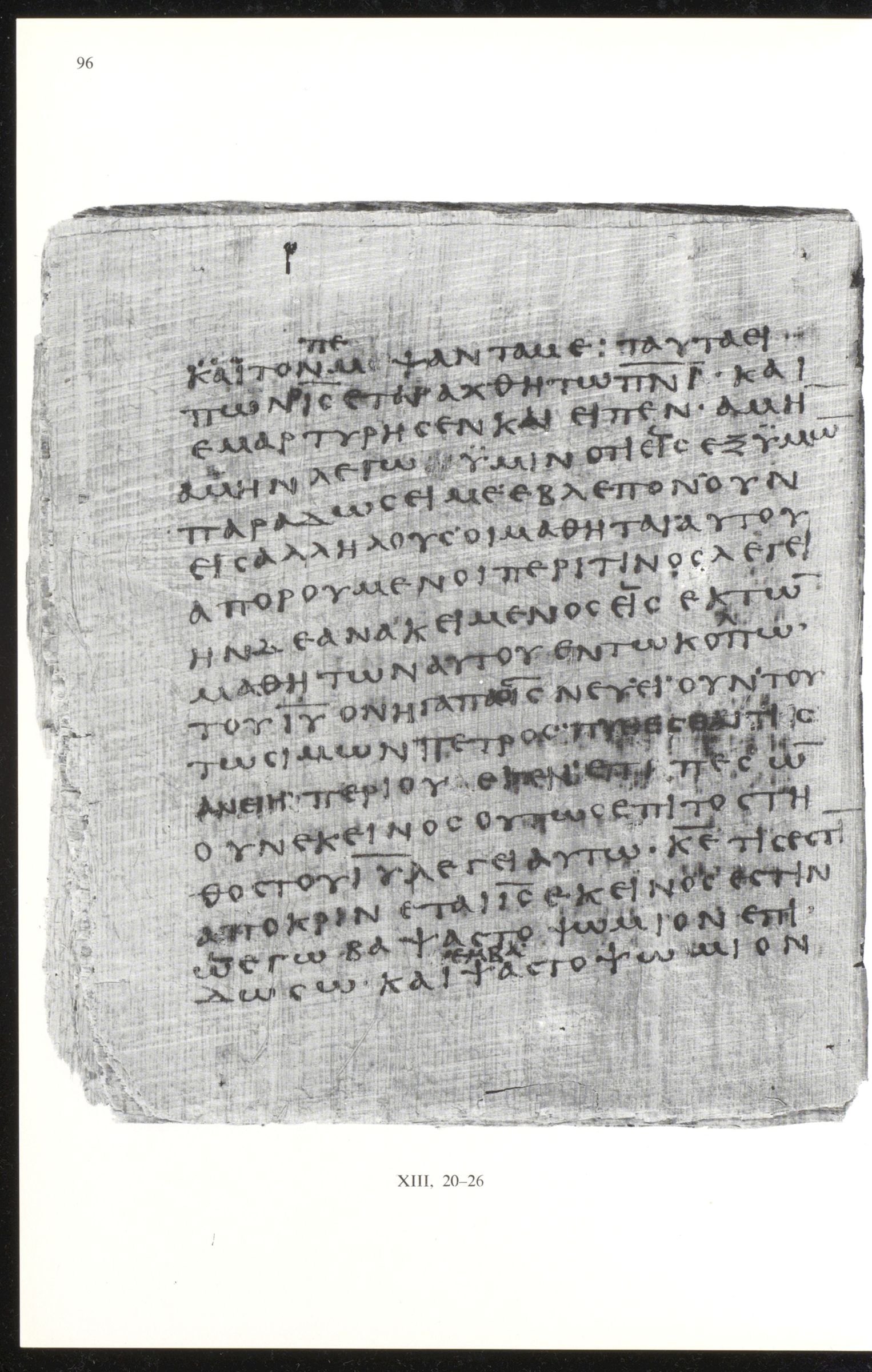
Where on the image
Fondation Martin Bodmer, Papyrus Bodmer II, Bodmer Lab image 1072205287_104 (https://bodmerlab.unige.ch/fr/constellations/papyri/mirador/1072205287), photographic plate of the 1962 Martin-Barns edition, shown whole. NTVMR page 960 (page 100) is linked to this image in NTVMR's page index. 13:20 begins on the previous page; 13:26 continues on the next page. Checked on the image: the printed caption reads ‹XIII, 20-26›; the last line of writing, ‹δωσω· και ψας το ψωμιον› (line 17 of the transcription), is legible at the foot of the page.
13:20 και τον μεψαντα με· 21 ταυτα ει
πων ι̅ς̅ εταραχθη τω π̅ν̅α̣̣̅· και
εμαρτυρησεν και ειπεν· αμην
αμην λεγων υμιν οτι εις εξ υμων
παραδωσει με· 22 εβλεπον· ουν
εις αλληλους· οι μαθηται· αυτου
απορουμενοι περι τινος λεγει
23 ην δε ανακειμενος εις εκ των
μαθητων αυτου εν τω κοπω
του ι̅υ̅ ον ηγαπα ι̅ς̅ 24 νευει ουν του
τω σιμων πετρος· [...]
ε̣σ̣τ̣ι̣ν̣ περι ου λεγει· 25 α̣ν̣απεσων
ουν εκεινος ουτως επι το στη
θος του ι̅υ̅ λεγει αυτω· κ̅ε̅ τις εστιν
26 αποκρινεται ι̅ς̅ εκεινος εστιν
ω εγω βαψας το ψωμιον επι
δωσω· και ψας το ψωμιον
13:20Verily, verily, I say unto you, He tha t receiveth whomsoever I send receiveth me; and he that receiveth me receiveth him that sent me. 21When Jesus had thus said, he was troubled in spirit, and testified, and said, Verily, verily, I say unto you, that one of you shall betray me. 22Then the disciples looked one on another, doubting of whom he spake. 23Now there was leaning on Jesus’ bosom one of his disciples, whom Jesus loved. 24Simon Peter therefore beckoned to him, that he should ask who it should be of whom he spake. 25He then lying on Jesus’ breast saith unto him, Lord, who is it? 26Jesus answered, He it is, to whom I shall give a sop, when I have dipped it. And when he had dipped the sop, he gave it to Judas Iscariot, the son of Simon.
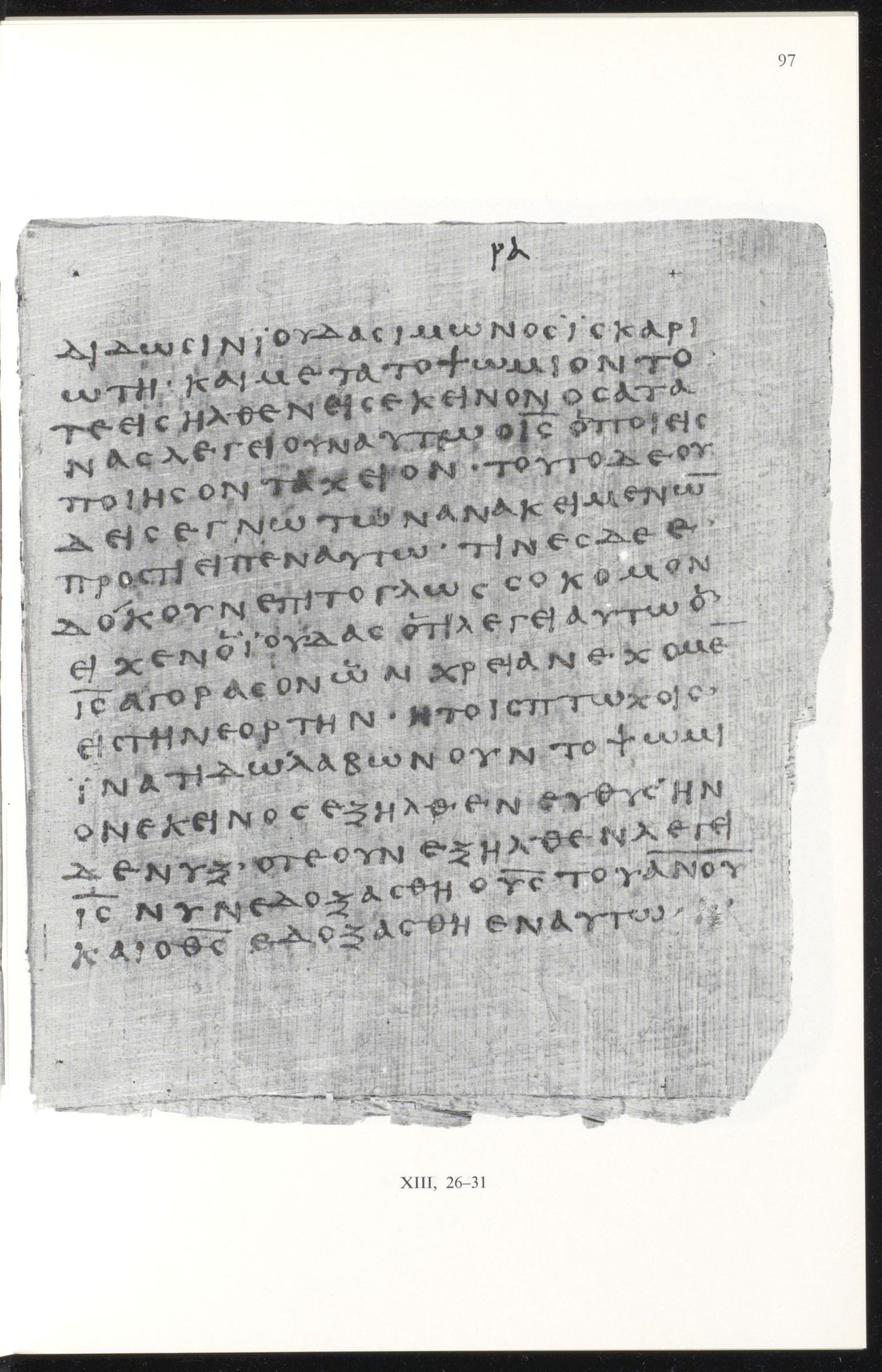
Where on the image
Fondation Martin Bodmer, Papyrus Bodmer II, Bodmer Lab image 1072205287_105 (https://bodmerlab.unige.ch/fr/constellations/papyri/mirador/1072205287), photographic plate of the 1962 Martin-Barns edition, shown whole. NTVMR page 970 (page 101) is linked to this image in NTVMR's page index. 13:26 begins on the previous page; 13:32 continues on the next page. Checked on the image: the printed caption reads ‹XIII, 26-31›.
13:26 διδωσιν ιουδα σιμωνος ισκαρι
ωτη· 27 και μετα το ψωμιον το
τε εισηλθεν εις εκεινον ο σατα
νας λεγει ουν αυτω ο ι̅ς̅ ο ποιεις
ποιησον ταχειον· 28 τουτο δε ου
δεις εγνω των ανακειμενων
προς τι ειπεν αυτω· 29 τινες δε ε
δοκουν επι το γλωσσοκομον
ειχεν ο ιουδας οτι λεγει αυτω ο
ι̅ς̅ αγορασον ων χρειαν εχομεν
εις την εορτην· η τοις πτωχοις
ινα τι δω· 30 λαβων ουν το ψωμι
ον εκεινος εξηλθεν ευθυς· ην
δε νυξ 31 οτε ουν εξηλθεν λεγει
ι̅ς̅ νυν εδοξασθη ο υ̅ς̅ του α̅ν̅ο̅υ̅
και ο θ̅ς̅ εδοξασθη εν αυτω 32 κ̣α̣ι̣
13:26Jesus answered, He it is, to whom I shall give a sop, when I have dipped it. And when he had dipped the sop, he gave it to Judas Iscariot, the son of Simon. 27And after the sop Satan entered into him. Then said Jesus unto him, That thou doest, do quickly. 28Now no man at the table knew for what intent he spake this unto him. 29For some of them thought, because Judas had the bag, that Jesus had said unto him, Buy those things that we have need of against the feast; or, that he should give something to the poor. 30He then having received the sop went immediately out: and it was night. 31¶ Therefore, when he was gone out, Jesus said, Now is the Son of man glorified, and God is glorified in him. 32If God be glorified in him, God shall also glorify him in himself, and shall straightway glorify him.
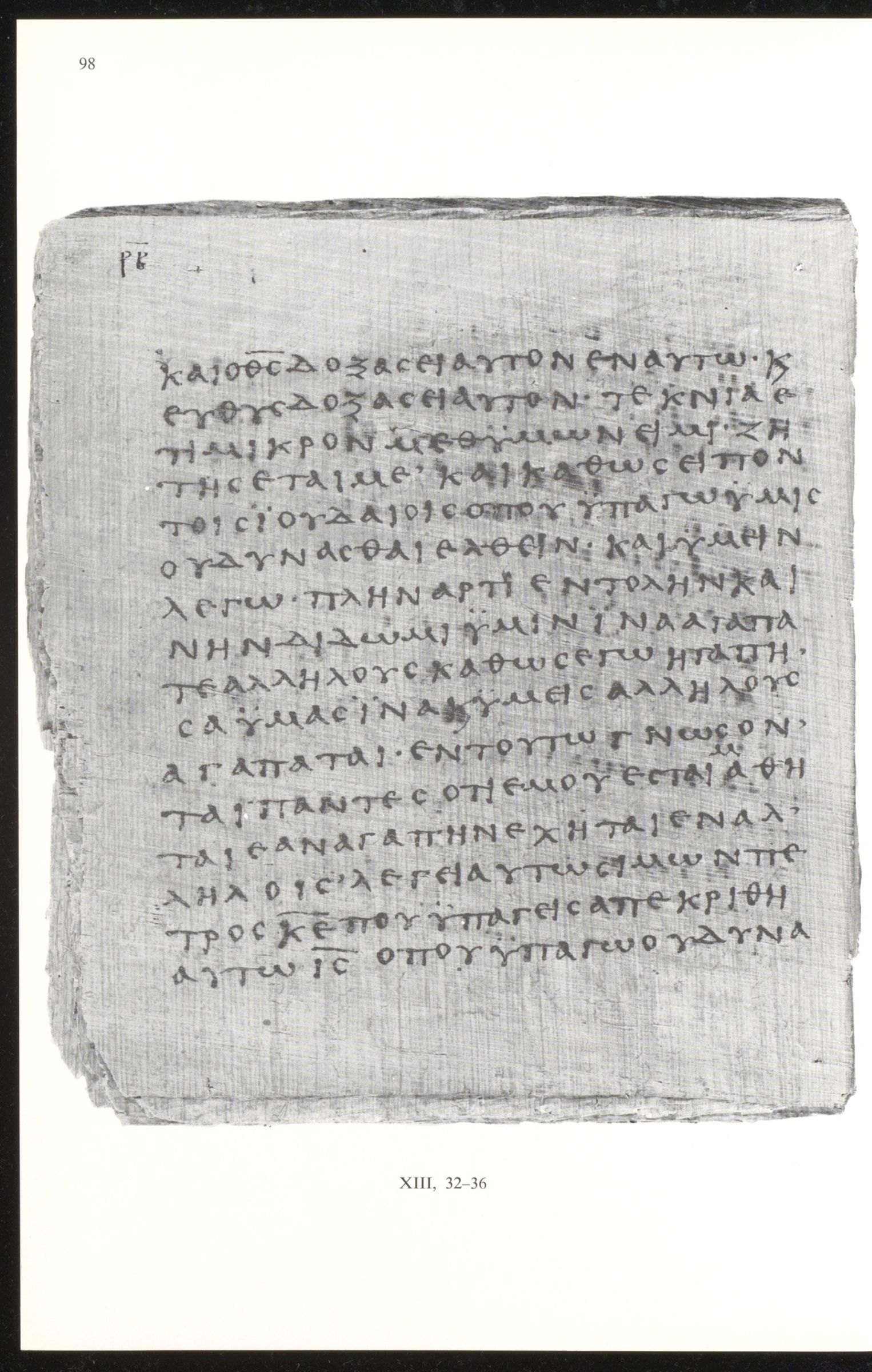
Where on the image
Fondation Martin Bodmer, Papyrus Bodmer II, Bodmer Lab image 1072205287_106 (https://bodmerlab.unige.ch/fr/constellations/papyri/mirador/1072205287), photographic plate of the 1962 Martin-Barns edition, shown whole. NTVMR page 980 (page 102) is linked to this image in NTVMR's page index. 13:32 begins on the previous page; 13:36 continues on the next page. Checked on the image: the printed caption reads ‹XIII, 32-36›.
13:32 και ο θ̅ς̅ δοξασει αυτον εν αυτω· και
ευθυς δοξασει αυτον· 33 τεκνια ε
τι μικρον μεθ υμων ειμι· ζη
τησεται με και καθως ειπον
τοις ιουδαιοις οπου υπαγω υμις
ου δυνασθαι ελθειν· και υμειν
λεγω· πλην αρτι 34 εντολην και
νην διδωμι υμιν ινα αγαπα
τε αλληλους καθως εγω ηγαπη
σα υμας ινα και υμεις αλληλους
αγαπαται· 35 εν τουτω γνωσον
ται παντες οτι εμου εσται αθη
ται εαν αγαπην εχηται εν αλ
ληλοις 36 λεγει αυτω σιμων πε
τρος κ̅ε̅ που υπαγεις απεκριθη
αυτω ι̅ς̅ οπου υπαγω ου δυνα
13:32If God be glorified in him, God shall also glorify him in himself, and shall straightway glorify him. 33Little children, yet a little while I am with you. Ye shall seek me: and as I said unto the Jews, Whither I go, ye cannot come; so now I say to you. 34A new commandment I give unto you, That ye love one another; as I have loved you, that ye also love one another. 35By this shall all men know that ye are my disciples, if ye have love one to another. 36¶ Simon Peter said unto him, Lord, whither goest thou? Jesus answered him, Whither I go, thou canst not follow me now; but thou shalt follow me afterwards.
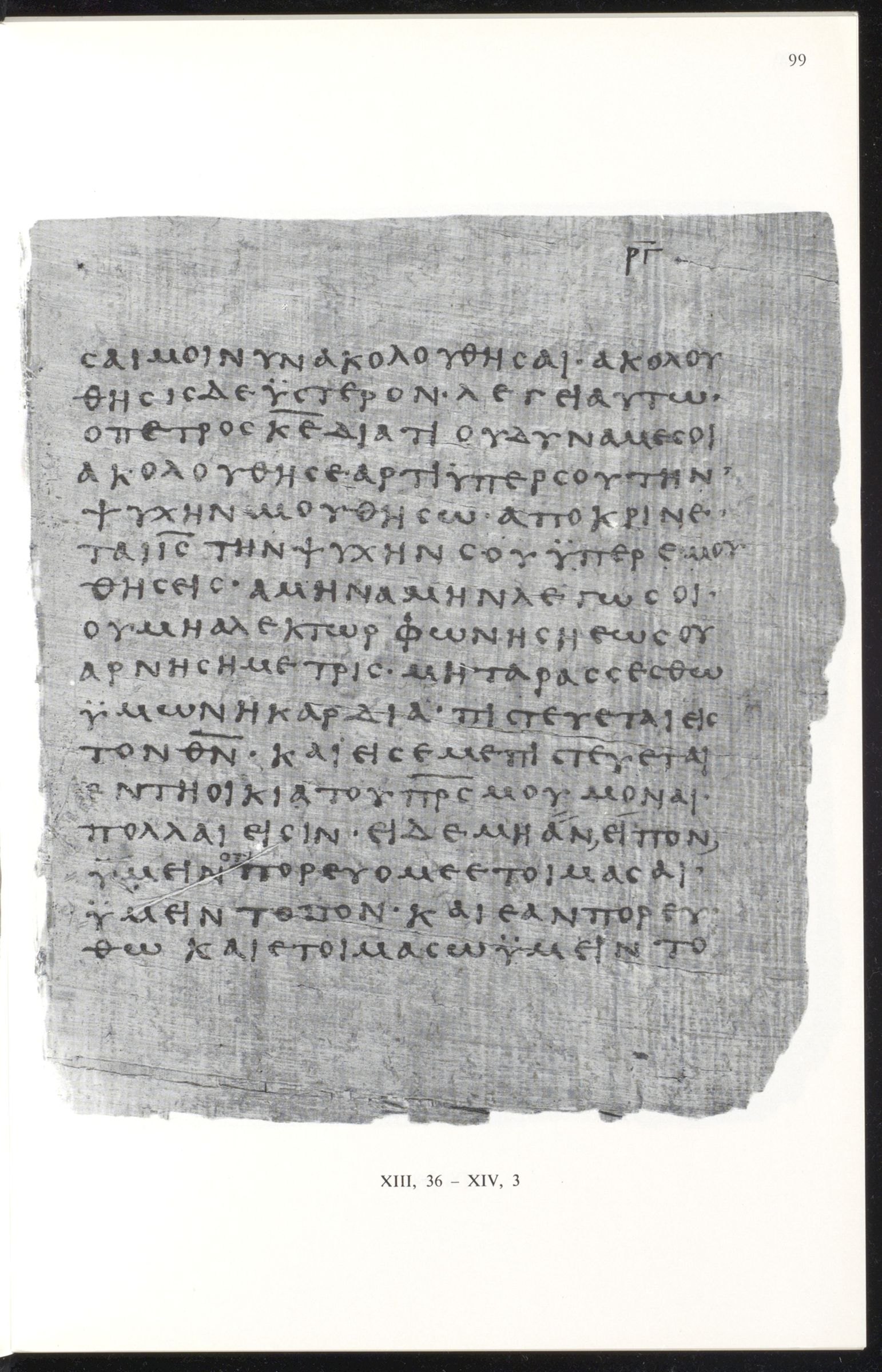
Where on the image
Fondation Martin Bodmer, Papyrus Bodmer II, Bodmer Lab image 1072205287_107 (https://bodmerlab.unige.ch/fr/constellations/papyri/mirador/1072205287), photographic plate of the 1962 Martin-Barns edition, shown whole. NTVMR page 990 (page 103) is linked to this image in NTVMR's page index. 13:36 begins on the previous page; 14:3 continues on the next page. Checked on the image: the printed caption reads ‹XIII, 36 - XIV, 3›.
13:36 σαι μοι νυν ακολουθησαι· ακολου
θησις δε υστερον· 37 λεγει αυτω·
ο πετρος κ̅ε̅ δια τι ου δυναμε σοι
ακολουθησε αρτι υπερ σου την
ψυχην μου θησω· 38 αποκρινε
ται ι̅ς̅ την ψυχην σου υπερ εμου
θησεις· αμην αμην λεγω σοι
ου μη αλεκτωρ φωνηση εως ου
αρνηση με τρις· 14:1 μη ταρασσεσθω
υμων η καρδια· πιστευεται εις
τον θ̅ν̅· και εις εμε πιστευεται
2 εν τη οικια του π̅ρ̅ς̅ μου μοναι
πολλαι εισιν· ει δε μη αν ειπον
υμειν πορευομε ετοιμασαι
υμειν τοπον· 3 και εαν πορευ
θω και ετοιμασω υμειν το
13:36¶ Simon Peter said unto him, Lord, whither goest thou? Jesus answered him, Whither I go, thou canst not follow me now; but thou shalt follow me afterwards. 37Peter said unto him, Lord, why cannot I follow thee now? I will lay down my life for thy sake. 38Jesus answered him, Wilt thou lay down thy life for my sake? Verily, verily, I say unto thee, The cock shall not crow, till thou hast denied me thrice. 14:1Let not your heart be troubled: ye believe in God, believe also in me. 2In my Father’s house are many mansions: if it were not so, I would have told you. I go to prepare a place for you. 3And if I go and prepare a place for you, I will come again, and receive you unto myself; that where I am, there ye may be also.
Notes
- Greek: the NTVMR diplomatic transcription, line by line as on the papyrus. Square brackets enclose letters that are lost or illegible and were supplied by the transcribers; a dot under a letter marks it as uncertain; [...] marks a gap. Nomina sacra and numerals keep the scribe's overline. Spelling is the scribe's (no accents or breathings). Words broken at a line end stay broken as on the papyrus. Corrections are not shown: the text is the first hand.
- English: the King James Version (1611), whole verses, for every verse that has text on the page. A verse that begins on one page and ends on the next is given in full on both. The KJV translates a later form of the Greek text, so its wording does not always match the papyrus; material differences (such as verses the papyrus does not have) are noted in the section.
Cite
Sources
- Source: Papyrus Bodmer II (P66), Fondation Martin Bodmer: images from the Bodmer Lab, University of Geneva; Greek from the INTF NTVMR transcription of P66; English from the King James Version (holding institution)
- Critical edition: INTF NTVMR diplomatic transcription (CC BY 4.0)
← previous · → next · v cycle view · l back to library