P72 (Papyrus Bodmer VIII): 1 Peter 5:2-14 (pages 20-22)
Introduction
P72 is a papyrus codex copied in Egypt in the 3rd or early 4th century. It holds the oldest known copies of 1 Peter, 2 Peter and Jude. The pages are numbered by the scribe. 1-2 Peter (papyrus pages 1-36) are Papyrus Bodmer VIII, given by Martin Bodmer to Pope Paul VI in 1969 and now in the Vatican Library; Jude (pages 62-68) is Papyrus Bodmer VII, still at the Fondation Martin Bodmer, Cologny (Geneva). Both belong to the Bodmer "Miscellaneous" or "Composite" codex, which also contains the Nativity of Mary, the apocryphal correspondence of Paul with the Corinthians, the 11th Ode of Solomon, Melito's sermon On the Pascha, a hymn fragment and other texts. 1-2 Peter seem to have formed a separate booklet before being bound with the rest.
Each section below is one papyrus page: the photograph, the NTVMR diplomatic transcription of that page line by line, and the King James Version of every verse on it. The scribe's spelling is irregular (ει for ι, ε for αι, and so on) and is kept as written.
This entry covers papyrus pages 20-22 (1 Peter 5:2-14). The photographs are from the Vatican Library (Pap. Bodmer VIII).
How was this verified? (Provenance)
Where on the image
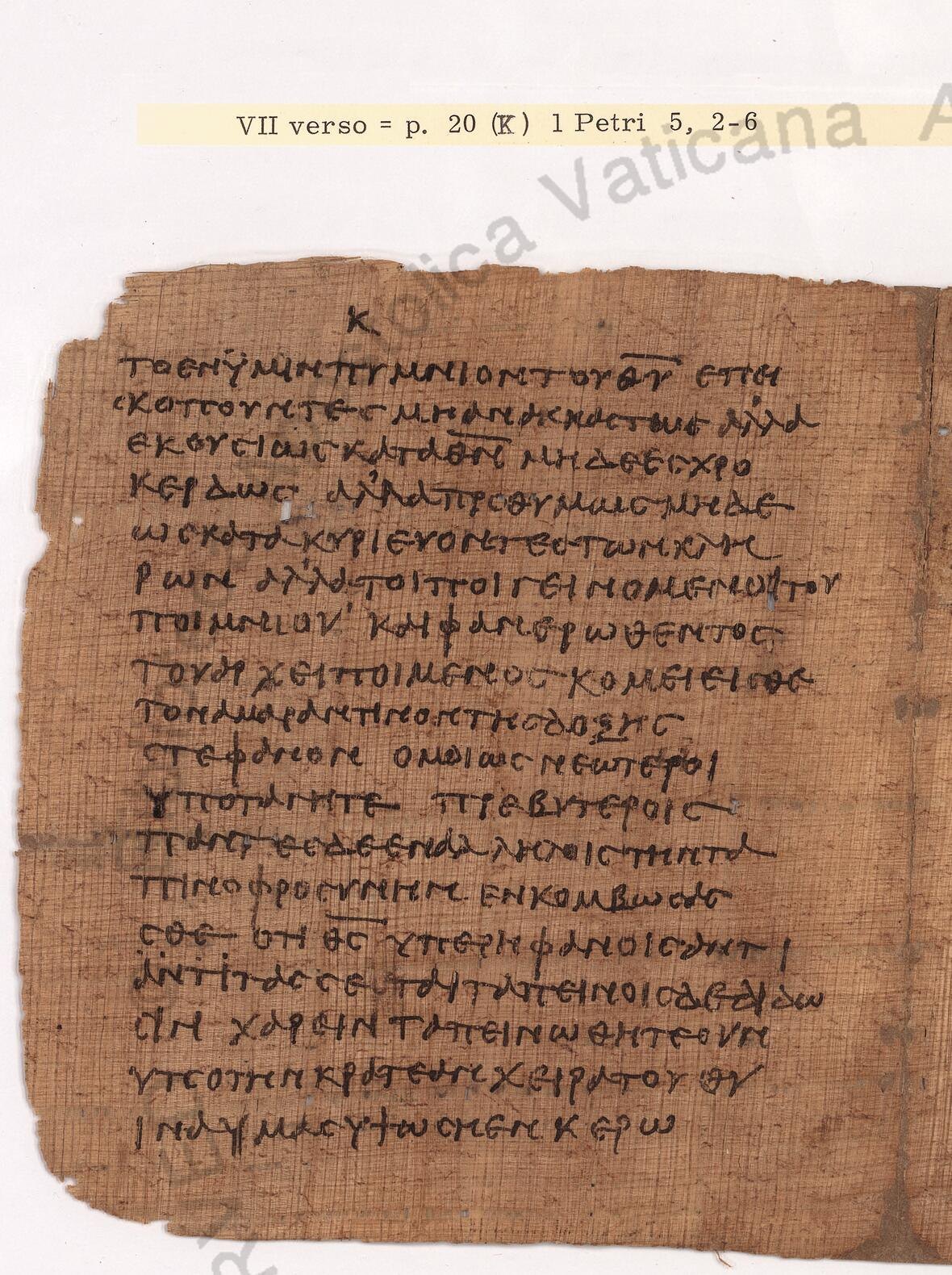
Vatican Library, Pap. Bodmer VIII, DigiVatLib image 14 (https://digi.vatlib.it/view/MSS_Pap.Bodmer.VIII/0014), the left-hand page of the opening, cropped at the fold. The typed label on the glass frame reads "VII verso = p. 20 (K) 1 Petri 5, 2-6". 5:2 begins on the previous page. Checked on the image: 18 lines in the transcription; the first legible line (line 1) reads ‹το εν υμιν πυμνιον του θ̅υ̅ επει›, the last legible line (line 18) ‹ινα υμας υψωση εν κερω›; both match the page.
5:2 το εν υμιν πυμνιον του θ̅υ̅ επει
σκοπουντες μη ανακκαστως αλλα
εκουσιως κατα θ̅ν̅ μηδε εσχρο
κερδως αλλα προθυμως 3 μηδε
ως κατακυριευοντες των κλη
ρων αλλα τοιποι γεινομενοι του
ποιμνιου 4 και φανερωθεντος
του αρχειποιμενος κομειεισθε
τον αμαραντινον της δοξης
στεφανον 5 ομοιως νεωτεροι
υποταγητε πρεβυτεροις
παντες δε εν αλληλοις την τα
πινοφροσυνην ενκομβωσασ
σθε οτι θ̅ς̅ υπερηφανοις αντι
αντιτασσεσται ταπεινοις δε διδω
σιν χαρειν 6 ταπεινωθητε ουν
υπο την κρατεαν χειρα του θυ
ινα υμας υψωση εν κερω
5:2Feed the flock of God which is among you, taking the oversight thereof, not by constraint, but willingly; not for filthy lucre, but of a ready mind; 3Neither as being lords over God’s heritage, but being ensamples to the flock. 4And when the chief Shepherd shall appear, ye shall receive a crown of glory that fadeth not away. 5Likewise, ye younger, submit yourselves unto the elder. Yea, all of you be subject one to another, and be clothed with humility: for God resisteth the proud, and giveth grace to the humble. 6Humble yourselves therefore under the mighty hand of God, that he may exalt you in due time:
Where on the image
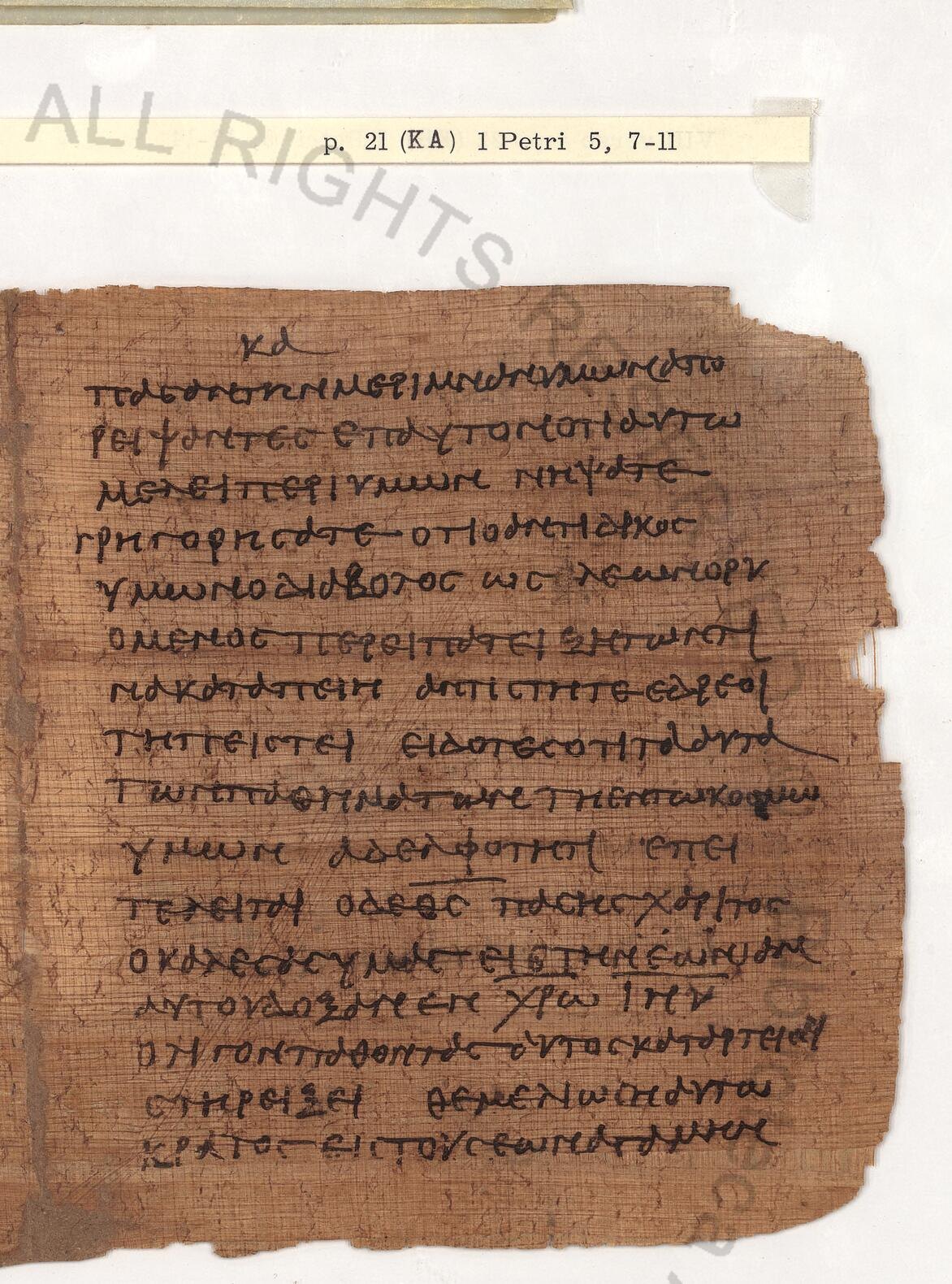
Vatican Library, Pap. Bodmer VIII, DigiVatLib image 15 (https://digi.vatlib.it/view/MSS_Pap.Bodmer.VIII/0015), the right-hand page of the opening, cropped at the fold. The typed label on the glass frame reads "p. 21 (KA) 1 Petri 5, 7-11". Checked on the image: 16 lines in the transcription; the first legible line (line 1) reads ‹πασαν την μεριμναν υμων απο›, the last legible line (line 16) ‹κρατος εις τους εωνας αμην›; both match the page.
5:7 πασαν την μεριμναν υμων απο
ρειψαντες επ αυτον οτι αυτω
μελει περι υμων 8 νηψατε
γρηγορησατε οτι ο αντιδικος
υμων ο διαβολος ως ελεων ορυ
ομενος περειπατει ζητων τι
να καταπειη 9 αντιστητε εδρεοι
τη πειστει ειδοτες οτι τα αυτα
των παθηματων τη εν τω κοσμω
υμων αδελφοτητι επει
τελειται 10 ο δε θ̅ς̅ πασης χαριτος
ο καλεσας υμας εις την εωνιαν
αυτου δοξαν εν χ̅ρ̅ω̅ ι̅η̅υ̅
ολιγον παθοντας αυτος κ̣α̣τ̣α̣ρ̣τ̣ε̣ι̣
στηρειξει θεμελιωση 11 αυτω
κρατος εις τους εωνας αμην
5:7Casting all your care upon him; for he careth for you. 8Be sober, be vigilant; because your adversary the devil, as a roaring lion, walketh about, seeking whom he may devour: 9Whom resist stedfast in the faith, knowing that the same afflictions are accomplished in your brethren that are in the world. 10But the God of all grace, who hath called us unto his eternal glory by Christ Jesus, after that ye have suffered a while, make you perfect, stablish, strengthen, settle you. 11To him be glory and dominion for ever and ever. Amen.
Where on the image
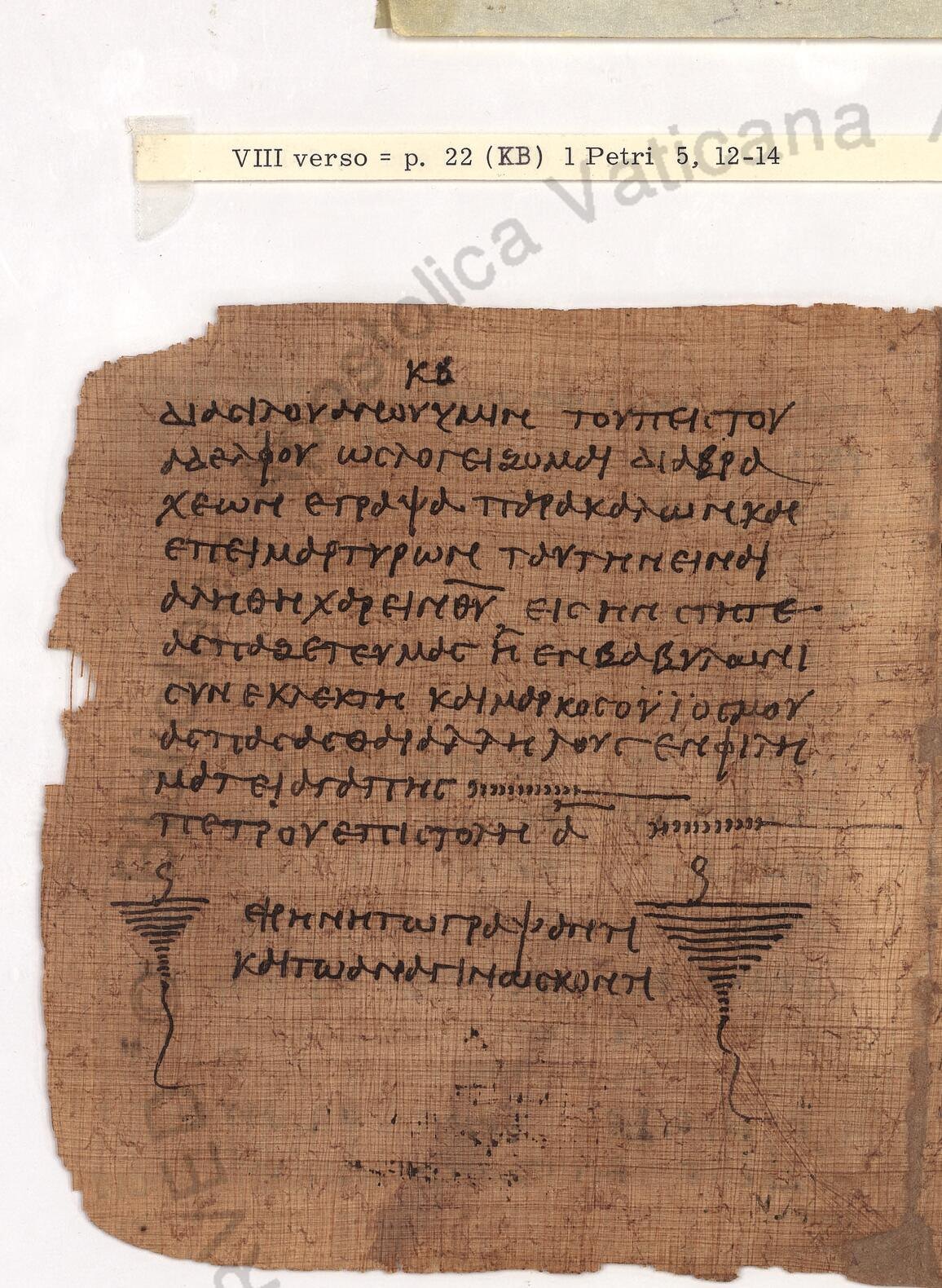
Vatican Library, Pap. Bodmer VIII, DigiVatLib image 16 (https://digi.vatlib.it/view/MSS_Pap.Bodmer.VIII/0016), the left-hand page of the opening, cropped at the fold. The typed label on the glass frame reads "VIII verso = p. 22 (KB) 1 Petri 5, 12-14". The page also carries a book title, shown in italics in the Greek (πετρου επιστολη α̅); the KJV has no English for it. Checked on the image: 10 lines in the transcription; the first legible line (line 1) reads ‹δια σιλουανου υμιν του πειστου›, the last legible line (line 10) ‹πετρου επιστολη α̅›; both match the page. Below the title, between two drawn ornaments, the scribe added ειρηνη τω γραψαντι και τω αναγινωσκοντι; the NTVMR transcription records these words only in an editorial note, so they are not in the Greek column.
5:12 δια σιλουανου υμιν του πειστου
αδελφου ως λογειζομαι δια βρα
χεων εγραψα παρακαλων και
επειμαρτυρων ταυτην ειναι
αληθη χαρειν θ̅υ̅ εις ην στητε
13 ασπαζετε υμας η εν βαβυλωνι
συνεκλεκτη και μαρκος ο υιος μου
14 ασπασασθαι αλληλους εν φιλη
ματει αγαπης
πετρου επιστολη α̅
5:12By Silvanus, a faithful brother unto you, as I suppose, I have written briefly, exhorting, and testifying that this is the true grace of God wherein ye stand. 13The church that is at Babylon, elected together with you, saluteth you; and so doth Marcus my son. 14Greet ye one another with a kiss of charity. Peace be with you all that are in Christ Jesus. Amen.
Notes
- Greek: the NTVMR diplomatic transcription, line by line as on the papyrus. Square brackets enclose letters that are lost or illegible and were supplied by the transcribers; a dot under a letter marks it as uncertain; [...] marks a gap. Nomina sacra and numerals keep the scribe's overline. Spelling is the scribe's (no accents or breathings). Words broken at a line end stay broken as on the papyrus. Corrections are not shown: the text is the first hand.
- English: the King James Version (1611), whole verses, for every verse that has text on the page. A verse that begins on one page and ends on the next is given in full on both. The KJV translates a later form of the Greek text, so its wording does not always match the papyrus; material differences (such as verses the papyrus does not have) are noted in the section.
Cite
Sources
- Source: Papyrus Bodmer VIII (Vatican Library): photographs from DigiVatLib; Greek from the INTF NTVMR transcription of P72; English from the King James Version (holding institution)
- Critical edition: INTF NTVMR diplomatic transcription (CC BY 4.0)
← previous · → next · v cycle view · l back to library