P72 (Papyrus Bodmer VIII): 2 Peter 1:1-2:2 (pages 23-27)
Introduction
P72 is a papyrus codex copied in Egypt in the 3rd or early 4th century. It holds the oldest known copies of 1 Peter, 2 Peter and Jude. The pages are numbered by the scribe. 1-2 Peter (papyrus pages 1-36) are Papyrus Bodmer VIII, given by Martin Bodmer to Pope Paul VI in 1969 and now in the Vatican Library; Jude (pages 62-68) is Papyrus Bodmer VII, still at the Fondation Martin Bodmer, Cologny (Geneva). Both belong to the Bodmer "Miscellaneous" or "Composite" codex, which also contains the Nativity of Mary, the apocryphal correspondence of Paul with the Corinthians, the 11th Ode of Solomon, Melito's sermon On the Pascha, a hymn fragment and other texts. 1-2 Peter seem to have formed a separate booklet before being bound with the rest.
Each section below is one papyrus page: the photograph, the NTVMR diplomatic transcription of that page line by line, and the King James Version of every verse on it. The scribe's spelling is irregular (ει for ι, ε for αι, and so on) and is kept as written.
This entry covers papyrus pages 23-27 (2 Peter 1:1-2:2). The photographs are from the Vatican Library (Pap. Bodmer VIII).
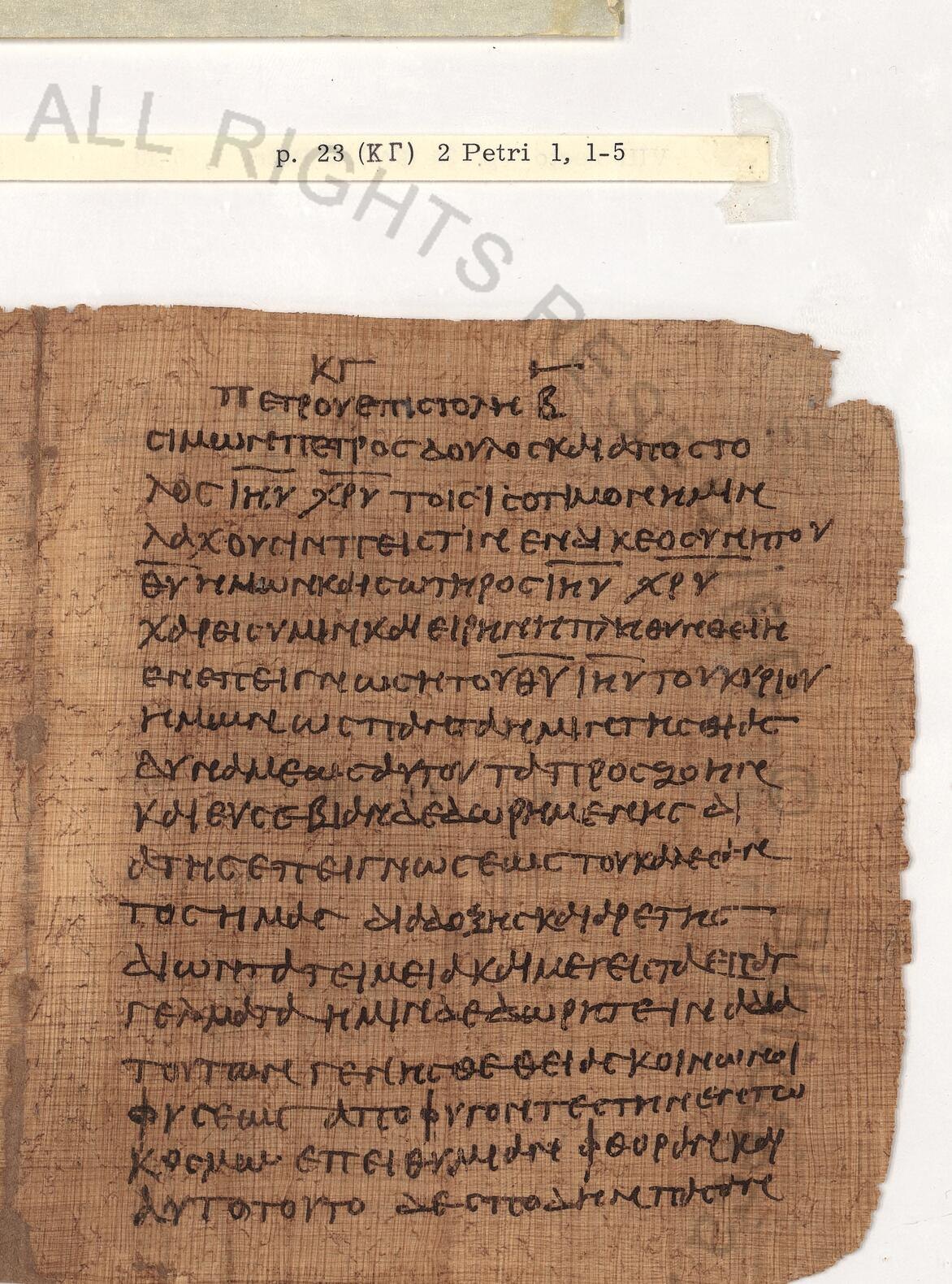
2 Peter 1:4 is on papyrus page 23 (lines 13-17). The KJV renders it "that by these ye might be partakers of the divine nature"; P72 reads ινα δια τουτων γενησθε θειας κοινωνοι φυσεως. It is the New Testament verse from which the Greek fathers drew the doctrine of theosis.
How was this verified? (Provenance)
Where on the image
Vatican Library, Pap. Bodmer VIII, DigiVatLib image 16 (https://digi.vatlib.it/view/MSS_Pap.Bodmer.VIII/0016), the right-hand page of the opening, cropped at the fold. The typed label on the glass frame reads "p. 23 (KΓ) 2 Petri 1, 1-5". 1:5 continues on the next page. The page also carries a book title, shown in italics in the Greek (πετρου επιστολη β̅); the KJV has no English for it. Checked on the image: 18 lines in the transcription; the first legible line (line 1) reads ‹πετρου επιστολη β̅›, the last legible line (line 18) ‹αυτο τουτο δε σποδην πασαν›; both match the page. 2 Peter 1:4 occupies lines 13-17, from ‹δι ων τα τειμεια› to ‹φθοραν›; the words θειας κοινωνοι φυσεως ("partakers of the divine nature") end line 15 and begin line 16.
πετρου επιστολη β̅
1:1 σιμων πετρος δουλος και αποστο
λος ι̅η̅υ̅ χ̅ρ̅υ̅ τοις ισοτιμον ημιν
λαχουσιν πειστιν εν δικεοσυνη του
θ̅υ̅ ημων και σωτηρος ι̅η̅υ̅ χ̅ρ̅υ̅
2 χαρεις υμιν και ειρηνη πληθυνθειη
εν επειγνωση του θ̅υ̅ ι̅η̅υ̅ του κυριου
ημων 3 ως παντα ημιν της θιας
δυναμεως αυτου τα προς ζοην
και ευσεβιαν δεδωρημενης δι
α της επειγνωσεως του καλεσαν
τος ημας δια δοξης και αρετης
4 δι ων τα τειμεια και μεγειστα επαγ
γελματα ημιν δεδωρητε ινα δια
τουτων γενησθε θειας κοινωνοι
φυσεως αποφυγοντες την εν τω
κοσμω επειθυμιαν φθοραν 5 και
αυτο τουτο δε σποδην πασαν
1:1Simon Peter, a servant and an apostle of Jesus Christ, to them that have obtained like precious faith with us through the righteousness of God and our Saviour Jesus Christ: 2Grace and peace be multiplied unto you through the knowledge of God, and of Jesus our Lord, 3According as his divine power hath given unto us all things that pertain unto life and godliness, through the knowledge of him that hath called us to glory and virtue: 4Whereby are given unto us exceeding great and precious promises: that by these ye might be partakers of the divine nature, having escaped the corruption that is in the world through lust. 5And beside this, giving all diligence, add to your faith virtue; and to virtue knowledge;
Where on the image
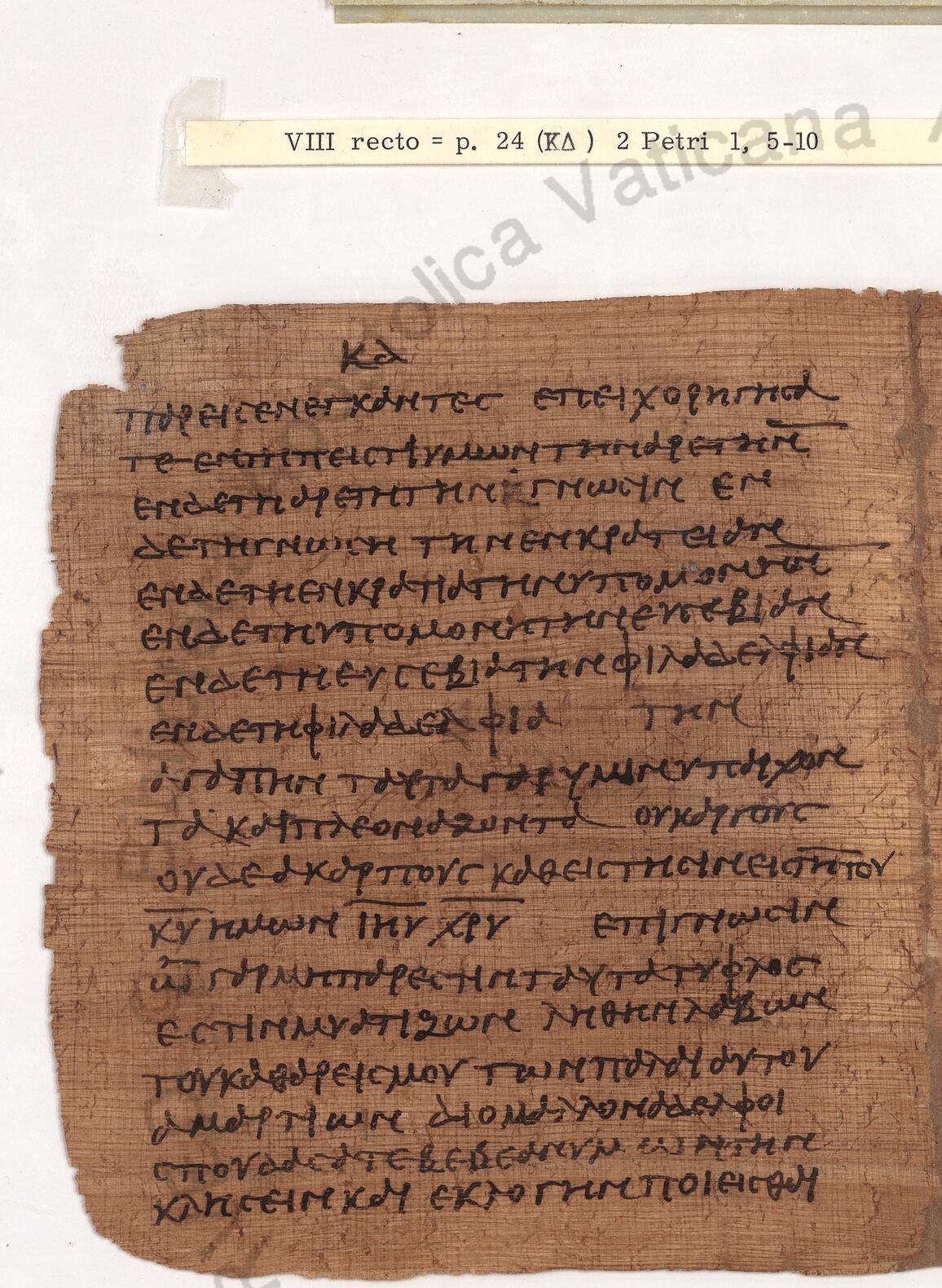
Vatican Library, Pap. Bodmer VIII, DigiVatLib image 15 (https://digi.vatlib.it/view/MSS_Pap.Bodmer.VIII/0015), the left-hand page of the opening, cropped at the fold. The typed label on the glass frame reads "VIII recto = p. 24 (KΔ) 2 Petri 1, 5-10". 1:5 begins on the previous page; 1:10 continues on the next page. Checked on the image: 18 lines in the transcription; the first legible line (line 1) reads ‹παρεισενεγκαντες επειχορηγησα›, the last legible line (line 18) ‹κλησειν και εκλογην ποιεισθαι›; both match the page.
1:5 παρεισενεγκαντες επειχορηγησα
τε εν τη πειστι υμων την αρετην
εν δε τη αρετη την κ γνωσιν 6 εν
δε τη γνωση την ενκρατειαν
εν δε τη ενκρατια την υπομονην
εν δε τη υπομονη την ευσεβιαν
7 εν δε τη ευσεβια την φιλαδελφιαν
εν δε τη φιλαδελφια την
αγαπην 8 ταυτα γαρ υμιν υπαρχον
τα και πλεοναζοντα ουκ αργους
ουδε ακαρπους καθειστησιν εις την
κ̅υ̅ ημων ι̅η̅υ̅ χ̅ρ̅υ̅ επιγνωσιν
9 ω γαρ μη παρεστιν ταυτα τυφλος
εστιν μυατιζων ληθην λαβων
του καθαρεισμου των παλαι αυτου
αμαρτιων 10 διο μαλλον αδελφοι
σπουδασατε βεβεαν υμων την
κλησειν και εκλογην ποιεισθαι
1:5And beside this, giving all diligence, add to your faith virtue; and to virtue knowledge; 6And to knowledge temperance; and to temperance patience; and to patience godliness; 7And to godliness brotherly kindness; and to brotherly kindness charity. 8For if these things be in you, and abound, they make you that ye shall neither be barren nor unfruitful in the knowledge of our Lord Jesus Christ. 9But he that lacketh these things is blind, and cannot see afar off, and hath forgotten that he was purged from his old sins. 10Wherefore the rather, brethren, give diligence to make your calling and election sure: for if ye do these things, ye shall never fall:
Where on the image
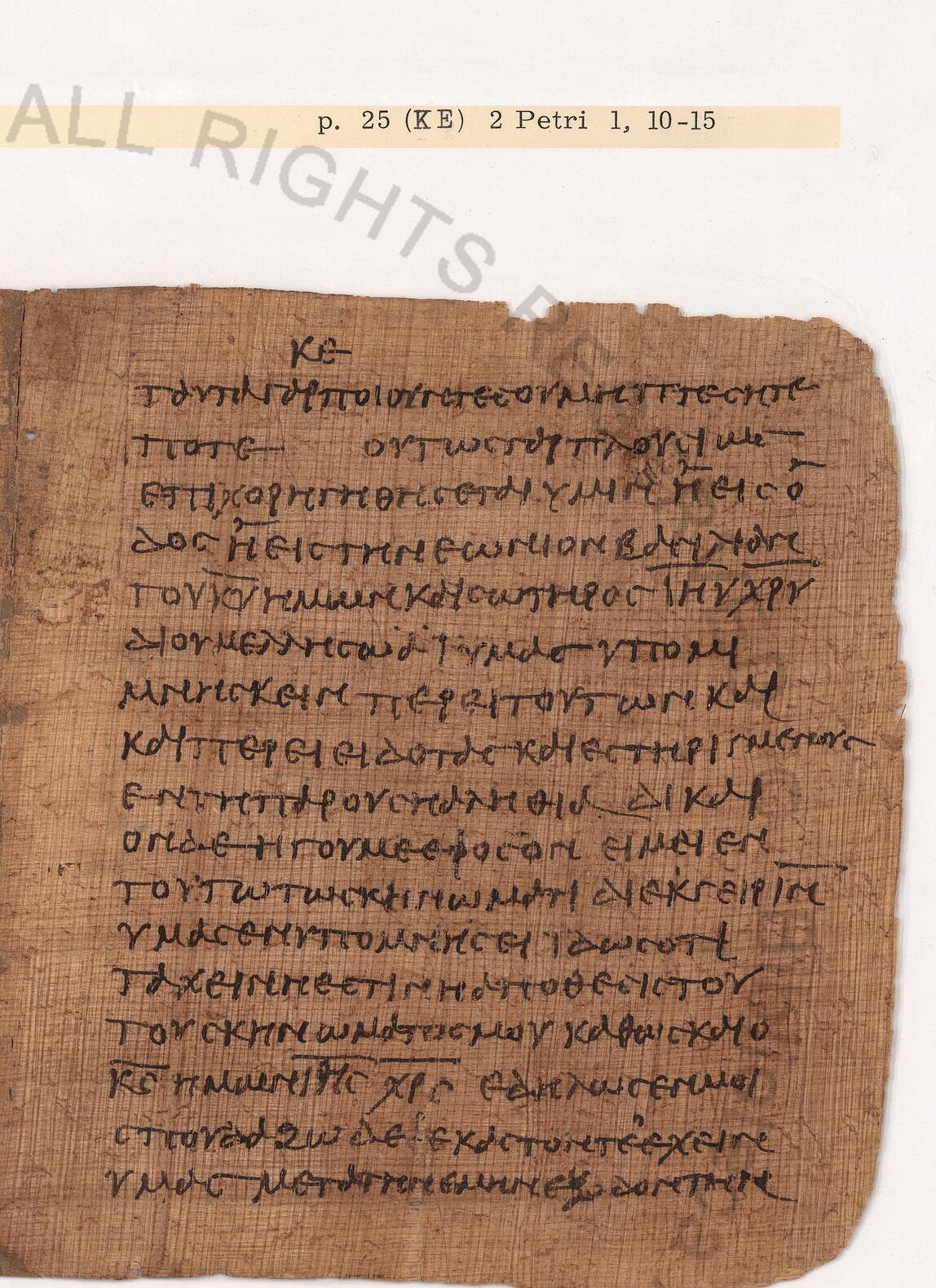
Vatican Library, Pap. Bodmer VIII, DigiVatLib image 14 (https://digi.vatlib.it/view/MSS_Pap.Bodmer.VIII/0014), the right-hand page of the opening, cropped at the fold. The typed label on the glass frame reads "p. 25 (KE) 2 Petri 1, 10-15". 1:10 begins on the previous page; 1:15 continues on the next page. Checked on the image: 17 lines in the transcription; the first legible line (line 1) reads ‹ταυτα γαρ ποιουντες ου μη πτεσητε›, the last legible line (line 17) ‹υμας μετα την εμην εξοδον την›; both match the page.
1:10 ταυτα γαρ ποιουντες ου μη πτεσητε
ποτε 11 ουτως γαρ πλουσιως
επιχορηγηθησεται υμιν η εισο
δος η εις την εωνιον βασιλιαν
του κ̅υ̅ ημων και σωτηρος ι̅η̅υ̅ χ̅ρ̅υ̅
12 δι ου μελλησω αι υμας υπομι
μνησκειν περει τουτων και
καιπερ ειειδοτας και εστηριγμενους
εν τη παρουση αληθια 13 δικαι
ον δε ηγουμε εφ οσον ειμει εν
τουτω τω σκηνωματι διεκγειριν
υμας εν υπομνησει 14 ιδως οτι
ταχεινη εστιν η αποθεσις του
του σκηνωματος μου καθως και ο
κ̅ς̅ ημων ι̅η̅ς̅ χ̅ρ̅ς̅ εδηλωσεν μοι
15 σπουδαζω δε εκαστοντε εχειν
υμας μετα την εμην εξοδον την
1:10Wherefore the rather, brethren, give diligence to make your calling and election sure: for if ye do these things, ye shall never fall: 11For so an entrance shall be ministered unto you abundantly into the everlasting kingdom of our Lord and Saviour Jesus Christ. 12Wherefore I will not be negligent to put you always in remembrance of these things, though ye know them, and be established in the present truth. 13Yea, I think it meet, as long as I am in this tabernacle, to stir you up by putting you in remembrance; 14Knowing that shortly I must put off this my tabernacle, even as our Lord Jesus Christ hath shewed me. 15Moreover I will endeavour that ye may be able after my decease to have these things always in remembrance.
Where on the image
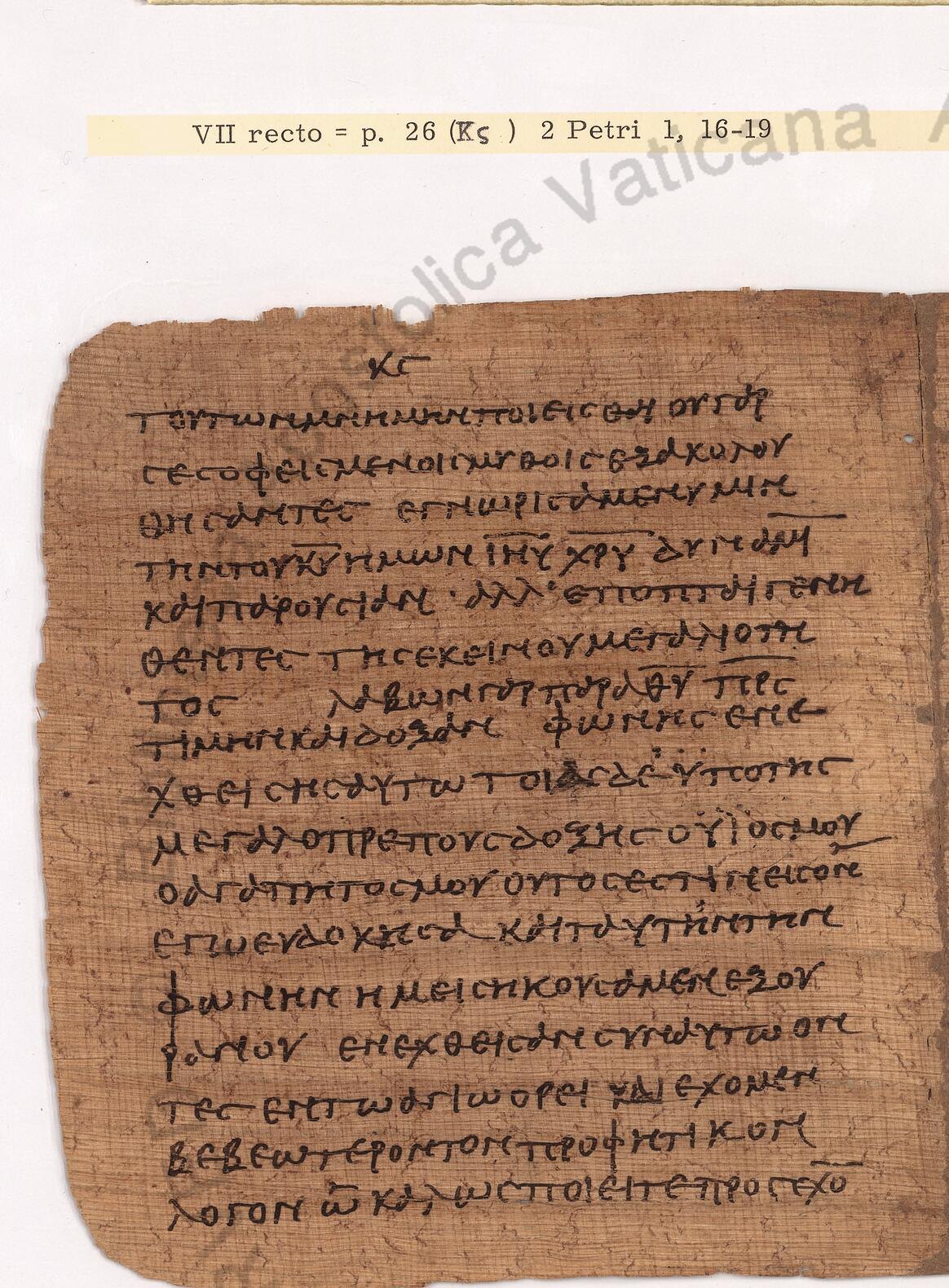
Vatican Library, Pap. Bodmer VIII, DigiVatLib image 13 (https://digi.vatlib.it/view/MSS_Pap.Bodmer.VIII/0013), the left-hand page of the opening, cropped at the fold. The typed label on the glass frame reads "VII recto = p. 26 (Kς) 2 Petri 1, 16-19". 1:15 begins on the previous page; 1:19 continues on the next page. Checked on the image: 17 lines in the transcription; the first legible line (line 1) reads ‹τουτων μνημην ποιεισθαι ου γαρ›, the last legible line (line 17) ‹λογον ω καλως ποιειτε προσεχον›; both match the page.
1:15 τουτων μνημην ποιεισθαι 16 ου γαρ
σεσοφεισμενοις μυθοις εξακολου
θησαντες εγνωρισαμεν υμιν
την του κ̅υ̅ ημων ι̅η̅υ̅ χ̅ρ̅υ̅ δυναμιν
και παρουσιαν· αλλ εποπται γενη
θεντες της εκεινου μεγαλιοτη
τος 17 λαβων γαρ παρα θ̅υ̅ π̅ρ̅ς̅
τιμην και δοξαν φωνης ενε
χθεισης αυτω τοι[.]σδε υπο της
μεγαλοπρεπους δοξης ο υιος μου
ο αγαπητος μου ουτος εστιν εις ον
εγω ευδοκησα 18 και ταυτην την
φωνην ημεις ηκουσαμεν εξ ου
ρανου ενεχθεισαν συν αυτω ον
τες εν τω αγιω ορει 19 και εχομεν
βεβεωτερον τον προφητικον
λογον ω καλως ποιειτε προσεχον
1:15Moreover I will endeavour that ye may be able after my decease to have these things always in remembrance. 16For we have not followed cunningly devised fables, when we made known unto you the power and coming of our Lord Jesus Christ, but were eyewitnesses of his majesty. 17For he received from God the Father honour and glory, when there came such a voice to him from the excellent glory, This is my beloved Son, in whom I am well pleased. 18And this voice which came from heaven we heard, when we were with him in the holy mount. 19We have also a more sure word of prophecy; whereunto ye do well that ye take heed, as unto a light that shineth in a dark place, until the day dawn, and the day star arise in your hearts:
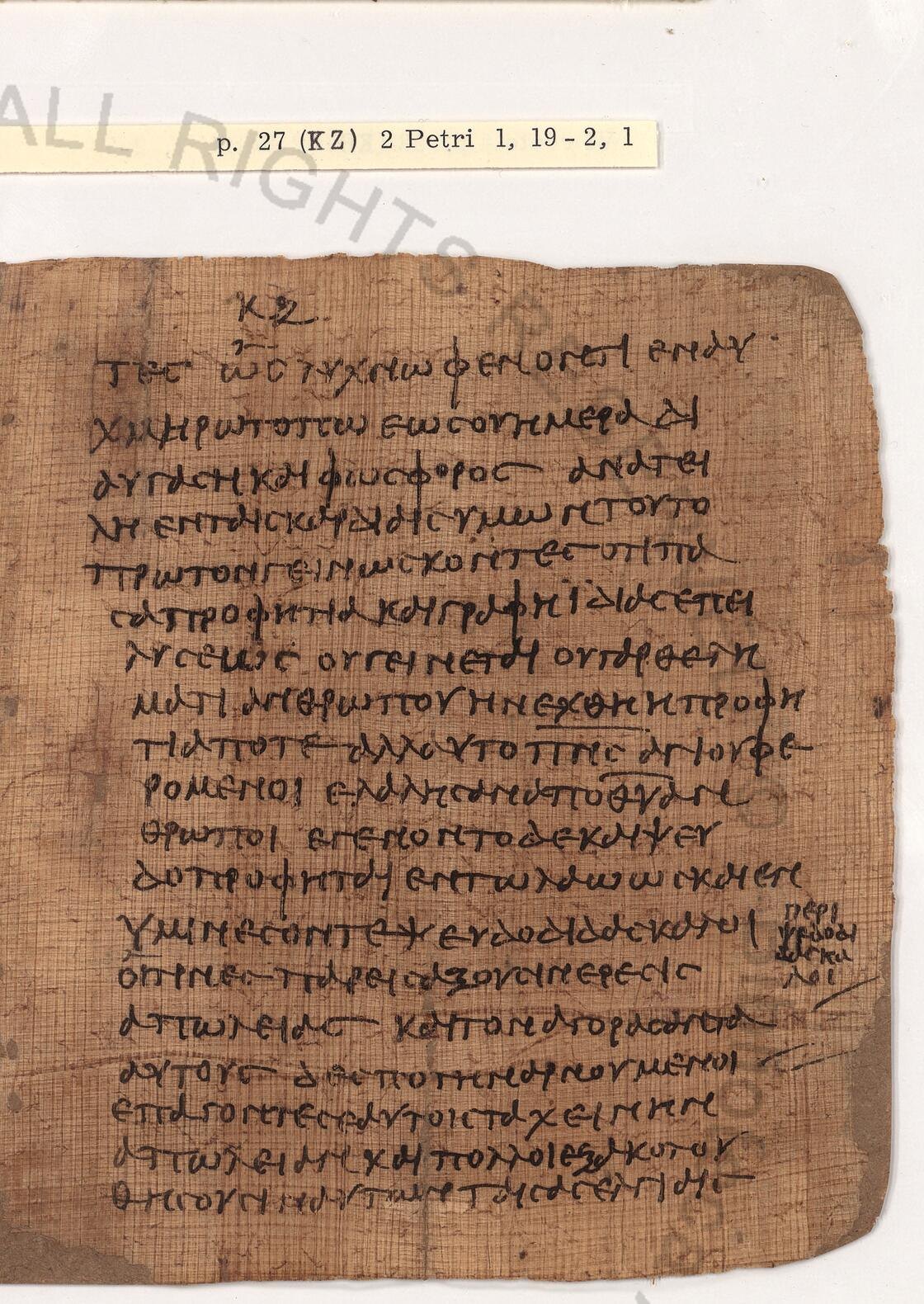
Where on the image
Vatican Library, Pap. Bodmer VIII, DigiVatLib image 12 (https://digi.vatlib.it/view/MSS_Pap.Bodmer.VIII/0012), the right-hand page of the opening, cropped at the fold. The typed label on the glass frame reads "p. 27 (KZ) 2 Petri 1, 19-2, 1". 1:19 begins on the previous page; 2:2 continues on the next page. Checked on the image: 19 lines in the transcription; the first legible line (line 1) reads ‹τες ως λυχνω φενοντι εν αυ›, the last legible line (line 19) ‹θησουσιν αυτων ταις ασελγιαις›; both match the page.
1:19 τες ως λυχνω φενοντι εν αυ
χμηρω τοπω εως ου ημερα δι
αυγαση και φωσφορος ανατει
λη εν ταις καρδιαις υμων 20 τουτο
πρωτον γεινωσκοντες οτι πα
σα προφητια και γραφη ιδιας επει
λυσει ου γεινεται 21 ου γαρ θελη
ματι ανθρωπου ηνεχθη η προφη
τια ποτε αλλα υτο π̅ν̅ς̅ αγιου φε
ρομενοι ελαλησαν απο θ̅υ̅ αν
θρωποι 2:1 εγενοντο δε και ψευ
δοπροφηται εν τω λαω ως και εν
υμιν εσοντε ψευδοδιδασκαλοι
οιτινες παρεισαξουσιν ερεσις
απωλειας και τον αγορασαντα
αυτους δεσποτην αρνουμενοι
επαγοντες εαυτοις ταχεινην
απωλειαν 2 και πολλοι εξακολου
θησουσιν αυτων ταις ασελγιαις
1:19We have also a more sure word of prophecy; whereunto ye do well that ye take heed, as unto a light that shineth in a dark place, until the day dawn, and the day star arise in your hearts: 20Knowing this first, that no prophecy of the scripture is of any private interpretation. 21For the prophecy came not in old time by the will of man: but holy men of God spake as they were moved by the Holy Ghost. 2:1But there were false prophets also among the people, even as there shall be false teachers among you, who privily shall bring in damnable heresies, even denying the Lord that bought them, and bring upon themselves swift destruction. 2And many shall follow their pernicious ways; by reason of whom the way of truth shall be evil spoken of.
Notes
- Greek: the NTVMR diplomatic transcription, line by line as on the papyrus. Square brackets enclose letters that are lost or illegible and were supplied by the transcribers; a dot under a letter marks it as uncertain; [...] marks a gap. Nomina sacra and numerals keep the scribe's overline. Spelling is the scribe's (no accents or breathings). Words broken at a line end stay broken as on the papyrus. Corrections are not shown: the text is the first hand.
- English: the King James Version (1611), whole verses, for every verse that has text on the page. A verse that begins on one page and ends on the next is given in full on both. The KJV translates a later form of the Greek text, so its wording does not always match the papyrus; material differences (such as verses the papyrus does not have) are noted in the section.
Cite
Sources
- Source: Papyrus Bodmer VIII (Vatican Library): photographs from DigiVatLib; Greek from the INTF NTVMR transcription of P72; English from the King James Version (holding institution)
- Critical edition: INTF NTVMR diplomatic transcription (CC BY 4.0)
← previous · → next · v cycle view · l back to library