P72 (Papyrus Bodmer VIII): 2 Peter 3:3-18 (pages 33-36)
Introduction
P72 is a papyrus codex copied in Egypt in the 3rd or early 4th century. It holds the oldest known copies of 1 Peter, 2 Peter and Jude. The pages are numbered by the scribe. 1-2 Peter (papyrus pages 1-36) are Papyrus Bodmer VIII, given by Martin Bodmer to Pope Paul VI in 1969 and now in the Vatican Library; Jude (pages 62-68) is Papyrus Bodmer VII, still at the Fondation Martin Bodmer, Cologny (Geneva). Both belong to the Bodmer "Miscellaneous" or "Composite" codex, which also contains the Nativity of Mary, the apocryphal correspondence of Paul with the Corinthians, the 11th Ode of Solomon, Melito's sermon On the Pascha, a hymn fragment and other texts. 1-2 Peter seem to have formed a separate booklet before being bound with the rest.
Each section below is one papyrus page: the photograph, the NTVMR diplomatic transcription of that page line by line, and the King James Version of every verse on it. The scribe's spelling is irregular (ει for ι, ε for αι, and so on) and is kept as written.
This entry covers papyrus pages 33-36 (2 Peter 3:3-18). The photographs are from the Vatican Library (Pap. Bodmer VIII).
How was this verified? (Provenance)
Where on the image
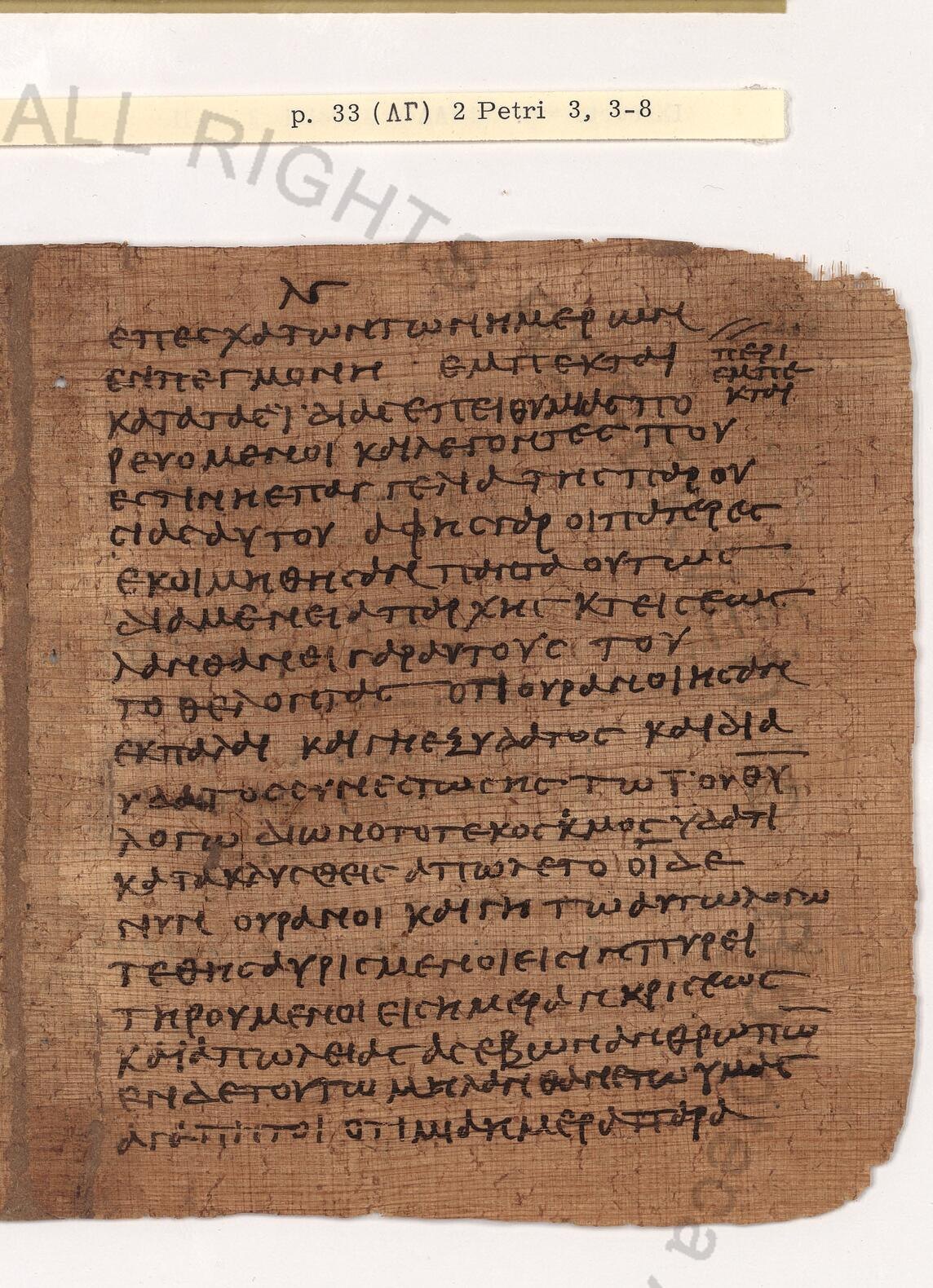
Vatican Library, Pap. Bodmer VIII, DigiVatLib image 18 (https://digi.vatlib.it/view/MSS_Pap.Bodmer.VIII/0018), the right-hand page of the opening, cropped at the fold. The typed label on the glass frame reads "p. 33 (ΛΓ) 2 Petri 3, 3-8". 3:3 begins on the previous page; 3:8 continues on the next page. Checked on the image: 20 lines in the transcription; the first legible line (line 1) reads ‹επ εσχατων των ημερων›, the last legible line (line 20) ‹αγαπητοι οτι μια ημερα παρα›; both match the page.
3:3 επ εσχατων των ημερων
ενπεγμονη εμπεκται
κατα τας ιδιας επειθυμιας πο
ρευομενοι 4 και λεγοντες που
εστιν η επαγγελια της παρου
σιας αυτου αφ ης γαρ οι πατερες
εκοιμηθησαν παντα ουτως
διαμενει απ αρχης κτεισεως
5 λανθανει γαρ αυτους του
το θελοντας οτι ουρανοι ησαν
εκπαλαι και γη εξ υδατος και δια
υδατος συνεστωσης τω του θ̅υ̅
λογω 6 δι ων ο τοτε κοσκμος υδατι
κατακλυσθεις απωλετο 7 οι δε
νυν ουρανοι και γη τω αυτω λογω
τεθησαυρισμενοι εισιν πυρει
τηρουμενοι εις ημεραν κρισεως
και απωλειας ασεβων ανθρωπων
8 εν δε τουτω μη λανθανετω υμας
αγαπητοι οτι μια ημερα παρα
3:3Knowing this first, that there shall come in the last days scoffers, walking after their own lusts, 4And saying, Where is the promise of his coming? for since the fathers fell asleep, all things continue as they were from the beginning of the creation. 5For this they willingly are ignorant of, that by the word of God the heavens were of old, and the earth standing out of the water and in the water: 6Whereby the world that then was, being overflowed with water, perished: 7But the heavens and the earth, which are now, by the same word are kept in store, reserved unto fire against the day of judgment and perdition of ungodly men. 8But, beloved, be not ignorant of this one thing, that one day is with the Lord as a thousand years, and a thousand years as one day.
Where on the image
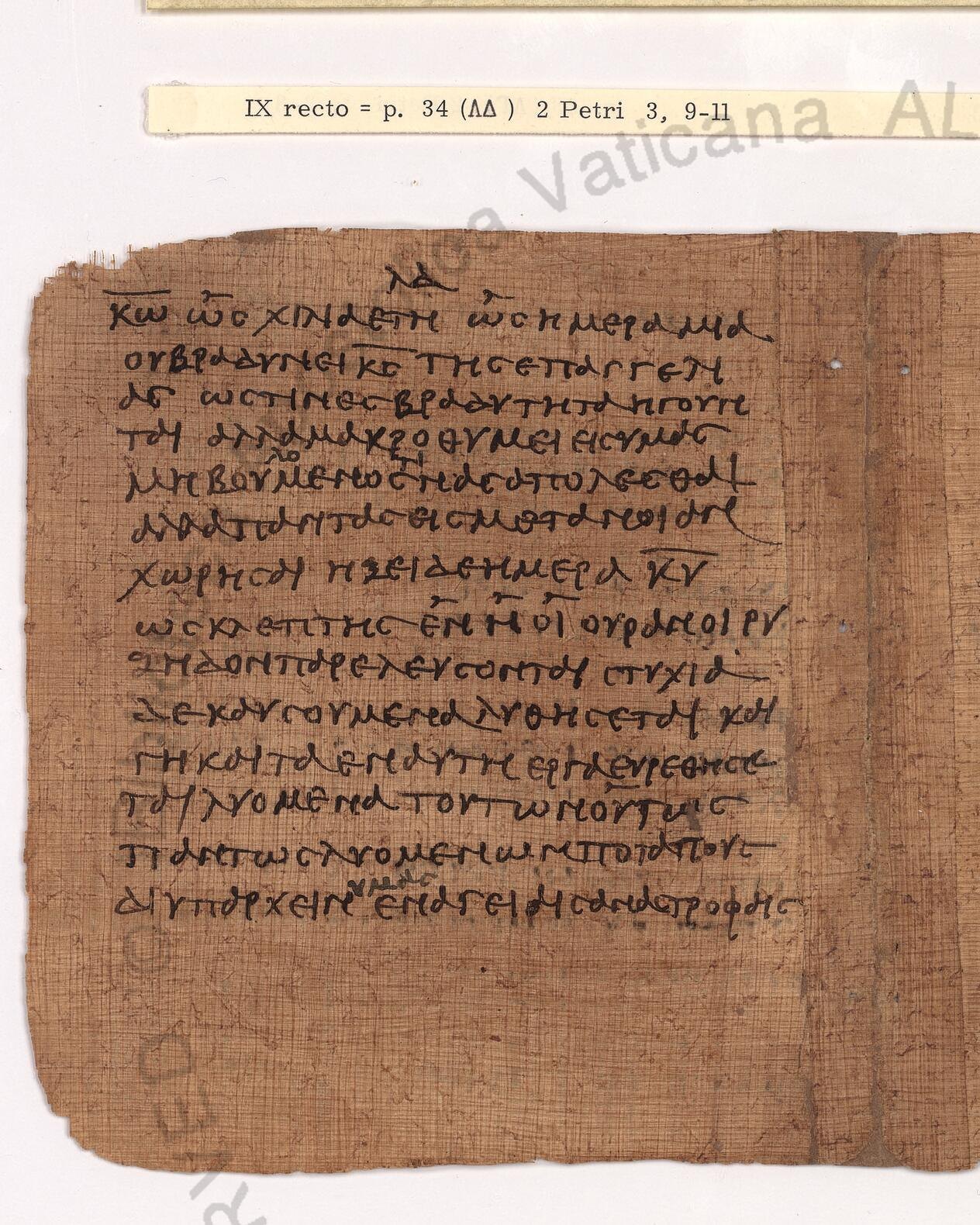
Vatican Library, Pap. Bodmer VIII, DigiVatLib image 17 (https://digi.vatlib.it/view/MSS_Pap.Bodmer.VIII/0017), the left-hand page of the opening, cropped at the fold. The typed label on the glass frame reads "IX recto = p. 34 (ΛΔ) 2 Petri 3, 9-11". 3:8 begins on the previous page; 3:11 continues on the next page. Checked on the image: 14 lines in the transcription; the first legible line (line 1) reads ‹κ̅ω̅ ως χιλια ετη ως ημερα μια›, the last legible line (line 14) ‹δι υπαρχειν εν αγειαις αναστροφαις›; both match the page.
3:8 κ̅ω̅ ως χιλια ετη ως ημερα μια
9 ου βραδυνει κ̅ς̅ της επαγγελι
ας ως τινες βραδυτητα ηγουν
ται αλλα μακροθυμει εις υμας
μη βουμενος νας απολεσθαι
αλλα παντας εις μετανοιαν
χωρησαι 10 ηξει δε ημερα κ̅υ̅
ως κλεπτης εν η οι ουρανοι ρυ
ζηδον παρελευσονται στυχια
δε καυσουμενα λυθησεται και
γη και τα εν αυτη εργα ευρεθησε
ται λυομενα 11 τουτων ουτως
παντως λυομενων ποταπους
δι υπαρχειν εν αγειαις αναστροφαις
3:8But, beloved, be not ignorant of this one thing, that one day is with the Lord as a thousand years, and a thousand years as one day. 9The Lord is not slack concerning his promise, as some men count slackness; but is longsuffering to us-ward, not willing that any should perish, but that all should come to repentance. 10But the day of the Lord will come as a thief in the night; in the which the heavens shall pass away with a great noise, and the elements shall melt with fervent heat, the earth also and the works that are therein shall be burned up. 11Seeing then that all these things shall be dissolved, what manner of persons ought ye to be in all holy conversation and godliness,
Where on the image
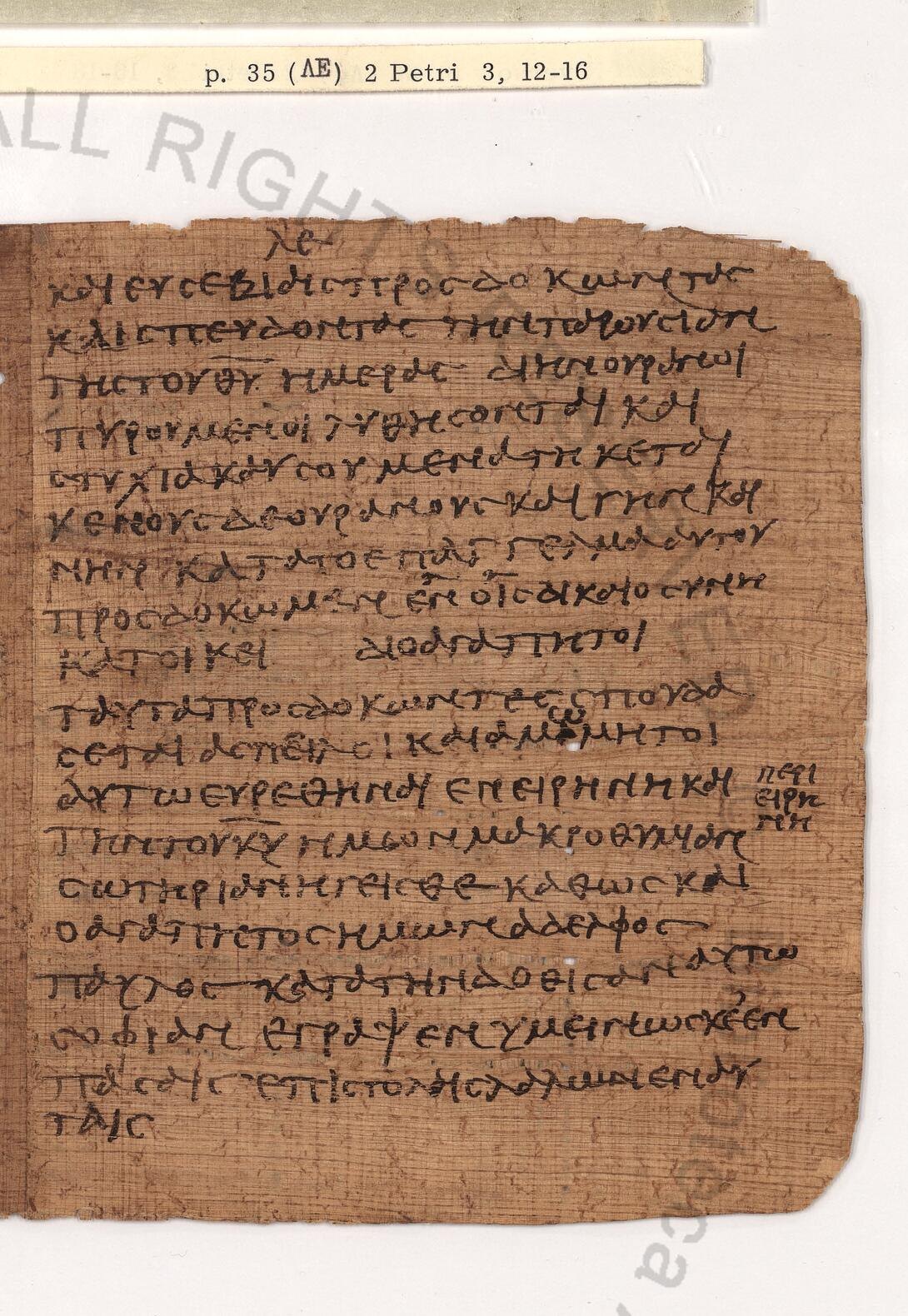
Vatican Library, Pap. Bodmer VIII, DigiVatLib image 19 (https://digi.vatlib.it/view/MSS_Pap.Bodmer.VIII/0019), the single leaf in the frame. The typed label on the glass frame reads "p. 35 (ΛE) 2 Petri 3, 12-16". 3:11 begins on the previous page; 3:16 continues on the next page. Checked on the image: 19 lines in the transcription; the first legible line (line 1) reads ‹και ευσεβιαις προσδοκωντας›, the last legible line (line 19) ‹ταις›; both match the page.
3:11 και ευσεβιαις 12 προσδοκωντας
και σπευδοντας την παρουσιαν
της του θ̅υ̅ ημερας δι ην ουρανοι
πυρουμενοι λυθησονται και
στυχια καυσουμενα τηκεται
13 κενους δε ουρανους και γην και
νην κατα το επαγγελμα αυτου
προσδοκωμεν εν οις δικαιοσυνη
κατοικει 14 διο αγαπητοι
ταυτα προσδοκωντες σπουδα
σεται ασπειλοι και αμα̣μητοι
αυτω ευρεθηναι εν ειρηνη 15 και
την του κ̅υ̅ ημων μακροθυμιαν
σωτηριαν ηγεισθε καθως και
ο αγαπητος ημων αδελφος
παυλος κατα την δοθισαν αυτω
σοφιαν εγραψεν υμειν 16 ως κε εν
πασαις επιστολαις λαλων εν αυ
ταις
3:11Seeing then that all these things shall be dissolved, what manner of persons ought ye to be in all holy conversation and godliness, 12Looking for and hasting unto the coming of the day of God, wherein the heavens being on fire shall be dissolved, and the elements shall melt with fervent heat? 13Nevertheless we, according to his promise, look for new heavens and a new earth, wherein dwelleth righteousness. 14Wherefore, beloved, seeing that ye look for such things, be diligent that ye may be found of him in peace, without spot, and blameless. 15And account that the longsuffering of our Lord is salvation; even as our beloved brother Paul also according to the wisdom given unto him hath written unto you; 16As also in all his epistles, speaking in them of these things; in which are some things hard to be understood, which they that are unlearned and unstable wrest, as they do also the other scriptures, unto their own destruction.
Where on the image
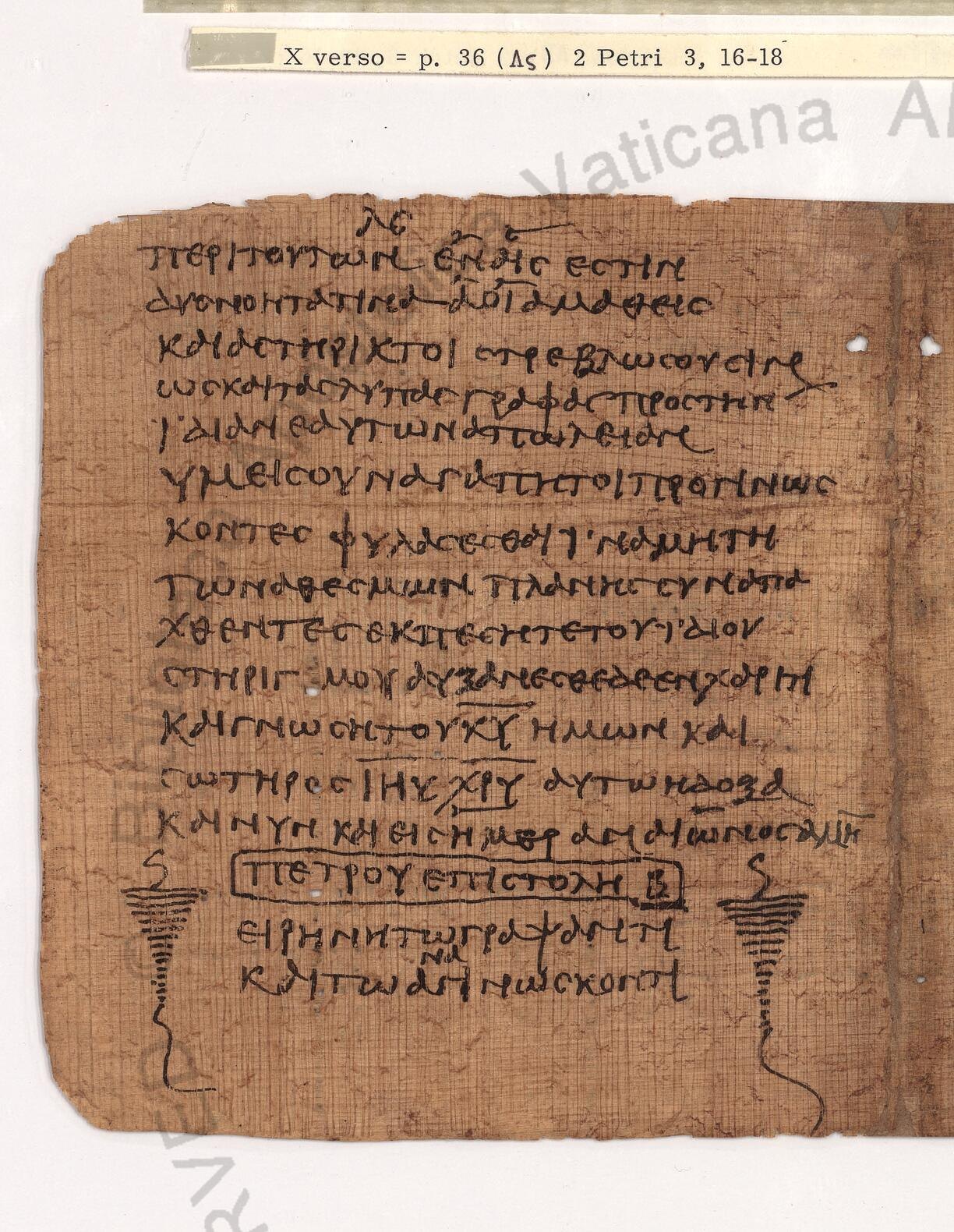
Vatican Library, Pap. Bodmer VIII, DigiVatLib image 20 (https://digi.vatlib.it/view/MSS_Pap.Bodmer.VIII/0020), the single leaf in the frame. The typed label on the glass frame reads "X verso = p. 36 (Λς) 2 Petri 3, 16-18". 3:16 begins on the previous page. The page also carries a book title, shown in italics in the Greek (πετρου επιστολη β); the KJV has no English for it. Checked on the image: 14 lines in the transcription; the first legible line (line 1) reads ‹περι τουτων εν αις εστιν›, the last legible line (line 14) ‹πετρου επιστολη β›; both match the page. As on page 22, the title is followed by ειρηνη τω γραψαντι και τω αναγινωσκοντι between two ornaments, recorded by NTVMR only in a note.
3:16 περι τουτων εν αις εστιν
δυσνοητα τινα α οι αμαθεις
και αστηρικτοι στρεβλωσουσιν
ως και τας λυπας γραφας προς την
ιδιαν εαυτων απωλειαν
17 υμεις ουν αγαπητοι προγινωσ
κοντες φυλασεσθαι ινα μη τη
των αθεσμων πλανης συναπα
χθεντες εκπεσητε του ιδιου
στηριγμου 18 αυξανεσθε δε εν χαριτι
και γνωση του κ̅υ̅ ημων και
σωτηρος ι̅η̅υ̅ χ̅ρ̅υ̅ αυτω η δοξα
και νυν και εις ημεραν αιωνος αμην
πετρου επιστολη β
3:16As also in all his epistles, speaking in them of these things; in which are some things hard to be understood, which they that are unlearned and unstable wrest, as they do also the other scriptures, unto their own destruction. 17Ye therefore, beloved, seeing ye know these things before, beware lest ye also, being led away with the error of the wicked, fall from your own stedfastness. 18But grow in grace, and in the knowledge of our Lord and Saviour Jesus Christ. To him be glory both now and for ever. Amen.
Notes
- Greek: the NTVMR diplomatic transcription, line by line as on the papyrus. Square brackets enclose letters that are lost or illegible and were supplied by the transcribers; a dot under a letter marks it as uncertain; [...] marks a gap. Nomina sacra and numerals keep the scribe's overline. Spelling is the scribe's (no accents or breathings). Words broken at a line end stay broken as on the papyrus. Corrections are not shown: the text is the first hand.
- English: the King James Version (1611), whole verses, for every verse that has text on the page. A verse that begins on one page and ends on the next is given in full on both. The KJV translates a later form of the Greek text, so its wording does not always match the papyrus; material differences (such as verses the papyrus does not have) are noted in the section.
Cite
Sources
- Source: Papyrus Bodmer VIII (Vatican Library): photographs from DigiVatLib; Greek from the INTF NTVMR transcription of P72; English from the King James Version (holding institution)
- Critical edition: INTF NTVMR diplomatic transcription (CC BY 4.0)
← previous · → next · v cycle view · l back to library