P75 (Papyrus Hanna 1): John 14:8-26 (fol. 64r)
Introduction
P75 is a papyrus codex of Luke and John copied in Egypt around 175-225, the oldest known copy of Luke and one of the oldest of John. It was bought by Martin Bodmer in the 1950s and published as Papyrus Bodmer XIV-XV; in 2006 it was given to the Vatican Library, where it is kept as Papyrus Hanna 1 (Mater Verbi). Its text is very close to that of Codex Vaticanus, written some 150 years later. Where Luke ends and John begins (folio 44r) both titles stand on the same page.
About 51 leaves survive, many damaged at the top and edges, especially in Luke 3-7. Lost: Luke 1:1-3:17, most of 3:23-4:33, 5:11-36, 6:5-10, 7:33-34 and 7:44-45 (and parts of 7:36-49), 17:16-19, 18:19-22:3; John 11:46-47, 12:1-2, 13:11-14:7 and everything after 15:10 except small fragments. Each section below is one page: the photograph, the NTVMR diplomatic transcription line by line, and the King James Version of every verse on the page. Where P75 lacks a verse or words that the KJV has (for example John 5:4 or the account of the adulteress, John 7:53-8:11), the section says so. Six damaged pages (folios 7v, 11r, 39v, 58r, 58v and 64v) are left out because their text could not be matched to the photographs with certainty.
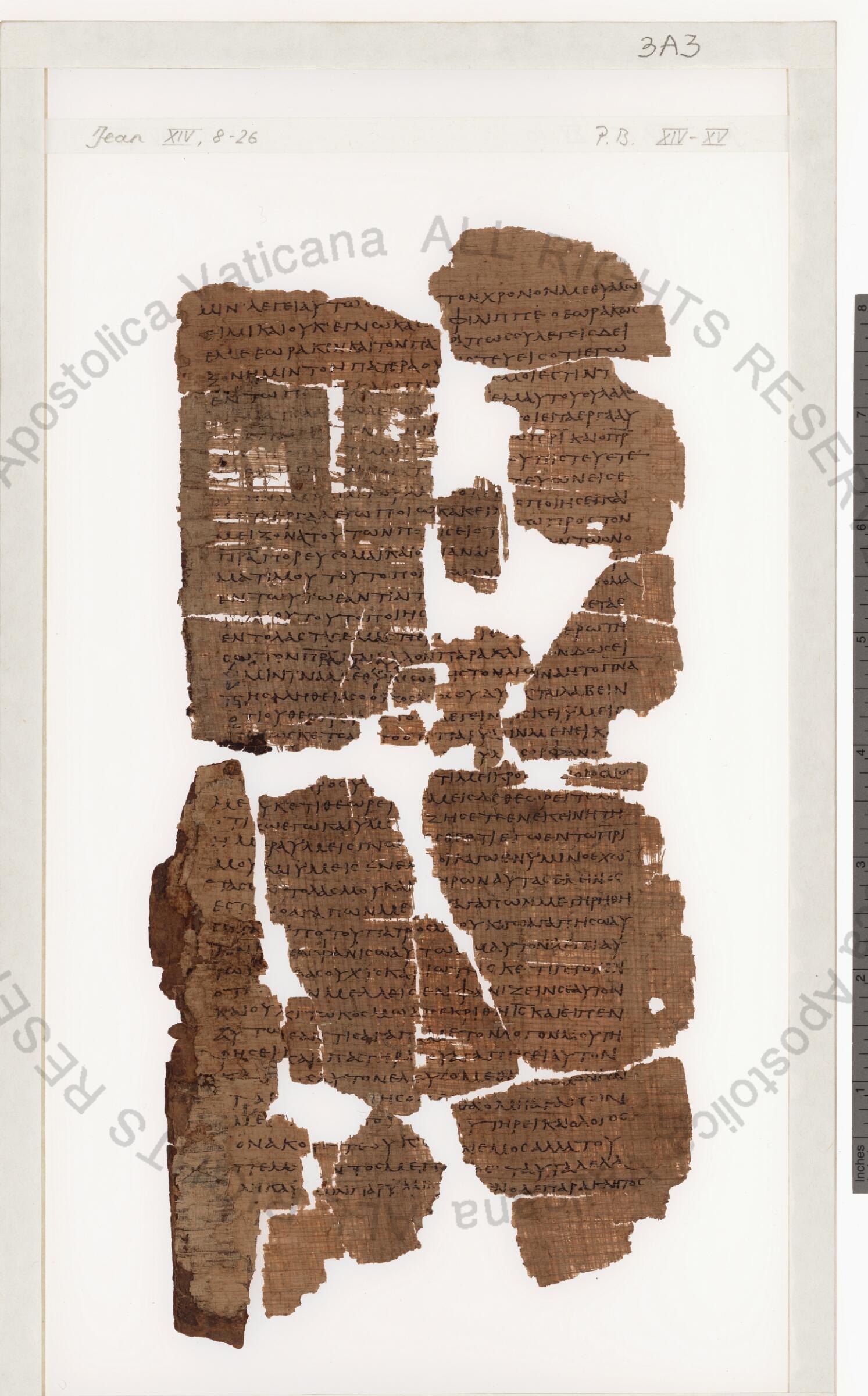
This entry covers fol. 64r (John 14:8-26), shown on the Vatican Library's photograph (frame 3A.3r).
How was this verified? (Provenance)
Where on the image
Vatican Library, Pap. Hanna 1 (Mater Verbi), DigiVatLib image 101, frame 3A.3r (https://digi.vatlib.it/view/MSS_Pap.Hanna.1(Mater.Verbi)/0101), cropped to the frame. NTVMR page 1010 (folio 64r). 14:8 begins on the previous page; 14:26 continues on the next page. Checked on the image: first line [υ]μιν λεγει αυτω ο ι̅ς̅ τοσουτον χρονον, then δειξον ημιν τον πατερα (14:9), matching the transcription of this page.
14:8 μιν· 9 λεγει αυτω ο̣ ι̣̣̅[ς̅ τοσο]υ̣τον χρονον μεθ υμων
ειμι και ουκ εγνωκας μ̣[ε] φιλιππε ο εωρακως
εμε εωρακεν και τον πατ̣[ε]ρ̣α πως συ λεγεις δει
ξον ημιν τον πατερα 10 ου [π]ι̣σ̣τευεις οτι εγω
εν τω πατρι και ο πατ̣[ηρ εν] ε̣μοι εστιν τ[α]
ρ̣ημ̣ατα α εγω λεγω υμ̣[ιν α]π̣ εμαυτου ου λαλω̣
ο δε̣ πατη̣ρ̣ εν ε̣μ̣οι μ̣[ενων] π̣οιει τα εργα αυ
το̣ς̣ 11 πισ̣τευετε μοι οτι [εγω εν τ]ω π̅ρ̅ι̅ και ο π̅ρ̅
εν εμοι ει δε μη δια τα̣ [εργα αυτ]ου πιστευετε·
12 αμην αμην λεγω υμι̣ν̣ ο πι[σ]τευων εις ε
με τα εργα α εγω ποιω κακειν̣[ο]ς ποιησει και
μειζονα τουτων ποι̣η̣σει οτ[ι ε]γω προς τον
π̅ρ̅α̅ πορευσομαι 13 και ο [τ]ι αν αιτ̣[ητε] ε̣ν τω ονο
ματι μου τουτο ποι[η]σ̣ω ινα̣ [δοξασθη ο π̅]ρ̣̣̅
εν τω υιω 14 εαν τι αιτ[ησητε με εν τω ο]ν̣ομα
τι μου τουτο ποιησ[ω] 15 [εαν αγαπατε] μ̣ε τας
εντολας τας εμας τηρ̣η̣[ση]τ̣ε 16 κ̣[αγω] ερωτη
σω τον π̅ρ̅α̅ και αλλον παρακλη̣τ̣ο̣ν δωσει
υ̣μιν ινα μεθ υμων̣ ε̣ις τον αιωνα η 17 το π̅ν̅α̅
της αληθειας ο ο κοσμ̣ος ου δυ[ν]α̣ται λαβειν
οτι ου θεωρε̣ι αυτο ο̣[υ]δε γεινω̣σκει υμεις
γε̣ι̣ν̣ωσκετε αυτο οτ[ι] παρ υμιν μενει κα̣[ι]
[εν υμιν εσται] 18 [ουκ αφησω] υμ̣[α]ς ορφανου̣[ς]
[ερχομαι] π̣ρος υμ̣[ας] 19 ε̣τι μεικρον̣ [κ]α̣ι ο κοσμος
με [ο]υκετι θεωρει υ̣μεις δε θεωρειτε με̣
οτι ζ̣ω εγω και υμε̣ι̣[ς] ζησετε 20 εν εκεινη τη
ημε̣ρα υμεις γνω[σ]ε̣σθε οτι εγω εν τω π̅ρ̅ι̅
μου και υμεις εν εμοι καγω εν υμιν 21 ο εχων
τας ε̣ν̣τολας μου και τ̣ηρων αυτας εκεινος
εστι̣ν̣ ο αγαπων με [ο δ]ε αγαπων με τηρηθη
σετα[ι] υ̣πο του πατρος μου καγω αγαπησω αυ
τον κ̣[αι] ε̣μ̣φανισω αυτω ε̣μαυτον· 22 λεγει αυ
τω ιο̣[υ]δας ουχ ισκαρ̣ιωτης κ̅ε̅· τι γεγονεν
οτι [η]μ̣ι̣ν μελλεις ενφανιζειν σεαυτον
και ουχι τω κοσμω 23 απεκριθη ι̅ς̅ και ειπεν
αυτω εαν τις αγαπα με τον λογον μου τη
ρησει και ο̣ πατηρ μ̣ου αγαπησει αυτον
κ̣αι π̣[ρ]ο̣ς α̣υτον ελευσομεθα κ̣α̣ι̣ μονην
παρ̣ [αυτω π]ο̣ιησομ̣ε̣θα· 24 ο μη αγαπων
με τ̣[ους λο]γου̣ς̣ [μου] ο̣υ τηρει και ο λογος
ον ακου̣ετε ουκ ε̣[στ]ι̣ν εμος αλλα του
πεμψ̣[α]ν̣τος με πα̣[τρ]ος· 25 ταυτα λελα
ληκα υμ̣ιν παρ υμιν [μεν]ω̣ν 26 ο δε παρακλητος
14:8Philip saith unto him, Lord, shew us the Father, and it sufficeth us. 9Jesus saith unto him, Have I been so long time with you, and yet hast thou not known me, Philip? he that hath seen me hath seen the Father; and how sayest thou then, Shew us the Father? 10Believest thou not that I am in the Father, and the Father in me? the words that I speak unto you I speak not of myself: but the Father that dwelleth in me, he doeth the works. 11Believe me that I am in the Father, and the Father in me: or else believe me for the very works’ sake. 12Verily, verily, I say unto you, He that believeth on me, the works that I do shall he do also; and greater works than these shall he do; because I go unto my Father. 13And whatsoever ye shall ask in my name, that will I do, that the Father may be glorified in the Son. 14If ye shall ask any thing in my name, I will do it. 15¶ If ye love me, keep my commandments. 16And I will pray the Father, and he shall give you another Comforter, that he may abide with you for ever; 17Even the Spirit of truth; whom the world cannot receive, because it seeth him not, neither knoweth him: but ye know him; for he dwelleth with you, and shall be in you. 18I will not leave you comfortless: I will come to you. 19Yet a little while, and the world seeth me no more; but ye see me: because I live, ye shall live also. 20At that day ye shall know that I am in my Father, and ye in me, and I in you. 21He that hath my commandments, and keepeth them, he it is that loveth me: and he that loveth me shall be loved of my Father, and I will love him, and will manifest myself to him. 22Judas saith unto him, not Iscariot, Lord, how is it that thou wilt manifest thyself unto us, and not unto the world? 23Jesus answered and said unto him, If a man love me, he will keep my words: and my Father will love him, and we will come unto him, and make our abode with him. 24He that loveth me not keepeth not my sayings: and the word which ye hear is not mine, but the Father’s which sent me. 25These things have I spoken unto you, being yet present with you. 26But the Comforter, which is the Holy Ghost, whom the Father will send in my name, he shall teach you all things, and bring all things to your remembrance, whatsoever I have said unto you.
Notes
- Greek: the NTVMR diplomatic transcription, line by line as on the papyrus. Square brackets enclose letters that are lost or illegible and were supplied by the transcribers; a dot under a letter marks it as uncertain; [...] marks a gap. Nomina sacra and numerals keep the scribe's overline. Spelling is the scribe's (no accents or breathings). Words broken at a line end stay broken as on the papyrus. Corrections are not shown: the text is the first hand.
- English: the King James Version (1611), whole verses, for every verse that has text on the page. A verse that begins on one page and ends on the next is given in full on both. The KJV translates a later form of the Greek text, so its wording does not always match the papyrus; material differences (such as verses the papyrus does not have) are noted in the section.
Cite
Sources
- Source: Papyrus Hanna 1 (Mater Verbi), Vatican Library: photographs from DigiVatLib; Greek from the INTF NTVMR transcription of P75; English from the King James Version (holding institution)
- Critical edition: INTF NTVMR diplomatic transcription (CC BY 4.0)
← previous · → next · v cycle view · l back to library