P75 (Papyrus Hanna 1): Luke 10:8-11:1 (fols. 21r-22r)
Introduction
P75 is a papyrus codex of Luke and John copied in Egypt around 175-225, the oldest known copy of Luke and one of the oldest of John. It was bought by Martin Bodmer in the 1950s and published as Papyrus Bodmer XIV-XV; in 2006 it was given to the Vatican Library, where it is kept as Papyrus Hanna 1 (Mater Verbi). Its text is very close to that of Codex Vaticanus, written some 150 years later. Where Luke ends and John begins (folio 44r) both titles stand on the same page.
About 51 leaves survive, many damaged at the top and edges, especially in Luke 3-7. Lost: Luke 1:1-3:17, most of 3:23-4:33, 5:11-36, 6:5-10, 7:33-34 and 7:44-45 (and parts of 7:36-49), 17:16-19, 18:19-22:3; John 11:46-47, 12:1-2, 13:11-14:7 and everything after 15:10 except small fragments. Each section below is one page: the photograph, the NTVMR diplomatic transcription line by line, and the King James Version of every verse on the page. Where P75 lacks a verse or words that the KJV has (for example John 5:4 or the account of the adulteress, John 7:53-8:11), the section says so. Six damaged pages (folios 7v, 11r, 39v, 58r, 58v and 64v) are left out because their text could not be matched to the photographs with certainty.
This entry covers fols. 21r-22r (Luke 10:8-11:1), shown on the Vatican Library's photographs (frames 1B.1r to 1B.2r).
How was this verified? (Provenance)
Where on the image
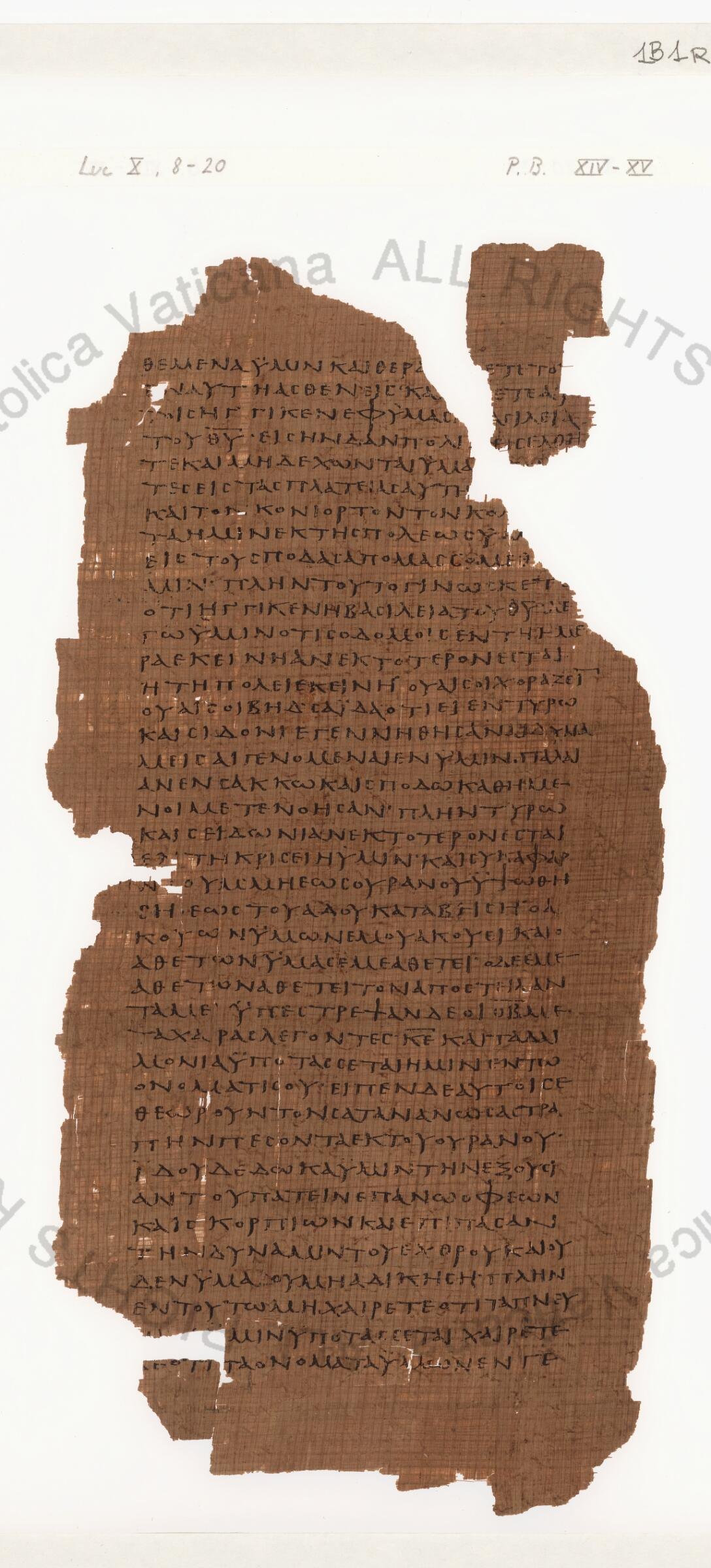
Vatican Library, Pap. Hanna 1 (Mater Verbi), DigiVatLib image 25, frame 1B.1r (https://digi.vatlib.it/view/MSS_Pap.Hanna.1(Mater.Verbi)/0025), cropped to the frame. NTVMR page 240 (folio 21r). 10:8 begins on the previous page; 10:20 continues on the next page. Checked on the image: first line θεμενα υμιν και θεραπ[ευετε], last line τα ονοματα υμων ενγε[γραπται] (10:20), matching the transcription of this page.
10:8 θεμενα υμιν 9 και θερα̣[πευ]ετε του̣[ς]
ε̣ν αυτη ασθενεις· κα[ι λεγ]ετε αυ̣
τοις ηγγικεν εφ υμας η̣ [β]α̣σιλεια
του θ̅υ̅· 10 εις ην δ αν πολι[ν] εισελθη
τε και μη δεχωνται υμα[ς εξελθον]
τες εις τας πλατειας αυτη[ς ειπατε]
11 και τον κονιορτον τον κολ̣[ληθεν]
τα ημιν εκ της πολεως υμ̣[ων]
εις τους ποδας απομασσομεθ[α υ]
μιν· πλην τουτο γινωσκετε̣
οτι ηγγικεν η βασιλεια του θ̅υ̅· 12 λε
γω υμιν οτι σοδομοις εν τη η̣με
ρα εκεινη ανεκτοτερον εσται
η τη πολει εκεινη· 13 ουαι σοι χοραζειν
ουαι σοι βηδσαιδα· οτι ει εν τυρω
και σιδονι εγεννηθησαν αι δυνα
μεις αι γενομεναι εν υμιν. παλαι
αν εν σακκω και σποδω καθημε
νοι μετενοησαν· 14 πλην τυρω
και σειδωνι ανεκτοτερον εσται
εν τη κρισει η υμιν· 15 και συ καφαρ
να̣ουμ· μη εως ουρανου υψωθη
ση. εως του αδου καταβηση· 16 ο α
κουων υμων εμου ακουει· και ο
αθετων υμας εμε αθετει· ο δε εμε
αθετων αθετει τον αποστειλαν
τα με· 17 υπεστρεψαν δε οι ο̅β̅ με
τα χαρας λεγοντες· κ̅ε̅ και τα δαι
μονια υποτασσεται ημιν εν τω
ονοματι σου· 18 ειπεν δε αυτοις ε
θεωρουν τον σαταναν ως αστρα
πην πεσοντα εκ του ουρανου·
19 ιδου δεδωκα υμιν την εξουσι
αν του πατειν επανω οφεων
και σκορπιων και επι πασαν
την δυναμιν του εχθρου και ου
δεν υμας̣ ου μη αδικηση· 20 πλην
εν τουτω μη χαιρετε οτι τα πνευ
μ̣α̣[τ]α̣ υ̣μιν υποτασσεται χαιρετε
δ̣ε̣ οτι τα ονοματα υμ̣ω̣ν ενγε
10:8And into whatsoever city ye enter, and they receive you, eat such things as are set before you: 9And heal the sick that are therein, and say unto them, The kingdom of God is come nigh unto you. 10But into whatsoever city ye enter, and they receive you not, go your ways out into the streets of the same, and say, 11Even the very dust of your city, which cleaveth on us, we do wipe off against you: notwithstanding be ye sure of this, that the kingdom of God is come nigh unto you. 12But I say unto you, that it shall be more tolerable in that day for Sodom, than for that city. 13Woe unto thee, Chorazin! woe unto thee, Bethsaida! for if the mighty works had been done in Tyre and Sidon, which have been done in you, they had a great while ago repented, sitting in sackcloth and ashes. 14But it shall be more tolerable for Tyre and Sidon at the judgment, than for you. 15And thou, Capernaum, which art exalted to heaven, shalt be thrust down to hell. 16He that heareth you heareth me; and he that despiseth you despiseth me; and he that despiseth me despiseth him that sent me. 17¶ And the seventy returned again with joy, saying, Lord, even the devils are subject unto us through thy name. 18And he said unto them, I beheld Satan as lightning fall from heaven. 19Behold, I give unto you power to tread on serpents and scorpions, and over all the power of the enemy: and nothing shall by any means hurt you. 20Notwithstanding in this rejoice not, that the spirits are subject unto you; but rather rejoice, because your names are written in heaven.
Where on the image
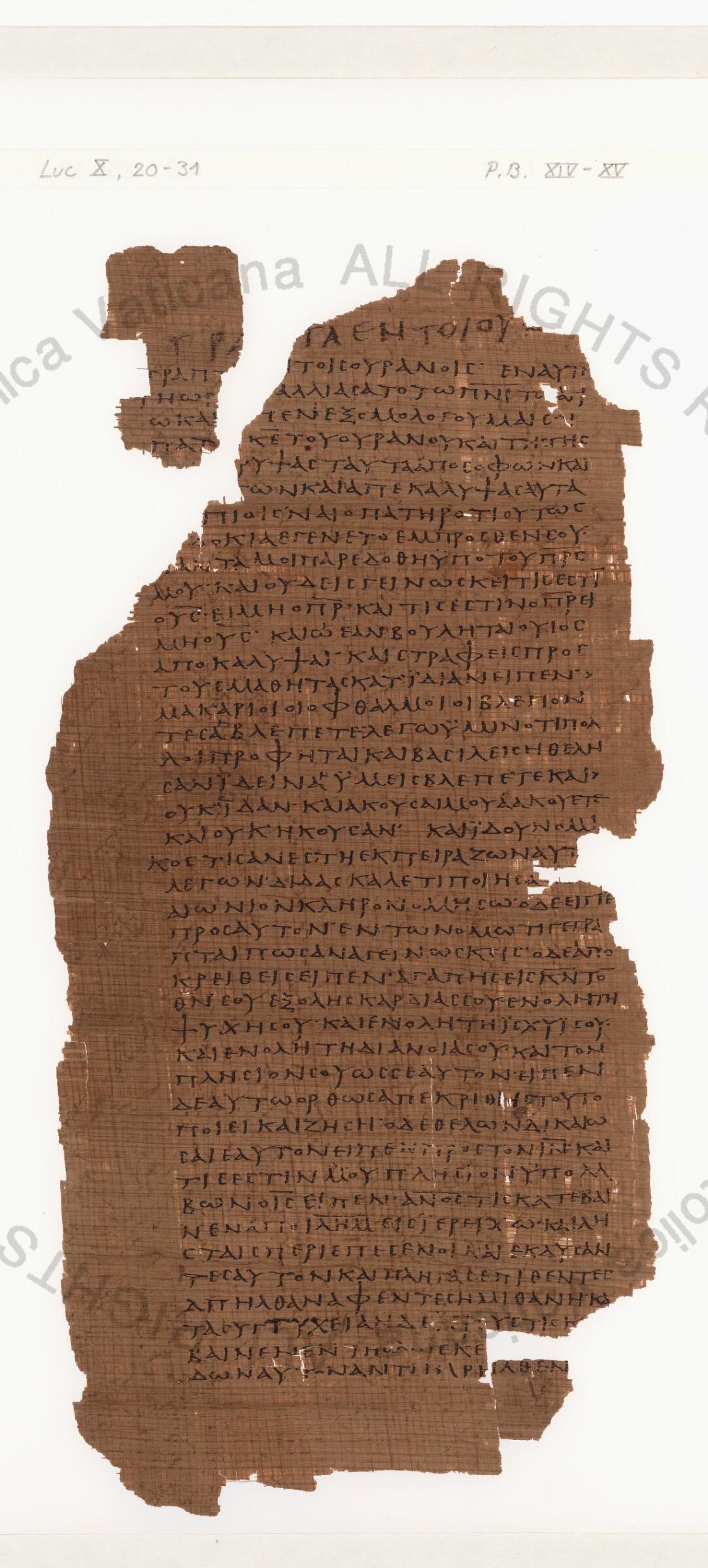
Vatican Library, Pap. Hanna 1 (Mater Verbi), DigiVatLib image 26, frame 1B.1v (https://digi.vatlib.it/view/MSS_Pap.Hanna.1(Mater.Verbi)/0026), cropped to the frame. NTVMR page 250 (folio 21v). 10:20 begins on the previous page; 10:32 continues on the next page. Checked on the image: first line γραπτ[αι] εν τοις ουρανοις, last line ιδων αυτον αντιπαρηλθεν (10:32), matching the transcription of this page.
10:20 γραπτ̣[αι ε]ν̣ τοις ουρανοις· 21 εν αυτη̣
τ̣η ωρ[α ηγ]αλλιασατο τω π̅ν̅ι̅ τω̣ αγ̣ι
ω και [ει]π̣εν εξομολογουμαι σο̣ι
πατ[ερ] κ̅ε̅ του ουρανου και της γης
[οτι ε]κ̣ρυψας ταυτα απο σοφων και
[συνε]τ̣ων και απεκαλυψας αυτα
[νη]πιοις· ναι ο πατηρ οτι ουτως
[ευ]δοκια εγενετο εμπροσθεν σου·
22 π̣αντα μοι παρεδοθη υπο του π̅ρ̅ς̅
μου· και ουδεις γεινωσκει τις εστιν
ο υ̅ς̅· ει μη ο π̅ρ̅· και τις εστιν ο π̅ρ̅ ει
μη ο υ̅ς̅· και ω εαν βουληται ο υιος
αποκαλυψαι· 23 και στραφεις προς
τους μαθητας κατ ιδιαν ειπεν·
μακαριοι οι οφθαλμοι οι βλεπον
τες α βλεπετε· 24 λεγω υμιν οτι πολ
λοι προφηται και βασιλεις ηθελη
σαν ιδειν α υμεις βλεπετε και
ουκ ιδαν· και ακουσαι μου α ακουετε
και ουκ ηκουσαν· 25 και ιδου νομι
κος τις ανεστη εκπειραζων αυτ[ον]
λεγων· διδασκαλε τι ποιησας̣ ζ̣[ωην]
αιωνιον κληρονομησω· 26 ο δε ειπε[ν]
προς αυτον· εν τω νομω τι γεγρα
πται πως αναγεινωσκεις· 27 ο δε απο
κρειθεις ειπεν· αγαπησεις κ̅ν̅ τον
θ̅ν̅ σου εξ ολης καρδιας σου· εν ολη τη
ψυχη σου· και εν ολη τη ισχυι σου·
και εν ολη τη διανοια σου· και τον
πλησιον σου ως σεαυτον· 28 ειπεν
δε αυτω ορθως απεκριθε̣ις τουτο
ποιει και ζηση· 29 ο δε θελων δικαιω
σαι εαυτον ειπεν προς τον ι̅ν̅· και
τις εστιν μου πλησιον 30 υπολα̣
βων ο ι̅ς̅ ειπεν· α̅ν̅ο̅ς̅ τις κατεβαι
νεν απο ι̅λ̅η̅μ̅ εις ιερειχω· και λη
σταις περιεπεσεν οι και εκδυσαν
τες αυτον και πληγας επιθεντες
απηλθαν αφεντες ημιθανη· 31 κα
τα συγκ̣υ̣ρ̣ειαν δε ι̣ε̣ρ̣ε̣υς τις κ[ατε]
βαινεν εν τ̣η ο̣δ̣ω εκε[ινη και ι]
δων αυτο̣ν αντιπαρηλθεν 32 [ομοι]
10:20Notwithstanding in this rejoice not, that the spirits are subject unto you; but rather rejoice, because your names are written in heaven. 21¶ In that hour Jesus rejoiced in spirit, and said, I thank thee, O Father, Lord of heaven and earth, that thou hast hid these things from the wise and prudent, and hast revealed them unto babes: even so, Father; for so it seemed good in thy sight. 22All things are delivered to me of my Father: and no man knoweth who the Son is, but the Father; and who the Father is, but the Son, and he to whom the Son will reveal him. 23¶ And he turned him unto his disciples, and said privately, Blessed are the eyes which see the things that ye see: 24For I tell you, that many prophets and kings have desired to see those things which ye see, and have not seen them; and to hear those things which ye hear, and have not heard them. 25¶ And, behold, a certain lawyer stood up, and tempted him, saying, Master, what shall I do to inherit eternal life? 26He said unto him, What is written in the law? how readest thou? 27And he answering said, Thou shalt love the Lord thy God with all thy heart, and with all thy soul, and with all thy strength, and with all thy mind; and thy neighbour as thyself. 28And he said unto him, Thou hast answered right: this do, and thou shalt live. 29But he, willing to justify himself, said unto Jesus, And who is my neighbour? 30And Jesus answering said, A certain man went down from Jerusalem to Jericho, and fell among thieves, which stripped him of his raiment, and wounded him, and departed, leaving him half dead. 31And by chance there came down a certain priest that way: and when he saw him, he passed by on the other side. 32And likewise a Levite, when he was at the place, came and looked on him, and passed by on the other side.
Where on the image
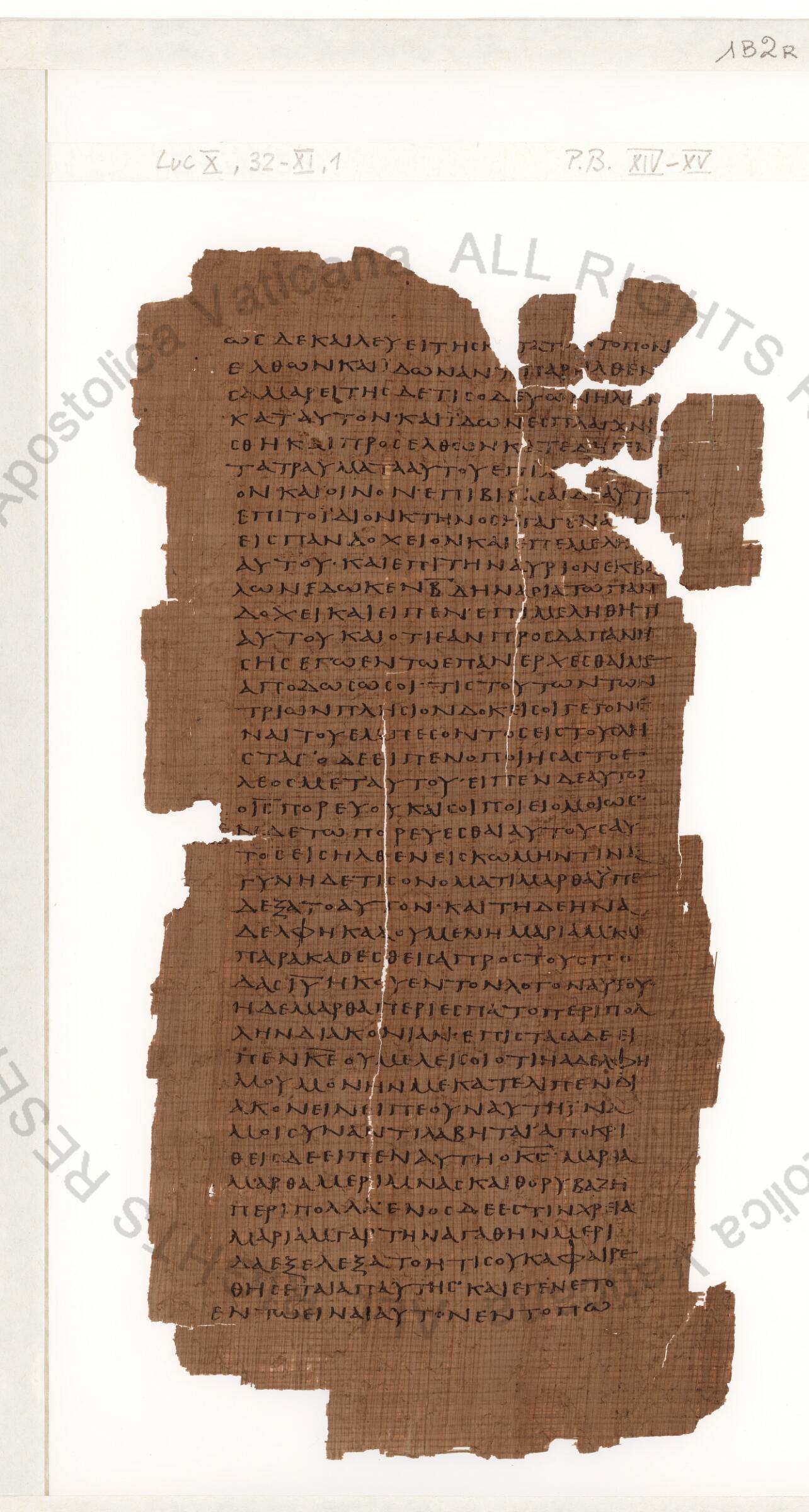
Vatican Library, Pap. Hanna 1 (Mater Verbi), DigiVatLib image 27, frame 1B.2r (https://digi.vatlib.it/view/MSS_Pap.Hanna.1(Mater.Verbi)/0027), cropped to the frame. NTVMR page 260 (folio 22r). 10:32 begins on the previous page; 11:1 continues on the next page. Checked on the image: first line ως δε και λευειτης, last line εν τω ειναι αυτον εν τοπω (11:1), matching the transcription of this page.
10:32 ως δε και λευειτης κ̣[α]τα το̣ν̣ τοπον
ελθων και ιδων αντι̣παρηλθεν
33 σαμαρειτης δε τις οδευων ηλθ̣ε̣ν̣
κατ αυτον· και ιδων εσπλαγχνι
σθη 34 και προσελθων κατεδησε̣ν
τα τραυματα αυτου επιχ̣[εω]ν̣ [ελα]ι
ον και οινον· επιβιβασας̣ δε αυτο̣ν
επι το ιδιον κτηνος ηγαγεν α[υ]τ̣[ο]ν
εις πανδοχειον και επεμελη[θη]
αυτου· 35 και επι την αυριον εκβα
λων εδωκεν β̅ δηναρια τω παν
δοχει και ειπεν· επιμεληθητι
αυτου και ο τι εαν προσδαπανη
σης εγω εν τω επανερχεσθαι με
αποδωσω σοι· 36 τις τουτων των
τριων πλησιον δοκει σοι γεγονε
ναι του εμπεσοντος εις τους λη
στας· 37 ο δε ειπεν ο ποιησας το ε
λεος μετ αυτου· ειπεν δε αυτω
ο ι̅ς̅ πορευου και σοι ποιει ομοιως·
38 ε̣ν δε τω πορευεσθαι αυτους αυ
τος εισηλθεν εις κωμην τινα·
γυνη δε τις ονοματι μαρθα υπε
δεξατο αυτον· 39 και τηδε ην α
δελφη καλουμενη μαριαμ· κα̣ι
παρακαθεσθεισα προς τους πο
δας ι̅υ̅ ηκο̣υεν τον λογον αυτου·
40 η δε μαρθα περιεσπατο περι πολ
λην διακονιαν· επιστασα δε ει
πεν κ̅ε̅ ου μελει σοι οτι η αδελφη
μου μονην με κατελιπεν δι
ακονειν ειπε ουν αυτη ινα
μοι συναντιλαβηται· 41 αποκρι
θεις δε ειπεν αυτη ο κ̅ς̅· μαρθ̣α
μαρθα μεριμνας και θορυβαζη
περι πολλα· 42 ενος δε εστιν χρεια·
μαριαμ γαρ την αγαθην μερι
δα εξελεξατο ητις ουκ αφαιρε
θησεται απ αυτης· 11:1 και εγενετο
εν τω ειναι αυτον εν τοπω
10:32And likewise a Levite, when he was at the place, came and looked on him, and passed by on the other side. 33But a certain Samaritan, as he journeyed, came where he was: and when he saw him, he had compassion on him, 34And went to him, and bound up his wounds, pouring in oil and wine, and set him on his own beast, and brought him to an inn, and took care of him. 35And on the morrow when he departed, he took out two pence, and gave them to the host, and said unto him, Take care of him; and whatsoever thou spendest more, when I come again, I will repay thee. 36Which now of these three, thinkest thou, was neighbour unto him that fell among the thieves? 37And he said, He that shewed mercy on him. Then said Jesus unto him, Go, and do thou likewise. 38¶ Now it came to pass, as they went, that he entered into a certain village: and a certain woman named Martha received him into her house. 39And she had a sister called Mary, which also sat at Jesus’ feet, and heard his word. 40But Martha was cumbered about much serving, and came to him, and said, Lord, dost thou not care that my sister hath left me to serve alone? bid her therefore that she help me. 41And Jesus answered and said unto her, Martha, Martha, thou art careful and troubled about many things: 42But one thing is needful: and Mary hath chosen that good part, which shall not be taken away from her. 11:1And it came to pass, that, as he was praying in a certain place, when he ceased, one of his disciples said unto him, Lord, teach us to pray, as John also taught his disciples.
Notes
- Greek: the NTVMR diplomatic transcription, line by line as on the papyrus. Square brackets enclose letters that are lost or illegible and were supplied by the transcribers; a dot under a letter marks it as uncertain; [...] marks a gap. Nomina sacra and numerals keep the scribe's overline. Spelling is the scribe's (no accents or breathings). Words broken at a line end stay broken as on the papyrus. Corrections are not shown: the text is the first hand.
- English: the King James Version (1611), whole verses, for every verse that has text on the page. A verse that begins on one page and ends on the next is given in full on both. The KJV translates a later form of the Greek text, so its wording does not always match the papyrus; material differences (such as verses the papyrus does not have) are noted in the section.
Cite
Sources
- Source: Papyrus Hanna 1 (Mater Verbi), Vatican Library: photographs from DigiVatLib; Greek from the INTF NTVMR transcription of P75; English from the King James Version (holding institution)
- Critical edition: INTF NTVMR diplomatic transcription (CC BY 4.0)
← previous · → next · v cycle view · l back to library