P75 (Papyrus Hanna 1): Luke 9:10-10:8 (fols. 18v-20v)
Introduction
P75 is a papyrus codex of Luke and John copied in Egypt around 175-225, the oldest known copy of Luke and one of the oldest of John. It was bought by Martin Bodmer in the 1950s and published as Papyrus Bodmer XIV-XV; in 2006 it was given to the Vatican Library, where it is kept as Papyrus Hanna 1 (Mater Verbi). Its text is very close to that of Codex Vaticanus, written some 150 years later. Where Luke ends and John begins (folio 44r) both titles stand on the same page.
About 51 leaves survive, many damaged at the top and edges, especially in Luke 3-7. Lost: Luke 1:1-3:17, most of 3:23-4:33, 5:11-36, 6:5-10, 7:33-34 and 7:44-45 (and parts of 7:36-49), 17:16-19, 18:19-22:3; John 11:46-47, 12:1-2, 13:11-14:7 and everything after 15:10 except small fragments. Each section below is one page: the photograph, the NTVMR diplomatic transcription line by line, and the King James Version of every verse on the page. Where P75 lacks a verse or words that the KJV has (for example John 5:4 or the account of the adulteress, John 7:53-8:11), the section says so. Six damaged pages (folios 7v, 11r, 39v, 58r, 58v and 64v) are left out because their text could not be matched to the photographs with certainty.
This entry covers fols. 18v-20v (Luke 9:10-10:8), shown on the Vatican Library's photographs (frames 1A.10v to 1A.12v).
How was this verified? (Provenance)
Where on the image
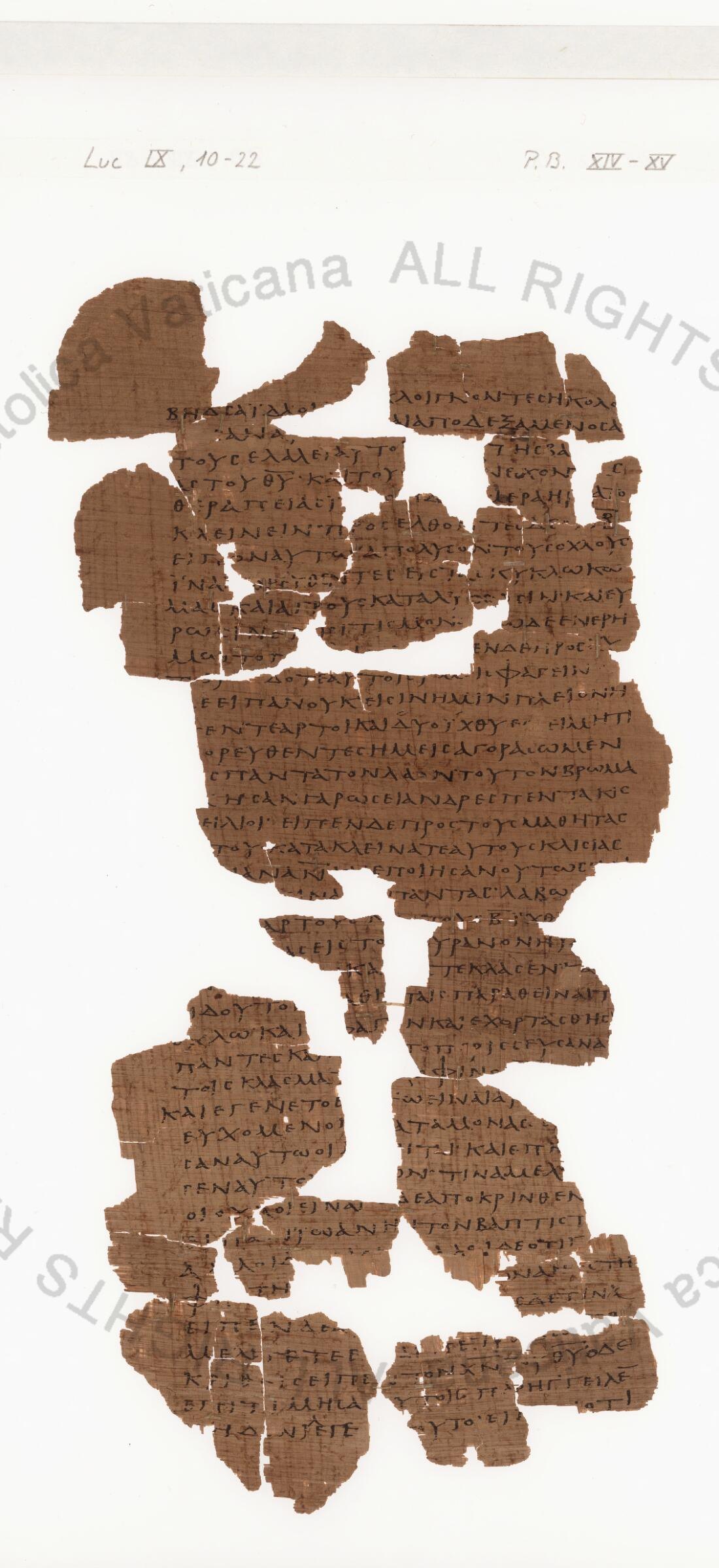
Vatican Library, Pap. Hanna 1 (Mater Verbi), DigiVatLib image 20, frame 1A.10v (https://digi.vatlib.it/view/MSS_Pap.Hanna.1(Mater.Verbi)/0020), cropped to the frame. NTVMR page 190 (folio 18v). 9:10 begins on the previous page; 9:22 continues on the next page. Checked on the image: first line βηδσαιδα οι δε οχλοι γνοντες ηκολουθησαν, near the foot μηδενι λεγειν τουτο (9:21), matching the transcription of this page.
9:10 βηδσαιδα· 11 οι̣ [δε ο]χ̣λοι γνοντες ηκολο[υ]
[θη]σ̣αν αυ̣[τω κ]αι αποδεξαμενος α[υ]
τους ελαλει αυτοις π̣[ερι] τ̣ης βα[σιλει]
α̣ς του θ̅υ̅· και του[ς] χρ̣[εια]ν εχοντ̣α̣ς
θεραπειας ι[ατ]ο 12 η̣ δ[ε η]μ̣ερα ηρ̣[ξ]ατο
κλεινειν· προσελθον̣τες δε ο̣ι̣ ι̣̣̅β̅
ειπον αυτω· απολυσον τους οχλους
ινα π̣ορευθεντες εις τ̣α̣ς̣ κυκλω κω
μας και αγρους καταλυσω̣σιν· και ευ
ρωσιν επ̣ισιτισμον ο̣[τι] ωδε εν ερη
μω τοπ̣[ω εσ]μ̣[εν] 13 [ειπεν δε προς α]υ̣
τ̣[ο]υ̣[ς δοτε αυτοις υμεις φαγειν] [...]
14 [...]
[αυτου] κ̣α̣[τακλινατε αυτους κλισιας ω]
[σει α]ν̣α ν̅ 15 [και εποιησαν ουτως και]
[κατεκλ]ε̣ι̣να̣[ν απαντας] 16 [λαβων δε τους]
[πεντε] αρτους̣ κ̣[αι τους] β̣̣̅ ι̣χ̣[θυας]
[αναβλεψ]α̣ς εις το[ν ο]υρανον ηυ̣λ̣[ο]
[γησεν αυτους] · κα[ι κ]α̣τεκλασεν· κ̣α̣[ι ε]
[δ]ιδου τοι̣[ς μ]α̣θη̣ταις παραθειναι τ[ω]
ο̣χλω· 17 και [ε]φ̣αγ[ο]ν και εχορτασθησα̣[ν]
παντες και̣ [ηρθη] το πε̣ρισσευσαν α[υ]
τοις κλασματ̣[ων] κ̣οφινο̣[ι ι̅β̅]
18 και εγενετο ε̣[ν] τ̣ω ειναι αυ̣[τον προσ]
ευχομενον̣ [κ]ατα μονας. σ̣[υνη]
σαν αυτω οι μ̣[αθ]η̣ται· και επη̣[ρωτη]
σεν αυτου̣[ς λεγ]ω̣ν· τινα με λ[εγουσιν]
οι οχλοι ειναι 19 [οι] δε αποκρινθεν[τες]
ε̣ιπαν̣ ιωανην̣ τον βαπτιστ[ην]
αλ̣λοι δ̣[ε η]λ̣ε̣ι̣[αν α]λ̣λ̣οι δε οτι π̣[ρο]
φη̣τη[ς τις των αρχαι]ω̣ν ανε̣στη
20 ειπεν δε α̣[υτοις υμει]ς δε τινα
με λεγετε ει̣[ν]αι π̣ετρ̣ο̣[ς] δ̣ε̣ α̣π̣ο̣
κριθε̣ις ειπεν̣ τον χ̅ν̅ τ̣ου θ̅υ̅ 21 ο δε
επιτιμησα[ς α]υτοις πα̣ρ̣ηγγειλεν
[μ]ηδε̣νι εγε[ιν] τ̣ο̣υτο· 22 ειπ̣[ω]ν̣ οτι
9:10¶ And the apostles, when they were returned, told him all that they had done. And he took them, and went aside privately into a desert place belonging to the city called Bethsaida. 11And the people, when they knew it, followed him: and he received them, and spake unto them of the kingdom of God, and healed them that had need of healing. 12And when the day began to wear away, then came the twelve, and said unto him, Send the multitude away, that they may go into the towns and country round about, and lodge, and get victuals: for we are here in a desert place. 13But he said unto them, Give ye them to eat. And they said, We have no more but five loaves and two fishes; except we should go and buy meat for all this people. 14For they were about five thousand men. And he said to his disciples, Make them sit down by fifties in a company. 15And they did so, and made them all sit down. 16Then he took the five loaves and the two fishes, and looking up to heaven, he blessed them, and brake, and gave to the disciples to set before the multitude. 17And they did eat, and were all filled: and there was taken up of fragments that remained to them twelve baskets. 18¶ And it came to pass, as he was alone praying, his disciples were with him: and he asked them, saying, Whom say the people that I am? 19They answering said, John the Baptist; but some say, Elias; and others say, that one of the old prophets is risen again. 20He said unto them, But whom say ye that I am? Peter answering said, The Christ of God. 21And he straitly charged them, and commanded them to tell no man that thing; 22Saying, The Son of man must suffer many things, and be rejected of the elders and chief priests and scribes, and be slain, and be raised the third day.
Where on the image
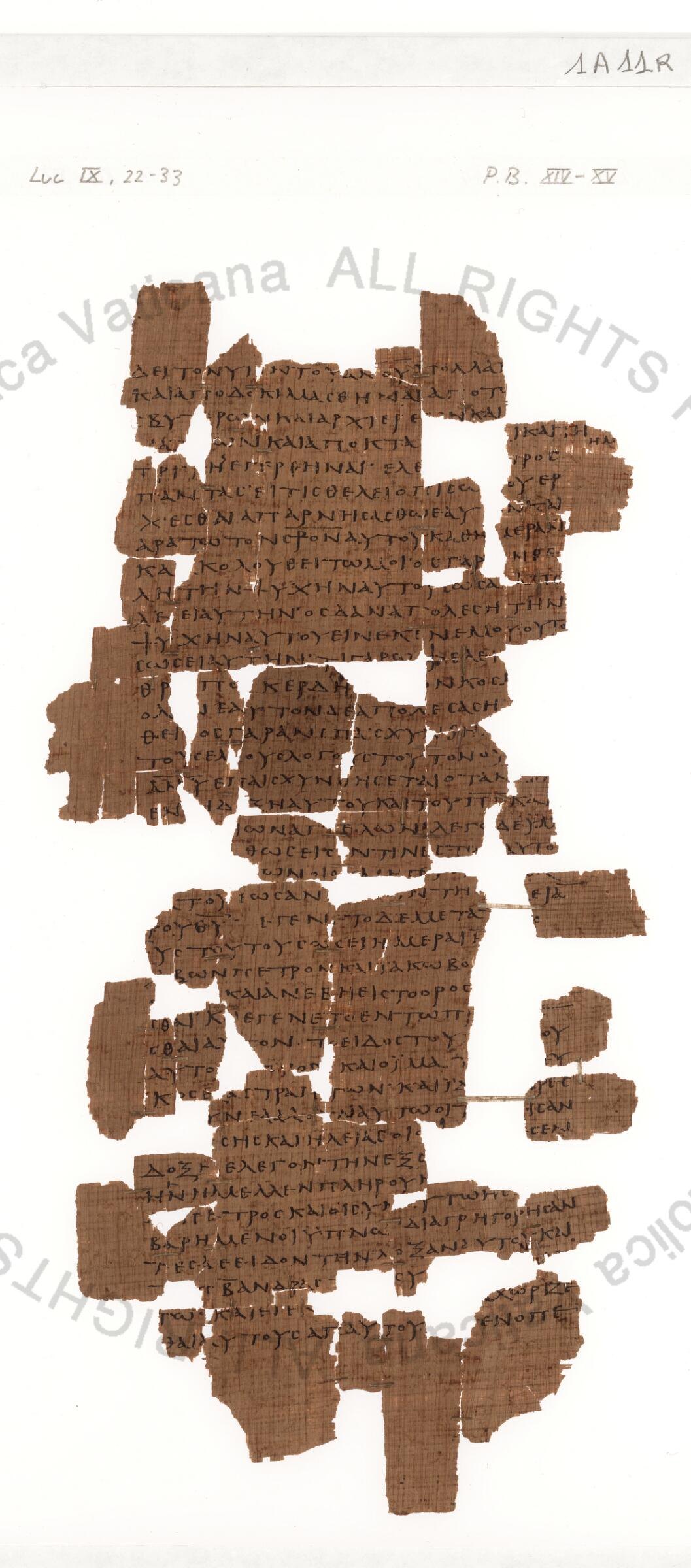
Vatican Library, Pap. Hanna 1 (Mater Verbi), DigiVatLib image 21, frame 1A.11r (https://digi.vatlib.it/view/MSS_Pap.Hanna.1(Mater.Verbi)/0021), cropped to the frame. NTVMR page 200 (folio 19r). 9:22 begins on the previous page; 9:33 continues on the next page. Checked on the image: first line δει τον υιον του α̅ν̅ο̅υ̅ πολλα, last line αυτους απ αυτου ειπεν ο πετρος (9:33), matching the transcription of this page.
9:22 δει τον υιο̣ν του α̅ν̣̣̅ο̅υ̅ πολλα π̣[αθειν]
και αποδοκιμασθηναι απο τω̣[ν πρε]
σ̣βυτ̣ε̣ρων και αρχιερεω̣ν και [γραμ]
μ̣ατ̣[ε]ων και αποκτα[νθηνα]ι και
τριτ̣η εγερθηναι· 23 ελε[γεν δε] π̣ρος
παντας· ει τις θελει οπισω [μ]ου ερ
χεσθαι απαρνησασθω εαυτ̣[ο]ν και
αρατω τον σ̅τ̅ρ̅ο̅ν̅ αυτου καθ ημ̣εραν
κα[ι] α̣κολουθειτω μοι· 24 ος γαρ [α]ν θε
λη την ψυχην αυτου̣ σ̣ωσαι̣ α̣πο
λεσ̣ει αυτην· ος δ αν απ̣ολεση την
ψυχην αυτου εινεκε̣ν εμου· ουτο[ς]
σωσει αυτην· 25 τι γαρ ωφελει[ται αν]
θρ[ω]πο[ς] κερδη[σας τ]ο̣ν κοσμ̣[ον]
ολ[ο]ν̣ εαυτον δε απολεσας η [ζημιω]
θει[ς] 26 ος γαρ αν ε̣παισχυν̣θη [με και]
του̣ς εμους λογου̣ς τουτον ο υ̣[ιος του]
α̅ν̅[ο̅]υ̅ επαισχυνθ̣ησεται οταν̣ [ελ]θ̣η̣
εν [τ]η̣ δ[ο]ξη αυτου και του π̅ρ̣̣̅[ς̅] και̣
[των αγ]ιων αγγ̣ελων· 27 λεγω̣ δε υμ̣[ιν]
[οτι αλη]θως εισ[ι]ν τινε̣ς τω̣[ν] αυτο[υ]
[εστηκοτ]ων οι ου̣ μ̣η̣ γευ̣[σωνται] θ̣α̣
[ν]α̣του̣ εως αν [ιδωσ]ι̣ν τη[ν βασι]λ̣ειαν
τ̣ου θ̅υ̅· 28 εγενετο δε μετα τ̣[ους λ]ο
[γο]υς τουτους ωσει ημεραι η̣̣̅ [και παρα]
λ̣α̣βων πετρον και ιακωβο[ν και ιω]
α̣[νην] και ανεβη εις το ορος [προσευξ]α̣
σθαι· 29 κα̣ι̣ εγενετο εν τω πρ̣[οσευχ]ε
σθαι αυ̣τ̣ον. το ειδος του [προσωπ]ου
αυτο[υ ε]τ̣ε̣ρ̣ον̣ και ο ιματ̣[ισμος λ]ευ
κος εξ̣αστραπ̣τ̣ων· 30 και ιδ[ου αν]δ̣ρες
[δυο σ]υ̣νελαλου̣ν αυτω οιτ̣[ινες] η̣σαν
[μωυ]σης και ηλειας 31 οι ο̣φ̣[θεντ]ε̣ς εν
δοξη̣ ελεγον την εξο̣[δον αυτου]
ην ημελλεν πληρουν̣ [εν ι̅λ̅η̅μ̅] 32 [ο]
δ̣[ε] π̣ετρος και οι συν̣ [α]υτω ησ̣[αν βε]
βαρημενοι υπνω· διαγρηγορησαν
τες δε ειδον την δ̣οξαν αυτου και
τ̣[ο]υ̣ς β̅ ανδρας τ̣[ους] συ[νεστωτα]ς̣ [αυ]
τω· 33 και εγεν̣[ετο εν τ]ω δ[ι]α̣χωριζε
[σ]θ̣αι αυτους απ̣ αυτου. ειπεν ο πε
9:22Saying, The Son of man must suffer many things, and be rejected of the elders and chief priests and scribes, and be slain, and be raised the third day. 23¶ And he said to them all, If any man will come after me, let him deny himself, and take up his cross daily, and follow me. 24For whosoever will save his life shall lose it: but whosoever will lose his life for my sake, the same shall save it. 25For what is a man advantaged, if he gain the whole world, and lose himself, or be cast away? 26For whosoever shall be ashamed of me and of my words, of him shall the Son of man be ashamed, when he shall come in his own glory, and in his Father’s, and of the holy angels. 27But I tell you of a truth, there be some standing here, which shall not taste of death, till they see the kingdom of God. 28¶ And it came to pass about an eight days after these sayings, he took Peter and John and James, and went up into a mountain to pray. 29And as he prayed, the fashion of his countenance was altered, and his raiment was white and glistering. 30And, behold, there talked with him two men, which were Moses and Elias: 31Who appeared in glory, and spake of his decease which he should accomplish at Jerusalem. 32But Peter and they that were with him were heavy with sleep: and when they were awake, they saw his glory, and the two men that stood with him. 33And it came to pass, as they departed from him, Peter said unto Jesus, Master, it is good for us to be here: and let us make three tabernacles; one for thee, and one for Moses, and one for Elias: not knowing what he said.
Where on the image
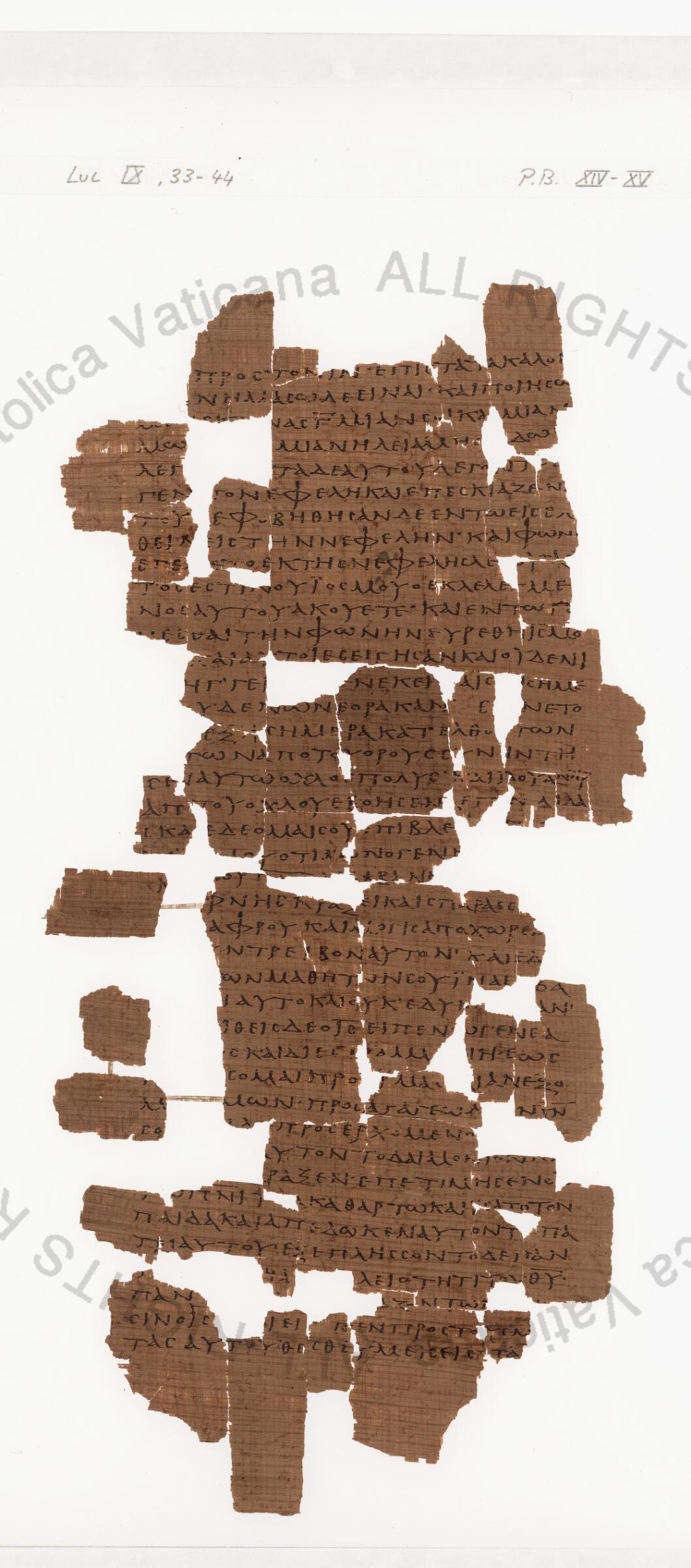
Vatican Library, Pap. Hanna 1 (Mater Verbi), DigiVatLib image 22, frame 1A.11v (https://digi.vatlib.it/view/MSS_Pap.Hanna.1(Mater.Verbi)/0022), cropped to the frame. NTVMR page 210 (folio 19v). 9:33 begins on the previous page; 9:44 continues on the next page. Checked on the image: near the top μωυσει και μιαν ηλεια ... νεφελη και επεσκιαζεν (9:33-34), last line τας αυτου θεσθε υμεις εις τα (9:44), matching the transcription of this page.
9:33 [τρος] προς τον̣ ι̅ν̅· επισ̣τατ̣α καλον̣
[εστι]ν ημας ωδε ειναι· και ποιησω̣
μ̣ε̣ν̣ σ̣κ̣[η]ν̣ας γ̅ μιαν σο̣ι κα[ι] μιαν̣
μω[σει και] μιαν ηλεια μη ε̣[ι]δω[ς ο]
λεγ[ει] 34 [ταυ]τα δε αυτου λεγον̣τ̣ο̣ς̣ [ε]
γεν[ε]το νεφελη και επεσκιαζεν [αυ]
του[ς] εφοβηθησαν δε εν τω εισελ
θειν̣ εις την νεφελην· 35 και φων[η]
εγεν̣ετ̣ο εκ της νεφελης λε[γ]ο̣υσ̣α̣ ο̣υ̣
τος εστιν ο υιος μου ο εκλελεγ̣με
νος αυτου ακουετε· 36 και εν τω γε̣
ν̣εσθ̣αι την φωνην ευρεθη ι̅ς̅ μο
[νος] κ̣αι αυ̣τοι εσειγησαν και ουδενι
[απ]ηγγει[λαν] ε̣ν εκει[ν]αις [τα]ις ημε
[ραις ο]υδεν ων εορακαν· 37 ε[γε]νετο
[δε τη] εξη̣ς ημερα κατελθο̣[ν]των
[αυ]των απο του̣ ορους συνη̣ντη
σε̣ν̣ αυτω οχλος̣ πολυς· 38 και ιδ̣ου ανηρ
απο̣ του οχλου εβ̣οησεν λ̣εγω̣ν διδα
σκα[λ]ε δεομαι σου ε̣πιβλεψ̣[αι ε]π̣[ι τον]
υ̣ι̣[ον] μ̣ο̣υ οτι μο̣νογενη̣[ς μοι εστιν]
39 κ̣[αι ι]δ̣ου π̣̣̅ν̣̣̅[α̅] λ̣α̣μ̣βανε̣[ι αυτον και]
[εξαι]φνης κρ̣αζ̣ει και σπα̣ρασσ[ει αυτον]
[μετα] αφρου και μογις αποχωρει̣ [απ αυ]
[του σ]υ̣ντρειβον αυτον· 40 και εδ[εη]
[θην τ]ων μαθητω̣ν σου ινα ε[κ]β̣α
[λωσι]ν̣ αυτο και ουκ εδυν̣[ηθησ]αν·
41 [αποκρ]ιθεις δε ο ι̅ς̅ ειπεν· ω̣ γενεα
[απιστο]ς και διεστ̣ρ̣αμμ̣[ε]ν̣η· εως
π̣[οτε ε]σομαι προ[ς] υ̣μας̣ [κ]α̣ι ανεξο
μ[αι υ]μων· προσαγαγε ωδ[ε το]ν υ̅ν̅
σο[υ] 42 [ετ]ι̣ δ̣[ε] προσερχομενο[υ αυτο]υ̣
[ερρηξεν] α̣υτον το δαιμονιον κ̣α̣[ι]
[συνεσπα]ραξεν· επετιμησεν ο [ι̅]ς̣̣̅
τ̣ω̣ π̅ν̅ι̅ τ̣[ω] α̣καθαρτω και ισα̣το τον
παιδα και απεδωκεν αυτον τω̣ πα
τρι αυτου· 43 εξεπλησσοντο δε παν
τ̣[ες επι τ]η μ̣[εγα]λειοτητι του̣ θ̅υ̅·
παν[τ]ων [δε θαυμ]α̣ζο̣ντων̣ [επ]ι̣ [πα]
σιν οις επο̣ιει [ει]πεν προς το̣υς μ[αθη]
τας αυτο̣υ· 44 θεσθε υμεις̣ εις τα [ωτα]
9:33And it came to pass, as they departed from him, Peter said unto Jesus, Master, it is good for us to be here: and let us make three tabernacles; one for thee, and one for Moses, and one for Elias: not knowing what he said. 34While he thus spake, there came a cloud, and overshadowed them: and they feared as they entered into the cloud. 35And there came a voice out of the cloud, saying, This is my beloved Son: hear him. 36And when the voice was past, Jesus was found alone. And they kept it close, and told no man in those days any of those things which they had seen. 37¶ And it came to pass, that on the next day, when they were come down from the hill, much people met him. 38And, behold, a man of the company cried out, saying, Master, I beseech thee, look upon my son: for he is mine only child. 39And, lo, a spirit taketh him, and he suddenly crieth out; and it teareth him that he foameth again, and bruising him hardly departeth from him. 40And I besought thy disciples to cast him out; and they could not. 41And Jesus answering said, O faithless and perverse generation, how long shall I be with you, and suffer you? Bring thy son hither. 42And as he was yet a coming, the devil threw him down, and tare him. And Jesus rebuked the unclean spirit, and healed the child, and delivered him again to his father. 43¶ And they were all amazed at the mighty power of God. But while they wondered every one at all things which Jesus did, he said unto his disciples, 44Let these sayings sink down into your ears: for the Son of man shall be delivered into the hands of men.
Where on the image
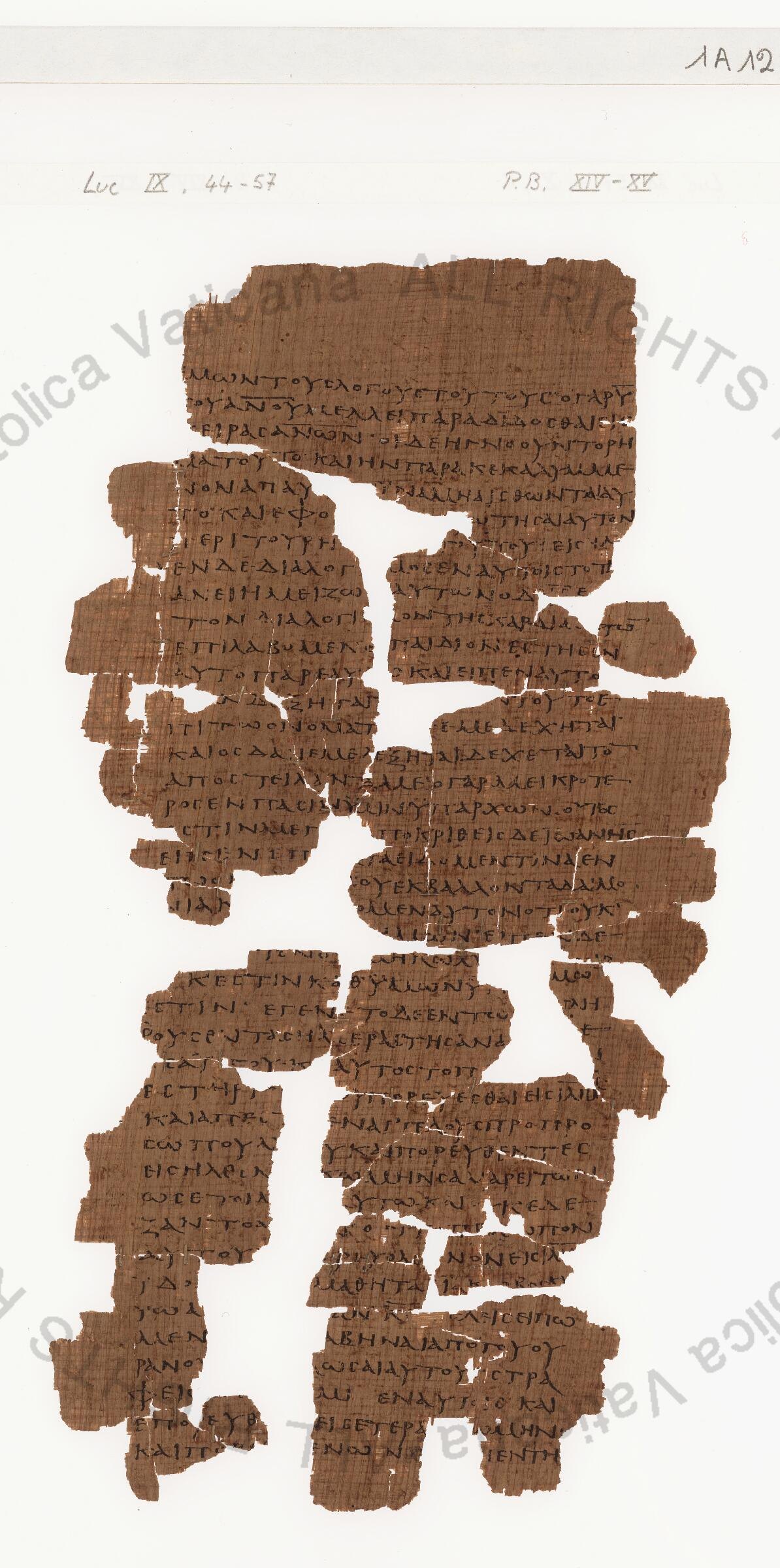
Vatican Library, Pap. Hanna 1 (Mater Verbi), DigiVatLib image 23, frame 1A.12r (https://digi.vatlib.it/view/MSS_Pap.Hanna.1(Mater.Verbi)/0023), cropped to the frame. NTVMR page 220 (folio 20r). 9:44 begins on the previous page; 9:57 continues on the next page. Checked on the image: first line υμων τους λογους τουτους, near the foot εις ετεραν κωμην (9:56), matching the transcription of this page. Luke 9:54-56: P75 does not have the words the KJV renders "even as Elias did" (9:54), "and said, Ye know not what manner of spirit ye are of" (9:55) and "For the Son of man is not come to destroy men's lives, but to save them" (9:56).
9:44 υ̣μων τους λογους τουτους ο γαρ υ̅[ς̅]
τ̣ου α̅ν̅ο̅υ̅ μελλει παραδιδοσθαι εις
χ̣ειρας α̅ν̅ω̅ν̅· 45 οι δε ηγνοουν το ρη
μα τουτο· και ην παρακεκαλυμμε
νον απ αυ[των] ινα μη αισθωνται αυ
το· και εφο[βουντο ε]ρ̣ωτησαι αυτον
περι του ρη[ματος] τ̣ουτου: 46 ειση̣λ
θ̣εν δε διαλογ[ισ]μος εν αυτοις το τι[ς]
αν ειη μειζω[ν] αυτων 47 ο δε̣ ι̣̣̅ς̣̣̅ ει̣[δως]
τον διαλογι[σ]μ̣ον της καρδιας̣ [αυ]των
επιλαβομενο[ς] παιδιον εστησε̣ν
αυτο παρ εαυ[τ]ω̣ 48 και ειπεν αυτο[ις]
ο[ς] α̣ν δε̣ξηται τ̣[ο παιδιο]ν̣ τουτο ε
πι τω ονοματ[ι μου] εμε δεχηται·
και ος δ αν εμε δ̣εξηται. δεχεται τον
αποστειλαντ̣α με· ο γαρ μεικροτε
ρος εν πασιν υμ̣ιν υπαρχων. ουτος
ε̣στιν μεγ[ας] 49 [α]ποκριθεις δε ιωανης
ειπεν επ[ιστ]α̣τ̣α ειδομεν τινα εν
τω ο̣ν̣[οματι] σ̣ου εκβαλλοντα δαιμο
ν̣ια κ[αι εκωλυ]ομεν αυτον οτι ουκ
[ακολουθει μεθ] η̣μ̣ων· 50 ειπε̣ν̣ δε
[προς αυ]τ̣ο̣ν ο [ι̅ς̅] μ̣η κωλυ̣[ετε ος] γ̣α̣ρ̣
[ου]κ εστιν κα̣θ υμων υπ̣[ερ υ]μων
ε̣στιν· 51 εγενε̣το δε εν τω [συμ]π̣λη
ρ̣ουσθαι τας ημερας της ανα[λημψ]ε
[ω]ς αυτ̣ου· κ[αι] αυτος το π[ροσωπο]ν̣
εστηρισ̣εν [τ]ο̣υ πορευεσθαι εις ι̅λ̅η̣̣̅μ̣̣̅·
52 και απεστ̣ει[λ]εν αγγελους προ προ
σωπου αυ̣[το]υ και πορευθεντες
εισηλθε̣ν [εις] κ̣ωμην σαμαρειτων
ως ετοιμ̣[ασαι] α̣υτω. 53 και ο̣υ̣κ εδε
ξαντο α[υτο]ν̣· οτ̣ι το̣ πρ̣ο̣σ̣ω̣πον
αυτου [ην πο]ρευομ[ε]νον εις ι̅λ̅η̣̣̅[μ̅]
54 ιδο[ντες δε οι] μαθητα[ι] ιακ̣ω̣βος̣ κ̣α̣[ι]
ιωα[νης ειπ]α̣ν κ̅[ε̅ θ]ελεις ειπω
μεν [πυρ κατ]α̣βηναι απο του ου
ρανου̣ [και ανα]λ̣ωσαι αυτους̣· 55 στρα
φεις̣ δ̣ε̣ [επετι]μη̣[σ]εν αυτοις· 56 και
επορ̣ευθ[ησαν] εις ετερα[ν κ]ω̣μην·
57 και πο̣ρ̣ε̣υ̣[ομ]ε̣νων α̣[υτω]ν̣ εν τη
9:44Let these sayings sink down into your ears: for the Son of man shall be delivered into the hands of men. 45But they understood not this saying, and it was hid from them, that they perceived it not: and they feared to ask him of that saying. 46¶ Then there arose a reasoning among them, which of them should be greatest. 47And Jesus, perceiving the thought of their heart, took a child, and set him by him, 48And said unto them, Whosoever shall receive this child in my name receiveth me: and whosoever shall receive me receiveth him that sent me: for he that is least among you all, the same shall be great. 49¶ And John answered and said, Master, we saw one casting out devils in thy name; and we forbad him, because he followeth not with us. 50And Jesus said unto him, Forbid him not: for he that is not against us is for us. 51¶ And it came to pass, when the time was come that he should be received up, he stedfastly set his face to go to Jerusalem, 52And sent messengers before his face: and they went, and entered into a village of the Samaritans, to make ready for him. 53And they did not receive him, because his face was as though he would go to Jerusalem. 54And when his disciples James and John saw this, they said, Lord, wilt thou that we command fire to come down from heaven, and consume them, even as Elias did? 55But he turned, and rebuked them, and said, Ye know not what manner of spirit ye are of. 56For the Son of man is not come to destroy men’s lives, but to save them. And they went to another village. 57¶ And it came to pass, that, as they went in the way, a certain man said unto him, Lord, I will follow thee whithersoever thou goest.
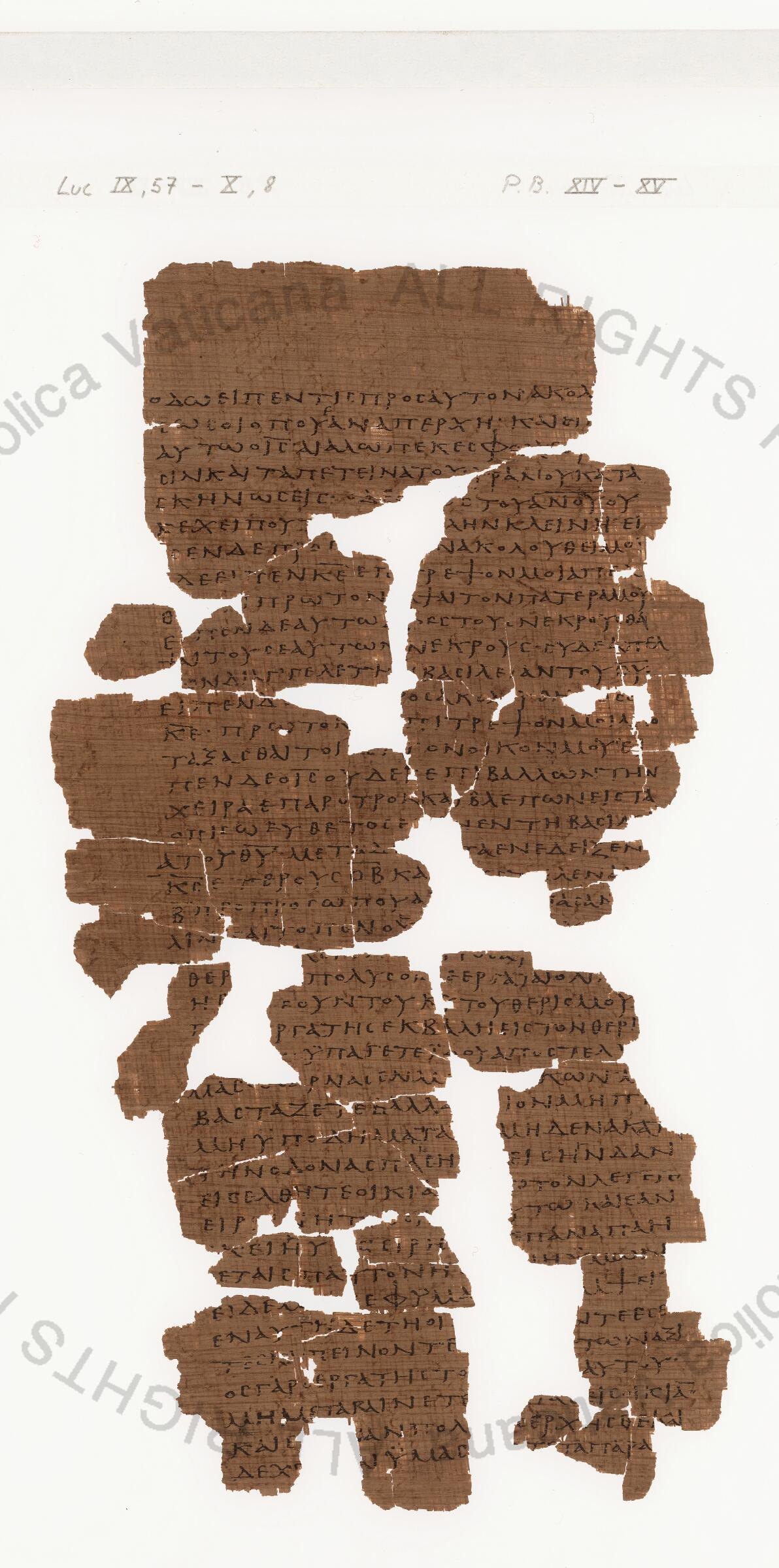
Where on the image
Vatican Library, Pap. Hanna 1 (Mater Verbi), DigiVatLib image 24, frame 1A.12v (https://digi.vatlib.it/view/MSS_Pap.Hanna.1(Mater.Verbi)/0024), cropped to the frame. NTVMR page 230 (folio 20v). 9:57 begins on the previous page; 10:8 continues on the next page. Checked on the image: near the top ουκ εχει που (9:58), near the foot ος γαρ ο εργατης (10:7), matching the transcription of this page.
9:57 οδω ειπεν τις προς αυτον· ακολ[ουθη]
σ̣ω σοι οπου αν απερχη· 58 και ειπ̣[εν]
αυτω ο ι̅ς̅· αι αλωπεκες φωλ̣ε̣ο̣υ̣[ς εχου]
σιν και τα πετεινα του̣ ο̣υρανου κατα
σκηνωσεις· ο δε ο̣ [υι]ο̣ς του α̅ν̅ο̅υ̅ ου
κ εχει που τ̣[ην κεφα]λην κλεινη· 59 ει
π̣εν δε προς̣ [ετερο]ν ακολουθει μοι
[ο] δε ειπ̣εν κ̅ε̅ επ[ι]τ̣ρεψον μοι απελ̣
θ[οντ]ι πρωτον [θ]α̣ψαι τον πατερα μου
60 ε[ι]πεν δε αυτω α̣φ̣ες τους̣ νεκρους θα
ψ̣αι τους εαυτων̣ νεκρους· συ δε απελ
[θ]ω̣ν διαγγελε τη̣ν̣ βασιλειαν του θ̅υ̅·
61 ειπεν δε̣ [και ετε]ρ̣ος ακολ[ο]υθη̣[σ]ω̣ σο̣[ι]
κ̅ε̅· πρωτον̣ [δε ε]πιτρεψον μοι απ̣ο
ταξασθαι τοι[ς] ε̣ι̣[ς] τ̣ον οικον μου· 62 ει̣
πεν δε ο ι̅ς̅ ουδει[ς] επιβαλλων την
χειρα επ αροτρον̣ και βλεπων εις τα
οπισω ευθετος ε[στι]ν̣ εν τη βασιλε̣[ι]
α του θ̅υ̅· 10:1 μετα̣ δ[ε ταυ]τ̣α ενεδειξεν [ο]
κ̅ς̅ ετερους ο̅β̅ κα[ι απ]ε̣σ̣τ̣[ε]ι̣λεν α̣ν̣[α]
β̅ προ προσωπου α[υτου εις] π̣ασαν̣ [πο]
λιν κ̣αι τοπον ου̣ [ημελλεν α]υ̣[τος ερ]
χ̣[εσθαι] 2 [ε]λ̣ε̣γ̣ε̣ν̣ [δε] π̣ρ̣ο̣ς̣ α̣υ̣[τους ο μεν]
θερ[ισμος] πολυς οι̣ δ̣ε εργαται ολιγ̣[οι δε]
ηθ̣[ητ]ε ουν του κ̅υ̣̣̅ του θερισμου [ο]
π̣[ως ε]ργατης εκβαλη εις τον θερι[σμον]
[αυτο]υ̣· 3 υπαγετε ιδου αποστελλ̣[ω υ]
μας ω̣ς̣ α̣ρνας εν μ[εσ]ω̣ [λυ]κων· 4 μ̣[η]
βασταζετε β̣αλλα̣ν̣τιον μη πη̣[ραν]
μη υποδηματα κ̣α̣ι̣ μηδενα κατ̣α̣
την οδον ασπαση[σθε] 5 εις ην δ αν
εισελθητε οικια[ν πρ]ω̣τον λεγετ̣ε
ειρη̣ν̣η τω̣ οι̣[κω το]υ̣τω· 6 και εαν
ε̣κει η υ[ιο]ς ειρη[νης] ε̣παναπαη
[σ]εται ε̣π αυ̣τον η [ειρη]ν̣η υ̣μων
ει δε μ[η γε] εφ υμα[ς ανακα]μψει·
7 εν αυτη δε τη οι[κια με]ν̣τε εσθ̣[ιον]
τες κα̣ι̣ πεινοντε[ς τα παρ αυ]των αξι
ος γαρ ο̣ εργατης το[υ μισθου] αυτου·
μη με̣ταβαινετε [εξ οικ]ι̣α̣ς̣ εις οικιαν·
8 και ε[ις η]ν̣ αν πολ[ιν ει]σ̣ερχη̣σθε και
δεχω̣[ντ]α̣ι υμας [εσθιε]τ̣ε̣ τα παρα[τι]
9:57¶ And it came to pass, that, as they went in the way, a certain man said unto him, Lord, I will follow thee whithersoever thou goest. 58And Jesus said unto him, Foxes have holes, and birds of the air have nests; but the Son of man hath not where to lay his head. 59And he said unto another, Follow me. But he said, Lord, suffer me first to go and bury my father. 60Jesus said unto him, Let the dead bury their dead: but go thou and preach the kingdom of God. 61And another also said, Lord, I will follow thee; but let me first go bid them farewell, which are at home at my house. 62And Jesus said unto him, No man, having put his hand to the plough, and looking back, is fit for the kingdom of God. 10:1After these things the Lord appointed other seventy also, and sent them two and two before his face into every city and place, whither he himself would come. 2Therefore said he unto them, The harvest truly is great, but the labourers are few: pray ye therefore the Lord of the harvest, that he would send forth labourers into his harvest. 3Go your ways: behold, I send you forth as lambs among wolves. 4Carry neither purse, nor scrip, nor shoes: and salute no man by the way. 5And into whatsoever house ye enter, first say, Peace be to this house. 6And if the son of peace be there, your peace shall rest upon it: if not, it shall turn to you again. 7And in the same house remain, eating and drinking such things as they give: for the labourer is worthy of his hire. Go not from house to house. 8And into whatsoever city ye enter, and they receive you, eat such things as are set before you:
Notes
- Greek: the NTVMR diplomatic transcription, line by line as on the papyrus. Square brackets enclose letters that are lost or illegible and were supplied by the transcribers; a dot under a letter marks it as uncertain; [...] marks a gap. Nomina sacra and numerals keep the scribe's overline. Spelling is the scribe's (no accents or breathings). Words broken at a line end stay broken as on the papyrus. Corrections are not shown: the text is the first hand.
- English: the King James Version (1611), whole verses, for every verse that has text on the page. A verse that begins on one page and ends on the next is given in full on both. The KJV translates a later form of the Greek text, so its wording does not always match the papyrus; material differences (such as verses the papyrus does not have) are noted in the section.
Cite
Sources
- Source: Papyrus Hanna 1 (Mater Verbi), Vatican Library: photographs from DigiVatLib; Greek from the INTF NTVMR transcription of P75; English from the King James Version (holding institution)
- Critical edition: INTF NTVMR diplomatic transcription (CC BY 4.0)
← previous · → next · v cycle view · l back to library