P75 (Papyrus Hanna 1): Luke 18:6-18 (fol. 34v)
Introduction
P75 is a papyrus codex of Luke and John copied in Egypt around 175-225, the oldest known copy of Luke and one of the oldest of John. It was bought by Martin Bodmer in the 1950s and published as Papyrus Bodmer XIV-XV; in 2006 it was given to the Vatican Library, where it is kept as Papyrus Hanna 1 (Mater Verbi). Its text is very close to that of Codex Vaticanus, written some 150 years later. Where Luke ends and John begins (folio 44r) both titles stand on the same page.
About 51 leaves survive, many damaged at the top and edges, especially in Luke 3-7. Lost: Luke 1:1-3:17, most of 3:23-4:33, 5:11-36, 6:5-10, 7:33-34 and 7:44-45 (and parts of 7:36-49), 17:16-19, 18:19-22:3; John 11:46-47, 12:1-2, 13:11-14:7 and everything after 15:10 except small fragments. Each section below is one page: the photograph, the NTVMR diplomatic transcription line by line, and the King James Version of every verse on the page. Where P75 lacks a verse or words that the KJV has (for example John 5:4 or the account of the adulteress, John 7:53-8:11), the section says so. Six damaged pages (folios 7v, 11r, 39v, 58r, 58v and 64v) are left out because their text could not be matched to the photographs with certainty.
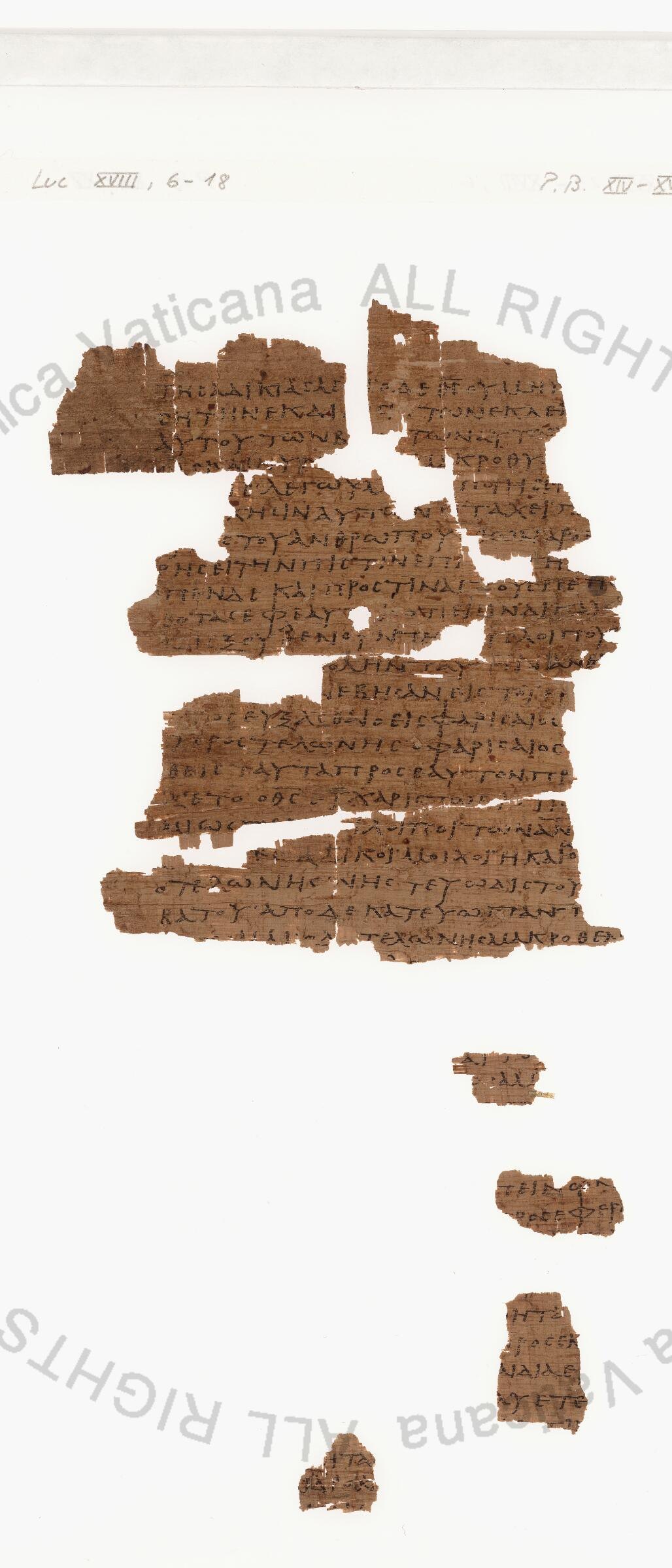
This entry covers fol. 34v (Luke 18:6-18), shown on the Vatican Library's photograph (frame 2A.2v).
How was this verified? (Provenance)
Where on the image
Vatican Library, Pap. Hanna 1 (Mater Verbi), DigiVatLib image 52, frame 2A.2v (https://digi.vatlib.it/view/MSS_Pap.Hanna.1(Mater.Verbi)/0052), cropped to the frame. NTVMR page 510 (folio 34v). 18:6 begins on the previous page; 18:18 continues on the next page. Checked on the image: first line της αδικιας λεγει (18:6), matching the transcription of this page.
18:6 της αδικιας λε[γε]ι· 7 ο δε θ̅ς̅ ου μη π̣[οιη]
ση την εκδι[κη]σι̣ν̣ των εκλεκ̣[των]
αυτου των β[οων]των αυτω [ημε]
ρ̣α̣ς και νυκ̣[τος και] μ̣α̣κροθυ[μει επ]
[αυτο]ις· 8 λεγω υμ̣[ιν οτι] ποιησε̣ι̣ [την]
[εκδι]κησιν αυτω̣ν ε̣ν̣ ταχει π[λην]
[ο] υ̣[ιο]ς του ανθρωπου [ελ]θων αρα̣ ε̣[υ]
ρησει την πιστιν επι [της] γ̣η[ς]
9 [ει]πεν δε και προς τινας̣ τ̣ους πεπο̣[ι]
θοτας εφ εαυτ̣[ο]ι̣ς̣ οτι εισ̣ιν δικαιο[ι]
κ̣α̣ι ε̣ξουθενου̣ντες̣ [το]υς λοιπου[ς]
[την παραβ]ολην ταυτ̣η̣ν· 10 ανθρ̣[ω]
[ποι δυο α]ν̣εβησαν εις το ιερ̣[ον]
π̣ρ̣οσευξασθαι ο εις φαρισαιος [και ο ε]
τ̣ε̣ρος τελωνης· 11 ο φαρισαιος [στα]
θεις ταυτα προς εαυτον πρ[οσηυ]
χετο· ο θ̅ς̅ ε̣υχαριστω σ[ο]ι ο̣τ̣ι ο̣[υκ ει]
μι ωσπ̣ε̣ρ̣ [...] ο̣ι λοιποι των α̅ν̅[ω̅ν̅]
[αρπαγ]ες αδ̣ικοι· μοιχοι· η και ο[υτος]
ο τελωνης· 12 νηστευω δις του [σαβ]
βατου· αποδεκατευω παντ̣[α οσα]
[κτ]ω̣μ̣α̣ι· 13 ο̣ δ[ε] τελωνης μακροθεν̣
[εστως ουκ ηθε]λ̣ε̣[ν ουδε τους οφ]
[θαλμους επαραι εις τον ουρανον]
[αλλ ετυπτεν το στηθος] αυ̣τ̣ο̣[υ λε]
[γων ο θ̅ς̅ ιλασθητι μοι τ]ω̣ αμ[αρτω]
[λω] 14 [...]
[...]
[τα]
[πεινωθησεται ο δε τα]π̣εινων̣
[εαυτον υψωθησεται] 15 π̣ρ̣οσεφερο̣[ν]
[δε αυτω και τα βρεφη ινα αυ]τ̣ω̣[ν]
[απτηται ιδοντες δε οι μαθ]ητα[ι]
[επετιμων αυτοις] 16 [ο δε ι̅ς̅] π̣ροσεκ[α]
[λεσατο λεγων αφετε τα π]αιδια ερ̣
[χεσθαι προς με και μη κω]λυετε
[αυτα των γαρ τοιουτων] ε̣[σ]τ̣ι̣ν̣
[...] 17 [...]
[υμιν ος αν μη δε]ξ̣ηται̣ [την βασι]
[λειαν του θ̅υ̅ ως π]α̣ιδιον̣ [ου μη εισ]
[ελθη εις αυτην] 18 κ̣α̣ι̣ ε̣[πηρωτη]
[σεν]
18:6And the Lord said, Hear what the unjust judge saith. 7And shall not God avenge his own elect, which cry day and night unto him, though he bear long with them? 8I tell you that he will avenge them speedily. Nevertheless when the Son of man cometh, shall he find faith on the earth? 9And he spake this parable unto certain which trusted in themselves that they were righteous, and despised others: 10Two men went up into the temple to pray; the one a Pharisee, and the other a publican. 11The Pharisee stood and prayed thus with himself, God, I thank thee, that I am not as other men are, extortioners, unjust, adulterers, or even as this publican. 12I fast twice in the week, I give tithes of all that I possess. 13And the publican, standing afar off, would not lift up so much as his eyes unto heaven, but smote upon his breast, saying, God be merciful to me a sinner. 14I tell you, this man went down to his house justified rather than the other: for every one that exalteth himself shall be abased; and he that humbleth himself shall be exalted. 15And they brought unto him also infants, that he would touch them: but when his disciples saw it, they rebuked them. 16But Jesus called them unto him, and said, Suffer little children to come unto me, and forbid them not: for of such is the kingdom of God. 17Verily I say unto you, Whosoever shall not receive the kingdom of God as a little child shall in no wise enter therein. 18And a certain ruler asked him, saying, Good Master, what shall I do to inherit eternal life?
Notes
- Greek: the NTVMR diplomatic transcription, line by line as on the papyrus. Square brackets enclose letters that are lost or illegible and were supplied by the transcribers; a dot under a letter marks it as uncertain; [...] marks a gap. Nomina sacra and numerals keep the scribe's overline. Spelling is the scribe's (no accents or breathings). Words broken at a line end stay broken as on the papyrus. Corrections are not shown: the text is the first hand.
- English: the King James Version (1611), whole verses, for every verse that has text on the page. A verse that begins on one page and ends on the next is given in full on both. The KJV translates a later form of the Greek text, so its wording does not always match the papyrus; material differences (such as verses the papyrus does not have) are noted in the section.
Cite
Sources
- Source: Papyrus Hanna 1 (Mater Verbi), Vatican Library: photographs from DigiVatLib; Greek from the INTF NTVMR transcription of P75; English from the King James Version (holding institution)
- Critical edition: INTF NTVMR diplomatic transcription (CC BY 4.0)
← previous · → next · v cycle view · l back to library