P75 (Papyrus Hanna 1): Luke 22:4-23:2 (fols. 38v-40v)
Introduction
P75 is a papyrus codex of Luke and John copied in Egypt around 175-225, the oldest known copy of Luke and one of the oldest of John. It was bought by Martin Bodmer in the 1950s and published as Papyrus Bodmer XIV-XV; in 2006 it was given to the Vatican Library, where it is kept as Papyrus Hanna 1 (Mater Verbi). Its text is very close to that of Codex Vaticanus, written some 150 years later. Where Luke ends and John begins (folio 44r) both titles stand on the same page.
About 51 leaves survive, many damaged at the top and edges, especially in Luke 3-7. Lost: Luke 1:1-3:17, most of 3:23-4:33, 5:11-36, 6:5-10, 7:33-34 and 7:44-45 (and parts of 7:36-49), 17:16-19, 18:19-22:3; John 11:46-47, 12:1-2, 13:11-14:7 and everything after 15:10 except small fragments. Each section below is one page: the photograph, the NTVMR diplomatic transcription line by line, and the King James Version of every verse on the page. Where P75 lacks a verse or words that the KJV has (for example John 5:4 or the account of the adulteress, John 7:53-8:11), the section says so. Six damaged pages (folios 7v, 11r, 39v, 58r, 58v and 64v) are left out because their text could not be matched to the photographs with certainty.
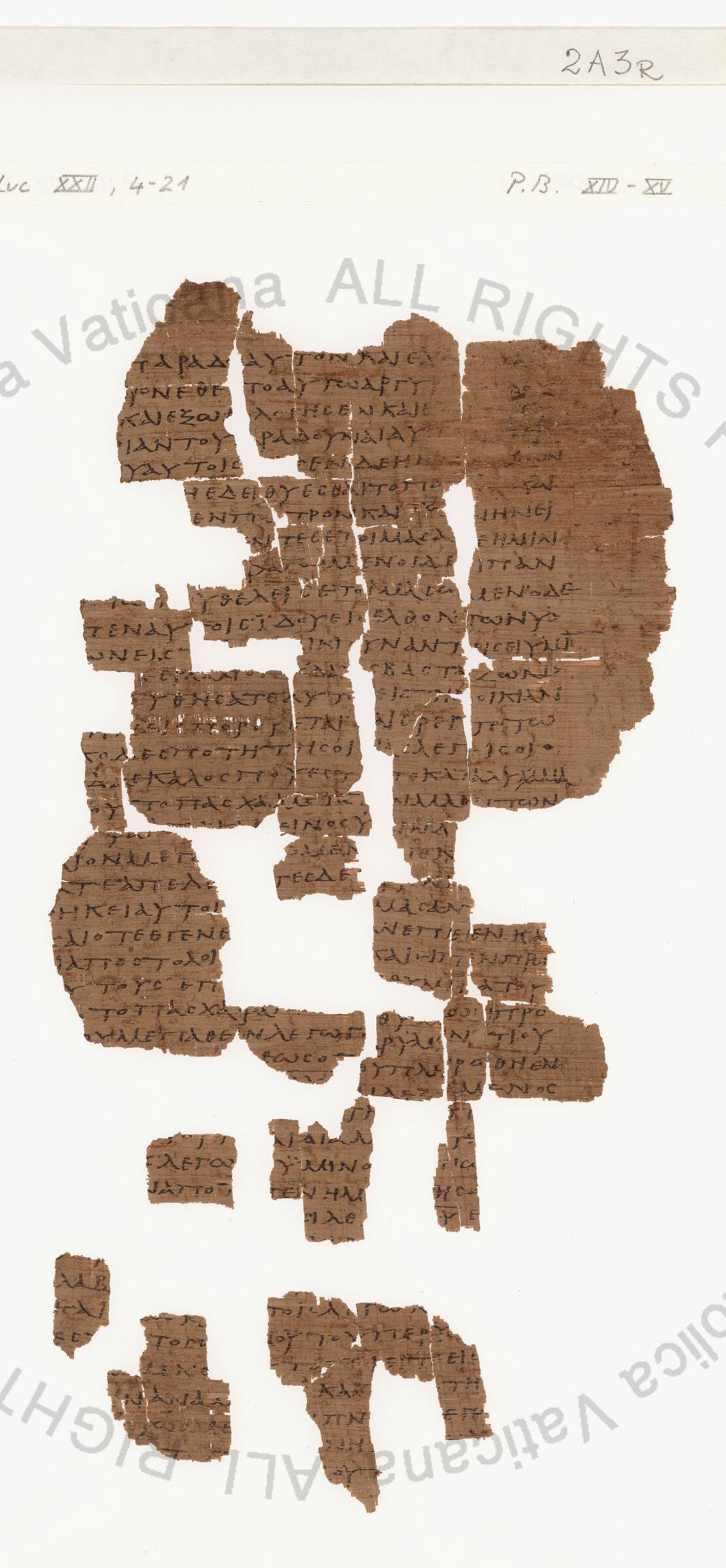
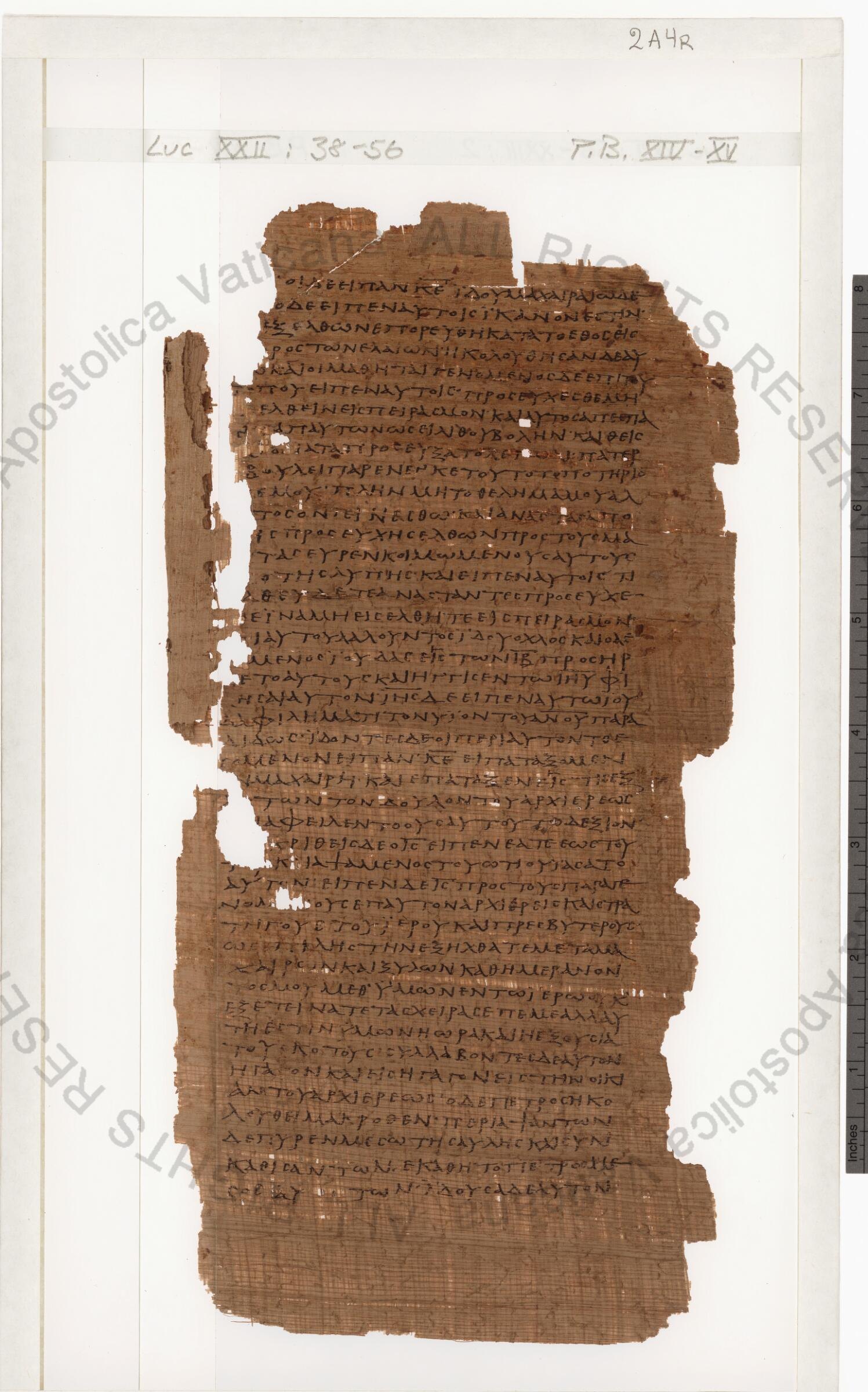
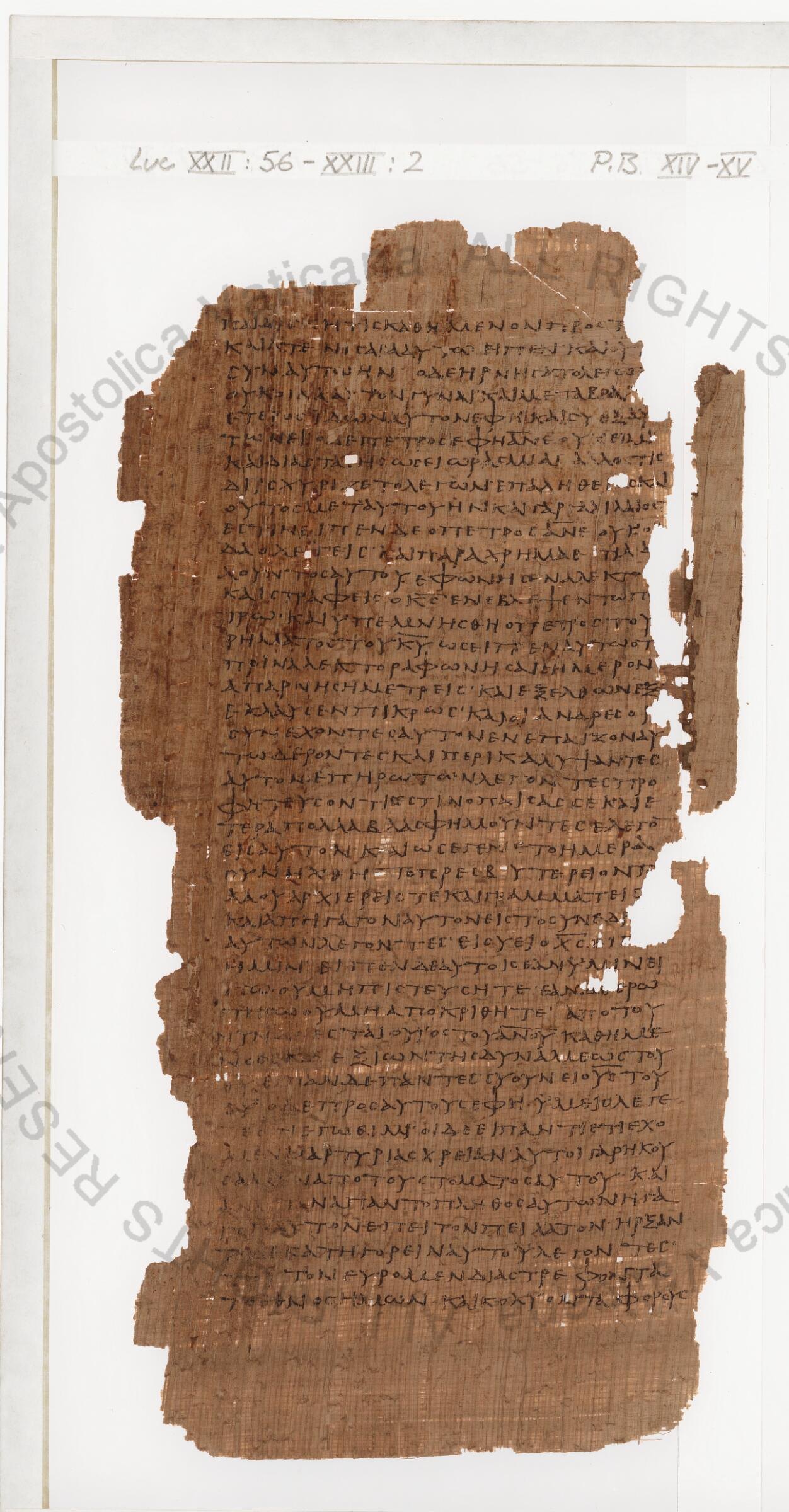
This entry covers fols. 38v-40v (Luke 22:4-23:2), shown on the Vatican Library's photographs (frames 2A.3r to 2A.4v).
How was this verified? (Provenance)
Where on the image
Vatican Library, Pap. Hanna 1 (Mater Verbi), DigiVatLib image 53, frame 2A.3r (https://digi.vatlib.it/view/MSS_Pap.Hanna.1(Mater.Verbi)/0053), cropped to the frame. NTVMR page 520 (folio 38v). 22:4 begins on the previous page. Checked on the image: first line [π]αραδω αυτον και εχαρησαν (22:4-5); NTVMR calls this page 38v, but it is the front of the frame 2A.3, matching the transcription of this page.
22:4 [τοις] π̣αραδω̣ αυτον 5 και εχα̣ρ̣η̣σ̣αν
[και σ]υ̣νεθε[ν]το αυτω αργυρι̣[ο]ν̣ δου
[ναι] 6 και εξωμ̣[ο]λογησεν και εζ̣[ητε]ι̣ ευ
[και]ρ̣ιαν του [π]α̣ραδουναι αυτο̣ν̣ α̣τερ
[οχλο]υ αυτοις 7 [ηλ]θ̣εν δε η η[μερα] τ̣ων
[αζυμων] η εδει θυεσθαι το πα[σχ]α̣ 8 κ̣αι
[απεστειλ]εν πε̣τρον και ι̣ω̣[α]ν̣ην ει
[πων πορευθ]ε̣ντες ετοιμασα[τ]ε ημιν
[το πασχα ινα] φαγωμεν· 9 οι δε [ε]ιπαν
[α]υ̣τ̣ω̣ π̣[ο]υ θελεις ετοιμασω̣μ̣εν· 10 ο δε
[ει]π̣εν αυτ̣οις· ιδου εισελθοντων υ
[μ]ων εις τ̣[ην πο]λ̣ιν σ̣υναντησει υμιν
[α̅ν̅]ο̅ς̅ κ̣ερ̣αμιο̣ν̣ υ̣δατ̣[ο]ς βασταζων
[ακ]ολο̣υθησατε αυτω̣ εις τ̣ην̣ οικιαν
[εις] η̣ν̣ εισπορε̣υεται· 11 [κ]αι ερειτε τω
[οι]κ̣οδεσποτη της οι[κ]ι̣α̣ς̣ λεγε̣ι σοι ο
[δι]δασκαλος που εστ[ιν] το καταλυμμα
[οπ]ου το πασχα μετα τ̣[ω]ν μαθη̣των
[μο]υ̣ φα̣γ̣ω̣ 12 κ̣α̣κ̣εινος υμ̣ιν δ[ειξει ανα]
[γ]α̣ιον μεγα̣ [εστρ]ω̣μεν̣[ο]ν̣ εκ[ει ετοιμα]
[σ]α̣τε· 13 απελθ̣[ον]τες δε ε̣υ̣ρ̣[ο]ν κ̣[αθως ει]
ρ̣ηκει αυτοι[ς και ητοι]μασαν τ̣[ο πασχα]
14 κ̣αι οτε εγενε[το η ωρα] α̣νεπεσ̣εν. κα[ι]
[ο]ι αποστολοι [συν αυτω] 15 κ̣αι ειπε̣ν προς̣
[α]υτους· επ[ιθυμια επ]ε̣θ̣υμη[σ]α του
[τ]ο̣ το πασχα φ̣αγ̣[ειν με]θ υμ̣ων̣ προ
[τ]ο̣υ με παθει̣ν 16 λεγω γα̣ρ υμι̣ν· [ο]τι ου
[μη φαγω αυτο] εως οτ̣ου πλη̣ρω̣θη εν
[τη βασιλεια του] θ̣̣̅υ̣̣̅ 17 [κ]α̣ι δεξ̣α̣με̣νος
[ποτηριον ευχαρισ]τ̣η̣[σας ει]π[εν λα]
[βετε] τ̣ου̣τ̣[ο κ]α̣ι διαμ[ερισα]τε̣ [εις εαυ]
[του]ς· 18 λεγω [γαρ] υμιν ο[υ μη] π̣ιω̣ [απο του]
[νυ]ν̣ απο τ[ου] γενημ[ατος τ]ης α̣[μπε]
λ̣[ο]υ̣ [ε]ως̣ [ου η βα]σιλε[ια του θ̅]υ̅ ε[λθη] 19 [και]
λαβ[ω]ν αρ̣[τον ευ]χ̣α̣ρ̣[ιστησας εκλασεν]
και [εδ]ω̣κ̣[εν αυ]τοις λε̣γων̣ [τουτο]
εστ̣[ιν] το σω̣[μα] μ̣ου το υπερ υ[μων]
[διδ]ο̣μ̣ενο[ν το]υ̣το ποιειτε εις̣ [την]
[εμ]η̣ν αναμ̣[νησιν] · 20 και τ̣[ο πο]τη[ριον ω]
[σαυ]τως με[τα το δε]ι̣πν[ησαι λ]εγω̣[ν]
[τουτο] τ[ο] π̣[οτηριο]ν η [καιν]η̣ δ̣ι̣[α]
[θηκη εν τω αιματι] μ̣ου τ̣[ο υπερ υ]
[μων]
22:4And he went his way, and communed with the chief priests and captains, how he might betray him unto them. 5And they were glad, and covenanted to give him money. 6And he promised, and sought opportunity to betray him unto them in the absence of the multitude. 7¶ Then came the day of unleavened bread, when the passover must be killed. 8And he sent Peter and John, saying, Go and prepare us the passover, that we may eat. 9And they said unto him, Where wilt thou that we prepare? 10And he said unto them, Behold, when ye are entered into the city, there shall a man meet you, bearing a pitcher of water; follow him into the house where he entereth in. 11And ye shall say unto the goodman of the house, The Master saith unto thee, Where is the guestchamber, where I shall eat the passover with my disciples? 12And he shall shew you a large upper room furnished: there make ready. 13And they went, and found as he had said unto them: and they made ready the passover. 14And when the hour was come, he sat down, and the twelve apostles with him. 15And he said unto them, With desire I have desired to eat this passover with you before I suffer: 16For I say unto you, I will not any more eat thereof, until it be fulfilled in the kingdom of God. 17And he took the cup, and gave thanks, and said, Take this, and divide it among yourselves: 18For I say unto you, I will not drink of the fruit of the vine, until the kingdom of God shall come. 19¶ And he took bread, and gave thanks, and brake it, and gave unto them, saying, This is my body which is given for you: this do in remembrance of me. 20Likewise also the cup after supper, saying, This cup is the new testament in my blood, which is shed for you.
Where on the image
Vatican Library, Pap. Hanna 1 (Mater Verbi), DigiVatLib image 55, frame 2A.4r (https://digi.vatlib.it/view/MSS_Pap.Hanna.1(Mater.Verbi)/0055), cropped to the frame. NTVMR page 540 (folio 40r). 22:37 begins on the previous page; 22:56 continues on the next page. Not written in this papyrus: Luke 22:43-44. The NTVMR transcription marks these verses as empty at this point of the text, so the English leaves them out. Checked on the image: near the top κ̅ε̅ ιδου μαχαιραι ωδε ... επορευθη κατα το εθος εις το ορος των ελαιων (22:38-39), lower down ως επι ληστην εξηλθατε μετα μαχαιρων (22:52), matching the transcription of this page.
22:37 [χει] · 38 οι δε ειπαν κ̅ε̅ ιδου μαχαιραι ωδε
[δυο] ο δε ειπεν αυτοις ικανον εστιν·
39 [και] εξελθων επορευθη κατα το εθος εις
[το ο]ρος των ελαιων· ηκολουθησαν δε αυ
[τ]ω̣· και οι μαθηται· 40 γενομενος δε επι του
τ̣ο̣που ειπεν αυτοις· προσευχεσθε μη
ε̣ι̣σ̣ελθειν εις πειρασμον· 41 και αυτος απεσπα
[σ]θη̣ απ αυτων ωσει λιθου βολην· και θεις
[τ]α̣ γ̣ον̣ατα προσευξατο 42 λεγων· πατερ
[ει] βουλει παρενεγκε τουτο το ποτηριον
[α]π̣ εμου· πλην μη το θελημα μου αλ
[λα] το σον γ̣εινεσθω· 45 και αναστας απο
[τ]η̣ς προσευχης ελθων προς τους μα
[θ]η̣τας ευρεν κοιμωμενους αυτους
[α]π̣ο της λυπης· 46 και ειπεν αυτοις· τι
[κ]αθευδετε ανασταντες προσευχε
[σθ]ε ινα μη εισελθητε εις πειρασμον·
47 [ε]τ̣ι αυτου λαλουντος ιδου οχλος και ο λε
[γο]μενος ιουδας εις των ι̅β̅ προσηρ
[χ]ετο αυτους και ηγγισεν τω ι̅η̅υ̅ φι
λ̣ησαι αυτον· 48 ι̅η̅ς̅ δε ειπεν αυτω ιου
δα φιληματι τον υιον του α̅ν̅ο̅υ̅ παρα
διδως· 49 ιδοντες δε οι περι αυτον το ε
σομενον ειπαν· κ̅ε̅ ει παταξομεν
[ε]ν̣ μαχαιρη· 50 και επαταξεν εις τις εξ
α̣υ̣των τον δουλον του αρχιερεως
[κα]ι αφειλεν το ους αυτου το δεξιον·
51 [απο]κριθεις δε ο ι̅ς̅ ειπεν εατε εως του
τ̣[ο]υ̣ κα̣ι αψαμενος του ωτιου ιασατο
αυτον· 52 ειπεν δε ι̅ς̅ προς τους παραγε
νομ[ε]ν̣ους επ αυτον αρχιερεις και στρα
τηγους του ιερου και πρεσβυτερους·
ως επι ληστην εξηλθατε μετα μα
χαιρων και ξυλων 53 καθ ημεραν ον
τος μου μεθ υμων εν τω ιερω ουκ
εξετεινατε τας χειρας επ εμε αλλ αυ
τη εστιν υμων η ωρα και η εξουσια
του σ̣κοτους· 54 συλλαβοντες δε αυτον
ηγαγον και εισηγαγον εις την οικι
αν του αρχιερεως· ο δε πετρος ηκο
λουθει μακροθεν· 55 περιαψαντων
δε πυρ εν μεσω της αυλης και συν
καθισαντων. εκαθητο πετρος με
σος [...]των· 56 ιδουσα δε αυτον
22:37For I say unto you, that this that is written must yet be accomplished in me, And he was reckoned among the transgressors: for the things concerning me have an end. 38And they said, Lord, behold, here are two swords. And he said unto them, It is enough. 39¶ And he came out, and went, as he was wont, to the mount of Olives; and his disciples also followed him. 40And when he was at the place, he said unto them, Pray that ye enter not into temptation. 41And he was withdrawn from them about a stone’s cast, and kneeled down, and prayed, 42Saying, Father, if thou be willing, remove this cup from me: nevertheless not my will, but thine, be done. 45And when he rose up from prayer, and was come to his disciples, he found them sleeping for sorrow, 46And said unto them, Why sleep ye? rise and pray, lest ye enter into temptation. 47¶ And while he yet spake, behold a multitude, and he that was called Judas, one of the twelve, went before them, and drew near unto Jesus to kiss him. 48But Jesus said unto him, Judas, betrayest thou the Son of man with a kiss? 49When they which were about him saw what would follow, they said unto him, Lord, shall we smite with the sword? 50¶ And one of them smote the servant of the high priest, and cut off his right ear. 51And Jesus answered and said, Suffer ye thus far. And he touched his ear, and healed him. 52Then Jesus said unto the chief priests, and captains of the temple, and the elders, which were come to him, Be ye come out, as against a thief, with swords and staves? 53When I was daily with you in the temple, ye stretched forth no hands against me: but this is your hour, and the power of darkness. 54¶ Then took they him, and led him, and brought him into the high priest’s house. And Peter followed afar off. 55And when they had kindled a fire in the midst of the hall, and were set down together, Peter sat down among them. 56But a certain maid beheld him as he sat by the fire, and earnestly looked upon him, and said, This man was also with him.
Where on the image
Vatican Library, Pap. Hanna 1 (Mater Verbi), DigiVatLib image 56, frame 2A.4v (https://digi.vatlib.it/view/MSS_Pap.Hanna.1(Mater.Verbi)/0056), cropped to the frame. NTVMR page 550 (folio 40v). 22:56 begins on the previous page; 23:2 continues on the next page. Checked on the image: near the top ουκ οιδα αυτον γυναι και μετα βραχυ ετερος (22:57-58), near the foot εκλαυσεν πικρως και οι ανδρες οι συνεχοντες αυτον (22:62-63), matching the transcription of this page.
22:56 παιδισκ̣η τις καθημενον προς τ[ο φως]
και ατενισασα αυτω ειπεν· και ουτ̣[ος]
συν αυτω ην· 57 ο δε ηρνησατο λεγων̣
ουκ οιδα αυτον γυναι· 58 και μετα βραχ̣[υ]
ετερος ιδων αυτον εφη και συ εξ αυ
των ει ο δε πετρος εφη α̅ν̅ε̅ ουκ̣ ειμι·
59 και διαστασ̣ης ωσει ωρας μιας αλλος̣ τις
διισχυριζετο λεγων· επ αληθεια̣ς και
ουτος μετ αυτου ην και γαρ γαλιλαιος
εστιν 60 ειπεν δε ο πετρος α̅ν̅ε̅ ουκ οι̣
δα ο λεγεις· και παραχρημα ετι λα
λουντος αυτου. εφωνησεν αλεκτω̣[ρ]
61 και στραφεις ο κ̅ς̅ ενεβλεψεν τω πε̣
τρω· και υπεμνησθη ο πετρος του
ρηματος του κ̅υ̅ ως ειπεν αυτω οτ[ι]
πριν αλεκτορα φωνησαι σημερον
απαρνηση με τρεις· 62 και εξελθων εξω̣
εκλαυσεν πικρως· 63 και οι ανδρες οι
συνεχοντες αυτον ενεπαιζον αυ
τω δεροντες 64 και περικαλυψαντες
αυτον. επηρωτων λεγοντες προ
φητευσον τι εστιν ο παισας σε 65 και ε
τερα πολλα βλασφημουντες ελεγον
εις αυτον· 66 και ως εγενετο ημερα
συνηχθη το πρεσβυτερειον το̣[υ]
λαου αρχιερεις τε και γραμματεις
και απηγαγον αυτον εις το συνεδρ[ιον]
αυτων 67 λεγοντες· ει συ ει ο χ̅ς̅. ειπ̣[ον]
ημιν· ειπεν δε αυτοις εαν υμιν ει
πω. ου μη πιστευσητε· 68 εαν δε̣ ερω
τησω ου μη αποκριθητε· 69 απο του
νυν δε εσται ο υιος του α̅ν̅ο̅υ̅ καθημε
νος εκ δεξιων της δυναμεως του
θ̅υ̅ 70 ειπαν δε παντες· συ ουν ει ο υ̅ς̅ του
θ̣̣̅υ̅· ο δε προς αυτους εφη· υμεις λεγε
τε οτι εγω ειμι· 71 οι δε ειπαν τι ετι εχο
μεν μαρτυριας χρειαν· αυτοι γαρ ηκου
σαμεν απο του στοματος αυτου· 23:1 και
ανασ̣ταν απαν το πληθος αυτων ηγα
γον̣ αυτον επει τον πειλατον· 2 ηρξαν
το δε κατηγορειν αυτον̣ λεγοντες·
το̣υτον ευρομεν διαστρεφοντα
το εθνος ημων. και κολυοντα φορους
22:56But a certain maid beheld him as he sat by the fire, and earnestly looked upon him, and said, This man was also with him. 57And he denied him, saying, Woman, I know him not. 58And after a little while another saw him, and said, Thou art also of them. And Peter said, Man, I am not. 59And about the space of one hour after another confidently affirmed, saying, Of a truth this fellow also was with him: for he is a Galilæan. 60And Peter said, Man, I know not what thou sayest. And immediately, while he yet spake, the cock crew. 61And the Lord turned, and looked upon Peter. And Peter remembered the word of the Lord, how he had said unto him, Before the cock crow, thou shalt deny me thrice. 62And Peter went out, and wept bitterly. 63¶ And the men that held Jesus mocked him, and smote him. 64And when they had blindfolded him, they struck him on the face, and asked him, saying, Prophesy, who is it that smote thee? 65And many other things blasphemously spake they against him. 66¶ And as soon as it was day, the elders of the people and the chief priests and the scribes came together, and led him into their council, saying, 67Art thou the Christ? tell us. And he said unto them, If I tell you, ye will not believe: 68And if I also ask you, ye will not answer me, nor let me go. 69Hereafter shall the Son of man sit on the right hand of the power of God. 70Then said they all, Art thou then the Son of God? And he said unto them, Ye say that I am. 71And they said, What need we any further witness? for we ourselves have heard of his own mouth. 23:1And the whole multitude of them arose, and led him unto Pilate. 2And they began to accuse him, saying, We found this fellow perverting the nation, and forbidding to give tribute to Cæsar, saying that he himself is Christ a King.
Notes
- Greek: the NTVMR diplomatic transcription, line by line as on the papyrus. Square brackets enclose letters that are lost or illegible and were supplied by the transcribers; a dot under a letter marks it as uncertain; [...] marks a gap. Nomina sacra and numerals keep the scribe's overline. Spelling is the scribe's (no accents or breathings). Words broken at a line end stay broken as on the papyrus. Corrections are not shown: the text is the first hand.
- English: the King James Version (1611), whole verses, for every verse that has text on the page. A verse that begins on one page and ends on the next is given in full on both. The KJV translates a later form of the Greek text, so its wording does not always match the papyrus; material differences (such as verses the papyrus does not have) are noted in the section.
Cite
Sources
- Source: Papyrus Hanna 1 (Mater Verbi), Vatican Library: photographs from DigiVatLib; Greek from the INTF NTVMR transcription of P75; English from the King James Version (holding institution)
- Critical edition: INTF NTVMR diplomatic transcription (CC BY 4.0)
← previous · → next · v cycle view · l back to library