P75 (Papyrus Hanna 1): Luke 17:3-18:5 (fols. 33r-34r)
Introduction
P75 is a papyrus codex of Luke and John copied in Egypt around 175-225, the oldest known copy of Luke and one of the oldest of John. It was bought by Martin Bodmer in the 1950s and published as Papyrus Bodmer XIV-XV; in 2006 it was given to the Vatican Library, where it is kept as Papyrus Hanna 1 (Mater Verbi). Its text is very close to that of Codex Vaticanus, written some 150 years later. Where Luke ends and John begins (folio 44r) both titles stand on the same page.
About 51 leaves survive, many damaged at the top and edges, especially in Luke 3-7. Lost: Luke 1:1-3:17, most of 3:23-4:33, 5:11-36, 6:5-10, 7:33-34 and 7:44-45 (and parts of 7:36-49), 17:16-19, 18:19-22:3; John 11:46-47, 12:1-2, 13:11-14:7 and everything after 15:10 except small fragments. Each section below is one page: the photograph, the NTVMR diplomatic transcription line by line, and the King James Version of every verse on the page. Where P75 lacks a verse or words that the KJV has (for example John 5:4 or the account of the adulteress, John 7:53-8:11), the section says so. Six damaged pages (folios 7v, 11r, 39v, 58r, 58v and 64v) are left out because their text could not be matched to the photographs with certainty.
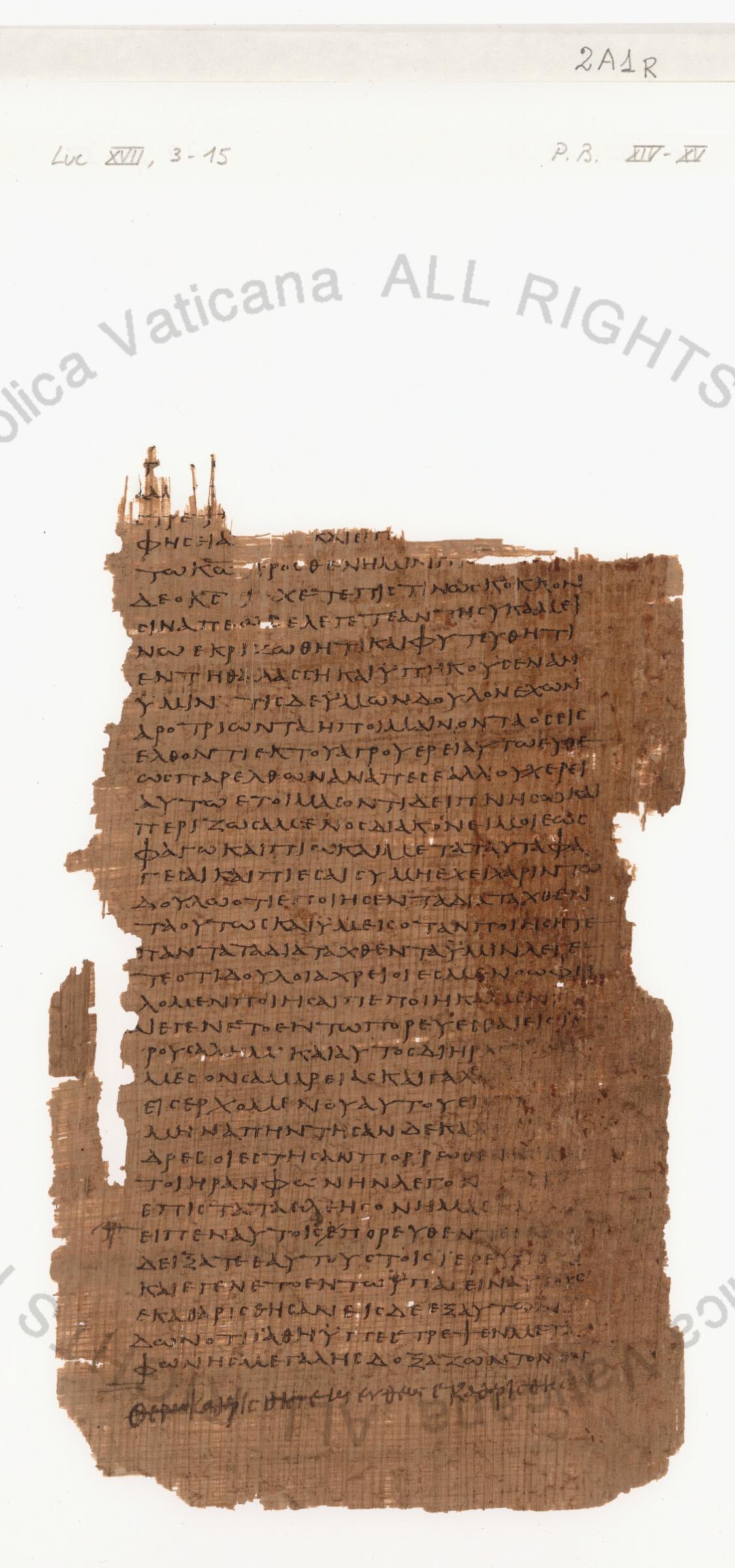
This entry covers fols. 33r-34r (Luke 17:3-18:5), shown on the Vatican Library's photographs (frames 2A.1r to 2A.2r).
How was this verified? (Provenance)
Where on the image
Vatican Library, Pap. Hanna 1 (Mater Verbi), DigiVatLib image 49, frame 2A.1r (https://digi.vatlib.it/view/MSS_Pap.Hanna.1(Mater.Verbi)/0049), cropped to the frame. NTVMR page 480 (folio 33r). 17:3 begins on the previous page. Checked on the image: in the lower part φωνην λεγοντες ... επιστατα ελεησον ημας ... ειπεν αυτοις πορευθεντες (17:13-14), matching the transcription of this page.
17:3 [α]υ̣[τω και εαν μετανοηση αφες αυ]
τ̣[ω] 4 [και εαν επτακις της ημερας]
αμ[αρ]τ̣[ηση εις σε και επτακις επι]
στρεψη̣ [προς σε λεγων μετανοω α]
φησει αυ̣[τω] 5 και ειπ[αν οι αποστολοι]
τω κ̅ω̅ π̣ροσθεν ημιν πι̣σ̣[τιν] 6 [ειπεν]
δε ο κ̅ς̅ ε̣ι ε̣χετε πιστιν ως κοκκον
σιναπεως ελεγετε αν τη συκαμει
νω εκριζωθητι και φυτευθητι
εν τη θαλασση και υπηκουσεν αν
υμιν· 7 τις δε υμων δουλον εχων
αροτριωντα η ποιμαινοντα ος εισ
ελθοντι εκ του αγρου ερει αυτω ευθε
ως παρελθων αναπεσε 8 αλλ ουχ ερει
αυτω ετοιμασον τι δειπνησω και
περιζωσαμενος διακονει μοι εως
φαγω και πιω και μετα ταυτα φα
γεσαι και πιεσαι συ 9 μη εχει χαριν τω
δουλω οτι εποιησεν τα διαταχθεν
τα 10 ουτως και υμεις οταν ποιησητε
παντα τα διαταχθεντα υμιν λεγε
τε οτι δουλοι αχρειοι εσμεν ο ωφει
λομεν ποιησαι πεποιηκαμεν·
11 [κ]αι εγενετο εν τω πορευεσθαι εις ιε
ρουσαλημ· και αυτος διηρχετ̣ο̣ δ̣ια
μεσον σαμαρειας και γαλι̣λ̣[αιας] 12 [και]
εισερχομενου αυτου εις τ̣ι̣[να κω]
μην απηντησαν δεκα λε̣π̣ρ̣[οι αν]
δρες οι εστησαν πορρωθεν 13 κ̣α̣ι̣ [αυ]
τοι ηραν φωνην λεγοντ̣ε̣ς̣ ι̣̣̅υ̣̣̅
επιστατα ελεησον ημας 14 και [ιδων]
ειπεν αυτοις επορευθεντες̣ ε̣π̣ι̣
δειξατε εαυτους τοις ιερευσ̣ιν̣
και εγενετο εν τω υπαγειν αυτους
εκαθαρισθησαν 15 εις δε εξ αυτων ι
δων οτι ιαθη υπεστρεψεν μετα
φωνης μεγαλης δοξαζων τον θ̅ν̅
17:3¶ Take heed to yourselves: If thy brother trespass against thee, rebuke him; and if he repent, forgive him. 4And if he trespass against thee seven times in a day, and seven times in a day turn again to thee, saying, I repent; thou shalt forgive him. 5And the apostles said unto the Lord, Increase our faith. 6And the Lord said, If ye had faith as a grain of mustard seed, ye might say unto this sycamine tree, Be thou plucked up by the root, and be thou planted in the sea; and it should obey you. 7But which of you, having a servant plowing or feeding cattle, will say unto him by and by, when he is come from the field, Go and sit down to meat? 8And will not rather say unto him, Make ready wherewith I may sup, and gird thyself, and serve me, till I have eaten and drunken; and afterward thou shalt eat and drink? 9Doth he thank that servant because he did the things that were commanded him? I trow not. 10So likewise ye, when ye shall have done all those things which are commanded you, say, We are unprofitable servants: we have done that which was our duty to do. 11¶ And it came to pass, as he went to Jerusalem, that he passed through the midst of Samaria and Galilee. 12And as he entered into a certain village, there met him ten men that were lepers, which stood afar off: 13And they lifted up their voices, and said, Jesus, Master, have mercy on us. 14And when he saw them, he said unto them, Go shew yourselves unto the priests. And it came to pass, that, as they went, they were cleansed. 15And one of them, when he saw that he was healed, turned back, and with a loud voice glorified God,
Where on the image
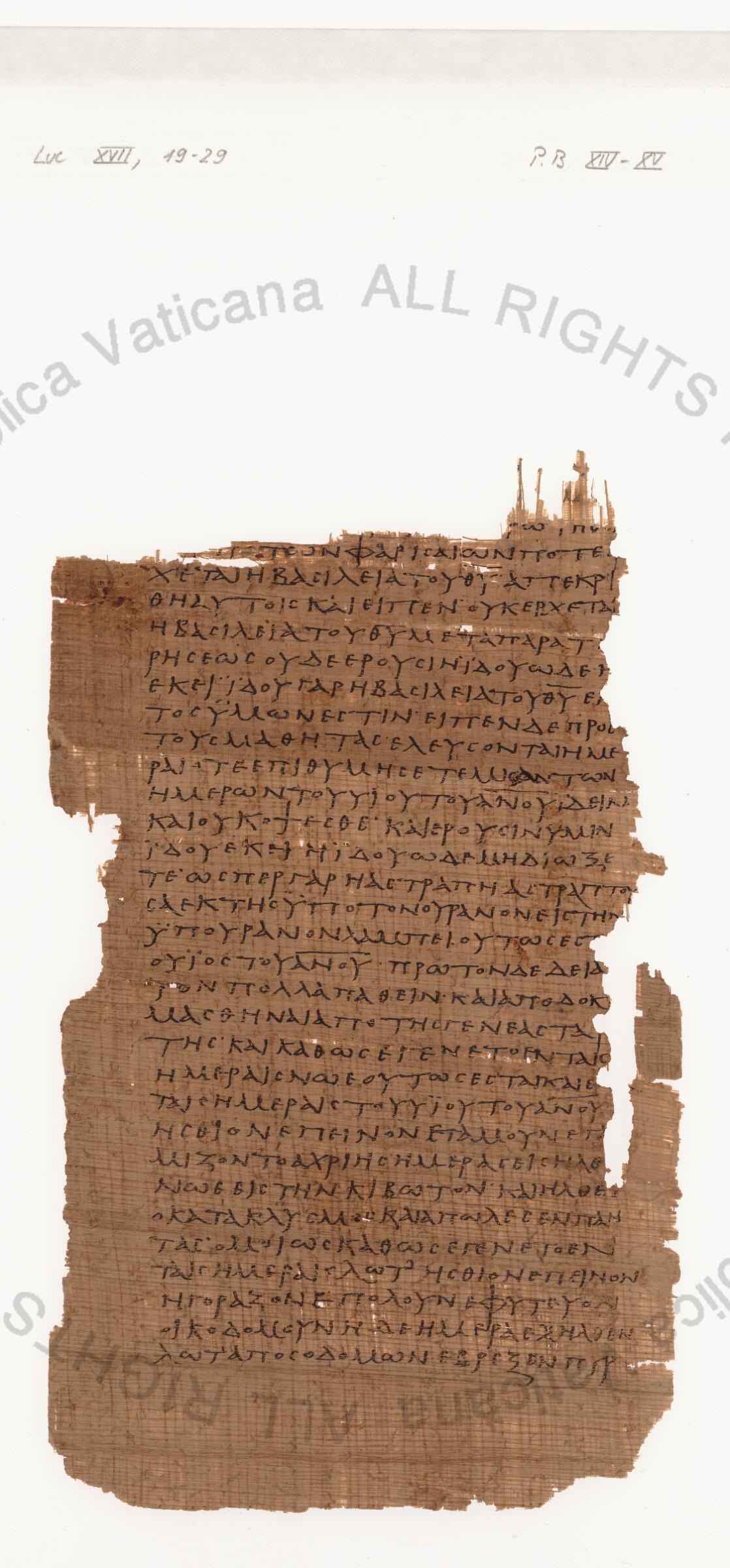
Vatican Library, Pap. Hanna 1 (Mater Verbi), DigiVatLib image 50, frame 2A.1v (https://digi.vatlib.it/view/MSS_Pap.Hanna.1(Mater.Verbi)/0050), cropped to the frame. NTVMR page 490 (folio 33v). 17:29 continues on the next page. Checked on the image: near the top υπο των φαρισαιων ποτε ερχεται η βασιλεια του θ̅υ̅ (17:20), near the foot ησθιον επινον εγαμουν εγαμιζοντο (17:27), matching the transcription of this page.
17:20 [επε]ρ̣ωτ̣η̣θ̣ε̣ι̣[ς]
[δε] υ̣π̣ο των φαρισαιων ποτε ε̣ρ̣
χεται η βασιλεια του θ̅υ̅ απεκρι
θη αυτοις και ειπεν· ουκ ερχεται
η βασιλεια του θ̅υ̅ μετα παρατη̣
ρησεως 21 ουδε ερουσιν ιδου ωδε η̣
εκει· ιδου γαρ η βασιλεια του θ̅υ̅ εν̣
τος υμων εστιν· 22 ε[ι]πεν δε προς̣
τους μαθητας· ελευσονται ημε
ραι οτε επιθυμησετε μιων των
ημερων του υιου του α̅ν̅ο̅υ̅ ιδειν.
και ουκ οψεσθε· 23 και ερουσιν υμιν
ιδου εκει η ιδου ωδε μη διωξε
τε· 24 ωσπερ γαρ η αστραπη αστραπτου
σα εκ της υπο τον ουρανον εις την
υπ ουρανον λαμπει. ουτως εστ̣[αι]
ο υιος του α̅ν̅ο̅υ̅· 25 πρωτον δε δει α[υ]
τον πολλα παθειν· και αποδοκι̣
μασθηναι απο της γενεας ταυ̣
της· 26 και καθως εγενετο εν ταις
ημεραις νωε ουτως εσται και ε[ν]
ταις ημεραις του υιου του α̅ν̅ο̅υ̅·
27 ησθιον επεινον γ εγα̣
μιζοντο αχρι ης ημερας εισηλθ[εν]
νωε εις την κιβωτον· και ηλθεν̣
ο κατακλυσμος και απωλεσεν παν
τας· 28 ομοιως καθως εγενετο εν
ταις ημεραις λωτ ησθιον επεινον
ηγοραζον η̣πολουν εφυτευον
οικοδομουν 29 η δε ημερα εξηλθεν
λωτ απο σοδομων εβρεξεν πυρ
17:20¶ And when he was demanded of the Pharisees, when the kingdom of God should come, he answered them and said, The kingdom of God cometh not with observation: 21Neither shall they say, Lo here! or, lo there! for, behold, the kingdom of God is within you. 22And he said unto the disciples, The days will come, when ye shall desire to see one of the days of the Son of man, and ye shall not see it. 23And they shall say to you, See here; or, see there: go not after them, nor follow them. 24For as the lightning, that lighteneth out of the one part under heaven, shineth unto the other part under heaven; so shall also the Son of man be in his day. 25But first must he suffer many things, and be rejected of this generation. 26And as it was in the days of Noe, so shall it be also in the days of the Son of man. 27They did eat, they drank, they married wives, they were given in marriage, until the day that Noe entered into the ark, and the flood came, and destroyed them all. 28Likewise also as it was in the days of Lot; they did eat, they drank, they bought, they sold, they planted, they builded; 29But the same day that Lot went out of Sodom it rained fire and brimstone from heaven, and destroyed them all.
Where on the image
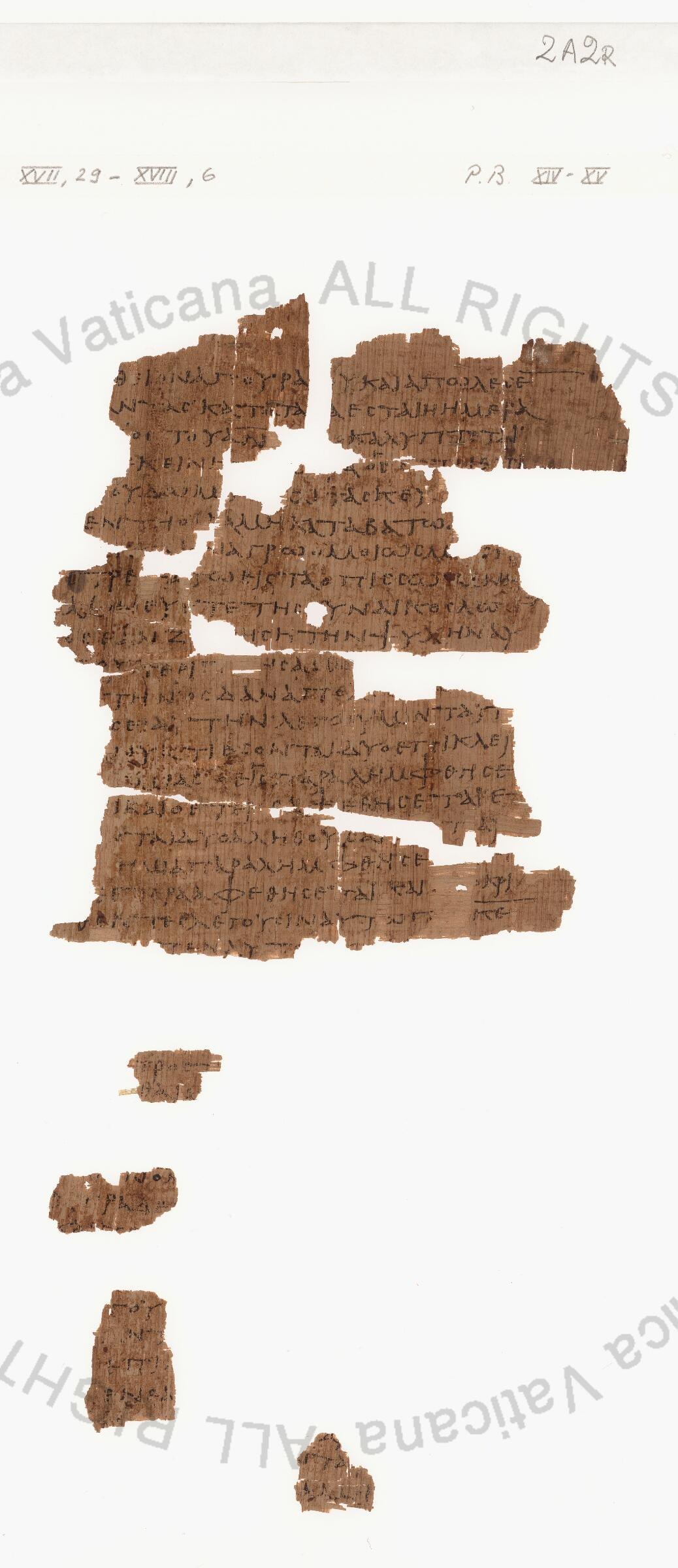
Vatican Library, Pap. Hanna 1 (Mater Verbi), DigiVatLib image 51, frame 2A.2r (https://digi.vatlib.it/view/MSS_Pap.Hanna.1(Mater.Verbi)/0051), cropped to the frame. NTVMR page 500 (folio 34r). 17:29 begins on the previous page; 18:5 continues on the next page. Not written in this papyrus: Luke 17:36. The NTVMR transcription marks this verse as empty at this point of the text, so the English leaves it out. Checked on the image: first line θειον απ ουρανου και απωλεσεν (17:29), lower down εν αγρω ομοιως (17:31), matching the transcription of this page.
17:29 [και] θε̣ιον απ ουρα[ν]ο̣υ και απωλεσεν
[π]α̣ντας· 30 κατα τα[υτ]α εσται η ημερα
[ο υ]ι̣ος του α̅ν̅[ο̅υ̅ απ]ο̣καλυπτεται·
31 [εν] ε̣κεινη [τη η]μ̣[ε]ρ̣α̣ ος εσ̣τ̣α̣ι ε̣π̣ι̣
[τ]ου δωμ[ατος] κ̣α̣ι τα σκευ[η αυτου]
εν τη οικ̣[ι]α μη καταβατω α̣[ραι αυ]
[τα] κ̣α̣ι̣ ο̣ [ε]ν αγρω ομοιως μ[η] ε̣π̣[ι]
στρε[ψ]α̣τω εις τα οπισσω 32 μ̣νη̣
μο̣νευε̣τε της [γ]υναικος λωτ̣
33 ος εαν ζ[ητ]ηση την ψυχην αυ
τ̣ο̣υ π̣εριπ̣[οι]η̣σασ̣θα̣[ι απολεσει]
[α]υ̣την· ος δ αν απολ̣ε̣σ̣[η ζωογο]
[νη]σει αυ̣την· 34 λεγω υμι̣ν ταυτ̣[η]
[τη] νυκτι εσονται δυο επι κλει
[νη]ς̣ μιας· ο εις παραλημφθησε
[τα]ι και ο ετερο̣ς̣ αφ̣εθησεται· 35 ε
[σο]ν̣ται δυο αληθουσαι̣ [επι] τ[ο] αυ̣
[το] η μια παραλημφθησε[ται] η̣
[δ]ε ετερα αφεθησεται· 37 και [απ]ο̣κρι
θ̣εντες λεγουσιν αυτω π[ου] κ̅ε̅
[ο δε ει]π̣ε̣ν α̣υτο̣[ις ο]π̣[ου το σωμα]
[...]
18:1 [... αυ]
[τοις] π̣ρος τ̣[ο δειν παντοτε προσ]
[ευχεσ]θαι α̣[υτους και μη εγκα]
[κειν] 2 [...]
[...]
[κα]ι̣ [α̅]ν̅ο̅ν̣̣̅ [μη εντρεπομενος]
3 χ̣η̣ρα δε [ην εν τη πολει εκεινη]
κ̣α̣ι̣ π̣ρ̣[οσηρχετο προς αυτον λε]
γου[σα εκδικησον με απο του]
α̣ντ̣[ιδικου μου] 4 [και ουκ ηθελεν]
επι χ̣[ρονον μετα δε ταυτα ειπεν]
εν εα[υτω ει και τον θ̅ν̅ ου φοβου]
μ̣[αι ουδε ανθρωπον εντρεπομαι]
5 [δια γε το π]α̣ρ̣[εχειν μοι κοπον]
[την χηρα]ν̣ ταυ̣[την εκδικησω]
[αυτην ιν]α̣ μη̣ [εις τελος ερχο]
[μενη]
17:29But the same day that Lot went out of Sodom it rained fire and brimstone from heaven, and destroyed them all. 30Even thus shall it be in the day when the Son of man is revealed. 31In that day, he which shall be upon the housetop, and his stuff in the house, let him not come down to take it away: and he that is in the field, let him likewise not return back. 32Remember Lot’s wife. 33Whosoever shall seek to save his life shall lose it; and whosoever shall lose his life shall preserve it. 34I tell you, in that night there shall be two men in one bed; the one shall be taken, and the other shall be left. 35Two women shall be grinding together; the one shall be taken, and the other left. 37And they answered and said unto him, Where, Lord? And he said unto them, Wheresoever the body is, thither will the eagles be gathered together. 18:1And he spake a parable unto them to this end, that men ought always to pray, and not to faint; 2Saying, There was in a city a judge, which feared not God, neither regarded man: 3And there was a widow in that city; and she came unto him, saying, Avenge me of mine adversary. 4And he would not for a while: but afterward he said within himself, Though I fear not God, nor regard man; 5Yet because this widow troubleth me, I will avenge her, lest by her continual coming she weary me.
Notes
- Greek: the NTVMR diplomatic transcription, line by line as on the papyrus. Square brackets enclose letters that are lost or illegible and were supplied by the transcribers; a dot under a letter marks it as uncertain; [...] marks a gap. Nomina sacra and numerals keep the scribe's overline. Spelling is the scribe's (no accents or breathings). Words broken at a line end stay broken as on the papyrus. Corrections are not shown: the text is the first hand.
- English: the King James Version (1611), whole verses, for every verse that has text on the page. A verse that begins on one page and ends on the next is given in full on both. The KJV translates a later form of the Greek text, so its wording does not always match the papyrus; material differences (such as verses the papyrus does not have) are noted in the section.
Cite
Sources
- Source: Papyrus Hanna 1 (Mater Verbi), Vatican Library: photographs from DigiVatLib; Greek from the INTF NTVMR transcription of P75; English from the King James Version (holding institution)
- Critical edition: INTF NTVMR diplomatic transcription (CC BY 4.0)
← previous · → next · v cycle view · l back to library