P75 (Papyrus Hanna 1): Luke 23:2-24:15 (fols. 41r-42v)
Introduction
P75 is a papyrus codex of Luke and John copied in Egypt around 175-225, the oldest known copy of Luke and one of the oldest of John. It was bought by Martin Bodmer in the 1950s and published as Papyrus Bodmer XIV-XV; in 2006 it was given to the Vatican Library, where it is kept as Papyrus Hanna 1 (Mater Verbi). Its text is very close to that of Codex Vaticanus, written some 150 years later. Where Luke ends and John begins (folio 44r) both titles stand on the same page.
About 51 leaves survive, many damaged at the top and edges, especially in Luke 3-7. Lost: Luke 1:1-3:17, most of 3:23-4:33, 5:11-36, 6:5-10, 7:33-34 and 7:44-45 (and parts of 7:36-49), 17:16-19, 18:19-22:3; John 11:46-47, 12:1-2, 13:11-14:7 and everything after 15:10 except small fragments. Each section below is one page: the photograph, the NTVMR diplomatic transcription line by line, and the King James Version of every verse on the page. Where P75 lacks a verse or words that the KJV has (for example John 5:4 or the account of the adulteress, John 7:53-8:11), the section says so. Six damaged pages (folios 7v, 11r, 39v, 58r, 58v and 64v) are left out because their text could not be matched to the photographs with certainty.
This entry covers fols. 41r-42v (Luke 23:2-24:15), shown on the Vatican Library's photographs (frames 2A.5r to 2A.6v).
How was this verified? (Provenance)
Where on the image
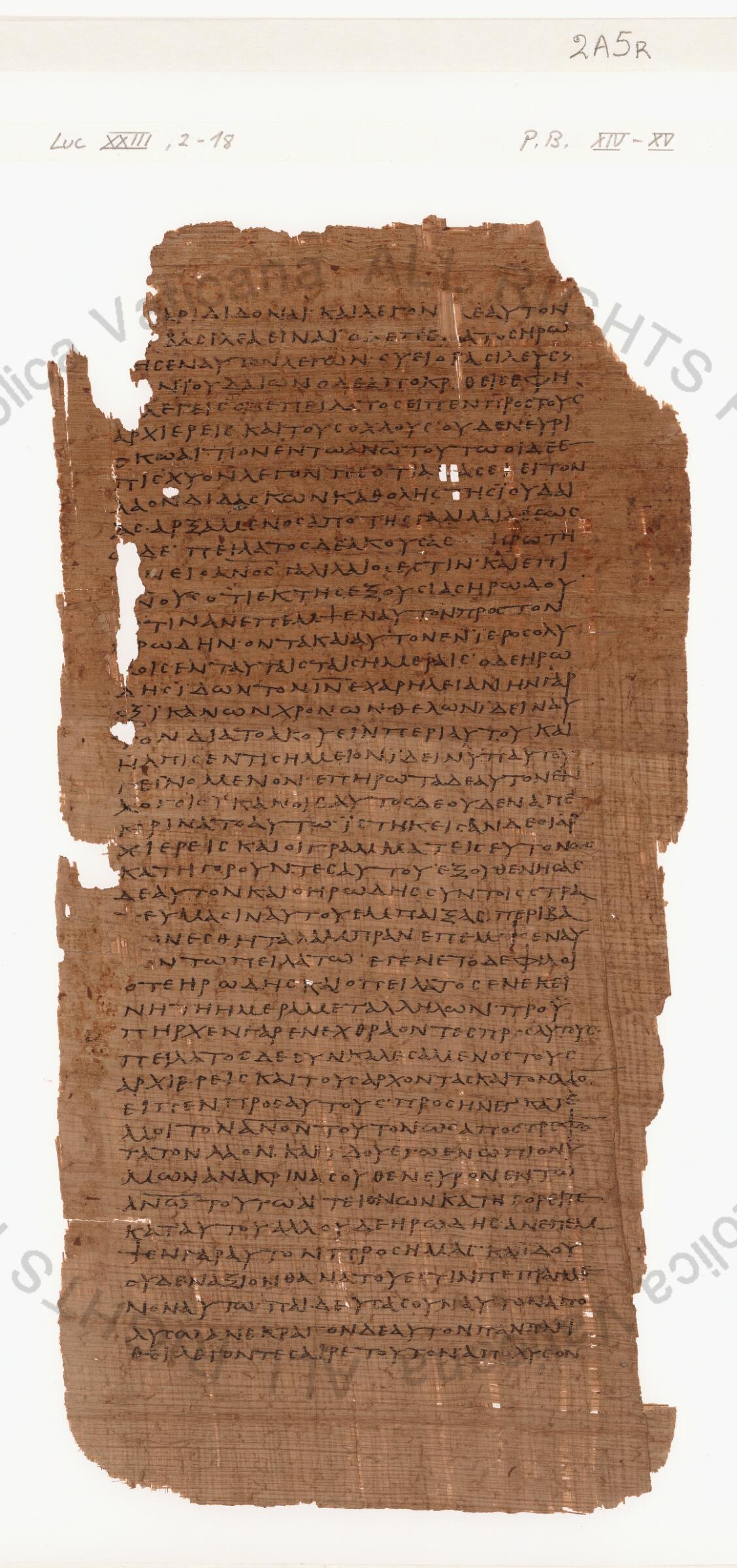
Vatican Library, Pap. Hanna 1 (Mater Verbi), DigiVatLib image 57, frame 2A.5r (https://digi.vatlib.it/view/MSS_Pap.Hanna.1(Mater.Verbi)/0057), cropped to the frame. NTVMR page 560 (folio 41r). 23:2 begins on the previous page; 23:18 continues on the next page. Not written in this papyrus: Luke 23:17. The NTVMR transcription marks this verse as empty at this point of the text, so the English leaves it out. Checked on the image: first line [και]σαρι διδοναι και λεγοντα εαυτον (23:2), last line θει λεγοντες αιρε τουτον απολυσον (23:18); just above, απολυσω ανεκραγον shows 23:16 running straight into 23:18, matching the transcription of this page.
23:2 [καισ]αρι διδοναι· και λεγον[τ]α̣ εαυτον
[χ̅ν̅] βασιλεα ειναι· 3 ο δ̣ε πει̣λ̣ατος ηρω
[τ]ησεν αυτον λεγων· συ ει ο β̣ασιλευς
[τω]ν ιουδαιων ο δε αποκρι̣θεις εφη
[συ] λεγεις 4 ο δ̣ε πειλατος ειπεν προς τους
αρχιερεις και τους οχλους· ουδεν ευρι
σκω αιτιον εν τω α̅ν̅ω̅ τουτω 5 οι δε ε
πισχυον λεγοντες οτι αν̣ασειει τον
λαον διδασκων καθ ολης τ̣ης ιουδαι
ας. αρξαμενος απο της γαλιλαιας εως
ω̣δε· 6 πειλατος δε ακουσας ε̣[π]ηρωτη
σ̣[ε]ν ει ο α̅ν̅ο̅ς̅ γαλιλαιος εστιν· 7 και επι
[γ]νους οτι εκ της εξουσιας ηρωδου·
[ε]σ̣τιν ανεπεμψεν αυτον προς τον
η̣ρωδην· οντα και αυτον εν ιεροσολυ
μ̣οις εν ταυταις ταις ημεραις· 8 ο δε ηρω
δης ιδων τον ι̅ν̅ εχαρη λειαν ην γαρ
εξ ικανων χρονων θελων ιδειν αυ
τ̣ον δια το ακουειν περι αυτου και
ηλπισεν τι σημειον ιδειν υπ αυτου
γεινομενον· 9 επηρωτα δε αυτον εν
λογοις ικανοις αυτος δε ουδεν απε
κρινατο αυτω· 10 ιστηκεισαν δε οι αρ
χιερεις και οι γραμματεις ευτονως
κατηγορουντες αυτου· 11 εξουθενησας
δε αυτον και ο ηρωδης συν τοις στρα
τ̣ευμασιν αυτου εμπαιξας. περιβα
[λ]ω̣ν εσθητα λαμπραν επεμψεν αυ
[τ]ο̣ν τω πειλατω· 12 εγενετο δε φιλοι
ο τε ηρωδης και ο πειλατος εν εκει
νη τη ημερα μετ αλληλων· πρου
πηρχεν γαρ εν εχθρα οντες προς αυτους·
13 πειλατος δε συνκαλεσαμενος τους
αρχιερεις και τους αρχοντας και τον λαον
14 ειπεν προς αυτους· προσηνεγκατε
μοι τον α̅ν̅ο̅ν̅ τουτον ως αποστρεφον
τα τον λαον. και ιδου εγω ενωπιον υ
μων ανακρινας ουθεν ευρον εν τω
α̅ν̅ω̅ τουτω αιτειον ων κατηγορειτε
κατ αυτου· 15 αλλ ουδε ηρωδης· ανεπεμ
ψεν γαρ αυτον προς ημας· και ιδου
ουδεν αξιον θανατου εστιν πεπραγμε
νον αυτω· 16 παιδευσας ουν αυτον απο
λυσω 18 ανεκραγον δε αυτον πανπλη
θει λεγοντες αιρε τουτον· απολυσον
23:2And they began to accuse him, saying, We found this fellow perverting the nation, and forbidding to give tribute to Cæsar, saying that he himself is Christ a King. 3And Pilate asked him, saying, Art thou the King of the Jews? And he answered him and said, Thou sayest it. 4Then said Pilate to the chief priests and to the people, I find no fault in this man. 5And they were the more fierce, saying, He stirreth up the people, teaching throughout all Jewry, beginning from Galilee to this place. 6When Pilate heard of Galilee, he asked whether the man were a Galilæan. 7And as soon as he knew that he belonged unto Herod’s jurisdiction, he sent him to Herod, who himself also was at Jerusalem at that time. 8¶ And when Herod saw Jesus, he was exceeding glad: for he was desirous to see him of a long season, because he had heard many things of him; and he hoped to have seen some miracle done by him. 9Then he questioned with him in many words; but he answered him nothing. 10And the chief priests and scribes stood and vehemently accused him. 11And Herod with his men of war set him at nought, and mocked him, and arrayed him in a gorgeous robe, and sent him again to Pilate. 12¶ And the same day Pilate and Herod were made friends together: for before they were at enmity between themselves. 13¶ And Pilate, when he had called together the chief priests and the rulers and the people, 14Said unto them, Ye have brought this man unto me, as one that perverteth the people: and, behold, I, having examined him before you, have found no fault in this man touching those things whereof ye accuse him: 15No, nor yet Herod: for I sent you to him; and, lo, nothing worthy of death is done unto him. 16I will therefore chastise him, and release him. 18And they cried out all at once, saying, Away with this man, and release unto us Barabbas:
Where on the image
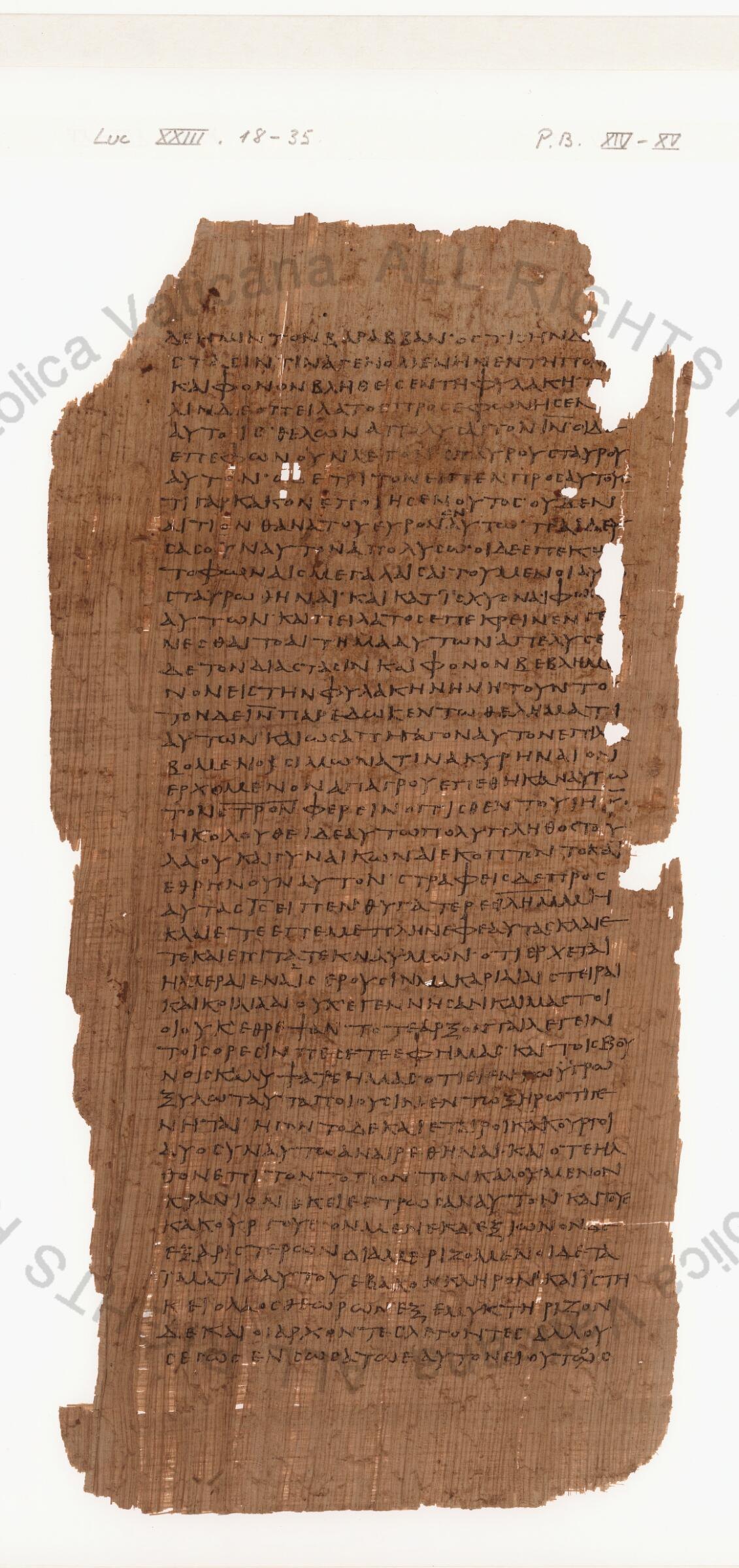
Vatican Library, Pap. Hanna 1 (Mater Verbi), DigiVatLib image 58, frame 2A.5v (https://digi.vatlib.it/view/MSS_Pap.Hanna.1(Mater.Verbi)/0058), cropped to the frame. NTVMR page 570 (folio 41v). 23:18 begins on the previous page; 23:35 continues on the next page. Checked on the image: in the middle σταυρωθηναι και κατισχυον αι φωναι αυτων ... απελυσε δε τον δια στασιν και φονον βεβλημενον (23:23-25), matching the transcription of this page. Luke 23:34: P75 does not have the words the KJV renders "Then said Jesus, Father, forgive them; for they know not what they do"; the verse begins διαμεριζομενοι δε τα ιματια αυτου.
23:18 δε ημιν τον βαραββαν· 19 οστις ην δι̣[α]
στασιν τινα γενομενην εν τη πολ̣ε̣[ι]
και φονον βληθεις εν τη φυλακη· 20 π̣[α]
λιν δε ο πειλατος προσεφωνησεν̣
αυτοις· θελων απολυσαι τον ι̅ν̅· 21 οι δε̣
επεφωνουν λεγον· σταυρου σταυρου
αυτον· 22 ο δ̣ε τριτον ειπεν προς αυτους
τι γαρ κακον εποιησεν ουτος· ουδεν
αιτιον θανατου ευρον αυτω· παιδευ
σας ουν αυτον απολυσω· 23 οι δε επεκει[ν]
το φωναις μεγαλαις αιτουμενοι αυ[τ]ο̣ν
σταυρωθηναι· και κατισχυον αι φων̣[α]ι̣
αυτων· 24 και πειλατος επεκρεινεν γε
νεσθαι το αιτημα αυτων· 25 απελυσεν̣
δε τον δια στασιν και φονον βεβλημε̣
νον εις την φυλακην ην ητουντο·
τον δε ι̅ν̅ παρεδωκεν τω θεληματι
αυτων· 26 και ως απηαγον αυτον επιλα̣
βομενος̣ σιμωνα τινα κυρηναιον
ερχομενον απ αγρου επεθηκαν αυτω
τον σ̅τ̅ρ̅ο̅ν̅ φερειν οπισθεν του ι̅η̅υ̣̣̅·
27 ηκολουθει δε αυτω πολυ πληθος του
λαου και γυναικων αι εκοπτοντο και
εθρηνουν αυτον· 28 στραφεις δε προς
αυτας ι̅ς̅ ειπεν· θυγατερε ι̅λ̅η̅μ̅ μη
κλαιετε επ εμε πλην εφ εαυτας κλαιε
τε και επι τα τεκνα υμων· 29 οτι ερχεται
ημεραι εν αις ερουσιν μακαριαι αι στειραι
και κοιλια αι ουκ εγεννησαν και μαστοι
οι ουκ εθρεψαν 30 τοτε αρξονται λεγειν
τοις ορεσιν πεσετε εφ ημας· και τοις βου
νοις καλυψατε ημας· 31 οτι ει εν τω υγρω
ξυλω ταυτα ποιουσιν. εν τω ξηρω τι γε
νηται· 32 ηγοντο δε και εταιροι κακουργοι
δυο συν αυτω αναιρεθηναι· 33 και οτε ηλ
θον επι τον τοπον τον καλουμενον
κρανιον εκει εστρωσαν αυτον· και τους
κακουργους· ον μεν εκ δεξιων ον δε
εξ αριστερων 34 διαμεριζομενοι δε τα
ιματια αυτου εβαλον κληρον· 35 και ιστη
κει ο λαος θεωρων· εξεμυκτηριζον
δε και οι αρχοντες λεγοντες αλλου
ς εσωσεν σωσατω εαυτον ει ουτως
23:18And they cried out all at once, saying, Away with this man, and release unto us Barabbas: 19(Who for a certain sedition made in the city, and for murder, was cast into prison.) 20Pilate therefore, willing to release Jesus, spake again to them. 21But they cried, saying, Crucify him, crucify him. 22And he said unto them the third time, Why, what evil hath he done? I have found no cause of death in him: I will therefore chastise him, and let him go. 23And they were instant with loud voices, requiring that he might be crucified. And the voices of them and of the chief priests prevailed. 24And Pilate gave sentence that it should be as they required. 25And he released unto them him that for sedition and murder was cast into prison, whom they had desired; but he delivered Jesus to their will. 26And as they led him away, they laid hold upon one Simon, a Cyrenian, coming out of the country, and on him they laid the cross, that he might bear it after Jesus. 27¶ And there followed him a great company of people, and of women, which also bewailed and lamented him. 28But Jesus turning unto them said, Daughters of Jerusalem, weep not for me, but weep for yourselves, and for your children. 29For, behold, the days are coming, in the which they shall say, Blessed are the barren, and the wombs that never bare, and the paps which never gave suck. 30Then shall they begin to say to the mountains, Fall on us; and to the hills, Cover us. 31For if they do these things in a green tree, what shall be done in the dry? 32And there were also two other, malefactors, led with him to be put to death. 33And when they were come to the place, which is called Calvary, there they crucified him, and the malefactors, one on the right hand, and the other on the left. 34¶ Then said Jesus, Father, forgive them; for they know not what they do. And they parted his raiment, and cast lots. 35And the people stood beholding. And the rulers also with them derided him, saying, He saved others; let him save himself, if he be Christ, the chosen of God.
Where on the image
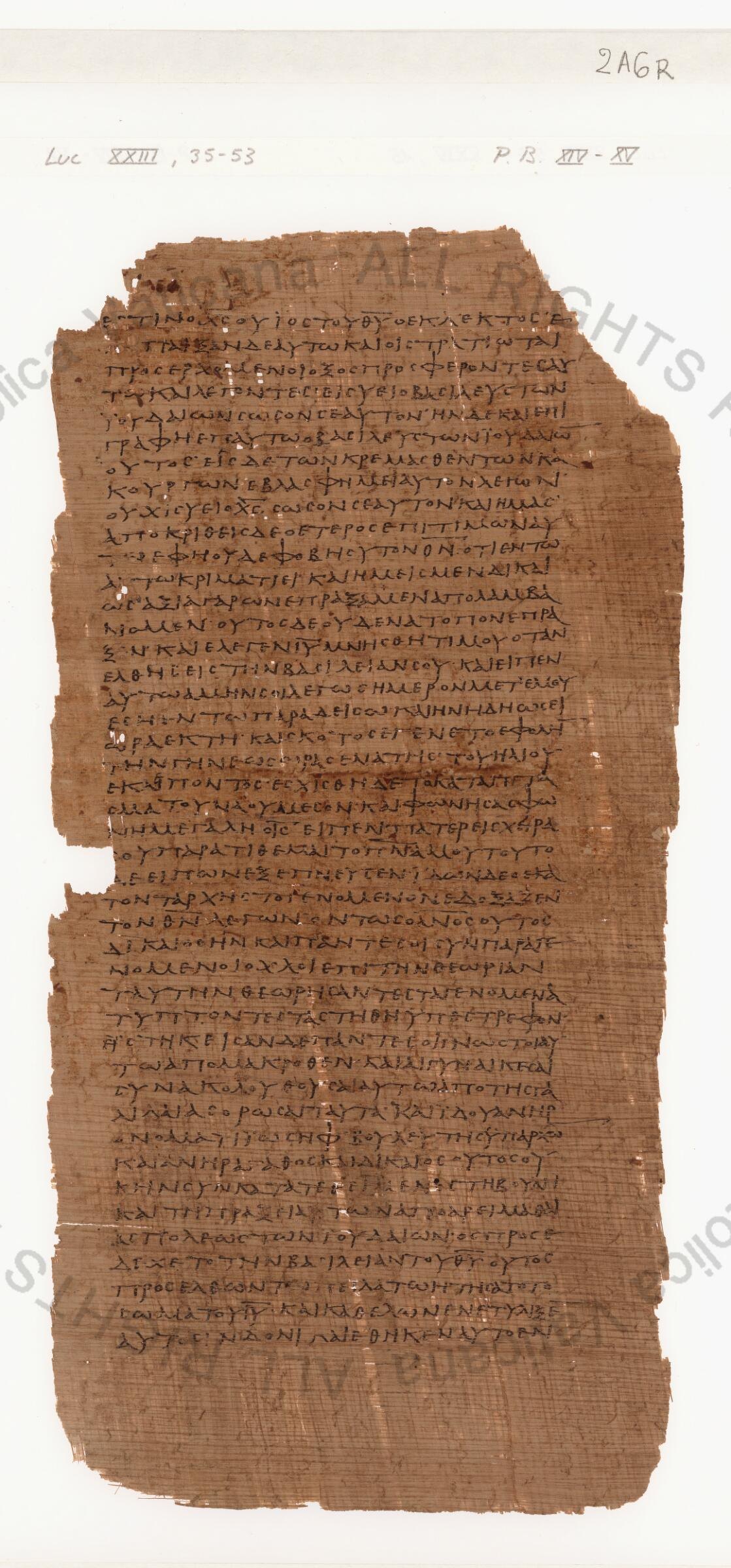
Vatican Library, Pap. Hanna 1 (Mater Verbi), DigiVatLib image 59, frame 2A.6r (https://digi.vatlib.it/view/MSS_Pap.Hanna.1(Mater.Verbi)/0059), cropped to the frame. NTVMR page 580 (folio 42r). 23:35 begins on the previous page; 23:53 continues on the next page. Checked on the image: first line εστιν ο χ̅ς̅ ... ο εκλεκτος (23:35), last line αυτο σινδονι και εθηκεν αυτο εν (23:53), matching the transcription of this page.
23:35 εσ̣τιν ο χ̅ς̅ ο υιος του θ̅υ̅ ο εκλεκτος· 36 ε
ν̣ε̣παιξαν δε αυτω και οι στρατιωται
προσερχομενοι οξος προσφεροντες αυ
τω 37 και λεγοντες· ει συ ει ο βασιλευς των
ιουδαιων σωσον σεαυτον· 38 ην δε και επι
γραφη επ αυτω ο βασιλευς των ιουδαιων
ουτος· 39 εις δε των κρεμασθεντων κα
κουργων εβλασφημει αυτον λεγων·
ουχι συ ει ο χ̅ς̅. σωσον σεαυτον και ημας·
40 αποκριθεις δε ο ετερος επιτιμων αυ
τω εφη ουδε φοβη συ τον θ̅ν̅. οτι εν τω
αυ̣τω κριματι ει· 41 και ημεις μεν δικαι
ως· αξια γαρ ων επραξαμεν απολαμβα
νομεν· ουτος δε ουδεν ατοπον επρα
ξε̣ν· 42 και ελεγεν ι̅υ̅ μνησθητι μου οταν
ελθης εις την βασιλειαν σου· 43 και ειπεν
αυτω αμην σοι λεγω σημερον μετ εμου
εση εν τω παραδεισω· 44 και ην ηδη ωσει
ωρα εκτη· και σκοτος εγενετο εφ ολην
την γην εως ωρας ενατης· 45 του ηλιου
εκλιποντος· εσχισθη δε το καταπετα
σμα του ναου μεσον· 46 και φωνησας φω
νη μεγαλη ο ι̅ς̅ ειπεν· πατερ εις χειρα
σ̣ου παρατιθεμαι το π̅ν̅α̅ μου τουτο
δ̣ε ειπων εξεπνευσεν· 47 ιδων δε ο εκα
τονταρχης το γενομενον εδοξαζεν
τον θ̅ν̅ λεγων· οντως ο α̅ν̅ο̅ς̅ ουτος
δικαιος ην 48 και παντες οι συνπαραγε
νομενοι οχλοι επι την θεωριαν
ταυτην θεωρησαντες τα γενομενα
τυπτοντες τα στηθη υπεστρεφον·
49 ιστηκεισαν δε παντες οι γνωστοι αυ
τω απο μακροθεν· και αι γυναικες αι
συνακολουθουσαι αυτω απο της γα
λιλαιας ορωσαι ταυτα· 50 και ιδου ανηρ
ονοματι ιωσηφ βουλευτης υπαρχων
και ανηρ αγαθος και δικαιος 51 ουτος ου
κ ην συνκατατεθειμενος τη βουλη
και τη πραξει αυτων απο αρειμαθαι
ας πολεως των ιουδαιων· ος προσε
δεχετο την βασ̣ιλειαν του θ̅υ̅ 52 ουτος
προσελθων τω πειλατω ητησατο το
σωμα του ι̅υ̅· 53 και καθελων ενετυλιξεν
αυτο σινδονι κ̣αι εθηκεν αυτο εν
23:35And the people stood beholding. And the rulers also with them derided him, saying, He saved others; let him save himself, if he be Christ, the chosen of God. 36And the soldiers also mocked him, coming to him, and offering him vinegar, 37And saying, If thou be the king of the Jews, save thyself. 38And a superscription also was written over him in letters of Greek, and Latin, and Hebrew, THIS IS THE KING OF THE JEWS. 39¶ And one of the malefactors which were hanged railed on him, saying, If thou be Christ, save thyself and us. 40But the other answering rebuked him, saying, Dost not thou fear God, seeing thou art in the same condemnation? 41And we indeed justly; for we receive the due reward of our deeds: but this man hath done nothing amiss. 42And he said unto Jesus, Lord, remember me when thou comest into thy kingdom. 43And Jesus said unto him, Verily I say unto thee, To day shalt thou be with me in paradise. 44And it was about the sixth hour, and there was a darkness over all the earth until the ninth hour. 45And the sun was darkened, and the veil of the temple was rent in the midst. 46¶ And when Jesus had cried with a loud voice, he said, Father, into thy hands I commend my spirit: and having said thus, he gave up the ghost. 47Now when the centurion saw what was done, he glorified God, saying, Certainly this was a righteous man. 48And all the people that came together to that sight, beholding the things which were done, smote their breasts, and returned. 49And all his acquaintance, and the women that followed him from Galilee, stood afar off, beholding these things. 50¶ And, behold, there was a man named Joseph, a counsellor; and he was a good man, and a just: 51(The same had not consented to the counsel and deed of them;) he was of Arimathæa, a city of the Jews: who also himself waited for the kingdom of God. 52This man went unto Pilate, and begged the body of Jesus. 53And he took it down, and wrapped it in linen, and laid it in a sepulchre that was hewn in stone, wherein never man before was laid.
Where on the image
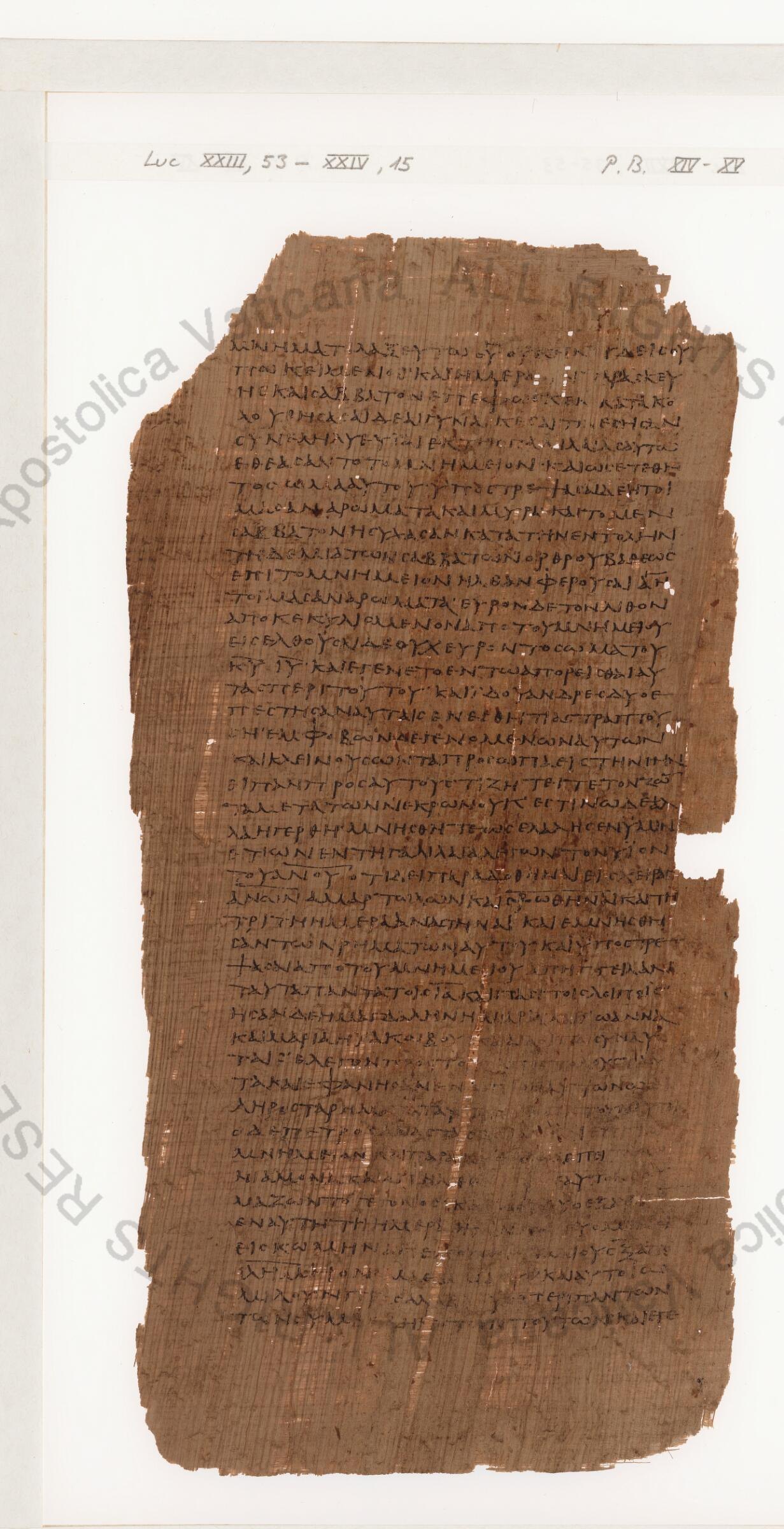
Vatican Library, Pap. Hanna 1 (Mater Verbi), DigiVatLib image 60, frame 2A.6v (https://digi.vatlib.it/view/MSS_Pap.Hanna.1(Mater.Verbi)/0060), cropped to the frame. NTVMR page 590 (folio 42v). 23:53 begins on the previous page; 24:15 continues on the next page. Checked on the image: near the top τη δε μια των σαββατων ορθρου βαθεως (24:1), near the foot ωμιλουν προς αλληλους περι παντων των συμβεβηκοτων τουτων (24:14), matching the transcription of this page.
23:53 μνηματι λαξευτω ου ουκ ην̣ [ο]υδεις ου
πω κειμενος· 54 και ημερα [η]ν̣ π̣αρασκευ
ης και σαββατον επεφωσκεν̣ 55 κατακο
λουθησασαι δε αι γυναι̣κες αιτιν̣ες ησαν
συνεληλυθ̣υιαι εκ της γαλιλαιας αυτω
εθεασαντο το μνημειον· και ως ετεθη
το σωμα αυτου· 56 υποστρεψασαι δε ητοι
μασαν αρωματα και μυρα και το μεν
σαββατον ησυχασαν κατα την εντολην
24:1 τη δε μια των σαββατων ορθρου βαθεως
επι το μνημειον ηλθαν φερουσαι α η
τοιμασαν αρωματα· 2 ευρον δε τον λιθον
αποκεκυλισμενον απο του μνημειου
3 εισελθουσαι δε ουχ ευρον το σωμα του
κ̅υ̅ ι̅υ̅· 4 και εγενετο εν τω απορεισθαι αυ
τας περι τουτου· και ιδου ανδρες δυο ε
πεστησαν αυταις εν εσθητι αστραπτου
ση· 5 εμφοβων δε γενομενων αυτων
και κλεινουσων τα προσωπα εις την γην
ειπαν προς αυτους· τι ζητειτε τον ζων
τα μετα των νεκρων 6 ουκ εστιν ωδε αλ
λα ηγερθη· μνησθητε ως ελαλησεν υμιν
ετι ων εν τη γαλιλαια 7 λεγων τον υιον
του α̅ν̅ο̅υ̅ οτι δει παραδοθηναι εις χειρας
α̅ν̅ω̅ν̅ αμαρτωλων και σ̅τ̅ρ̅ω̅θ̅η̅ν̅α̅ι̅ και τη
τριτη ημερα ανασηναι 8 και εμνησθη
σαν των ρηματων αυτου 9 και υποστρε
ψασαι απο του μνημειου απηγγειλαν
ταυτα παντα τοις ι̅α̅ και πασι τοις λοιποις
10 ησαν δε η μαγδαληνη μαρια και ιωαννα
και μαρια η ιακωβου και αι λοιπαι συν αυ
ταις· ελεγον προς του̣[ς] α̣πο̣σ̣τολους τ̣αυ
τα 11 και εφανησ̣α̣ν ενω̣πι̣ον̣ αυτων ωσ̣ει
ληρος τα ρηματα ταυτα̣ κ̣α̣ι̣ η̣πιστουν αυτα̣ι̣ς̣
12 ο δε πετρος αναστας εδ̣ρ̣α̣μ̣ε̣ν επι το
μνημειο̣ν και παρακυψα̣ς̣ [β]λεπει τα οθο
νια μονα· και απηλθεν̣ π̣ρ̣[ο]ς̣ εαυτον θα̣υ
μαζων το γεγονος· 13 και̣ ι̣δ̣ο̣υ δ̣υο εξ αυτ̣[ω]ν
εν αυτη τη ημερα̣ ησ̣α̣ν π̣ο̣[ρ]ε̣υομε̣ν̣οι
εις κωμην απεχ̣ου̣σ̣α̣[ν] σ̣τ̣α̣διους ξ̅ απο
ι̅λ̅η̅μ̅ η ονο̣μα εμμαο̣υς̣· 14 και αυτοι ω
μιλουν προ̣ς αλλ̣η̣λο̣υς̣ περι παντων
των συμβ̣ε̣β̣ηκ̣ο̣τω̣ν τουτων· 15 και εγε
23:53And he took it down, and wrapped it in linen, and laid it in a sepulchre that was hewn in stone, wherein never man before was laid. 54And that day was the preparation, and the sabbath drew on. 55And the women also, which came with him from Galilee, followed after, and beheld the sepulchre, and how his body was laid. 56And they returned, and prepared spices and ointments; and rested the sabbath day according to the commandment. 24:1Now upon the first day of the week, very early in the morning, they came unto the sepulchre, bringing the spices which they had prepared, and certain others with them. 2And they found the stone rolled away from the sepulchre. 3And they entered in, and found not the body of the Lord Jesus. 4And it came to pass, as they were much perplexed thereabout, behold, two men stood by them in shining garments: 5And as they were afraid, and bowed down their faces to the earth, they said unto them, Why seek ye the living among the dead? 6He is not here, but is risen: remember how he spake unto you when he was yet in Galilee, 7Saying, The Son of man must be delivered into the hands of sinful men, and be crucified, and the third day rise again. 8And they remembered his words, 9And returned from the sepulchre, and told all these things unto the eleven, and to all the rest. 10It was Mary Magdalene, and Joanna, and Mary the mother of James, and other women that were with them, which told these things unto the apostles. 11And their words seemed to them as idle tales, and they believed them not. 12Then arose Peter, and ran unto the sepulchre; and stooping down, he beheld the linen clothes laid by themselves, and departed, wondering in himself at that which was come to pass. 13¶ And, behold, two of them went that same day to a village called Emmaus, which was from Jerusalem about threescore furlongs. 14And they talked together of all these things which had happened. 15And it came to pass, that, while they communed together and reasoned, Jesus himself drew near, and went with them.
Notes
- Greek: the NTVMR diplomatic transcription, line by line as on the papyrus. Square brackets enclose letters that are lost or illegible and were supplied by the transcribers; a dot under a letter marks it as uncertain; [...] marks a gap. Nomina sacra and numerals keep the scribe's overline. Spelling is the scribe's (no accents or breathings). Words broken at a line end stay broken as on the papyrus. Corrections are not shown: the text is the first hand.
- English: the King James Version (1611), whole verses, for every verse that has text on the page. A verse that begins on one page and ends on the next is given in full on both. The KJV translates a later form of the Greek text, so its wording does not always match the papyrus; material differences (such as verses the papyrus does not have) are noted in the section.
Cite
Sources
- Source: Papyrus Hanna 1 (Mater Verbi), Vatican Library: photographs from DigiVatLib; Greek from the INTF NTVMR transcription of P75; English from the King James Version (holding institution)
- Critical edition: INTF NTVMR diplomatic transcription (CC BY 4.0)
← previous · → next · v cycle view · l back to library