Plato, Critias 108a-108e: Hermocrates encourages Critias; the invocation of Memory
Introduction
Stephanus page 108 of Plato's Critias (108a-108e): Hermocrates encourages Critias; the invocation of Memory.
The Critias is Plato's full account of Atlantis and of the Athens that fought it: the land and city of ancient Athens (109b-112e), then the island of Atlantis, Poseidon's kingdom beyond the Pillars of Heracles, its royal city, plain, army and laws (113b-120d), and the moral decline of its kings (120e-121c). Plato left the dialogue unfinished; it stops in mid-sentence as Zeus begins to speak, and the manuscript shown here stops at the same words.
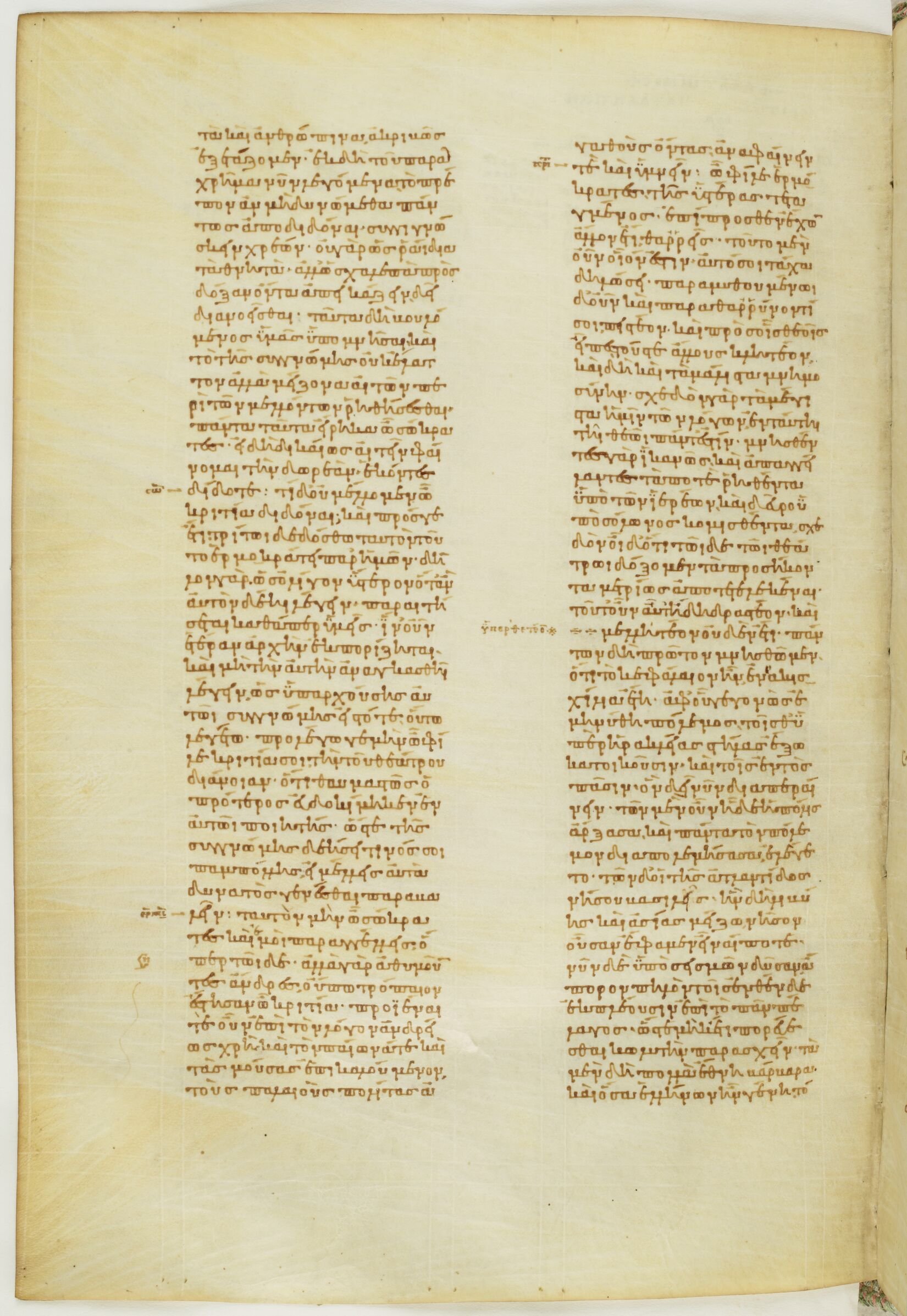
The manuscript is Paris, Bibliothèque nationale de France, grec 1807, known to editors as Plato A. It was copied in Constantinople around 850-875 by the scribe of the so-called philosophical collection, and is the oldest surviving medieval manuscript of the Timaeus and Critias (tetralogies VIII-IX: Clitophon, Republic, Timaeus, Critias, Minos, Laws, Epinomis, Letters). Each page has two columns of 44 lines. The Timaeus fills fol. 114r-144v and the Critias fol. 145r-151r.
On the manuscript this page of text runs over fol. 145v col. a to fol. 145v col. b. Each section below is linked to the folio side(s) that carry it. The mapping comes from reading the first words of every column on the images and finding them in Burnet's text: fol. 145v col. a begins ‹-τὰ καὶ ἀνθρώπινα ἀκριβῶς ἐξετάζομεν. ἐκ› (Crit. 107d); fol. 145v col. b begins ‹-γαθοὺς ὄντας ἀναφαίνειν τε καὶ ὑμνεῖν› (Crit. 108c).
The Greek is John Burnet's critical text (Oxford, 1902), not a transcription of this manuscript; the scribe's spelling, accents and occasional readings differ from it. The English is R. G. Bury's Loeb translation (1929).
How was this verified? (Provenance)
Where on the image
Crit. 108a stands in Paris gr. 1807, fol. 145v col. a. Checked on the image (column openings read on the BnF photographs and found in Burnet's text, quoted in Burnet's spelling): fol. 145v col. a begins ‹-τὰ καὶ ἀνθρώπινα ἀκριβῶς ἐξετάζομεν. ἐκ› (Crit. 107d).
ταῦτα δὴ βουλόμενος ὑμᾶς ὑπομνῆσαι, καὶ τὸ τῆς συγγνώμης οὐκ ἔλαττον ἀλλὰ μεῖζον αἰτῶν περὶ τῶν μελλόντων ῥηθήσεσθαι, πάντα ταῦτα εἴρηκα, ὦ Σώκρατες. εἰ δὴ δικαίως αἰτεῖν φαίνομαι τὴν δωρεάν, ἑκόντες δίδοτε.
ΣΩ. τί δʼ οὐ μέλλομεν, ὦ Κριτία, διδόναι; καὶ πρός γε ἔτι τρίτῳ δεδόσθω ταὐτὸν τοῦτο Ἑρμοκράτει παρʼ ἡμῶν. δῆλον γὰρ ὡς ὀλίγον ὕστερον, ὅταν αὐτὸν δέῃ λέγειν,
and crave a greater rather than a less measure of indulgence for what I am about to say, that I have made all these observations, Socrates. If, therefore, I seem justified in craving this boon, pray grant it willingly.
Soc. And why should we hesitate to grant it, Critias? Nay, what is more,the same boon shall be granted by us to a third, Hermocrates. For it is plain that later on, before long, when it is his duty to speak, he will make the same request as you.
Where on the image
Crit. 108b stands in Paris gr. 1807, fol. 145v col. a. Checked on the image (column openings read on the BnF photographs and found in Burnet's text, quoted in Burnet's spelling): fol. 145v col. a begins ‹-τὰ καὶ ἀνθρώπινα ἀκριβῶς ἐξετάζομεν. ἐκ› (Crit. 107d).
παραιτήσεται καθάπερ ὑμεῖς· ἵνʼ οὖν ἑτέραν ἀρχὴν ἐκπορίζηται καὶ μὴ τὴν αὐτὴν ἀναγκασθῇ λέγειν, ὡς ὑπαρχούσης αὐτῷ συγγνώμης εἰς τότε οὕτω λεγέτω. προλέγω γε μήν, ὦ φίλε Κριτία, σοὶ τὴν τοῦ θεάτρου διάνοιαν, ὅτι θαυμαστῶς ὁ πρότερος ηὐδοκίμηκεν ἐν αὐτῷ ποιητής, ὥστε τῆς συγγνώμης δεήσει τινός σοι παμπόλλης, εἰ μέλλεις αὐτὰ δυνατὸς γενέσθαι παραλαβεῖν.
ΕΡ. ταὐτὸν μήν, ὦ Σώκρατες, κἀμοὶ παραγγέλλεις ὅπερ
So, in order that he may provide a different prelude and not be compelled to repeat the same one, let him assume, when he comes to speak, that he already has our indulgence. I forewarn you, however, my dear Critias, of the mind of your audience,—how that the former poet won marvellous applause from it, so that you will require an extraordinary measure of indulgence if you are to prove capable of following in his steps.
Herm. And in truth, Socrates, you are giving me the same warning as Critias.
Where on the image
Crit. 108c stands in Paris gr. 1807, fol. 145v col. a to fol. 145v col. b. Checked on the image (column openings read on the BnF photographs and found in Burnet's text, quoted in Burnet's spelling): fol. 145v col. a begins ‹-τὰ καὶ ἀνθρώπινα ἀκριβῶς ἐξετάζομεν. ἐκ› (Crit. 107d); fol. 145v col. b begins ‹-γαθοὺς ὄντας ἀναφαίνειν τε καὶ ὑμνεῖν› (Crit. 108c).
τῷδε. ἀλλὰ γὰρ ἀθυμοῦντες ἄνδρες οὔπω τρόπαιον ἔστησαν, ὦ Κριτία· προϊέναι τε οὖν ἐπὶ τὸν λόγον ἀνδρείως χρή, καὶ τὸν Παίωνά τε καὶ τὰς μούσας ἐπικαλούμενον τοὺς παλαιοὺς πολίτας ἀγαθοὺς ὄντας ἀναφαίνειν τε καὶ ὑμνεῖν.
ΚΡΙ. ὦ φίλε Ἑρμόκρατες, τῆς ὑστέρας τεταγμένος, ἐπίπροσθεν ἔχων ἄλλον, ἔτι θαρρεῖς. τοῦτο μὲν οὖν οἷόν ἐστιν, αὐτό σοι τάχα δηλώσει· παραμυθουμένῳ δʼ οὖν καὶ
But men of faint heart never yet set up a trophy, Critias; wherefore you must go forward to your discoursing manfully, and, invoking the aid of Paion and the Muses, exhibit and celebrate the excellence of your ancient citizens.
Crit. You, my dear Hermocrates, are posted in the last rank, with another man before you, so you are still courageous. But experience of our task will of itself speedily enlighten you as to its character. However, I must trust to your consolation
Where on the image
Crit. 108d stands in Paris gr. 1807, fol. 145v col. b. Checked on the image (column openings read on the BnF photographs and found in Burnet's text, quoted in Burnet's spelling): fol. 145v col. b begins ‹-γαθοὺς ὄντας ἀναφαίνειν τε καὶ ὑμνεῖν› (Crit. 108c).
παραθαρρύνοντί σοι πειστέον, καὶ πρὸς οἷς θεοῖς εἶπες τούς τε ἄλλους κλητέον καὶ δὴ καὶ τὰ μάλιστα Μνημοσύνην. σχεδὸν γὰρ τὰ μέγιστα ἡμῖν τῶν λόγων ἐν ταύτῃ τῇ θεῷ πάντʼ ἐστίν· μνησθέντες γὰρ ἱκανῶς καὶ ἀπαγγείλαντες τά ποτε ῥηθέντα ὑπὸ τῶν ἱερέων καὶ δεῦρο ὑπὸ Σόλωνος κομισθέντα σχεδὸν οἶδʼ ὅτι τῷδε τῷ θεάτρῳ δόξομεν τὰ προσήκοντα μετρίως ἀποτετελεκέναι. τοῦτʼ οὖν αὔτʼ ἤδη δραστέον, καὶ μελλητέον οὐδὲν ἔτι.
and encouragement, and in addition to the gods you mentioned I must call upon all the rest and especially upon Mnemosyne. For practically all the most important part of our speech depends upon this goddess; for if I can sufficiently remember and report the tale once told by the priests and brought hither by Solon, I am wellnigh convinced that I shall appear to the present audience to have fulfilled my task adequately. This, then, I must at once proceed to do, and procrastinate no longer.
Where on the image
Crit. 108e stands in Paris gr. 1807, fol. 145v col. b. Checked on the image (column openings read on the BnF photographs and found in Burnet's text, quoted in Burnet's spelling): fol. 145v col. b begins ‹-γαθοὺς ὄντας ἀναφαίνειν τε καὶ ὑμνεῖν› (Crit. 108c).
πάντων δὴ πρῶτον μνησθῶμεν ὅτι τὸ κεφάλαιον ἦν ἐνακισχίλια ἔτη, ἀφʼ οὗ γεγονὼς ἐμηνύθη πόλεμος τοῖς θʼ ὑπὲρ Ἡρακλείας στήλας ἔξω κατοικοῦσιν καὶ τοῖς ἐντὸς πᾶσιν· ὃν δεῖ νῦν διαπεραίνειν. τῶν μὲν οὖν ἥδε ἡ πόλις ἄρξασα καὶ πάντα τὸν πόλεμον διαπολεμήσασα ἐλέγετο, τῶν δʼ οἱ τῆς Ἀτλαντίδος νήσου βασιλῆς, ἣν δὴ Λιβύης καὶ Ἀσίας μείζω νῆσον οὖσαν ἔφαμεν εἶναί ποτε, νῦν δὲ ὑπὸ σεισμῶν δῦσαν ἄπορον πηλὸν τοῖς ἐνθένδε ἐκπλέουσιν
Now first of all we must recall the fact that 9000 is the sum of years since the war occurred, as is recorded, between the dwellers beyond the pillars of Heracles and all that dwelt within them ; which war we have now to relate in detail. It was stated that this city of ours was in command of the one side and fought through the whole of the war, and in command of the other side were the kings of the island of Atlantis, which we said was an island larger than Libya and Asia once upon a time, but now lies sunk by earthquakes and has created a barrier of impassable mud
Notes
- Greek: John Burnet, Platonis Opera IV (Oxford, 1902), via Perseus canonical-greekLit; Burnet's text is a critical edition, so its wording can differ from the manuscript shown.
- English: R. G. Bury, Plato IX (Loeb Classical Library, 1929), via Perseus. Bury's footnotes are not reproduced. Quotation marks stand where Perseus marks quoted speech.
- Stephanus sections (a-e) are those of the 1578 Stephanus edition as given by Burnet and Bury; Bury's section breaks can fall a few words away from Burnet's because English word order differs.
Cite
Sources
- Source: Paris, BnF grec 1807 (Plato A, c. 850-875) fol. 145v via BnF IIIF + Burnet's Greek (Perseus) + R. G. Bury's English (Loeb 1929, Perseus) (holding institution)
- Critical edition: Burnet, Platonis Opera IV (1902), via Perseus
← previous · → next · v cycle view · l back to library