Plato, Critias 109a-109e: the war 9,000 years ago; the gods divide the earth; Hephaestus and Athena receive Attica
Introduction
Stephanus page 109 of Plato's Critias (109a-109e): the war 9,000 years ago; the gods divide the earth; Hephaestus and Athena receive Attica.
The Critias is Plato's full account of Atlantis and of the Athens that fought it: the land and city of ancient Athens (109b-112e), then the island of Atlantis, Poseidon's kingdom beyond the Pillars of Heracles, its royal city, plain, army and laws (113b-120d), and the moral decline of its kings (120e-121c). Plato left the dialogue unfinished; it stops in mid-sentence as Zeus begins to speak, and the manuscript shown here stops at the same words.
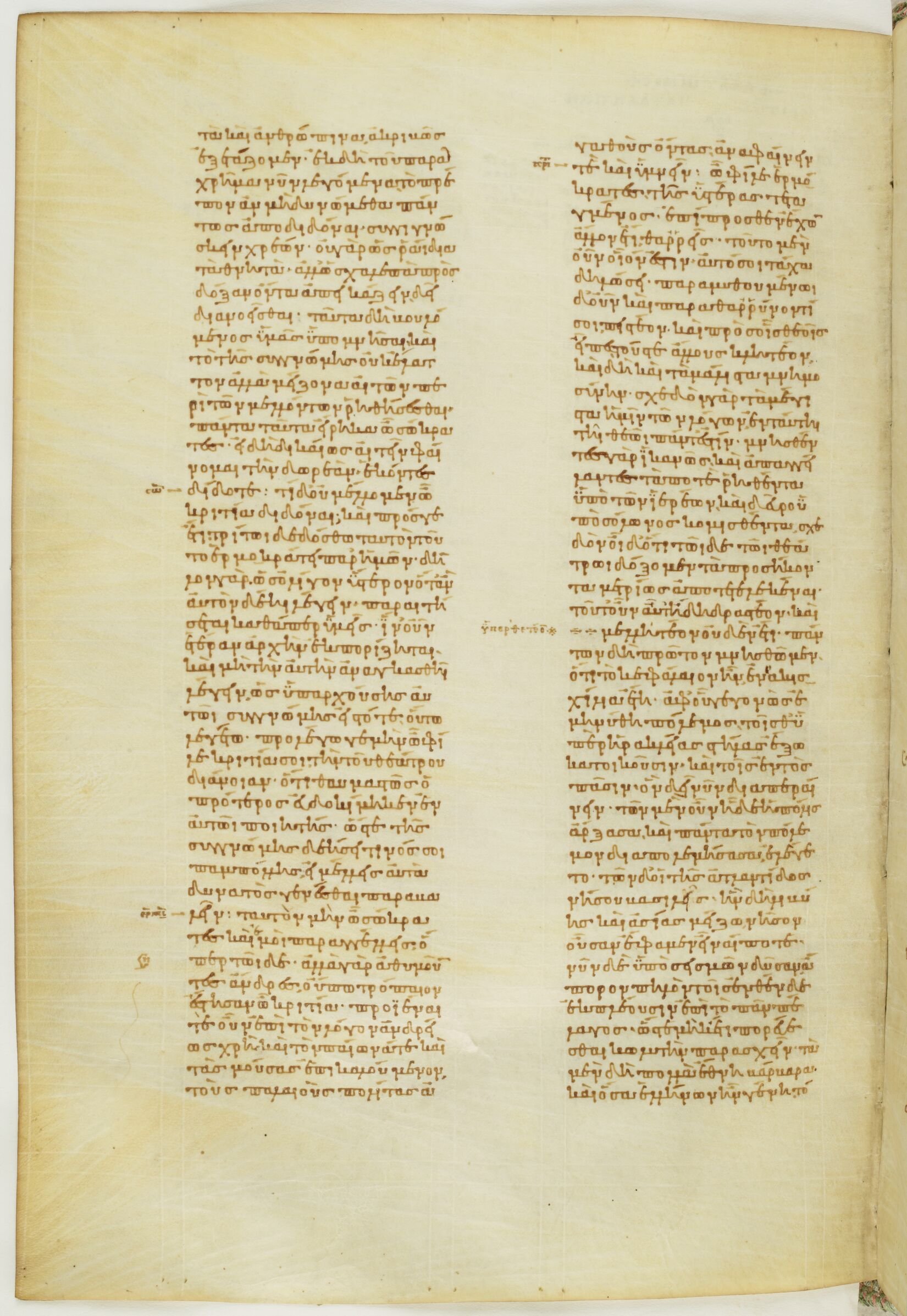
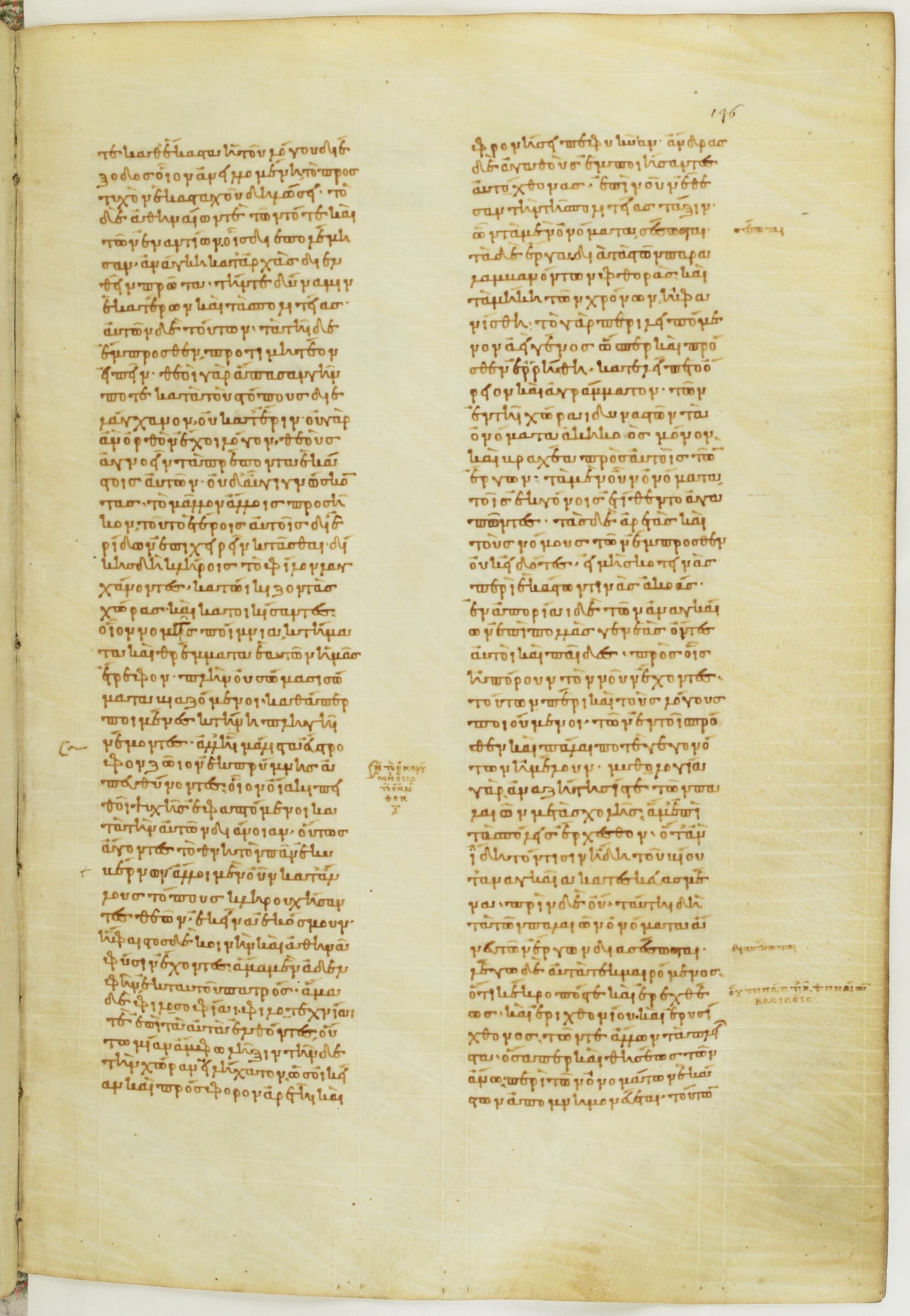
The manuscript is Paris, Bibliothèque nationale de France, grec 1807, known to editors as Plato A. It was copied in Constantinople around 850-875 by the scribe of the so-called philosophical collection, and is the oldest surviving medieval manuscript of the Timaeus and Critias (tetralogies VIII-IX: Clitophon, Republic, Timaeus, Critias, Minos, Laws, Epinomis, Letters). Each page has two columns of 44 lines. The Timaeus fills fol. 114r-144v and the Critias fol. 145r-151r.
On the manuscript this page of text runs over fol. 145v col. b to fol. 146r col. b. Each section below is linked to the folio side(s) that carry it. The mapping comes from reading the first words of every column on the images and finding them in Burnet's text: fol. 145v col. b begins ‹-γαθοὺς ὄντας ἀναφαίνειν τε καὶ ὑμνεῖν› (Crit. 108c); fol. 146r col. a begins ‹-τε, καθʼ ἕκαστα ἡ τοῦ λόγου› (Crit. 109a); fol. 146r col. b begins ‹φρονήσει πεφυκυῖαν, ἄνδρας δὲ ἀγαθοὺς ἐμποιήσαντες› (Crit. 109d).
The Greek is John Burnet's critical text (Oxford, 1902), not a transcription of this manuscript; the scribe's spelling, accents and occasional readings differ from it. The English is R. G. Bury's Loeb translation (1929).
How was this verified? (Provenance)
Where on the image
Crit. 109a stands in Paris gr. 1807, fol. 145v col. b to fol. 146r col. a. Checked on the image (column openings read on the BnF photographs and found in Burnet's text, quoted in Burnet's spelling): fol. 145v col. b begins ‹-γαθοὺς ὄντας ἀναφαίνειν τε καὶ ὑμνεῖν› (Crit. 108c); fol. 146r col. a begins ‹-τε, καθʼ ἕκαστα ἡ τοῦ λόγου› (Crit. 109a).
ἐπὶ τὸ πᾶν πέλαγος, ὥστε μηκέτι πορεύεσθαι, κωλυτὴν παρασχεῖν.
τὰ μὲν δὴ πολλὰ ἔθνη βάρβαρα, καὶ ὅσα Ἑλλήνων ἦν γένη τότε, καθʼ ἕκαστα ἡ τοῦ λόγου διέξοδος οἷον ἀνειλλομένη τὸ προστυχὸν ἑκασταχοῦ δηλώσει· τὸ δὲ Ἀθηναίων τε τῶν τότε καὶ τῶν ἐναντίων, οἷς διεπολέμησαν, ἀνάγκη κατʼ ἀρχὰς διελθεῖν πρῶτα, τήν τε δύναμιν ἑκατέρων καὶ τὰς πολιτείας. αὐτῶν δὲ τούτων τὰ τῇδε ἔμπροσθεν προτιμητέον εἰπεῖν.
which prevents those who are sailing out from here to the ocean beyond from proceeding further.
Now as regards the numerous barbaric tribes and all the Hellenic nations that then existed, the sequel of our story, when it is, as it were, unrolled, will disclose what happened in each locality; but the facts about the Athenians of that age and the enemies with whom they fought we must necessarily describe first, at the outset,—the military power, that is to say, of each and their forms of government. And of these two we must give the priority in our account to the state of Athens.
Where on the image
Crit. 109b stands in Paris gr. 1807, fol. 146r col. a. Checked on the image (column openings read on the BnF photographs and found in Burnet's text, quoted in Burnet's spelling): fol. 146r col. a begins ‹-τε, καθʼ ἕκαστα ἡ τοῦ λόγου› (Crit. 109a).
θεοὶ γὰρ ἅπασαν γῆν ποτε κατὰ τοὺς τόπους διελάγχανον—οὐ κατʼ ἔριν· οὐ γὰρ ἂν ὀρθὸν ἔχοι λόγον θεοὺς ἀγνοεῖν τὰ πρέποντα ἑκάστοις αὑτῶν, οὐδʼ αὖ γιγνώσκοντας τὸ μᾶλλον ἄλλοις προσῆκον τοῦτο ἑτέρους αὑτοῖς διʼ ἐρίδων ἐπιχειρεῖν κτᾶσθαι—δίκης δὴ κλήροις τὸ φίλον λαγχάνοντες κατῴκιζον τὰς χώρας, καὶ κατοικίσαντες, οἷον νομῆς ποίμνια, κτήματα καὶ θρέμματα ἑαυτῶν ἡμᾶς ἔτρεφον, πλὴν οὐ σώμασι
Once upon a time the gods were taking over by lot the whole earth according to its regions,—not according to the results of strife : for it would not be reasonable to suppose that the gods were ignorant of their own several rights, nor yet that they attempted to obtain for themselves by means of strife a possession to which others, as they knew, had a better claim. So by just allotments they received each one his own, and they settled their countries; and when they had thus settled them, they reared us up, even as herdsmen
Where on the image
Crit. 109c stands in Paris gr. 1807, fol. 146r col. a. Checked on the image (column openings read on the BnF photographs and found in Burnet's text, quoted in Burnet's spelling): fol. 146r col. a begins ‹-τε, καθʼ ἕκαστα ἡ τοῦ λόγου› (Crit. 109a).
σώματα βιαζόμενοι, καθάπερ ποιμένες κτήνη πληγῇ νέμοντες, ἀλλʼ ᾗ μάλιστα εὔστροφον ζῷον, ἐκ πρύμνης ἀπευθύνοντες, οἷον οἴακι πειθοῖ ψυχῆς ἐφαπτόμενοι κατὰ τὴν αὐτῶν διάνοιαν, οὕτως ἄγοντες τὸ θνητὸν πᾶν ἐκυβέρνων. ἄλλοι μὲν οὖν κατʼ ἄλλους τόπους κληρουχήσαντες θεῶν ἐκεῖνα ἐκόσμουν, Ἥφαιστος δὲ κοινὴν καὶ Ἀθηνᾶ φύσιν ἔχοντες, ἅμα μὲν ἀδελφὴν ἐκ ταὐτοῦ πατρός, ἅμα δὲ φιλοσοφίᾳ φιλοτεχνίᾳ τε ἐπὶ τὰ αὐτὰ ἐλθόντες, οὕτω μίαν ἄμφω λῆξιν τήνδε τὴν χώραν εἰλήχατον ὡς οἰκείαν καὶ πρόσφορον ἀρετῇ
rear their flocks, to be their cattle and nurslings; only it was not our bodies that they constrained by bodily force, like shepherds guiding their flocks with stroke of staff, but they directed from the stern where the living creature is easiest to turn about, laying hold on the soul by persuasion, as by a rudder, according to their own disposition; and thus they drove and steered all the mortal kind. Now in other regions others of the gods had their allotments and ordered the affairs, but inasmuch as Hephaestus and Athena were of a like nature, being born of the same father, and agreeing, moreover, in their love of wisdom and of craftsmanship, they both took for their joint portion this land of ours as being naturally congenial and adapted for virtue
Where on the image
Crit. 109d stands in Paris gr. 1807, fol. 146r col. a to fol. 146r col. b. Checked on the image (column openings read on the BnF photographs and found in Burnet's text, quoted in Burnet's spelling): fol. 146r col. a begins ‹-τε, καθʼ ἕκαστα ἡ τοῦ λόγου› (Crit. 109a); fol. 146r col. b begins ‹φρονήσει πεφυκυῖαν, ἄνδρας δὲ ἀγαθοὺς ἐμποιήσαντες› (Crit. 109d).
καὶ φρονήσει πεφυκυῖαν, ἄνδρας δὲ ἀγαθοὺς ἐμποιήσαντες αὐτόχθονας ἐπὶ νοῦν ἔθεσαν τὴν τῆς πολιτείας τάξιν· ὧν τὰ μὲν ὀνόματα σέσωται, τὰ δὲ ἔργα διὰ τὰς τῶν παραλαμβανόντων φθορὰς καὶ τὰ μήκη τῶν χρόνων ἠφανίσθη. τὸ γὰρ περιλειπόμενον ἀεὶ γένος, ὥσπερ καὶ πρόσθεν ἐρρήθη, κατελείπετο ὄρειον καὶ ἀγράμματον, τῶν ἐν τῇ χώρᾳ δυναστῶν τὰ ὀνόματα ἀκηκοὸς μόνον καὶ βραχέα πρὸς αὐτοῖς τῶν ἔργων. τὰ μὲν οὖν ὀνόματα τοῖς ἐκγόνοις ἐτίθεντο
and for wisdom, and therein they planted as native to the soil men of virtue and ordained to their mind the mode of government. And of these citizens the names are preserved, but their works have vanished owing to the repeated destruction of their successors and the length of the intervening periods. For, as was said before, the stock that survived on each occasion was a remnant of unlettered mountaineers which had heard the names only of the rulers, and but little besides of their works. So though they gladly passed on these names
Where on the image
Crit. 109e stands in Paris gr. 1807, fol. 146r col. b. Checked on the image (column openings read on the BnF photographs and found in Burnet's text, quoted in Burnet's spelling): fol. 146r col. b begins ‹φρονήσει πεφυκυῖαν, ἄνδρας δὲ ἀγαθοὺς ἐμποιήσαντες› (Crit. 109d).
ἀγαπῶντες, τὰς δὲ ἀρετὰς καὶ τοὺς νόμους τῶν ἔμπροσθεν οὐκ εἰδότες, εἰ μὴ σκοτεινὰς περὶ ἑκάστων τινὰς ἀκοάς, ἐν ἀπορίᾳ δὲ τῶν ἀναγκαίων ἐπὶ πολλὰς γενεὰς ὄντες αὐτοὶ
to their descendants, concerning the mighty deeds and the laws of their predecessors they had no knowledge, save for some invariably obscure reports; and since, moreover, they and their children for many generations were themselves in want of the necessaries of life, their attention was given to their own needs
Notes
- Greek: John Burnet, Platonis Opera IV (Oxford, 1902), via Perseus canonical-greekLit; Burnet's text is a critical edition, so its wording can differ from the manuscript shown.
- English: R. G. Bury, Plato IX (Loeb Classical Library, 1929), via Perseus. Bury's footnotes are not reproduced. Quotation marks stand where Perseus marks quoted speech.
- Stephanus sections (a-e) are those of the 1578 Stephanus edition as given by Burnet and Bury; Bury's section breaks can fall a few words away from Burnet's because English word order differs.
Cite
Sources
- Source: Paris, BnF grec 1807 (Plato A, c. 850-875) fol. 145v-146r via BnF IIIF + Burnet's Greek (Perseus) + R. G. Bury's English (Loeb 1929, Perseus) (holding institution)
- Critical edition: Burnet, Platonis Opera IV (1902), via Perseus
← previous · → next · v cycle view · l back to library