Plato, Critias 111a-111e: the fertility of ancient Attica and the soil carried off by floods
Introduction
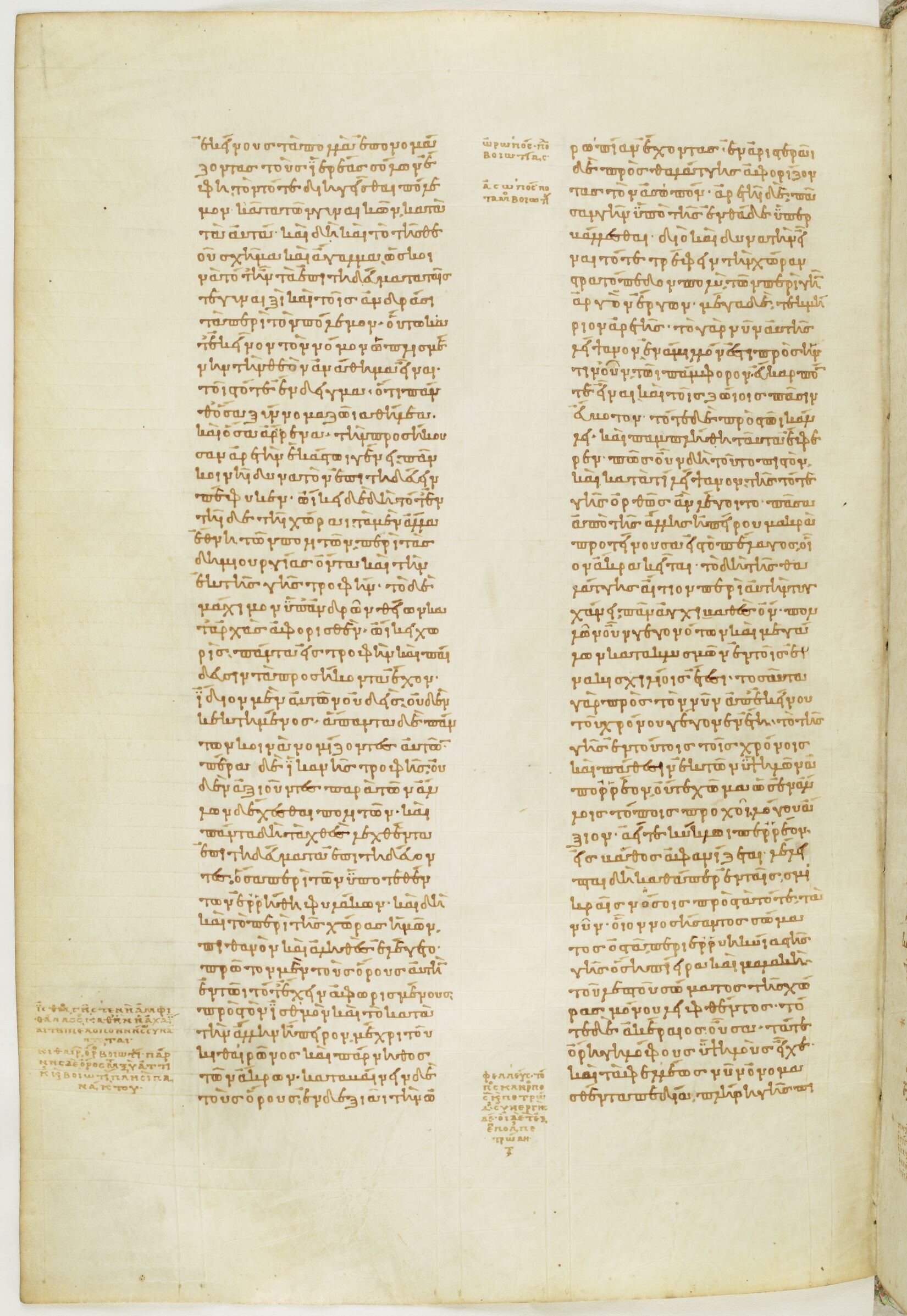
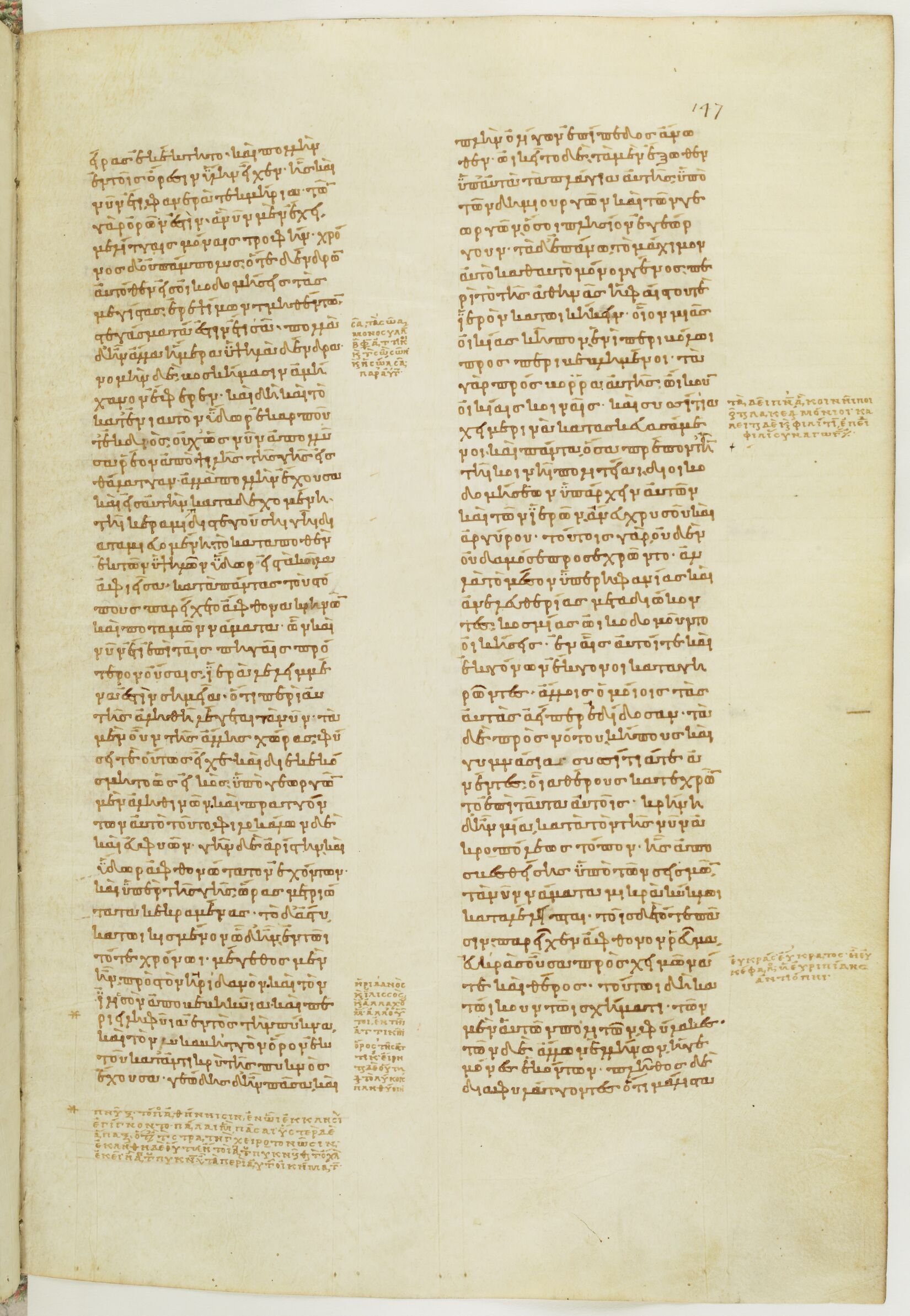
Stephanus page 111 of Plato's Critias (111a-111e): the fertility of ancient Attica and the soil carried off by floods.
The Critias is Plato's full account of Atlantis and of the Athens that fought it: the land and city of ancient Athens (109b-112e), then the island of Atlantis, Poseidon's kingdom beyond the Pillars of Heracles, its royal city, plain, army and laws (113b-120d), and the moral decline of its kings (120e-121c). Plato left the dialogue unfinished; it stops in mid-sentence as Zeus begins to speak, and the manuscript shown here stops at the same words.
The manuscript is Paris, Bibliothèque nationale de France, grec 1807, known to editors as Plato A. It was copied in Constantinople around 850-875 by the scribe of the so-called philosophical collection, and is the oldest surviving medieval manuscript of the Timaeus and Critias (tetralogies VIII-IX: Clitophon, Republic, Timaeus, Critias, Minos, Laws, Epinomis, Letters). Each page has two columns of 44 lines. The Timaeus fills fol. 114r-144v and the Critias fol. 145r-151r.
On the manuscript this page of text runs over fol. 146v col. b to fol. 147r col. a. Each section below is linked to the folio side(s) that carry it. The mapping comes from reading the first words of every column on the images and finding them in Burnet's text: fol. 146v col. b begins ‹-ρωπίαν ἔχοντας, ἐν ἀριστερᾷ δὲ πρὸς› (Crit. 110e); fol. 147r col. a begins ‹ἐκέκτητο, καὶ πολλὴν ἐν τοῖς ὄρεσιν› (Crit. 111c).
The Greek is John Burnet's critical text (Oxford, 1902), not a transcription of this manuscript; the scribe's spelling, accents and occasional readings differ from it. The English is R. G. Bury's Loeb translation (1929).
How was this verified? (Provenance)
Where on the image
Crit. 111a stands in Paris gr. 1807, fol. 146v col. b. Checked on the image (column openings read on the BnF photographs and found in Burnet's text, quoted in Burnet's spelling): fol. 146v col. b begins ‹-ρωπίαν ἔχοντας, ἐν ἀριστερᾷ δὲ πρὸς› (Crit. 110e).
τε εἶναι καὶ τοῖς ζῴοις πᾶσιν εὔβοτον. τότε δὲ πρὸς τῷ κάλλει καὶ παμπλήθη ταῦτα ἔφερεν. πῶς οὖν δὴ τοῦτο πιστόν, καὶ κατὰ τί λείψανον τῆς τότε γῆς ὀρθῶς ἂν λέγοιτο; πᾶσα ἀπὸ τῆς ἄλλης ἠπείρου μακρὰ προτείνουσα εἰς τὸ πέλαγος οἷον ἄκρα κεῖται· τὸ δὴ τῆς θαλάττης ἀγγεῖον περὶ αὐτὴν τυγχάνει πᾶν ἀγχιβαθὲς ὄν. πολλῶν οὖν γεγονότων καὶ μεγάλων κατακλυσμῶν ἐν τοῖς ἐνακισχιλίοις ἔτεσι—τοσαῦτα γὰρ πρὸς τὸν νῦν ἀπʼ ἐκείνου τοῦ χρόνου
and at that period, in addition to their fine quality it produced these things in vast quantity. How, then, is this statement plausible, and what residue of the land then existing serves to confirm its truth? The whole of the land lies like a promontory jutting out from the rest of the continent far into the sea and all the cup of the sea; round about it is, as it happens, of a great depth. Consequently, since many great convulsions took place during the 9000 years—for such was the number of years
Where on the image
Crit. 111b stands in Paris gr. 1807, fol. 146v col. b. Checked on the image (column openings read on the BnF photographs and found in Burnet's text, quoted in Burnet's spelling): fol. 146v col. b begins ‹-ρωπίαν ἔχοντας, ἐν ἀριστερᾷ δὲ πρὸς› (Crit. 110e).
γέγονεν ἔτη—τὸ τῆς γῆς ἐν τούτοις τοῖς χρόνοις καὶ πάθεσιν ἐκ τῶν ὑψηλῶν ἀπορρέον οὔτε χῶμα, ὡς ἐν ἄλλοις τόποις, προχοῖ λόγου ἄξιον ἀεί τε κύκλῳ περιρρέον εἰς βάθος ἀφανίζεται· λέλειπται δή, καθάπερ ἐν ταῖς σμικραῖς νήσοις, πρὸς τὰ τότε τὰ νῦν οἷον νοσήσαντος σώματος ὀστᾶ, περιερρυηκυίας τῆς γῆς ὅση πίειρα καὶ μαλακή, τοῦ λεπτοῦ σώματος τῆς χώρας μόνου λειφθέντος. τότε δὲ ἀκέραιος
from that time to this —the soil which has kept breaking away from the high lands during these ages and these disasters, forms no pile of sediment worth mentioning, as in other regions, but keeps sliding away ceaselessly and disappearing in the deep. And, just as happens in small islands, what now remains compared with what then existed is like the skeleton of a sick man, all the fat and soft earth having wasted away, and only the bare framework of the land being left. But at that epoch the country was unimpaired, and for its mountains it had
Where on the image
Crit. 111c stands in Paris gr. 1807, fol. 146v col. b to fol. 147r col. a. Checked on the image (column openings read on the BnF photographs and found in Burnet's text, quoted in Burnet's spelling): fol. 146v col. b begins ‹-ρωπίαν ἔχοντας, ἐν ἀριστερᾷ δὲ πρὸς› (Crit. 110e); fol. 147r col. a begins ‹ἐκέκτητο, καὶ πολλὴν ἐν τοῖς ὄρεσιν› (Crit. 111c).
οὖσα τά τε ὄρη γηλόφους ὑψηλοὺς εἶχε, καὶ τὰ φελλέως νῦν ὀνομασθέντα πεδία πλήρη γῆς πιείρας ἐκέκτητο, καὶ πολλὴν ἐν τοῖς ὄρεσιν ὕλην εἶχεν, ἧς καὶ νῦν ἔτι φανερὰ τεκμήρια· τῶν γὰρ ὀρῶν ἔστιν ἃ νῦν μὲν ἔχει μελίτταις μόναις τροφήν, χρόνος δʼ οὐ πάμπολυς ὅτε δένδρων αὐτόθεν εἰς οἰκοδομήσεις τὰς μεγίστας ἐρεψίμων τμηθέντων στεγάσματʼ ἐστὶν ἔτι σᾶ. πολλὰ δʼ ἦν ἄλλʼ ἥμερα ὑψηλὰ δένδρα, νομὴν δὲ βοσκήμασιν ἀμήχανον ἔφερεν. καὶ δὴ καὶ
high arable hills, and in place of the moorlands, as they are now called, it contained plains full of rich soil; and it had much forestland in its mountains, of which there are visible signs even to this day; for there are some mountains which now have nothing but food for bees, but they had trees no very long time ago, and the rafters from those felled there to roof the largest buildings are still sound. And besides, there were many lofty trees of cultivated species; and it produced boundless pasturage for flocks. Moreover, it was enriched by the yearly rains from Zeus,
Where on the image
Crit. 111d stands in Paris gr. 1807, fol. 147r col. a. Checked on the image (column openings read on the BnF photographs and found in Burnet's text, quoted in Burnet's spelling): fol. 147r col. a begins ‹ἐκέκτητο, καὶ πολλὴν ἐν τοῖς ὄρεσιν› (Crit. 111c).
τὸ κατʼ ἐνιαυτὸν ὕδωρ ἐκαρποῦτʼ ἐκ Διός, οὐχ ὡς νῦν ἀπολλῦσα ῥέον ἀπὸ ψιλῆς τῆς γῆς εἰς θάλατταν, ἀλλὰ πολλὴν ἔχουσα καὶ εἰς αὐτὴν καταδεχομένη, τῇ κεραμίδι στεγούσῃ γῇ διαταμιευομένη, τὸ καταποθὲν ἐκ τῶν ὑψηλῶν ὕδωρ εἰς τὰ κοῖλα ἀφιεῖσα κατὰ πάντας τοὺς τόπους παρείχετο ἄφθονα κρηνῶν καὶ ποταμῶν νάματα, ὧν καὶ νῦν ἔτι ἐπὶ ταῖς πηγαῖς πρότερον οὔσαις ἱερὰ λελειμμένα ἐστὶν σημεῖα ὅτι περὶ αὐτῆς ἀληθῆ λέγεται τὰ νῦν.
which were not lost to it, as now, by flowing from the bare land into the sea; but the soil; it had was deep, and therein it received the water, storing it up in the retentive loamy soil and by drawing off into the hollows from the heights the water that was there absorbed, it provided all the various districts with abundant supplies of springwaters and streams, whereof the shrines which still remain even now, at the spots where the fountains formerly existed, are signs which testify that our present description of the land is true.
Where on the image
Crit. 111e stands in Paris gr. 1807, fol. 147r col. a. Checked on the image (column openings read on the BnF photographs and found in Burnet's text, quoted in Burnet's spelling): fol. 147r col. a begins ‹ἐκέκτητο, καὶ πολλὴν ἐν τοῖς ὄρεσιν› (Crit. 111c).
τὰ μὲν οὖν τῆς ἄλλης χώρας φύσει τε οὕτως εἶχε, καὶ διεκεκόσμητο ὡς εἰκὸς ὑπὸ γεωργῶν μὲν ἀληθινῶν καὶ πραττόντων αὐτὸ τοῦτο, φιλοκάλων δὲ καὶ εὐφυῶν, γῆν δὲ ἀρίστην καὶ ὕδωρ ἀφθονώτατον ἐχόντων καὶ ὑπὲρ τῆς γῆς ὥρας μετριώτατα κεκραμένας· τὸ δʼ ἄστυ κατῳκισμένον ὧδʼ ἦν ἐν τῷ τότε χρόνῳ.
πρῶτον μὲν τὸ τῆς ἀκροπόλεως εἶχε
Such, then, was the natural condition of the rest of the country, and it was ornamented as you would expect from genuine husbandmen who made husbandry their sole task, and who were also men of taste and of native talent, and possessed of most excellent land and a great abundance of water, and also, above the land, a climate of most happily tempered seasons. And as to the city, this is the way in which it was laid out at that time.
In the first place, the acropolis, as it existed then, was different from
Notes
- Greek: John Burnet, Platonis Opera IV (Oxford, 1902), via Perseus canonical-greekLit; Burnet's text is a critical edition, so its wording can differ from the manuscript shown.
- English: R. G. Bury, Plato IX (Loeb Classical Library, 1929), via Perseus. Bury's footnotes are not reproduced. Quotation marks stand where Perseus marks quoted speech.
- Stephanus sections (a-e) are those of the 1578 Stephanus edition as given by Burnet and Bury; Bury's section breaks can fall a few words away from Burnet's because English word order differs.
Cite
Sources
- Source: Paris, BnF grec 1807 (Plato A, c. 850-875) fol. 146v-147r via BnF IIIF + Burnet's Greek (Perseus) + R. G. Bury's English (Loeb 1929, Perseus) (holding institution)
- Critical edition: Burnet, Platonis Opera IV (1902), via Perseus
← previous · → next · v cycle view · l back to library