Plato, Critias 112a-112e: the ancient Acropolis, the guardians' dwellings and the number of the warriors
Introduction
Stephanus page 112 of Plato's Critias (112a-112e): the ancient Acropolis, the guardians' dwellings and the number of the warriors.
The Critias is Plato's full account of Atlantis and of the Athens that fought it: the land and city of ancient Athens (109b-112e), then the island of Atlantis, Poseidon's kingdom beyond the Pillars of Heracles, its royal city, plain, army and laws (113b-120d), and the moral decline of its kings (120e-121c). Plato left the dialogue unfinished; it stops in mid-sentence as Zeus begins to speak, and the manuscript shown here stops at the same words.
The manuscript is Paris, Bibliothèque nationale de France, grec 1807, known to editors as Plato A. It was copied in Constantinople around 850-875 by the scribe of the so-called philosophical collection, and is the oldest surviving medieval manuscript of the Timaeus and Critias (tetralogies VIII-IX: Clitophon, Republic, Timaeus, Critias, Minos, Laws, Epinomis, Letters). Each page has two columns of 44 lines. The Timaeus fills fol. 114r-144v and the Critias fol. 145r-151r.
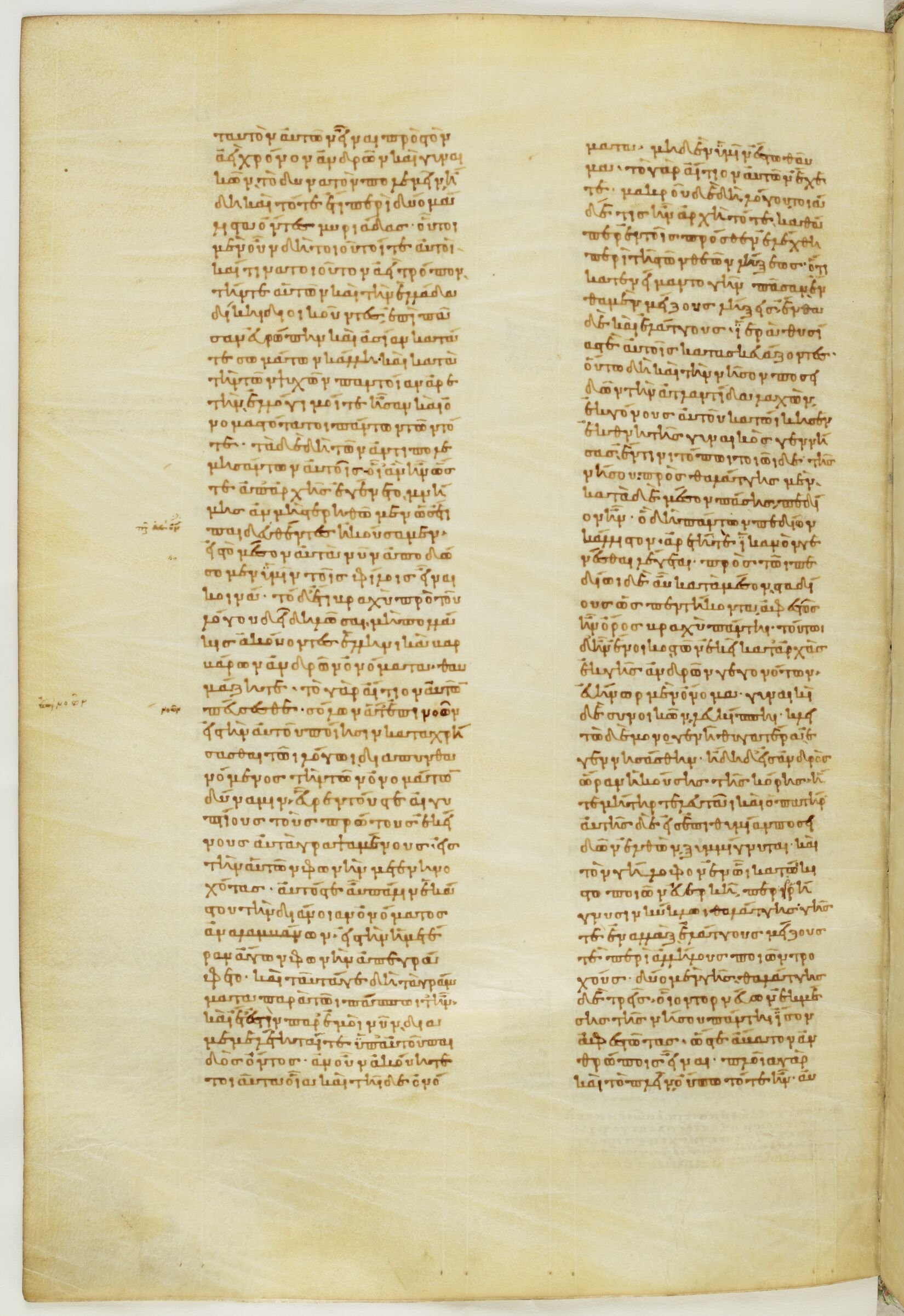
On the manuscript this page of text runs over fol. 147r col. a to fol. 147v col. a. Each section below is linked to the folio side(s) that carry it. The mapping comes from reading the first words of every column on the images and finding them in Burnet's text: fol. 147r col. a begins ‹ἐκέκτητο, καὶ πολλὴν ἐν τοῖς ὄρεσιν› (Crit. 111c); fol. 147r col. b begins ‹πλὴν ὀλίγον ἐπίπεδος ἄνωθεν. ᾠκεῖτο δὲ› (Crit. 112a); fol. 147v col. a begins ‹ταὐτὸν αὑτῶν εἶναι πρὸς τὸν ἀεὶ› (Crit. 112d).
The Greek is John Burnet's critical text (Oxford, 1902), not a transcription of this manuscript; the scribe's spelling, accents and occasional readings differ from it. The English is R. G. Bury's Loeb translation (1929).
How was this verified? (Provenance)
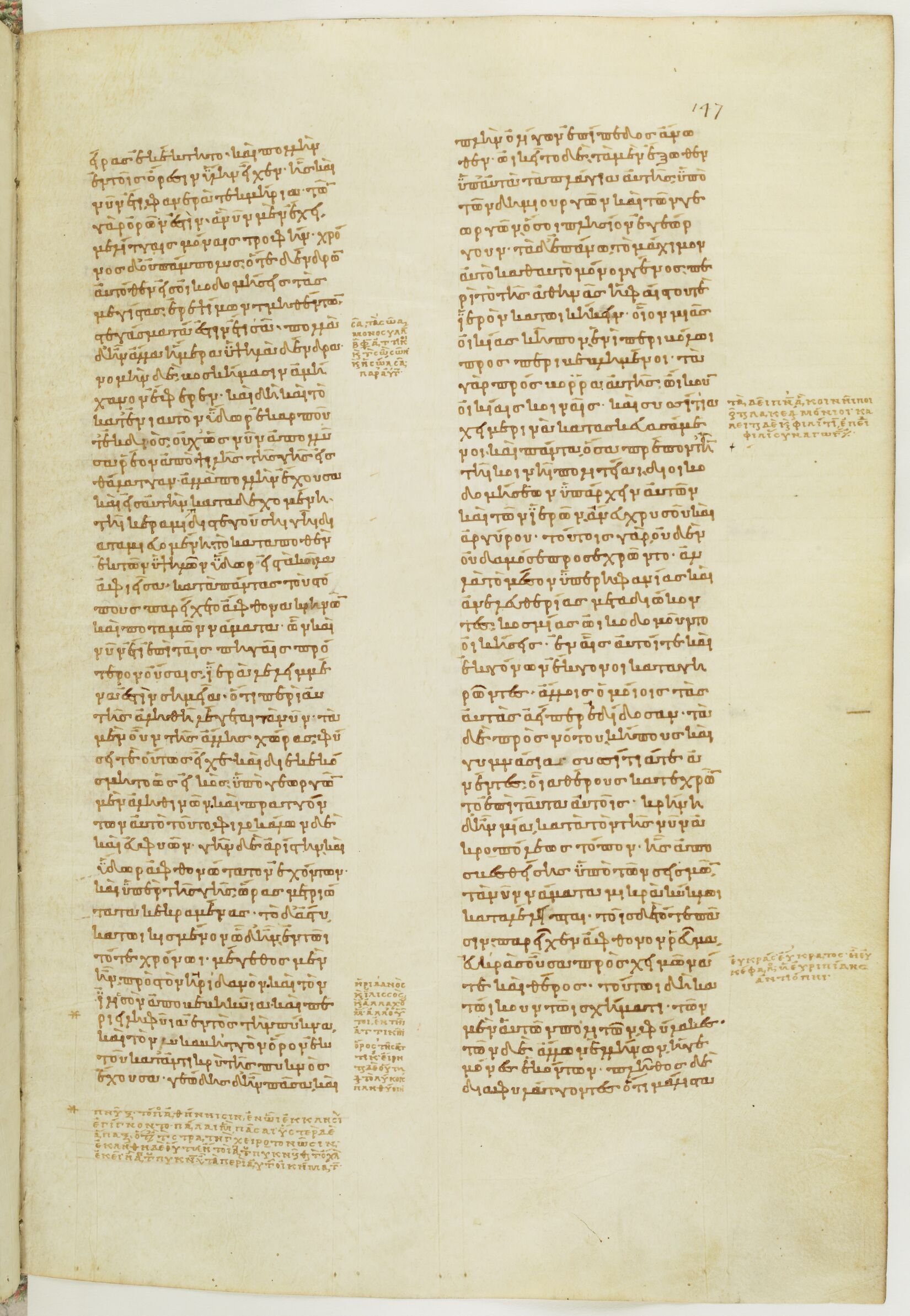
Where on the image
Crit. 112a stands in Paris gr. 1807, fol. 147r col. a to fol. 147r col. b. Checked on the image (column openings read on the BnF photographs and found in Burnet's text, quoted in Burnet's spelling): fol. 147r col. a begins ‹ἐκέκτητο, καὶ πολλὴν ἐν τοῖς ὄρεσιν› (Crit. 111c); fol. 147r col. b begins ‹πλὴν ὀλίγον ἐπίπεδος ἄνωθεν. ᾠκεῖτο δὲ› (Crit. 112a).
τότε οὐχ ὡς τὰ νῦν ἔχει. νῦν μὲν γὰρ μία γενομένη νὺξ ὑγρὰ διαφερόντως γῆς αὐτὴν ψιλὴν περιτήξασα πεποίηκε, σεισμῶν ἅμα καὶ πρὸ τῆς ἐπὶ Δευκαλίωνος φθορᾶς τρίτου πρότερον ὕδατος ἐξαισίου γενομένου· τὸ δὲ πρὶν ἐν ἑτέρῳ χρόνῳ μέγεθος μὲν ἦν πρὸς τὸν Ἠριδανὸν καὶ τὸν Ἰλισὸν ἀποβεβηκυῖα καὶ περιειληφυῖα ἐντὸς τὴν Πύκνα καὶ τὸν Λυκαβηττὸν ὅρον ἐκ τοῦ καταντικρὺ τῆς Πυκνὸς ἔχουσα, γεώδης δʼ ἦν πᾶσα καὶ πλὴν ὀλίγον ἐπίπεδος ἄνωθεν.
what it is now. For as it is now, the action of a single night of extraordinary rain has crumbled it away and made it bare of soil, when earthquakes occurred simultaneously with the third of the disastrous floods which preceded the destructive deluge in the time of Deucalion. But in its former extent, at an earlier period, it went down towards the Eridanus and the Ilissus, and embraced within it the Pnyx; and had the Lycabettus as its boundary over against the Pnyx ; and it was all rich in soil and, save for a small space, level on the top.
Where on the image
Crit. 112b stands in Paris gr. 1807, fol. 147r col. b. Checked on the image (column openings read on the BnF photographs and found in Burnet's text, quoted in Burnet's spelling): fol. 147r col. b begins ‹πλὴν ὀλίγον ἐπίπεδος ἄνωθεν. ᾠκεῖτο δὲ› (Crit. 112a).
ᾠκεῖτο δὲ τὰ μὲν ἔξωθεν, ὑπʼ αὐτὰ τὰ πλάγια αὐτῆς, ὑπὸ τῶν δημιουργῶν καὶ τῶν γεωργῶν ὅσοι πλησίον ἐγεώργουν· τὰ δʼ ἐπάνω τὸ μάχιμον αὐτὸ καθʼ αὑτὸ μόνον γένος περὶ τὸ τῆς Ἀθηνᾶς Ἡφαίστου τε ἱερὸν κατῳκήκειν, οἷον μιᾶς οἰκίας κῆπον ἑνὶ περιβόλῳ προσπεριβεβλημένοι. τὰ γὰρ πρόσβορρα αὐτῆς ᾤκουν οἰκίας κοινὰς καὶ συσσίτια χειμερινὰ κατασκευασάμενοι, καὶ πάντα ὅσα πρέποντʼ ἦν τῇ κοινῇ
And its outer parts, under its slopes, were inhabited by the craftsmen and by such of the husbandmen as had their farms close by; but on the topmost part only the military class by itself had its dwellings round about the temple of Athene and Hephaestus, surrounding themselves with a single ring-fence, which formed, as it were, the enclosure of a single dwelling. On the northward side of it they had established their public dwellings and winter mess-rooms, and all the arrangements in the way of buildings which were required for the community life
Where on the image
Crit. 112c stands in Paris gr. 1807, fol. 147r col. b. Checked on the image (column openings read on the BnF photographs and found in Burnet's text, quoted in Burnet's spelling): fol. 147r col. b begins ‹πλὴν ὀλίγον ἐπίπεδος ἄνωθεν. ᾠκεῖτο δὲ› (Crit. 112a).
πολιτείᾳ διʼ οἰκοδομήσεων ὑπάρχειν αὐτῶν καὶ τῶν ἱερῶν, ἄνευ χρυσοῦ καὶ ἀργύρου—τούτοις γὰρ οὐδὲν οὐδαμόσε προσεχρῶντο, ἀλλὰ τὸ μέσον ὑπερηφανίας καὶ ἀνελευθερίας μεταδιώκοντες κοσμίας ᾠκοδομοῦντο οἰκήσεις, ἐν αἷς αὐτοί τε καὶ ἐκγόνων ἔκγονοι καταγηρῶντες ἄλλοις ὁμοίοις τὰς αὐτὰς ἀεὶ παρεδίδοσαν—τὰ δὲ πρὸς νότου, κήπους καὶ γυμνάσια συσσίτιά τε ἀνέντες οἷα θέρους, κατεχρῶντο ἐπὶ ταῦτα αὐτοῖς. κρήνη δʼ ἦν μία κατὰ τὸν τῆς νῦν ἀκροπόλεως τόπον, ἧς
of themselves and the priests; but all was devoid of gold or silver, of which they made no use anywhere ; on the contrary, they aimed at the mean between luxurious display and meanness, and built themselves tasteful houses, wherein they and their children's children grew old and handed them on in succession unaltered to others like themselves. As for the southward parts, when they vacated their gardens and gymnasia and mess-rooms as was natural in summer, they used them for these purposes. And near the place of the present Acropolis
Where on the image
Crit. 112d stands in Paris gr. 1807, fol. 147r col. b to fol. 147v col. a. Checked on the image (column openings read on the BnF photographs and found in Burnet's text, quoted in Burnet's spelling): fol. 147r col. b begins ‹πλὴν ὀλίγον ἐπίπεδος ἄνωθεν. ᾠκεῖτο δὲ› (Crit. 112a); fol. 147v col. a begins ‹ταὐτὸν αὑτῶν εἶναι πρὸς τὸν ἀεὶ› (Crit. 112d).
ἀποσβεσθείσης ὑπὸ τῶν σεισμῶν τὰ νῦν νάματα μικρὰ κύκλῳ καταλέλειπται, τοῖς δὲ τότε πᾶσιν παρεῖχεν ἄφθονον ῥεῦμα, εὐκρὰς οὖσα πρὸς χειμῶνά τε καὶ θέρος. τούτῳ δὴ κατῴκουν τῷ σχήματι, τῶν μὲν αὑτῶν πολιτῶν φύλακες, τῶν δὲ ἄλλων Ἑλλήνων ἡγεμόνες ἑκόντων, πλῆθος δὲ διαφυλάττοντες ὅτι μάλιστα ταὐτὸν αὑτῶν εἶναι πρὸς τὸν ἀεὶ χρόνον ἀνδρῶν καὶ γυναικῶν, τὸ δυνατὸν πολεμεῖν ἤδη καὶ τὸ ἔτι, περὶ δύο
there was one spring— which was choked up by the earthquakes so that but small tricklings of it are now left round about; but to the men of that time it afforded a plentiful stream for them all, being well tempered both for winter and summer. In this fashion, then, they dwelt, acting as guardians of their own citizens and as leaders, by their own consent, of the rest of the Greeks and they watched carefully that their own numbers, of both men and women, who were neither too young nor too old to fight, should remain for all time as nearly as possible the same, namely, about 20,000.
Where on the image
Crit. 112e stands in Paris gr. 1807, fol. 147v col. a. Checked on the image (column openings read on the BnF photographs and found in Burnet's text, quoted in Burnet's spelling): fol. 147v col. a begins ‹ταὐτὸν αὑτῶν εἶναι πρὸς τὸν ἀεὶ› (Crit. 112d).
μάλιστα ὄντας μυριάδας.οὗτοι μὲν οὖν δὴ τοιοῦτοί τε ὄντες αὐτοὶ καί τινα τοιοῦτον ἀεὶ τρόπον τήν τε αὑτῶν καὶ τὴν Ἑλλάδα δίκῃ διοικοῦντες, ἐπὶ πᾶσαν Εὐρώπην καὶ Ἀσίαν κατά τε σωμάτων κάλλη καὶ κατὰ τὴν τῶν ψυχῶν παντοίαν ἀρετὴν ἐλλόγιμοί τε ἦσαν καὶ ὀνομαστότατοι πάντων τῶν τότε· τὰ δὲ δὴ τῶν ἀντιπολεμησάντων αὐτοῖς οἷα ἦν ὥς τε ἀπʼ ἀρχῆς ἐγένετο, μνήμης ἂν μὴ στερηθῶμεν ὧν ἔτι παῖδες ὄντες ἠκούσαμεν, εἰς τὸ μέσον αὐτὰ νῦν ἀποδώσομεν ὑμῖν τοῖς φίλοις εἶναι κοινά.
So it was that these men, being themselves of the character described and always justly administering in some such fashion both their own land and Hellas, were famous throughout all Europe and Asia both for their bodily beauty and for the perfection of their moral excellence, and were of all men then living the most renowned. And now, if we have not lost recollection of what we heard when we were still children, we will frankly impart to you all, as friends, our story of the men who warred against our Athenians, what their state was and how it originally came about.
Notes
- Greek: John Burnet, Platonis Opera IV (Oxford, 1902), via Perseus canonical-greekLit; Burnet's text is a critical edition, so its wording can differ from the manuscript shown.
- English: R. G. Bury, Plato IX (Loeb Classical Library, 1929), via Perseus. Bury's footnotes are not reproduced. Quotation marks stand where Perseus marks quoted speech.
- Stephanus sections (a-e) are those of the 1578 Stephanus edition as given by Burnet and Bury; Bury's section breaks can fall a few words away from Burnet's because English word order differs.
Cite
Sources
- Source: Paris, BnF grec 1807 (Plato A, c. 850-875) fol. 147r-147v via BnF IIIF + Burnet's Greek (Perseus) + R. G. Bury's English (Loeb 1929, Perseus) (holding institution)
- Critical edition: Burnet, Platonis Opera IV (1902), via Perseus
← previous · → next · v cycle view · l back to library