Plato, Critias 113a-113e: why the Atlantid names are Greek; Poseidon, Cleito and the rings of land and sea
Introduction
Stephanus page 113 of Plato's Critias (113a-113e): why the Atlantid names are Greek; Poseidon, Cleito and the rings of land and sea.
The Critias is Plato's full account of Atlantis and of the Athens that fought it: the land and city of ancient Athens (109b-112e), then the island of Atlantis, Poseidon's kingdom beyond the Pillars of Heracles, its royal city, plain, army and laws (113b-120d), and the moral decline of its kings (120e-121c). Plato left the dialogue unfinished; it stops in mid-sentence as Zeus begins to speak, and the manuscript shown here stops at the same words.
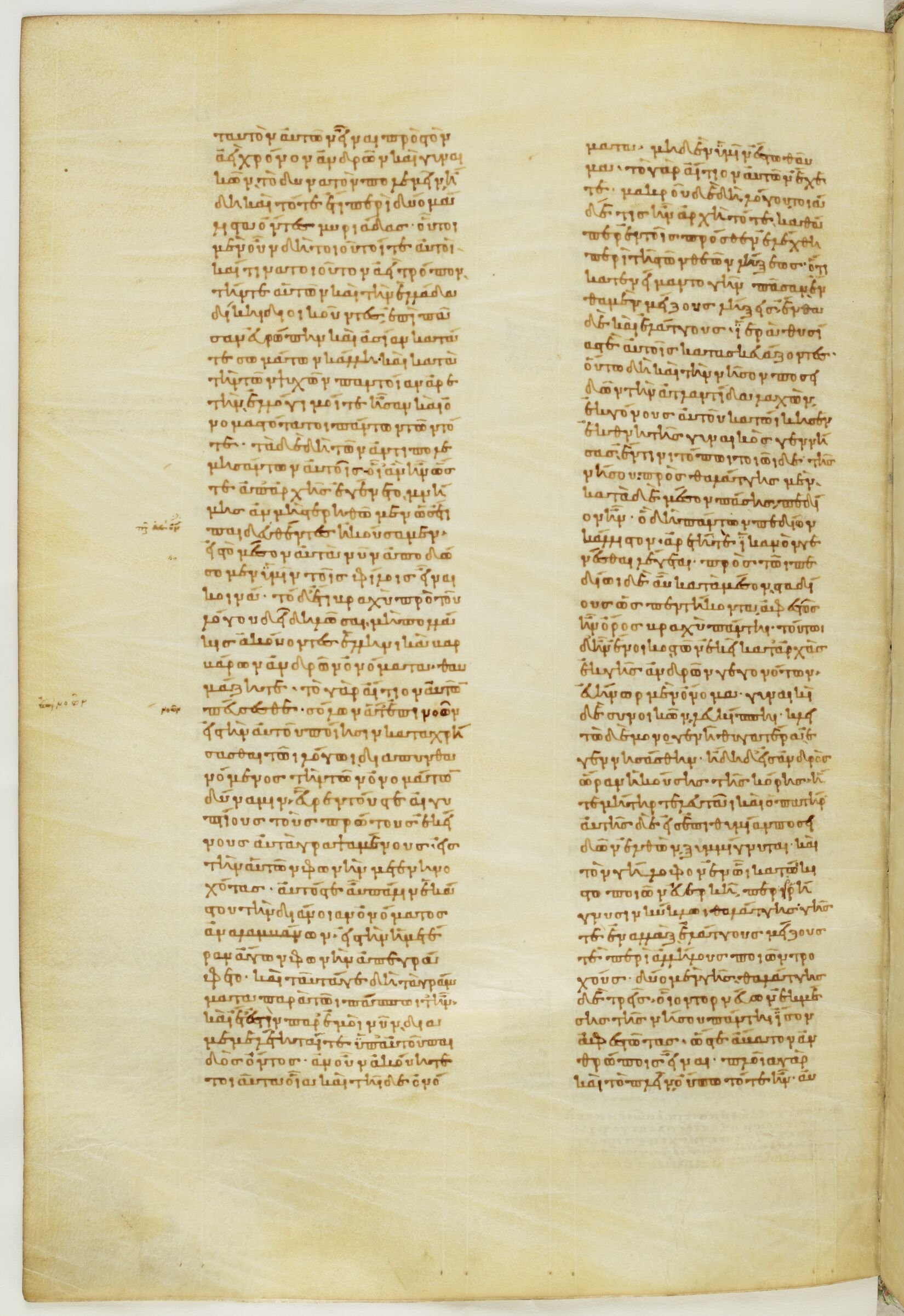
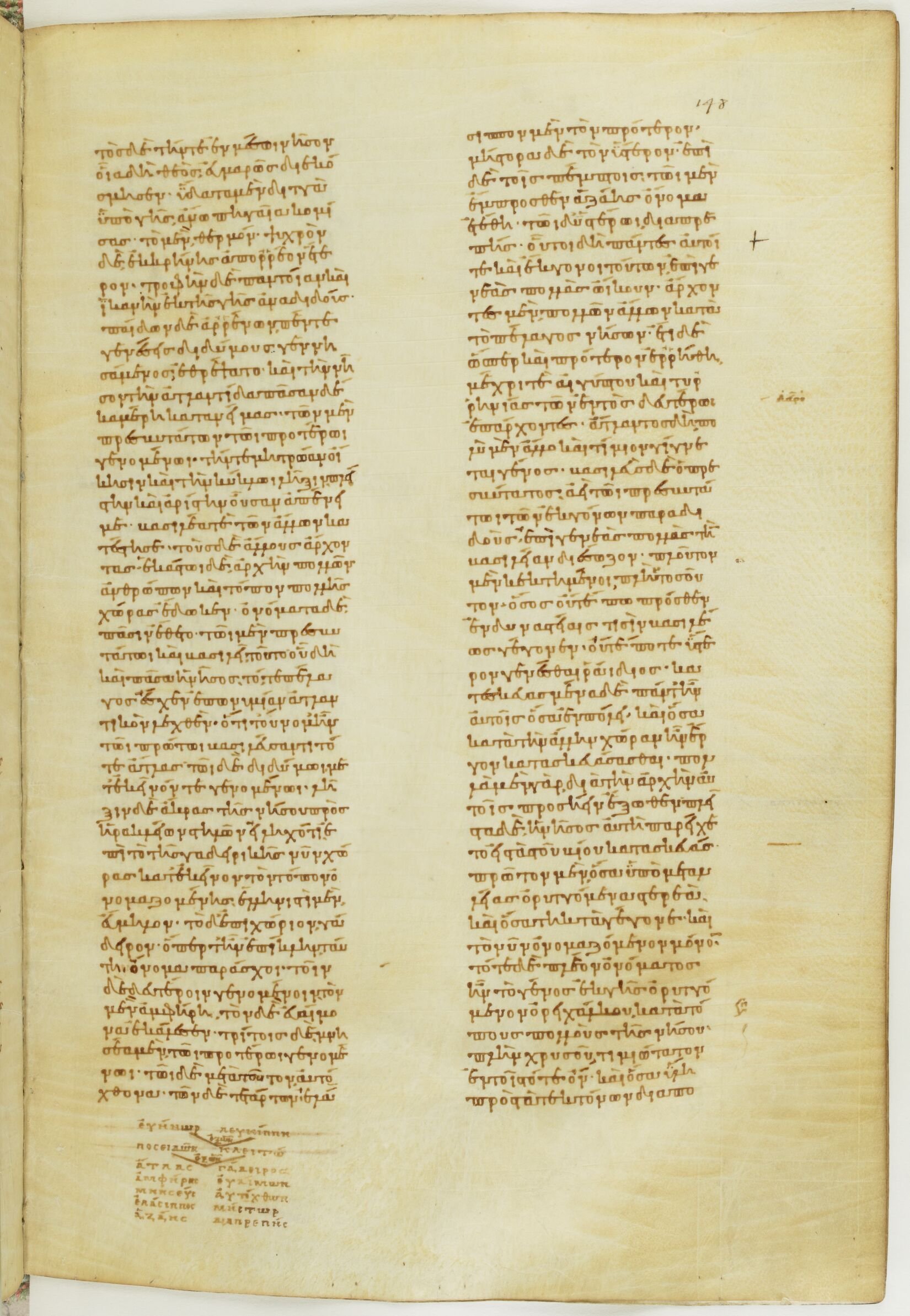
The manuscript is Paris, Bibliothèque nationale de France, grec 1807, known to editors as Plato A. It was copied in Constantinople around 850-875 by the scribe of the so-called philosophical collection, and is the oldest surviving medieval manuscript of the Timaeus and Critias (tetralogies VIII-IX: Clitophon, Republic, Timaeus, Critias, Minos, Laws, Epinomis, Letters). Each page has two columns of 44 lines. The Timaeus fills fol. 114r-144v and the Critias fol. 145r-151r.
On the manuscript this page of text runs over fol. 147v col. a to fol. 148r col. a. Each section below is linked to the folio side(s) that carry it. The mapping comes from reading the first words of every column on the images and finding them in Burnet's text: fol. 147v col. a begins ‹ταὐτὸν αὑτῶν εἶναι πρὸς τὸν ἀεὶ› (Crit. 112d); fol. 147v col. b begins ‹-ματα, μηδὲν ὑμῖν ἔστω θαῦμα· τὸ› (Crit. 113b); fol. 148r col. a begins ‹τήν τε ἐν μέσῳ νῆσον οἷα› (Crit. 113e).
The Greek is John Burnet's critical text (Oxford, 1902), not a transcription of this manuscript; the scribe's spelling, accents and occasional readings differ from it. The English is R. G. Bury's Loeb translation (1929).
How was this verified? (Provenance)
Where on the image
Crit. 113a stands in Paris gr. 1807, fol. 147v col. a. Checked on the image (column openings read on the BnF photographs and found in Burnet's text, quoted in Burnet's spelling): fol. 147v col. a begins ‹ταὐτὸν αὑτῶν εἶναι πρὸς τὸν ἀεὶ› (Crit. 112d).
τὸ δʼ ἔτι βραχὺ πρὸ τοῦ λόγου δεῖ δηλῶσαι, μὴ πολλάκις ἀκούοντες Ἑλληνικὰ βαρβάρων ἀνδρῶν ὀνόματα θαυμάζητε· τὸ γὰρ αἴτιον αὐτῶν πεύσεσθε. Σόλων, ἅτʼ ἐπινοῶν εἰς τὴν αὑτοῦ ποίησιν καταχρήσασθαι τῷ λόγῳ, διαπυνθανόμενος τὴν τῶν ὀνομάτων δύναμιν, ηὗρεν τούς τε Αἰγυπτίους τοὺς πρώτους ἐκείνους αὐτὰ γραψαμένους εἰς τὴν αὑτῶν φωνὴν μετενηνοχότας, αὐτός τε αὖ πάλιν ἑκάστου τὴν διάνοιαν ὀνόματος
But before I begin my account, there is still a small point which I ought to explain, lest you should be surprised at frequently hearing Greek names given to barbarians. The reason of this you shall now learn. Since Solon was planning to make use of the story for his own poetry, he had found, on investigating the meaning of the names, that those Egyptians who had first written them down had translated them into their own tongue. So he himself in turn recovered the original sense of each name and, rendering it into our tongue,
Where on the image
Crit. 113b stands in Paris gr. 1807, fol. 147v col. a to fol. 147v col. b. Checked on the image (column openings read on the BnF photographs and found in Burnet's text, quoted in Burnet's spelling): fol. 147v col. a begins ‹ταὐτὸν αὑτῶν εἶναι πρὸς τὸν ἀεὶ› (Crit. 112d); fol. 147v col. b begins ‹-ματα, μηδὲν ὑμῖν ἔστω θαῦμα· τὸ› (Crit. 113b).
ἀναλαμβάνων εἰς τὴν ἡμετέραν ἄγων φωνὴν ἀπεγράφετο· καὶ ταῦτά γε δὴ τὰ γράμματα παρὰ τῷ πάππῳ τʼ ἦν καὶ ἔτʼ ἐστὶν παρʼ ἐμοὶ νῦν, διαμεμελέτηταί τε ὑπʼ ἐμοῦ παιδὸς ὄντος. ἂν οὖν ἀκούητε τοιαῦτα οἷα καὶ τῇδε ὀνόματα, μηδὲν ὑμῖν ἔστω θαῦμα· τὸ γὰρ αἴτιον αὐτῶν ἔχετε. μακροῦ δὲ δὴ λόγου τοιάδε τις ἦν ἀρχὴ τότε. καθάπερ ἐν τοῖς πρόσθεν ἐλέχθη περὶ τῆς τῶν θεῶν λήξεως, ὅτι κατενείμαντο γῆν πᾶσαν ἔνθα μὲν μείζους
wrote it down so. And these very writings were in the possession of my grandfather and are actually now in mine, and when I was a child I learnt them all by heart. Therefore if the names you hear are just like our local names, do not be at all astonished; for now you know the reason for them. The story then told was a long one, and it began something like this. Like as we previously stated concerning the allotments of the Gods, that they portioned out the whole earth, here into larger allotments and there into smaller, and provided for themselves
Where on the image
Crit. 113c stands in Paris gr. 1807, fol. 147v col. b. Checked on the image (column openings read on the BnF photographs and found in Burnet's text, quoted in Burnet's spelling): fol. 147v col. b begins ‹-ματα, μηδὲν ὑμῖν ἔστω θαῦμα· τὸ› (Crit. 113b).
λήξεις, ἔνθα δὲ καὶ ἐλάττους, ἱερὰ θυσίας τε αὑτοῖς κατασκευάζοντες, οὕτω δὴ καὶ τὴν νῆσον Ποσειδῶν τὴν Ἀτλαντίδα λαχὼν ἐκγόνους αὑτοῦ κατῴκισεν ἐκ θνητῆς γυναικὸς γεννήσας ἔν τινι τόπῳ τοιῷδε τῆς νήσου. πρὸς θαλάττης μέν, κατὰ δὲ μέσον πάσης πεδίον ἦν, ὃ δὴ πάντων πεδίων κάλλιστον ἀρετῇ τε ἱκανὸν γενέσθαι λέγεται, πρὸς τῷ πεδίῳ δὲ αὖ κατὰ μέσον σταδίους ὡς πεντήκοντα ἀφεστὸς ἦν ὄρος βραχὺ πάντῃ. τούτῳ δʼ ἦν ἔνοικος τῶν ἐκεῖ κατὰ ἀρχὰς ἐκ
shrines and sacrifices, even so Poseidon took for his allotment the island of Atlantis and settled therein the children whom he had begotten of a mortal woman in a region of the island of the following description. Bordering on the sea and extending through the center of the whole island there was a plain, which is said to have been the fairest of all plains and highly fertile; and, moreover, near the plain, over against its center, at a distance of about 50 stades, there stood a mountain that was low on all sides. Thereon dwelt one of the natives originally sprung from the earth, Evenor by name,
Where on the image
Crit. 113d stands in Paris gr. 1807, fol. 147v col. b. Checked on the image (column openings read on the BnF photographs and found in Burnet's text, quoted in Burnet's spelling): fol. 147v col. b begins ‹-ματα, μηδὲν ὑμῖν ἔστω θαῦμα· τὸ› (Crit. 113b).
γῆς ἀνδρῶν γεγονότων Εὐήνωρ μὲν ὄνομα, γυναικὶ δὲ συνοικῶν Λευκίππῃ· Κλειτὼ δὲ μονογενῆ θυγατέρα ἐγεννησάσθην. ἤδη δʼ εἰς ἀνδρὸς ὥραν ἡκούσης τῆς κόρης ἥ τε μήτηρ τελευτᾷ καὶ ὁ πατήρ, αὐτῆς δὲ εἰς ἐπιθυμίαν Ποσειδῶν ἐλθὼν συμμείγνυται, καὶ τὸν γήλοφον, ἐν ᾧ κατῴκιστο, ποιῶν εὐερκῆ περιρρήγνυσιν κύκλῳ, θαλάττης γῆς τε ἐναλλὰξ ἐλάττους μείζους τε περὶ ἀλλήλους ποιῶν τροχούς, δύο μὲν γῆς, θαλάττης δὲ τρεῖς οἷον τορνεύων ἐκ μέσης τῆς νήσου,
with his wife Leucippe; and they had for offspring an only-begotten daughter, Cleito. And when this damsel was now come to marriageable age, her mother died and also her father; and Poseidon, being smitten with desire for her, wedded her; and to make the hill whereon she dwelt impregnable he broke it off all round about; and he made circular belts of sea and land enclosing one another alternately, some greater, some smaller, two being of land and three of sea, which he carved as it were out of the midst of the island; and these belts were at even distances on all sides, so as to be impassable for man;
Where on the image
Crit. 113e stands in Paris gr. 1807, fol. 147v col. b to fol. 148r col. a. Checked on the image (column openings read on the BnF photographs and found in Burnet's text, quoted in Burnet's spelling): fol. 147v col. b begins ‹-ματα, μηδὲν ὑμῖν ἔστω θαῦμα· τὸ› (Crit. 113b); fol. 148r col. a begins ‹τήν τε ἐν μέσῳ νῆσον οἷα› (Crit. 113e).
πάντῃ ἴσον ἀφεστῶτας, ὥστε ἄβατον ἀνθρώποις εἶναι· πλοῖα γὰρ καὶ τὸ πλεῖν οὔπω τότε ἦν. αὐτὸς δὲ τήν τε ἐν μέσῳ νῆσον οἷα δὴ θεὸς εὐμαρῶς διεκόσμησεν, ὕδατα μὲν διττὰ ὑπὸ γῆς ἄνω πηγαῖα κομίσας, τὸ μὲν θερμόν, ψυχρὸν δὲ ἐκ κρήνης ἀπορρέον ἕτερον, τροφὴν δὲ παντοίαν καὶ ἱκανὴν ἐκ τῆς γῆς ἀναδιδούς.
παίδων δὲ ἀρρένων πέντε γενέσεις διδύμους γεννησάμενος ἐθρέψατο, καὶ τὴν νῆσον τὴν Ἀτλαντίδα πᾶσαν δέκα μέρη κατανείμας τῶν μὲν πρεσβυτάτων τῷ προτέρῳ
for at that time neither ships nor sailing were as yet in existence. And Poseidon himself set in order with ease, as a god would, the central island, bringing up from beneath the earth two springs of waters, the one flowing warm from its source, the other cold, and producing out of the earth all kinds of food in plenty.
And he begat five pairs of twin sons and reared them up; and when he had divided all the island of Atlantis into ten portions, he assigned to the first-born of the eldest sons
Notes
- Greek: John Burnet, Platonis Opera IV (Oxford, 1902), via Perseus canonical-greekLit; Burnet's text is a critical edition, so its wording can differ from the manuscript shown.
- English: R. G. Bury, Plato IX (Loeb Classical Library, 1929), via Perseus. Bury's footnotes are not reproduced. Quotation marks stand where Perseus marks quoted speech.
- Stephanus sections (a-e) are those of the 1578 Stephanus edition as given by Burnet and Bury; Bury's section breaks can fall a few words away from Burnet's because English word order differs.
Cite
Sources
- Source: Paris, BnF grec 1807 (Plato A, c. 850-875) fol. 147v-148r via BnF IIIF + Burnet's Greek (Perseus) + R. G. Bury's English (Loeb 1929, Perseus) (holding institution)
- Critical edition: Burnet, Platonis Opera IV (1902), via Perseus
← previous · → next · v cycle view · l back to library