Plato, Critias 114a-114e: Atlas and the ten kings; the wealth of the island
Introduction
Stephanus page 114 of Plato's Critias (114a-114e): Atlas and the ten kings; the wealth of the island.
The Critias is Plato's full account of Atlantis and of the Athens that fought it: the land and city of ancient Athens (109b-112e), then the island of Atlantis, Poseidon's kingdom beyond the Pillars of Heracles, its royal city, plain, army and laws (113b-120d), and the moral decline of its kings (120e-121c). Plato left the dialogue unfinished; it stops in mid-sentence as Zeus begins to speak, and the manuscript shown here stops at the same words.
The manuscript is Paris, Bibliothèque nationale de France, grec 1807, known to editors as Plato A. It was copied in Constantinople around 850-875 by the scribe of the so-called philosophical collection, and is the oldest surviving medieval manuscript of the Timaeus and Critias (tetralogies VIII-IX: Clitophon, Republic, Timaeus, Critias, Minos, Laws, Epinomis, Letters). Each page has two columns of 44 lines. The Timaeus fills fol. 114r-144v and the Critias fol. 145r-151r.
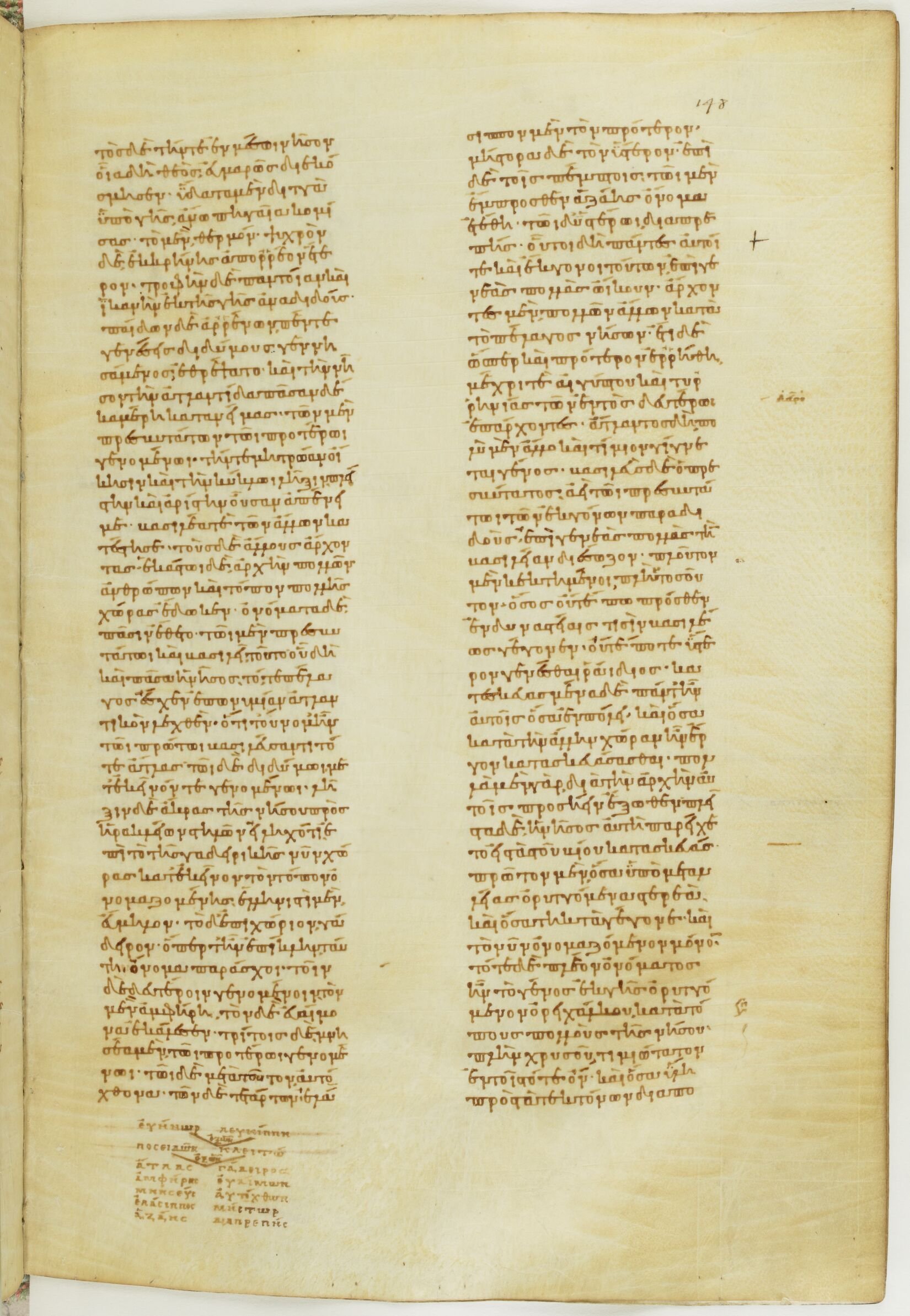
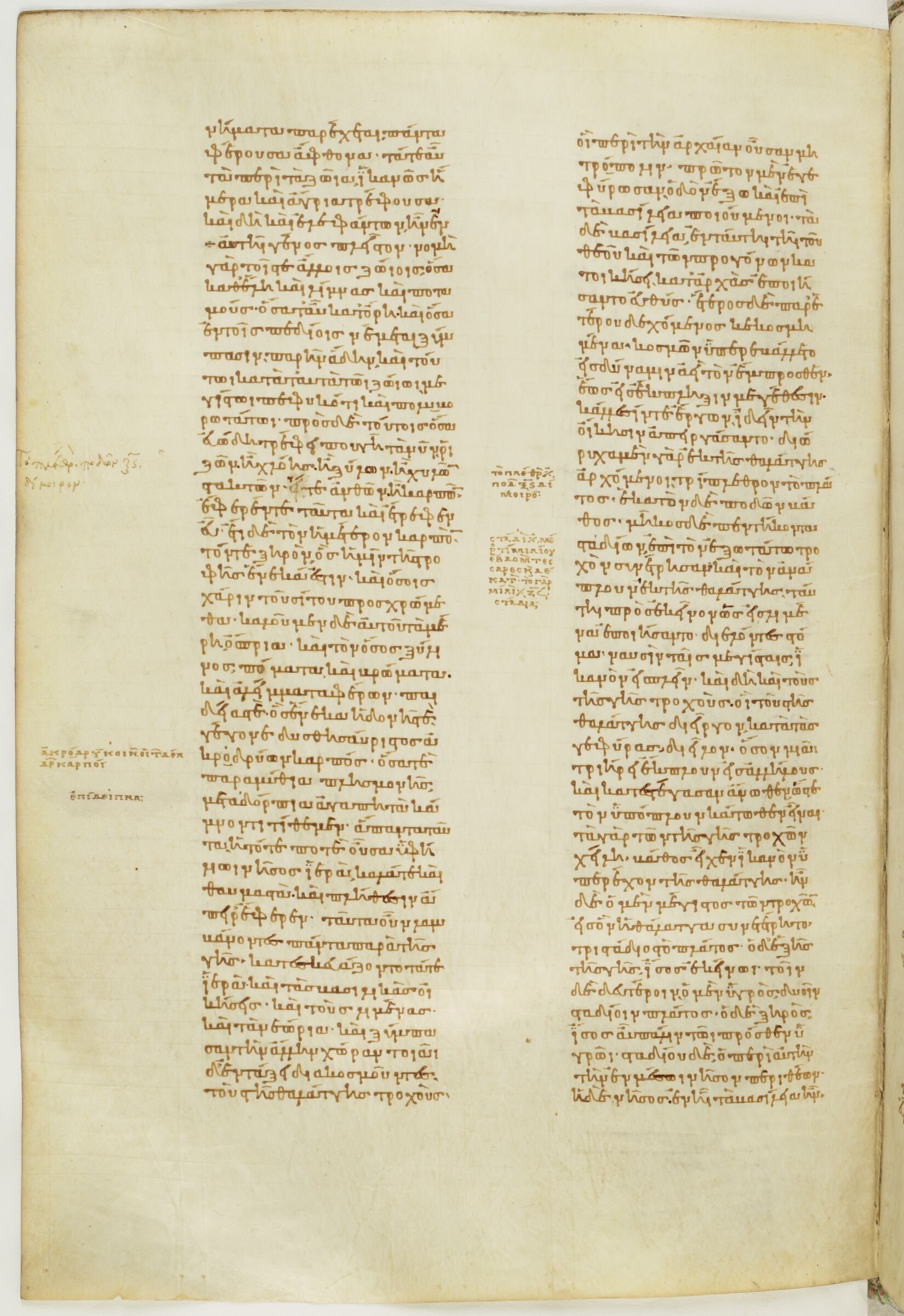
On the manuscript this page of text runs over fol. 148r col. a to fol. 148v col. a. Each section below is linked to the folio side(s) that carry it. The mapping comes from reading the first words of every column on the images and finding them in Burnet's text: fol. 148r col. a begins ‹τήν τε ἐν μέσῳ νῆσον οἷα› (Crit. 113e); fol. 148r col. b begins ‹-σιππον μὲν τὸν πρότερον, Μήστορα δὲ› (Crit. 114c); fol. 148v col. a begins ‹-νήματα παρέχεται, πάντα φέρουσα ἄφθονα, τά› (Crit. 114e).
The Greek is John Burnet's critical text (Oxford, 1902), not a transcription of this manuscript; the scribe's spelling, accents and occasional readings differ from it. The English is R. G. Bury's Loeb translation (1929).
How was this verified? (Provenance)
Where on the image
Crit. 114a stands in Paris gr. 1807, fol. 148r col. a. Checked on the image (column openings read on the BnF photographs and found in Burnet's text, quoted in Burnet's spelling): fol. 148r col. a begins ‹τήν τε ἐν μέσῳ νῆσον οἷα› (Crit. 113e).
γενομένῳ τήν τε μητρῴαν οἴκησιν καὶ τὴν κύκλῳ λῆξιν, πλείστην καὶ ἀρίστην οὖσαν, ἀπένειμε, βασιλέα τε τῶν ἄλλων κατέστησε, τοὺς δὲ ἄλλους ἄρχοντας, ἑκάστῳ δὲ ἀρχὴν πολλῶν ἀνθρώπων καὶ τόπον πολλῆς χώρας ἔδωκεν. ὀνόματα δὲ πᾶσιν ἔθετο, τῷ μὲν πρεσβυτάτῳ καὶ βασιλεῖ τοῦτο οὗ δὴ καὶ πᾶσα ἡ νῆσος τό τε πέλαγος ἔσχεν ἐπωνυμίαν, Ἀτλαντικὸν λεχθέν, ὅτι τοὔνομʼ ἦν τῷ πρώτῳ βασιλεύσαντι
his mother's dwelling and the allotment surrounding it, which was the largest and best; and him he appointed to be king over the rest, and the others to be rulers, granting to each the rule over many men and a large tract of country. And to all of them he gave names, giving to him that was eldest and king the name after which the whole island was called and the sea spoken of as the Atlantic, because the first king who then reigned had the name of Atlas. And the name of his younger twin-brother,
Where on the image
Crit. 114b stands in Paris gr. 1807, fol. 148r col. a. Checked on the image (column openings read on the BnF photographs and found in Burnet's text, quoted in Burnet's spelling): fol. 148r col. a begins ‹τήν τε ἐν μέσῳ νῆσον οἷα› (Crit. 113e).
τότε Ἄτλας· τῷ δὲ διδύμῳ μετʼ ἐκεῖνόν τε γενομένῳ, λῆξιν δὲ ἄκρας τῆς νήσου πρὸς Ἡρακλείων στηλῶν εἰληχότι ἐπὶ τὸ τῆς Γαδειρικῆς νῦν χώρας κατʼ ἐκεῖνον τὸν τόπον ὀνομαζομένης, Ἑλληνιστὶ μὲν Εὔμηλον, τὸ δʼ ἐπιχώριον Γάδειρον, ὅπερ τʼ ἦν ἐπίκλην ταύτῃ ὄνομʼ ἂν παράσχοι. τοῖν δὲ δευτέροιν γενομένοιν τὸν μὲν Ἀμφήρη, τὸν δὲ Εὐαίμονα ἐκάλεσεν· τρίτοις δέ, Μνησέα μὲν τῷ προτέρῳ γενομένῳ,
who had for his portion the extremity of the island near the pillars of Heracles up to the part of the country now called Gadeira after the name of that region, was Eumelus in Greek, but in the native tongue Gadeirus,—which fact may have given its title to the country. And of the pair that were born next he called the one Ampheres and the other Evaemon; and of the third pair the elder was named Mneseus
Where on the image
Crit. 114c stands in Paris gr. 1807, fol. 148r col. a to fol. 148r col. b. Checked on the image (column openings read on the BnF photographs and found in Burnet's text, quoted in Burnet's spelling): fol. 148r col. a begins ‹τήν τε ἐν μέσῳ νῆσον οἷα› (Crit. 113e); fol. 148r col. b begins ‹-σιππον μὲν τὸν πρότερον, Μήστορα δὲ› (Crit. 114c).
τῷ δὲ μετὰ τοῦτον Αὐτόχθονα· τῶν δὲ τετάρτων Ἐλάσιππον μὲν τὸν πρότερον, Μήστορα δὲ τὸν ὕστερον· ἐπὶ δὲ τοῖς πέμπτοις τῷ μὲν ἔμπροσθεν Ἀζάης ὄνομα ἐτέθη, τῷ δʼ ὑστέρῳ Διαπρέπης. οὗτοι δὴ πάντες αὐτοί τε καὶ ἔκγονοι τούτων ἐπὶ γενεὰς πολλὰς ᾤκουν ἄρχοντες μὲν πολλῶν ἄλλων κατὰ τὸ πέλαγος νήσων, ἔτι δέ, ὥσπερ καὶ πρότερον ἐρρήθη, μέχρι τε Αἰγύπτου καὶ Τυρρηνίας τῶν ἐντὸς δεῦρο ἐπάρχοντες.
and the younger Autochthon; and of the fourth pair, he called the first Elasippus and the second Mestor; and of the fifth pair, Azaes was the name given to the elder, and Diaprepes to the second. So all these, themselves and their descendants, dwelt for many generations bearing rule over many other islands throughout the sea, and holding sway besides, as was previously stated, over the Mediterranean peoples as far as Egypt and Tuscany. Now a large family of distinguished sons sprang from Atlas;
Where on the image
Crit. 114d stands in Paris gr. 1807, fol. 148r col. b. Checked on the image (column openings read on the BnF photographs and found in Burnet's text, quoted in Burnet's spelling): fol. 148r col. b begins ‹-σιππον μὲν τὸν πρότερον, Μήστορα δὲ› (Crit. 114c).
Ἄτλαντος δὴ πολὺ μὲν ἄλλο καὶ τίμιον γίγνεται γένος, βασιλεὺς δὲ ὁ πρεσβύτατος ἀεὶ τῷ πρεσβυτάτῳ τῶν ἐκγόνων παραδιδοὺς ἐπὶ γενεὰς πολλὰς τὴν βασιλείαν διέσῳζον, πλοῦτον μὲν κεκτημένοι πλήθει τοσοῦτον, ὅσος οὔτε πω πρόσθεν ἐν δυναστείαις τισὶν βασιλέων γέγονεν οὔτε ποτὲ ὕστερον γενέσθαι ῥᾴδιος, κατεσκευασμένα δὲ πάντʼ ἦν αὐτοῖς ὅσα ἐν πόλει καὶ ὅσα κατὰ τὴν ἄλλην χώραν ἦν ἔργον κατασκευάσασθαι. πολλὰ μὲν γὰρ διὰ τὴν ἀρχὴν αὐτοῖς προσῄειν
but it was the eldest, who, as king, always passed on the scepter to the eldest of his sons, and thus they preserved the sovereignty for many generations; and the wealth they possessed was so immense that the like had never been seen before in any royal house nor will ever easily be seen again; and they were provided with everything of which provision was needed either in the city or throughout the rest of the country. For because of their headship they had a large supply of imports from abroad,
Where on the image
Crit. 114e stands in Paris gr. 1807, fol. 148r col. b to fol. 148v col. a. Checked on the image (column openings read on the BnF photographs and found in Burnet's text, quoted in Burnet's spelling): fol. 148r col. b begins ‹-σιππον μὲν τὸν πρότερον, Μήστορα δὲ› (Crit. 114c); fol. 148v col. a begins ‹-νήματα παρέχεται, πάντα φέρουσα ἄφθονα, τά› (Crit. 114e).
ἔξωθεν, πλεῖστα δὲ ἡ νῆσος αὐτὴ παρείχετο εἰς τὰς τοῦ βίου κατασκευάς, πρῶτον μὲν ὅσα ὑπὸ μεταλλείας ὀρυττόμενα στερεὰ καὶ ὅσα τηκτὰ γέγονε, καὶ τὸ νῦν ὀνομαζόμενον μόνον—τότε δὲ πλέον ὀνόματος ἦν τὸ γένος ἐκ γῆς ὀρυττόμενον ὀρειχάλκου κατὰ τόπους πολλοὺς τῆς νήσου, πλὴν χρυσοῦ τιμιώτατον ἐν τοῖς τότε ὄν—καὶ ὅσα ὕλη πρὸς τὰ τεκτόνων διαπονήματα παρέχεται, πάντα φέρουσα ἄφθονα, τά τε αὖ περὶ τὰ ζῷα ἱκανῶς ἥμερα καὶ ἄγρια τρέφουσα.
καὶ δὴ καὶ ἐλεφάντων ἦν ἐν αὐτῇ γένος πλεῖστον· νομὴ γὰρ τοῖς τε ἄλλοις ζῴοις, ὅσα καθʼ ἕλη καὶ λίμνας καὶ ποταμούς, ὅσα
and the island itself furnished most of the requirements of daily life,—metals, to begin with, both the hard kind and the fusible kind, which are extracted by mining, and also that kind which is now known only by name but was more than a name then, there being mines of it in many places of the island,—I mean orichalcum, which was the most precious of the metals then known, except gold. It brought forth also in abundance all the timbers that a forest provides for the labors of carpenters; and of animals it produced a sufficiency, both of tame and wild.
Moreover, it contained a very large stock of elephants; for there was an ample food-supply not only for all the other animals which haunt the marshes and lakes and rivers,
Notes
- Greek: John Burnet, Platonis Opera IV (Oxford, 1902), via Perseus canonical-greekLit; Burnet's text is a critical edition, so its wording can differ from the manuscript shown.
- English: R. G. Bury, Plato IX (Loeb Classical Library, 1929), via Perseus. Bury's footnotes are not reproduced. Quotation marks stand where Perseus marks quoted speech.
- Stephanus sections (a-e) are those of the 1578 Stephanus edition as given by Burnet and Bury; Bury's section breaks can fall a few words away from Burnet's because English word order differs.
Cite
Sources
- Source: Paris, BnF grec 1807 (Plato A, c. 850-875) fol. 148r-148v via BnF IIIF + Burnet's Greek (Perseus) + R. G. Bury's English (Loeb 1929, Perseus) (holding institution)
- Critical edition: Burnet, Platonis Opera IV (1902), via Perseus
← previous · → next · v cycle view · l back to library