Plato, Critias 115a-115e: the produce of Atlantis; bridges and canals through the rings
Introduction
Stephanus page 115 of Plato's Critias (115a-115e): the produce of Atlantis; bridges and canals through the rings.
The Critias is Plato's full account of Atlantis and of the Athens that fought it: the land and city of ancient Athens (109b-112e), then the island of Atlantis, Poseidon's kingdom beyond the Pillars of Heracles, its royal city, plain, army and laws (113b-120d), and the moral decline of its kings (120e-121c). Plato left the dialogue unfinished; it stops in mid-sentence as Zeus begins to speak, and the manuscript shown here stops at the same words.
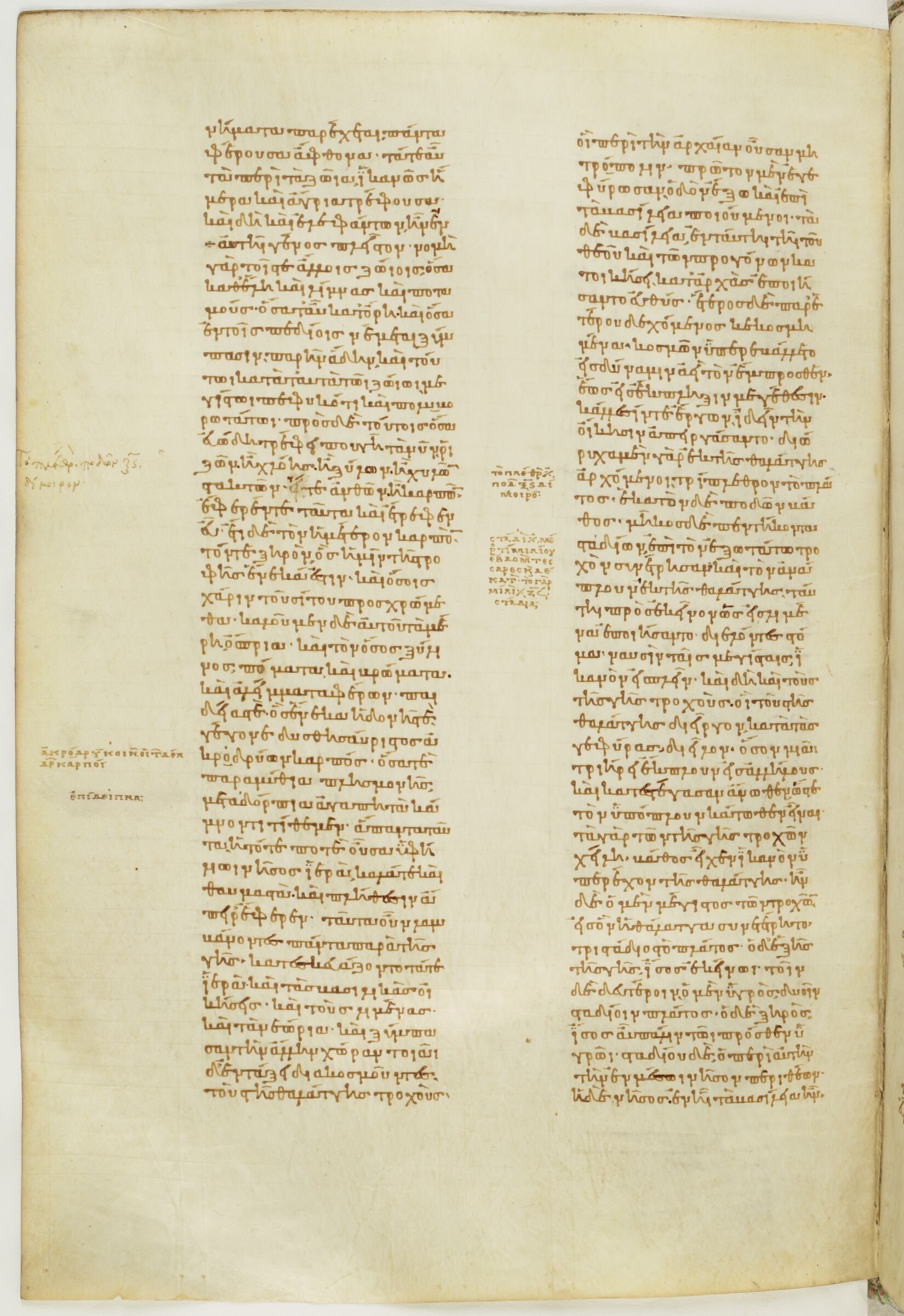
The manuscript is Paris, Bibliothèque nationale de France, grec 1807, known to editors as Plato A. It was copied in Constantinople around 850-875 by the scribe of the so-called philosophical collection, and is the oldest surviving medieval manuscript of the Timaeus and Critias (tetralogies VIII-IX: Clitophon, Republic, Timaeus, Critias, Minos, Laws, Epinomis, Letters). Each page has two columns of 44 lines. The Timaeus fills fol. 114r-144v and the Critias fol. 145r-151r.
On the manuscript this page of text runs over fol. 148v col. a to fol. 148v col. b. Each section below is linked to the folio side(s) that carry it. The mapping comes from reading the first words of every column on the images and finding them in Burnet's text: fol. 148v col. a begins ‹-νήματα παρέχεται, πάντα φέρουσα ἄφθονα, τά› (Crit. 114e); fol. 148v col. b begins ‹τὴν ἀρχαίαν ἦσαν μητρόπολιν, πρῶτον μὲν› (Crit. 115c).
The Greek is John Burnet's critical text (Oxford, 1902), not a transcription of this manuscript; the scribe's spelling, accents and occasional readings differ from it. The English is R. G. Bury's Loeb translation (1929).
How was this verified? (Provenance)
Where on the image
Crit. 115a stands in Paris gr. 1807, fol. 148v col. a. Checked on the image (column openings read on the BnF photographs and found in Burnet's text, quoted in Burnet's spelling): fol. 148v col. a begins ‹-νήματα παρέχεται, πάντα φέρουσα ἄφθονα, τά› (Crit. 114e).
τʼ αὖ κατʼ ὄρη καὶ ὅσα ἐν τοῖς πεδίοις νέμεται, σύμπασιν παρῆν ἅδην, καὶ τούτῳ κατὰ ταὐτὰ τῷ ζῴῳ, μεγίστῳ πεφυκότι καὶ πολυβορωτάτῳ. πρὸς δὲ τούτοις, ὅσα εὐώδη τρέφει που γῆ τὰ νῦν, ῥιζῶν ἢ χλόης ἢ ξύλων ἢ χυλῶν στακτῶν εἴτε ἀνθῶν ἢ καρπῶν, ἔφερέν τε ταῦτα καὶ ἔτρεφεν εὖ· ἔτι δὲ τὸν ἥμερον καρπόν, τόν τε ξηρόν, ὃς ἡμῖν τῆς τροφῆς ἕνεκά ἐστιν, καὶ ὅσοις χάριν τοῦ σίτου προσχρώμεθα—καλοῦμεν δὲ αὐτοῦ
or the mountains or the plains, but likewise also for this animal, which of its nature is the largest and most voracious. And in addition to all this, it produced and brought to perfection all those sweet-scented stuffs which the earth produces now, whether made of roots or herbs or trees, or of liquid gums derived from flowers or fruits. The cultivated fruit also, and the dry, which serves us for nutriment, and all the other kinds that we use for our meals—the various species of which are comprehended under the name vegetables—
Where on the image
Crit. 115b stands in Paris gr. 1807, fol. 148v col. a. Checked on the image (column openings read on the BnF photographs and found in Burnet's text, quoted in Burnet's spelling): fol. 148v col. a begins ‹-νήματα παρέχεται, πάντα φέρουσα ἄφθονα, τά› (Crit. 114e).
τὰ μέρη σύμπαντα ὄσπρια—καὶ τὸν ὅσος ξύλινος, πώματα καὶ βρώματα καὶ ἀλείμματα φέρων, παιδιᾶς τε ὃς ἕνεκα ἡδονῆς τε γέγονε δυσθησαύριστος ἀκροδρύων καρπός, ὅσα τε παραμύθια πλησμονῆς μεταδόρπια ἀγαπητὰ κάμνοντι τίθεμεν, ἅπαντα ταῦτα ἡ τότε ποτὲ οὖσα ὑφʼ ἡλίῳ νῆσος ἱερὰ καλά τε καὶ θαυμαστὰ καὶ πλήθεσιν ἄπειρʼ ἔφερεν. ταῦτα οὖν λαμβάνοντες πάντα παρὰ τῆς γῆς κατεσκευάζοντο τά τε
and all the produce of trees which affords liquid and solid food and unguents, and the fruit of the orchard-trees, so hard to store, which is grown for the sake of amusement and pleasure, and all the after-dinner fruits that we serve up as welcome remedies for the sufferer from repletion,—all these that hallowed island, as it lay then beneath the sun, produced in marvellous beauty and endless abundance. And thus, receiving from the earth all these products, they furnished forth
Where on the image
Crit. 115c stands in Paris gr. 1807, fol. 148v col. a to fol. 148v col. b. Checked on the image (column openings read on the BnF photographs and found in Burnet's text, quoted in Burnet's spelling): fol. 148v col. a begins ‹-νήματα παρέχεται, πάντα φέρουσα ἄφθονα, τά› (Crit. 114e); fol. 148v col. b begins ‹τὴν ἀρχαίαν ἦσαν μητρόπολιν, πρῶτον μὲν› (Crit. 115c).
ἱερὰ καὶ τὰς βασιλικὰς οἰκήσεις καὶ τοὺς λιμένας καὶ τὰ νεώρια καὶ σύμπασαν τὴν ἄλλην χώραν, τοιᾷδʼ ἐν τάξει διακοσμοῦντες. τοὺς τῆς θαλάττης τροχούς, οἳ περὶ τὴν ἀρχαίαν ἦσαν μητρόπολιν, πρῶτον μὲν ἐγεφύρωσαν, ὁδὸν ἔξω καὶ ἐπὶ τὰ βασίλεια ποιούμενοι. τὰ δὲ βασίλεια ἐν ταύτῃ τῇ τοῦ θεοῦ καὶ τῶν προγόνων κατοικήσει κατʼ ἀρχὰς ἐποιήσαντο εὐθύς, ἕτερος δὲ παρʼ ἑτέρου δεχόμενος, κεκοσμημένα κοσμῶν,
their temples and royal dwellings, their harbors and their docks, and all the rest of their country, ordering all in the fashion following. First of all they bridged over the circles of sea which surrounded the ancient metropolis, making thereby a road towards and from the royal palace. And they had built the palace at the very beginning where the settlement was first made by their God and their ancestors; and as each king received it from his predecessor, he added to its adornment
Where on the image
Crit. 115d stands in Paris gr. 1807, fol. 148v col. b. Checked on the image (column openings read on the BnF photographs and found in Burnet's text, quoted in Burnet's spelling): fol. 148v col. b begins ‹τὴν ἀρχαίαν ἦσαν μητρόπολιν, πρῶτον μὲν› (Crit. 115c).
ὑπερεβάλλετο εἰς δύναμιν ἀεὶ τὸν ἔμπροσθεν, ἕως εἰς ἔκπληξιν μεγέθεσιν κάλλεσίν τε ἔργων ἰδεῖν τὴν οἴκησιν ἀπηργάσαντο. διώρυχα μὲν γὰρ ἐκ τῆς θαλάττης ἀρχόμενοι τρίπλεθρον τὸ πλάτος, ἑκατὸν δὲ ποδῶν βάθος, μῆκος δὲ πεντήκοντα σταδίων, ἐπὶ τὸν ἐξωτάτω τροχὸν συνέτρησαν, καὶ τὸν ἀνάπλουν ἐκ τῆς θαλάττης ταύτῃ πρὸς ἐκεῖνον ὡς εἰς λιμένα ἐποιήσαντο, διελόντες στόμα ναυσὶν ταῖς μεγίσταις ἱκανὸν εἰσπλεῖν. καὶ δὴ καὶ τοὺς τῆς γῆς τροχούς, οἳ τοὺς
and did all he could to surpass the king before him, until finally they made of it an abode amazing to behold for the magnitude and beauty of its workmanship. For, beginning at the sea, they bored a channel right through to the outermost circle, which was three plethra in breadth, one hundred feet in depth, and fifty stades in length; and thus they made the entrance to it from the sea like that to a harbor by opening out a mouth large enough for the greatest ships to sail through. Moreover, through the circles of land,
Where on the image
Crit. 115e stands in Paris gr. 1807, fol. 148v col. b. Checked on the image (column openings read on the BnF photographs and found in Burnet's text, quoted in Burnet's spelling): fol. 148v col. b begins ‹τὴν ἀρχαίαν ἦσαν μητρόπολιν, πρῶτον μὲν› (Crit. 115c).
τῆς θαλάττης διεῖργον, κατὰ τὰς γεφύρας διεῖλον ὅσον μιᾷ τριήρει διέκπλουν εἰς ἀλλήλους, καὶ κατεστέγασαν ἄνωθεν ὥστε τὸν ὑπόπλουν κάτωθεν εἶναι· τὰ γὰρ τῶν τῆς γῆς τροχῶν χείλη βάθος εἶχεν ἱκανὸν ὑπερέχον τῆς θαλάττης. ἦν δὲ ὁ μὲν μέγιστος τῶν τροχῶν, εἰς ὃν ἡ θάλαττα συνετέτρητο, τριστάδιος τὸ πλάτος, ὁ δʼ ἑξῆς τῆς γῆς ἴσος ἐκείνῳ· τοῖν δὲ δευτέροιν ὁ μὲν ὑγρὸς δυοῖν σταδίοιν πλάτος, ὁ δὲ ξηρὸς ἴσος αὖ πάλιν τῷ πρόσθεν ὑγρῷ· σταδίου δὲ ὁ
which divided those of sea, over against the bridges they opened out a channel leading from circle to circle, large enough to give passage to a single trireme; and this they roofed over above so that the sea-way was subterranean; for the lips of the landcircles were raised a sufficient height above the level of the sea. The greatest of the circles into which a boring was made for the sea was three stades in breadth, and the circle of land next to it was of equal breadth; and of the second pair of circles that of water was two stades in breadth and that of dry land equal again to the preceding one of water; and the circle which ran round the central island itself was of a stade's breadth.
And this island,
Notes
- Greek: John Burnet, Platonis Opera IV (Oxford, 1902), via Perseus canonical-greekLit; Burnet's text is a critical edition, so its wording can differ from the manuscript shown.
- English: R. G. Bury, Plato IX (Loeb Classical Library, 1929), via Perseus. Bury's footnotes are not reproduced. Quotation marks stand where Perseus marks quoted speech.
- Stephanus sections (a-e) are those of the 1578 Stephanus edition as given by Burnet and Bury; Bury's section breaks can fall a few words away from Burnet's because English word order differs.
Cite
Sources
- Source: Paris, BnF grec 1807 (Plato A, c. 850-875) fol. 148v via BnF IIIF + Burnet's Greek (Perseus) + R. G. Bury's English (Loeb 1929, Perseus) (holding institution)
- Critical edition: Burnet, Platonis Opera IV (1902), via Perseus
← previous · → next · v cycle view · l back to library