Plato, Critias 116a-116e: the walls, the royal citadel and the temple of Poseidon
Introduction
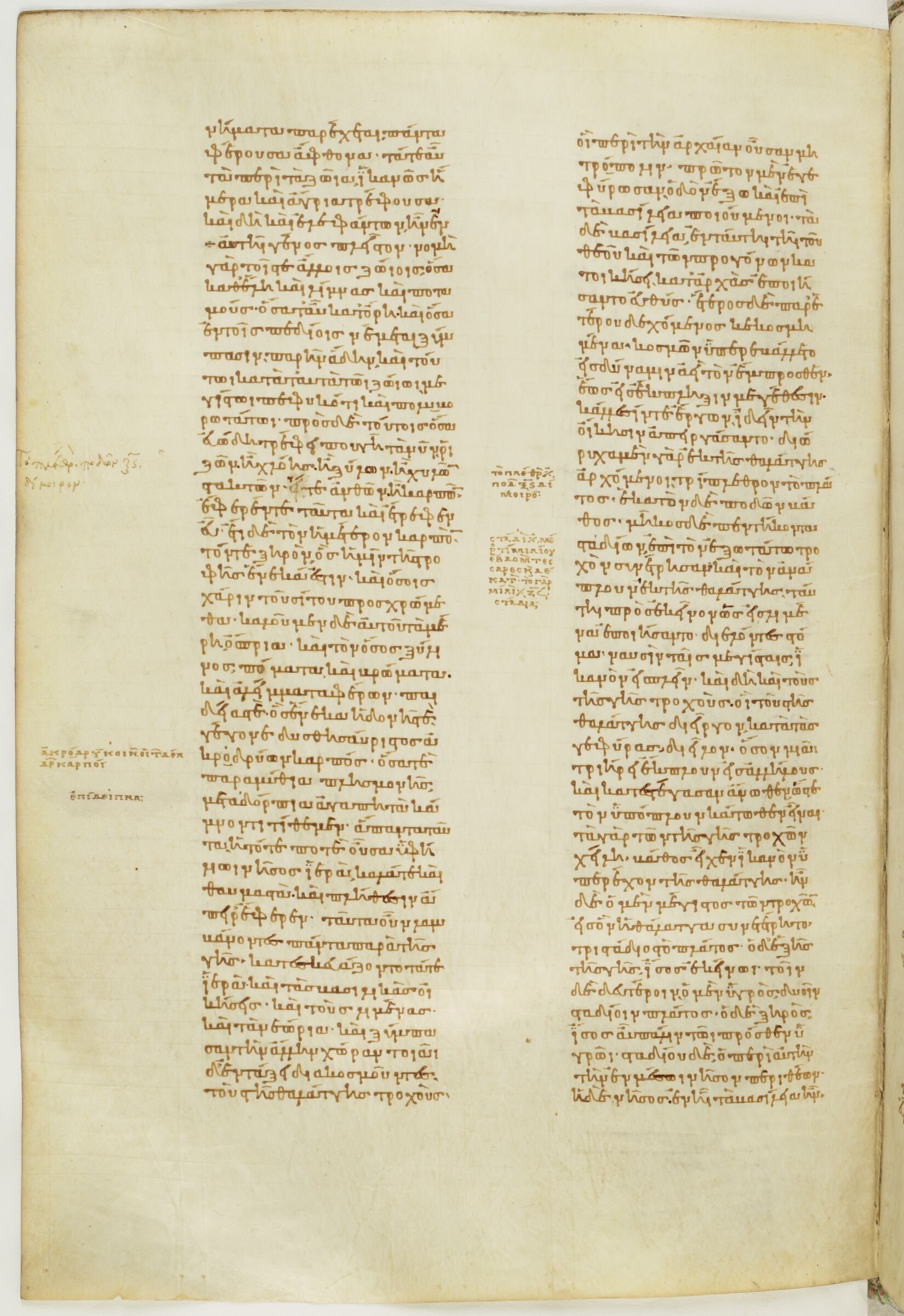
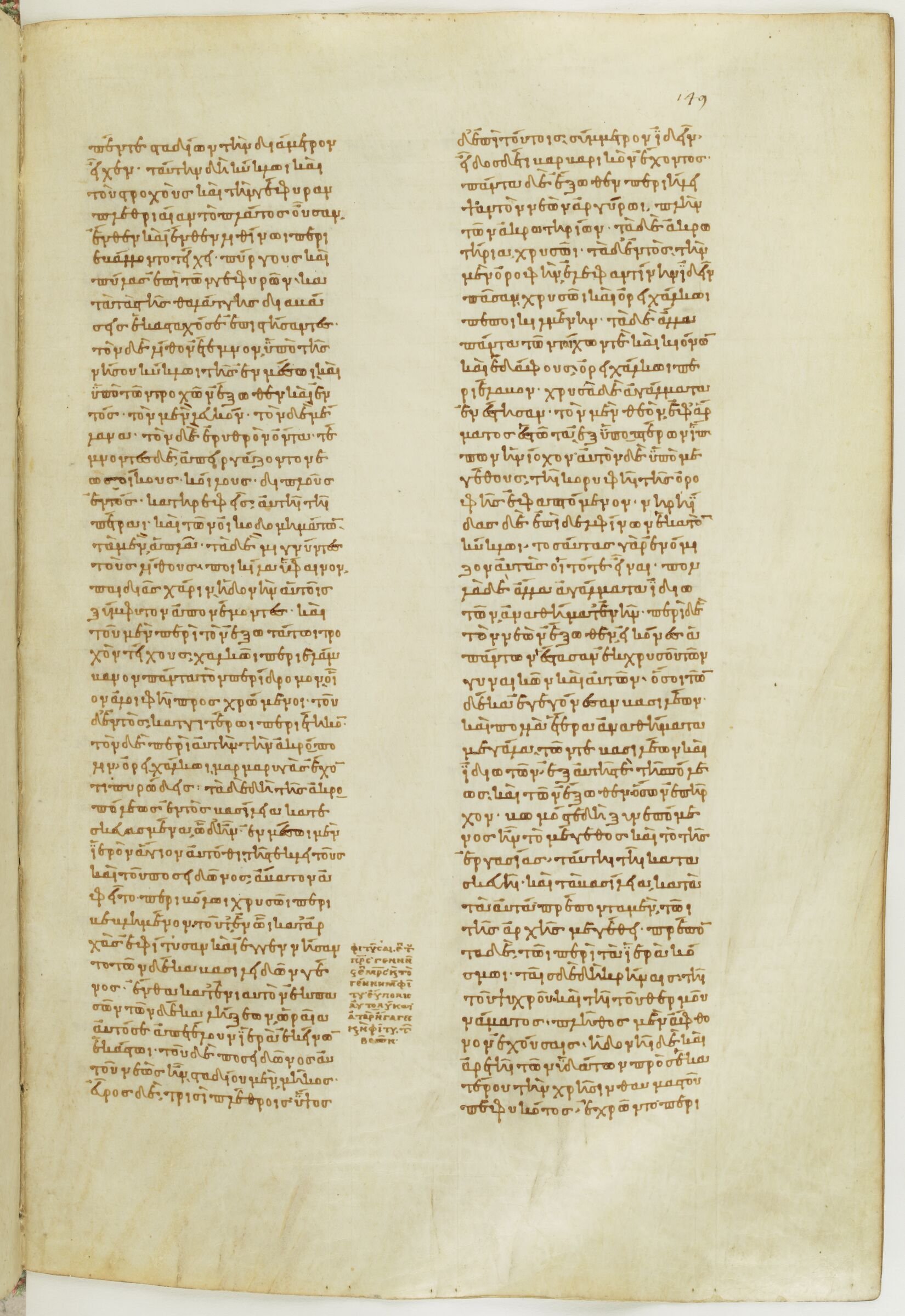
Stephanus page 116 of Plato's Critias (116a-116e): the walls, the royal citadel and the temple of Poseidon.
The Critias is Plato's full account of Atlantis and of the Athens that fought it: the land and city of ancient Athens (109b-112e), then the island of Atlantis, Poseidon's kingdom beyond the Pillars of Heracles, its royal city, plain, army and laws (113b-120d), and the moral decline of its kings (120e-121c). Plato left the dialogue unfinished; it stops in mid-sentence as Zeus begins to speak, and the manuscript shown here stops at the same words.
The manuscript is Paris, Bibliothèque nationale de France, grec 1807, known to editors as Plato A. It was copied in Constantinople around 850-875 by the scribe of the so-called philosophical collection, and is the oldest surviving medieval manuscript of the Timaeus and Critias (tetralogies VIII-IX: Clitophon, Republic, Timaeus, Critias, Minos, Laws, Epinomis, Letters). Each page has two columns of 44 lines. The Timaeus fills fol. 114r-144v and the Critias fol. 145r-151r.
On the manuscript this page of text runs over fol. 148v col. b to fol. 149r col. b. Each section below is linked to the folio side(s) that carry it. The mapping comes from reading the first words of every column on the images and finding them in Burnet's text: fol. 148v col. b begins ‹τὴν ἀρχαίαν ἦσαν μητρόπολιν, πρῶτον μὲν› (Crit. 115c); fol. 149r col. a begins ‹πέντε σταδίων τὴν διάμετρον εἶχεν. ταύτην› (Crit. 116a); fol. 149r col. b begins ‹δʼ ἐπὶ τούτοις σύμμετρον ἰδεῖν, εἶδος› (Crit. 116d).
The Greek is John Burnet's critical text (Oxford, 1902), not a transcription of this manuscript; the scribe's spelling, accents and occasional readings differ from it. The English is R. G. Bury's Loeb translation (1929).
How was this verified? (Provenance)
Where on the image
Crit. 116a stands in Paris gr. 1807, fol. 148v col. b to fol. 149r col. a. Checked on the image (column openings read on the BnF photographs and found in Burnet's text, quoted in Burnet's spelling): fol. 148v col. b begins ‹τὴν ἀρχαίαν ἦσαν μητρόπολιν, πρῶτον μὲν› (Crit. 115c); fol. 149r col. a begins ‹πέντε σταδίων τὴν διάμετρον εἶχεν. ταύτην› (Crit. 116a).
περὶ αὐτὴν τὴν ἐν μέσῳ νῆσον περιθέων.
ἡ δὲ νῆσος, ἐν ᾗ τὰ βασίλεια ἦν, πέντε σταδίων τὴν διάμετρον εἶχεν. ταύτην δὴ κύκλῳ καὶ τοὺς τροχοὺς καὶ τὴν γέφυραν πλεθριαίαν τὸ πλάτος οὖσαν ἔνθεν καὶ ἔνθεν λιθίνῳ περιεβάλλοντο τείχει, πύργους καὶ πύλας ἐπὶ τῶν γεφυρῶν κατὰ τὰς τῆς θαλάττης διαβάσεις ἑκασταχόσε ἐπιστήσαντες· τὸν δὲ λίθον ἔτεμνον ὑπὸ τῆς νήσου κύκλῳ τῆς ἐν μέσῳ καὶ ὑπὸ τῶν τροχῶν ἔξωθεν καὶ ἐντός, τὸν μὲν λευκόν, τὸν δὲ μέλανα,
wherein stood the royal palace, was of five stades in diameter. Now the island and the circles and the bridge, which was a plethrum in breadth, they encompassed round about, on this side and on that, with a wall of stone; and upon the bridges on each side, over against the passages for the sea, they erected towers and gates. And the stone they quarried beneath the central island all round, and from beneath the outer and inner circles, some of it being white, some black
Where on the image
Crit. 116b stands in Paris gr. 1807, fol. 149r col. a. Checked on the image (column openings read on the BnF photographs and found in Burnet's text, quoted in Burnet's spelling): fol. 149r col. a begins ‹πέντε σταδίων τὴν διάμετρον εἶχεν. ταύτην› (Crit. 116a).
τὸν δὲ ἐρυθρὸν ὄντα, τέμνοντες δὲ ἅμʼ ἠργάζοντο νεωσοίκους κοίλους διπλοῦς ἐντός, κατηρεφεῖς αὐτῇ τῇ πέτρᾳ. καὶ τῶν οἰκοδομημάτων τὰ μὲν ἁπλᾶ, τὰ δὲ μειγνύντες τοὺς λίθους ποικίλα ὕφαινον παιδιᾶς χάριν, ἡδονὴν αὐτοῖς σύμφυτον ἀπονέμοντες· καὶ τοῦ μὲν περὶ τὸν ἐξωτάτω τροχὸν τείχους χαλκῷ περιελάμβανον πάντα τὸν περίδρομον, οἷον ἀλοιφῇ προσχρώμενοι, τοῦ δʼ ἐντὸς καττιτέρῳ περιέτηκον, τὸν δὲ
and some red; and while quarrying it they constructed two inner docks, hollowed out and roofed over by the native rock. And of the buildings some they framed of one simple color, in others they wove a pattern of many colors by blending the stones for the sake of ornament so as to confer upon the buildings a natural charm. And they covered with brass, as though with plaster, all the circumference of the wall which surrounded the outermost circle; and that of the inner one they coated with tin; and that which encompassed the acropolis itself
Where on the image
Crit. 116c stands in Paris gr. 1807, fol. 149r col. a. Checked on the image (column openings read on the BnF photographs and found in Burnet's text, quoted in Burnet's spelling): fol. 149r col. a begins ‹πέντε σταδίων τὴν διάμετρον εἶχεν. ταύτην› (Crit. 116a).
περὶ αὐτὴν τὴν ἀκρόπολιν ὀρειχάλκῳ μαρμαρυγὰς ἔχοντι πυρώδεις. τὰ δὲ δὴ τῆς ἀκροπόλεως ἐντὸς βασίλεια κατεσκευασμένα ὧδʼ ἦν. ἐν μέσῳ μὲν ἱερὸν ἅγιον αὐτόθι τῆς τε Κλειτοῦς καὶ τοῦ Ποσειδῶνος ἄβατον ἀφεῖτο, περιβόλῳ χρυσῷ περιβεβλημένον, τοῦτʼ ἐν ᾧ κατʼ ἀρχὰς ἐφίτυσαν καὶ ἐγέννησαν τὸ τῶν δέκα βασιλειδῶν γένος· ἔνθα καὶ κατʼ ἐνιαυτὸν ἐκ πασῶν τῶν δέκα λήξεων ὡραῖα αὐτόσε ἀπετέλουν ἱερὰ ἐκείνων ἑκάστῳ. τοῦ δὲ Ποσειδῶνος αὐτοῦ νεὼς ἦν, σταδίου
with orichalcum which sparkled like fire. The royal palace within the acropolis was arranged in this manner. In the center there stood a temple sacred to Cleito and Poseidon, which was reserved as holy ground, and encircled with a wall of gold; this being the very spot where at the beginning they had generated and brought to birth the family of the ten royal lines. Thither also they brought year by year from all the ten allotments their seasonable offerings to do sacrifice to each of those princes.
Where on the image
Crit. 116d stands in Paris gr. 1807, fol. 149r col. a to fol. 149r col. b. Checked on the image (column openings read on the BnF photographs and found in Burnet's text, quoted in Burnet's spelling): fol. 149r col. a begins ‹πέντε σταδίων τὴν διάμετρον εἶχεν. ταύτην› (Crit. 116a); fol. 149r col. b begins ‹δʼ ἐπὶ τούτοις σύμμετρον ἰδεῖν, εἶδος› (Crit. 116d).
μὲν μῆκος, εὖρος δὲ τρίπλεθρος, ὕψος δʼ ἐπὶ τούτοις σύμμετρον ἰδεῖν, εἶδος δέ τι βαρβαρικὸν ἔχοντος. πάντα δὲ ἔξωθεν περιήλειψαν τὸν νεὼν ἀργύρῳ, πλὴν τῶν ἀκρωτηρίων, τὰ δὲ ἀκρωτήρια χρυσῷ· τὰ δʼ ἐντός, τὴν μὲν ὀροφὴν ἐλεφαντίνην ἰδεῖν πᾶσαν χρυσῷ καὶ ἀργύρῳ καὶ ὀρειχάλκῳ πεποικιλμένην, τὰ δὲ ἄλλα πάντα τῶν τοίχων τε καὶ κιόνων καὶ ἐδάφους ὀρειχάλκῳ περιέλαβον. χρυσᾶ δὲ ἀγάλματα ἐνέστησαν, τὸν μὲν θεὸν ἐφʼ ἅρματος ἑστῶτα ἓξ ὑποπτέρων
And the temple of Poseidon himself was a stade in length, three plethra in breadth, and of a height which appeared symmetrical therewith; and there was something of the barbaric in its appearance. All the exterior of the temple they coated with silver, save only the pinnacles, and these they coated with gold. As to the interior, they made the roof all of ivory in appearance, variegated with gold and silver and orichalcum, and all the rest of the walls and pillars and floors they covered with orichalcum. And they placed therein golden statues, one being that of the God standing on a chariot and driving six
Where on the image
Crit. 116e stands in Paris gr. 1807, fol. 149r col. b. Checked on the image (column openings read on the BnF photographs and found in Burnet's text, quoted in Burnet's spelling): fol. 149r col. b begins ‹δʼ ἐπὶ τούτοις σύμμετρον ἰδεῖν, εἶδος› (Crit. 116d).
ἵππων ἡνίοχον, αὐτόν τε ὑπὸ μεγέθους τῇ κορυφῇ τῆς ὀροφῆς ἐφαπτόμενον, Νηρῇδας δὲ ἐπὶ δελφίνων ἑκατὸν κύκλῳ— τοσαύτας γὰρ ἐνόμιζον αὐτὰς οἱ τότε εἶναι—πολλὰ δʼ ἐντὸς ἄλλα ἀγάλματα ἰδιωτῶν ἀναθήματα ἐνῆν. περὶ δὲ τὸν νεὼν ἔξωθεν εἰκόνες ἁπάντων ἕστασαν ἐκ χρυσοῦ, τῶν γυναικῶν καὶ αὐτῶν ὅσοι τῶν δέκα ἐγεγόνεσαν βασιλέων, καὶ πολλὰ ἕτερα ἀναθήματα μεγάλα τῶν τε βασιλέων καὶ ἰδιωτῶν ἐξ αὐτῆς τε τῆς πόλεως καὶ τῶν ἔξωθεν ὅσων ἐπῆρχον.
βωμός
winged steeds, his own figure so tall as to touch the ridge of the roof, and round about him a hundred Nereids on dolphins (for that was the number of them as men then believed) ; and it contained also many other images, the votive offerings of private men. And outside, round about the temple, there stood images in gold of all the princes, both themselves and their wives, as many as were descended from the ten kings, together with many other votive offerings both of the kings and of private persons not only from the State itself but also from all the foreign peoples over whom they ruled.
And the altar,
Notes
- Greek: John Burnet, Platonis Opera IV (Oxford, 1902), via Perseus canonical-greekLit; Burnet's text is a critical edition, so its wording can differ from the manuscript shown.
- English: R. G. Bury, Plato IX (Loeb Classical Library, 1929), via Perseus. Bury's footnotes are not reproduced. Quotation marks stand where Perseus marks quoted speech.
- Stephanus sections (a-e) are those of the 1578 Stephanus edition as given by Burnet and Bury; Bury's section breaks can fall a few words away from Burnet's because English word order differs.
Cite
Sources
- Source: Paris, BnF grec 1807 (Plato A, c. 850-875) fol. 148v-149r via BnF IIIF + Burnet's Greek (Perseus) + R. G. Bury's English (Loeb 1929, Perseus) (holding institution)
- Critical edition: Burnet, Platonis Opera IV (1902), via Perseus
← previous · → next · v cycle view · l back to library