Plato, Critias 117a-117e: springs, baths, gardens, docks and the outer wall
Introduction
Stephanus page 117 of Plato's Critias (117a-117e): springs, baths, gardens, docks and the outer wall.
The Critias is Plato's full account of Atlantis and of the Athens that fought it: the land and city of ancient Athens (109b-112e), then the island of Atlantis, Poseidon's kingdom beyond the Pillars of Heracles, its royal city, plain, army and laws (113b-120d), and the moral decline of its kings (120e-121c). Plato left the dialogue unfinished; it stops in mid-sentence as Zeus begins to speak, and the manuscript shown here stops at the same words.
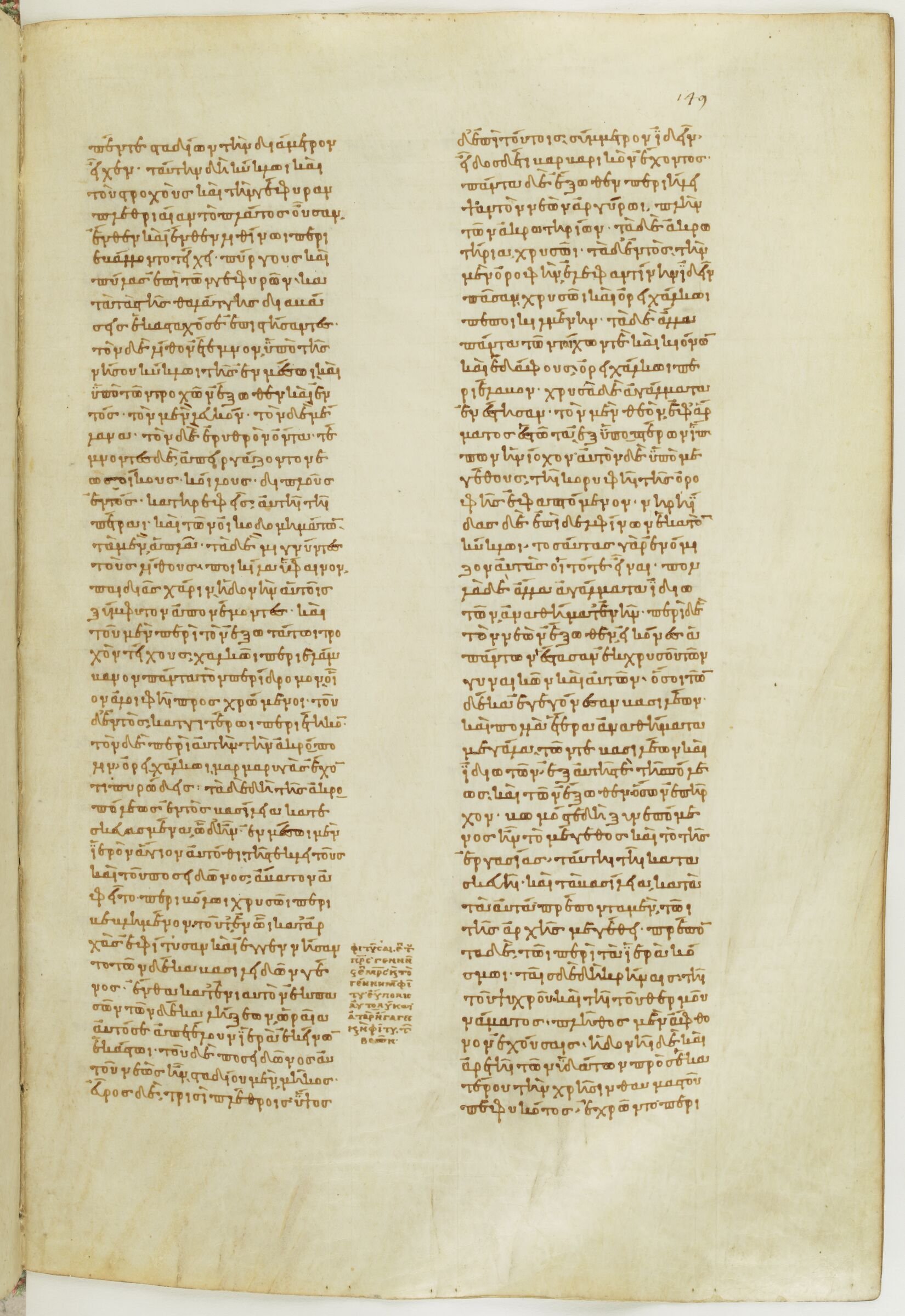
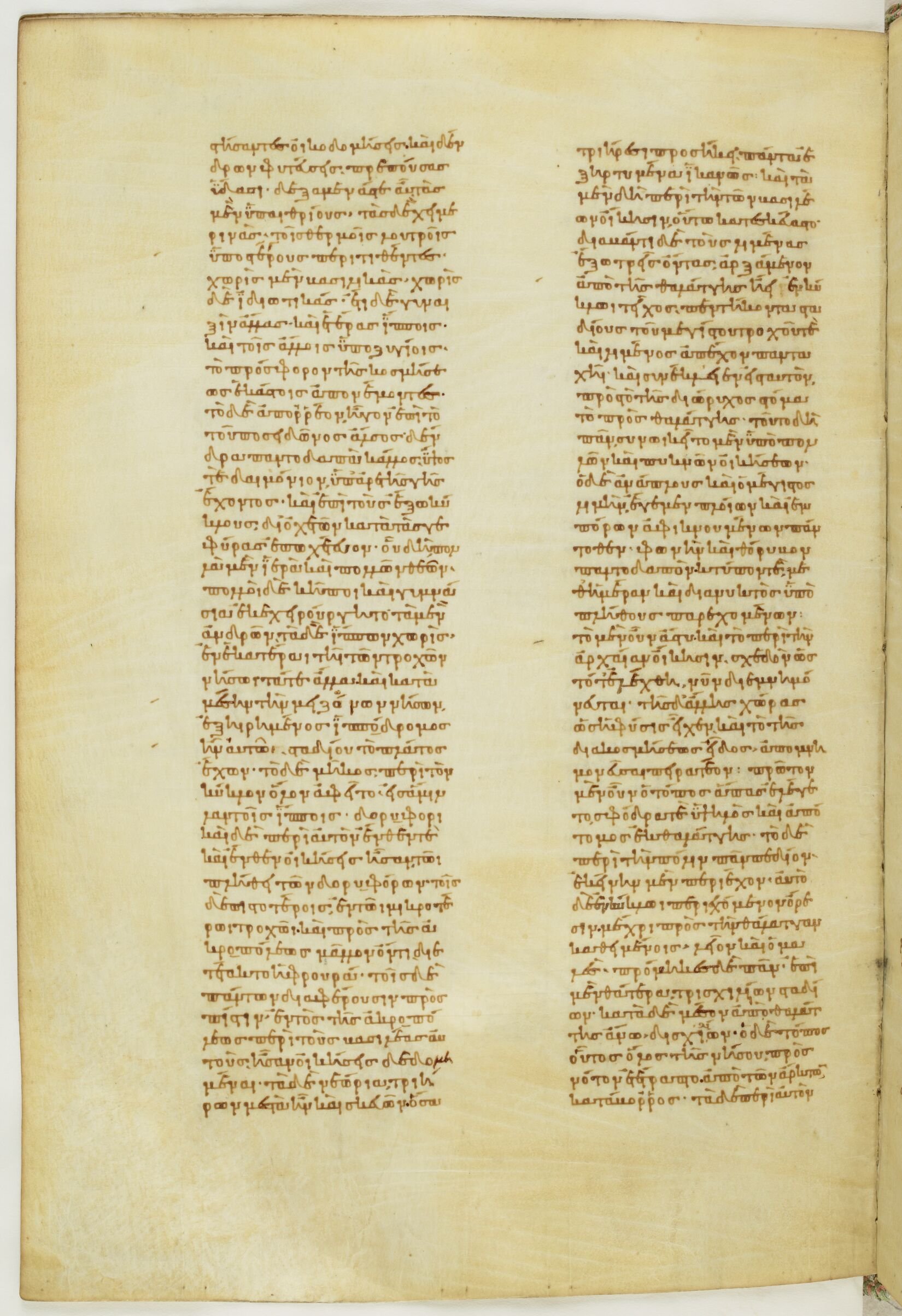
The manuscript is Paris, Bibliothèque nationale de France, grec 1807, known to editors as Plato A. It was copied in Constantinople around 850-875 by the scribe of the so-called philosophical collection, and is the oldest surviving medieval manuscript of the Timaeus and Critias (tetralogies VIII-IX: Clitophon, Republic, Timaeus, Critias, Minos, Laws, Epinomis, Letters). Each page has two columns of 44 lines. The Timaeus fills fol. 114r-144v and the Critias fol. 145r-151r.
On the manuscript this page of text runs over fol. 149r col. b to fol. 149v col. b. Each section below is linked to the folio side(s) that carry it. The mapping comes from reading the first words of every column on the images and finding them in Burnet's text: fol. 149r col. b begins ‹δʼ ἐπὶ τούτοις σύμμετρον ἰδεῖν, εἶδος› (Crit. 116d); fol. 149v col. a begins ‹-στήσαντες οἰκοδομήσεις καὶ δένδρων φυτεύσεις πρεπούσας› (Crit. 117a); fol. 149v col. b begins ‹τριήρεσιν προσήκει, πάντα δὲ ἐξηρτυμένα ἱκανῶς› (Crit. 117d).
The Greek is John Burnet's critical text (Oxford, 1902), not a transcription of this manuscript; the scribe's spelling, accents and occasional readings differ from it. The English is R. G. Bury's Loeb translation (1929).
How was this verified? (Provenance)
Where on the image
Crit. 117a stands in Paris gr. 1807, fol. 149r col. b to fol. 149v col. a. Checked on the image (column openings read on the BnF photographs and found in Burnet's text, quoted in Burnet's spelling): fol. 149r col. b begins ‹δʼ ἐπὶ τούτοις σύμμετρον ἰδεῖν, εἶδος› (Crit. 116d); fol. 149v col. a begins ‹-στήσαντες οἰκοδομήσεις καὶ δένδρων φυτεύσεις πρεπούσας› (Crit. 117a).
τε δὴ συνεπόμενος ἦν τὸ μέγεθος καὶ τὸ τῆς ἐργασίας ταύτῃ τῇ κατασκευῇ, καὶ τὰ βασίλεια κατὰ τὰ αὐτὰ πρέποντα μὲν τῷ τῆς ἀρχῆς μεγέθει, πρέποντα δὲ τῷ περὶ τὰ ἱερὰ κόσμῳ. ταῖς δὲ δὴ κρήναις, τῇ τοῦ ψυχροῦ καὶ τῇ τοῦ θερμοῦ νάματος, πλῆθος μὲν ἄφθονον ἐχούσαις, ἡδονῇ δὲ καὶ ἀρετῇ τῶν ὑδάτων πρὸς ἑκατέρου τὴν χρῆσιν θαυμαστοῦ πεφυκότος, ἐχρῶντο περιστήσαντες οἰκοδομήσεις καὶ δένδρων φυτεύσεις πρεπούσας
in respect of its size and its workmanship, harmonized with its surroundings; and the royal palace likewise was such as befitted the greatness of the kingdom, and equally befitted the splendor of the temples. The springs they made use of, one kind being of cold, another of warm water, were of abundant volume, and each kind was wonderfully well adapted for use because of the natural taste and excellence of its waters; and these they surrounded with buildings and with plantations of trees such as suited the waters;
Where on the image
Crit. 117b stands in Paris gr. 1807, fol. 149v col. a. Checked on the image (column openings read on the BnF photographs and found in Burnet's text, quoted in Burnet's spelling): fol. 149v col. a begins ‹-στήσαντες οἰκοδομήσεις καὶ δένδρων φυτεύσεις πρεπούσας› (Crit. 117a).
ὕδασι, δεξαμενάς τε αὖ τὰς μὲν ὑπαιθρίους, τὰς δὲ χειμερινὰς τοῖς θερμοῖς λουτροῖς ὑποστέγους περιτιθέντες, χωρὶς μὲν βασιλικάς, χωρὶς δὲ ἰδιωτικάς, ἔτι δὲ γυναιξὶν ἄλλας καὶ ἑτέρας ἵπποις καὶ τοῖς ἄλλοις ὑποζυγίοις, τὸ πρόσφορον τῆς κοσμήσεως ἑκάστοις ἀπονέμοντες. τὸ δὲ ἀπορρέον ἦγον ἐπὶ τὸ τοῦ Ποσειδῶνος ἄλσος, δένδρα παντοδαπὰ κάλλος ὕψος τε δαιμόνιον ὑπʼ ἀρετῆς τῆς γῆς ἔχοντα, καὶ ἐπὶ τοὺς ἔξω κύκλους διʼ ὀχετῶν κατὰ τὰς γεφύρας
and, moreover, they set reservoirs round about, some under the open sky, and others under cover to supply hot baths in the winter; they put separate baths for the kings and for the private citizens, besides others for women, and others again for horses and all other beasts of burden, fitting out each in an appropriate manner. And the outflowing water they conducted to the sacred grove of Poseidon, which contained trees of all kinds that were of marvellous beauty and height because of the richness of the soil; and by means of channels they led the water to the outer circles over against the bridges.
Where on the image
Crit. 117c stands in Paris gr. 1807, fol. 149v col. a. Checked on the image (column openings read on the BnF photographs and found in Burnet's text, quoted in Burnet's spelling): fol. 149v col. a begins ‹-στήσαντες οἰκοδομήσεις καὶ δένδρων φυτεύσεις πρεπούσας› (Crit. 117a).
ἐπωχέτευον· οὗ δὴ πολλὰ μὲν ἱερὰ καὶ πολλῶν θεῶν, πολλοὶ δὲ κῆποι καὶ πολλὰ γυμνάσια ἐκεχειρούργητο, τὰ μὲν ἀνδρῶν, τὰ δὲ ἵππων χωρὶς ἐν ἑκατέρᾳ τῇ τῶν τροχῶν νήσῳ, τά τε ἄλλα καὶ κατὰ μέσην τὴν μείζω τῶν νήσων ἐξῃρημένος ἱππόδρομος ἦν αὐτοῖς, σταδίου τὸ πλάτος ἔχων, τὸ δὲ μῆκος περὶ τὸν κύκλον ὅλον ἀφεῖτο εἰς ἅμιλλαν τοῖς ἵπποις. δορυφορικαὶ δὲ περὶ αὐτὸν ἔνθεν τε καὶ ἔνθεν οἰκήσεις ἦσαν
And there they had constructed many temples for gods, and many gardens and many exercising grounds, some for men and some set apart for horses, in each of the circular belts of island; and besides the rest they had in the center of the large island a racecourse laid out for horses, which was a stade in width, while as to length, a strip which ran round the whole circumference was reserved for equestrian contests. And round about it, on this side and on that, were barracks for the greater part of the spearmen ; but the guard-house of the more trusty
Where on the image
Crit. 117d stands in Paris gr. 1807, fol. 149v col. a to fol. 149v col. b. Checked on the image (column openings read on the BnF photographs and found in Burnet's text, quoted in Burnet's spelling): fol. 149v col. a begins ‹-στήσαντες οἰκοδομήσεις καὶ δένδρων φυτεύσεις πρεπούσας› (Crit. 117a); fol. 149v col. b begins ‹τριήρεσιν προσήκει, πάντα δὲ ἐξηρτυμένα ἱκανῶς› (Crit. 117d).
τῷ πλήθει τῶν δορυφόρων· τοῖς δὲ πιστοτέροις ἐν τῷ μικροτέρῳ τροχῷ καὶ πρὸς τῆς ἀκροπόλεως μᾶλλον ὄντι διετέτακτο ἡ φρουρά, τοῖς δὲ πάντων διαφέρουσιν πρὸς πίστιν ἐντὸς τῆς ἀκροπόλεως περὶ τοὺς βασιλέας αὐτοὺς ἦσαν οἰκήσεις δεδομέναι. τὰ δὲ νεώρια τριήρων μεστὰ ἦν καὶ σκευῶν ὅσα τριήρεσιν προσήκει, πάντα δὲ ἐξηρτυμένα ἱκανῶς. καὶ τὰ μὲν δὴ περὶ τὴν τῶν βασιλέων οἴκησιν οὕτω κατεσκεύαστο· διαβάντι δὲ τοὺς λιμένας ἔξω τρεῖς ὄντας ἀρξάμενον ἀπὸ
of them was posted in the smaller circle, which was nearer the acropolis; while those who were the most trustworthy of all had dwellings granted to them within the acropolis round about the persons of the kings. And the shipyards were full of triremes and all the tackling that belongs to triremes, and they were all amply equipped. Such then was the state of things round about the abode of the kings. And after crossing the three outer harbors,
Where on the image
Crit. 117e stands in Paris gr. 1807, fol. 149v col. b. Checked on the image (column openings read on the BnF photographs and found in Burnet's text, quoted in Burnet's spelling): fol. 149v col. b begins ‹τριήρεσιν προσήκει, πάντα δὲ ἐξηρτυμένα ἱκανῶς› (Crit. 117d).
τῆς θαλάττης ᾔειν ἐν κύκλῳ τεῖχος, πεντήκοντα σταδίους τοῦ μεγίστου τροχοῦ τε καὶ λιμένος ἀπέχον πανταχῇ, καὶ συνέκλειεν εἰς ταὐτὸν πρὸς τὸ τῆς διώρυχος στόμα τὸ πρὸς θαλάττης. τοῦτο δὴ πᾶν συνῳκεῖτο μὲν ὑπὸ πολλῶν καὶ πυκνῶν οἰκήσεων, ὁ δὲ ἀνάπλους καὶ ὁ μέγιστος λιμὴν ἔγεμεν πλοίων καὶ ἐμπόρων ἀφικνουμένων πάντοθεν, φωνὴν καὶ θόρυβον παντοδαπὸν κτύπον τε μεθʼ ἡμέραν καὶ διὰ νυκτὸς ὑπὸ πλήθους παρεχομένων.
τὸ μὲν οὖν ἄστυ καὶ τὸ περὶ τὴν ἀρχαίαν οἴκησιν σχεδὸν ὡς τότʼ ἐλέχθη νῦν διεμνημόνευται· τῆς δʼ ἄλλης χώρας
one found a wall which began at the sea and ran round in a circle, at a uniform distance of fifty stades from the largest circle and harbor, and its ends converged at the seaward mouth of the channel. The whole of this wall had numerous houses built on to it, set close together; while the sea-way and the largest harbor were filled with ships and merchants coming from all quarters, which by reason of their multitude caused clamor and tumult of every description and an unceasing din night and day.
Now as regards the city and the environs of the ancient dwelling we have now wellnigh completed the description as it was originally given. We must endeavor next to repeat the account of the rest of the country,
Notes
- Greek: John Burnet, Platonis Opera IV (Oxford, 1902), via Perseus canonical-greekLit; Burnet's text is a critical edition, so its wording can differ from the manuscript shown.
- English: R. G. Bury, Plato IX (Loeb Classical Library, 1929), via Perseus. Bury's footnotes are not reproduced. Quotation marks stand where Perseus marks quoted speech.
- Stephanus sections (a-e) are those of the 1578 Stephanus edition as given by Burnet and Bury; Bury's section breaks can fall a few words away from Burnet's because English word order differs.
Cite
Sources
- Source: Paris, BnF grec 1807 (Plato A, c. 850-875) fol. 149r-149v via BnF IIIF + Burnet's Greek (Perseus) + R. G. Bury's English (Loeb 1929, Perseus) (holding institution)
- Critical edition: Burnet, Platonis Opera IV (1902), via Perseus
← previous · → next · v cycle view · l back to library