Plato, Critias 118a-118e: the great plain and its ditch and canals
Introduction
Stephanus page 118 of Plato's Critias (118a-118e): the great plain and its ditch and canals.
The Critias is Plato's full account of Atlantis and of the Athens that fought it: the land and city of ancient Athens (109b-112e), then the island of Atlantis, Poseidon's kingdom beyond the Pillars of Heracles, its royal city, plain, army and laws (113b-120d), and the moral decline of its kings (120e-121c). Plato left the dialogue unfinished; it stops in mid-sentence as Zeus begins to speak, and the manuscript shown here stops at the same words.
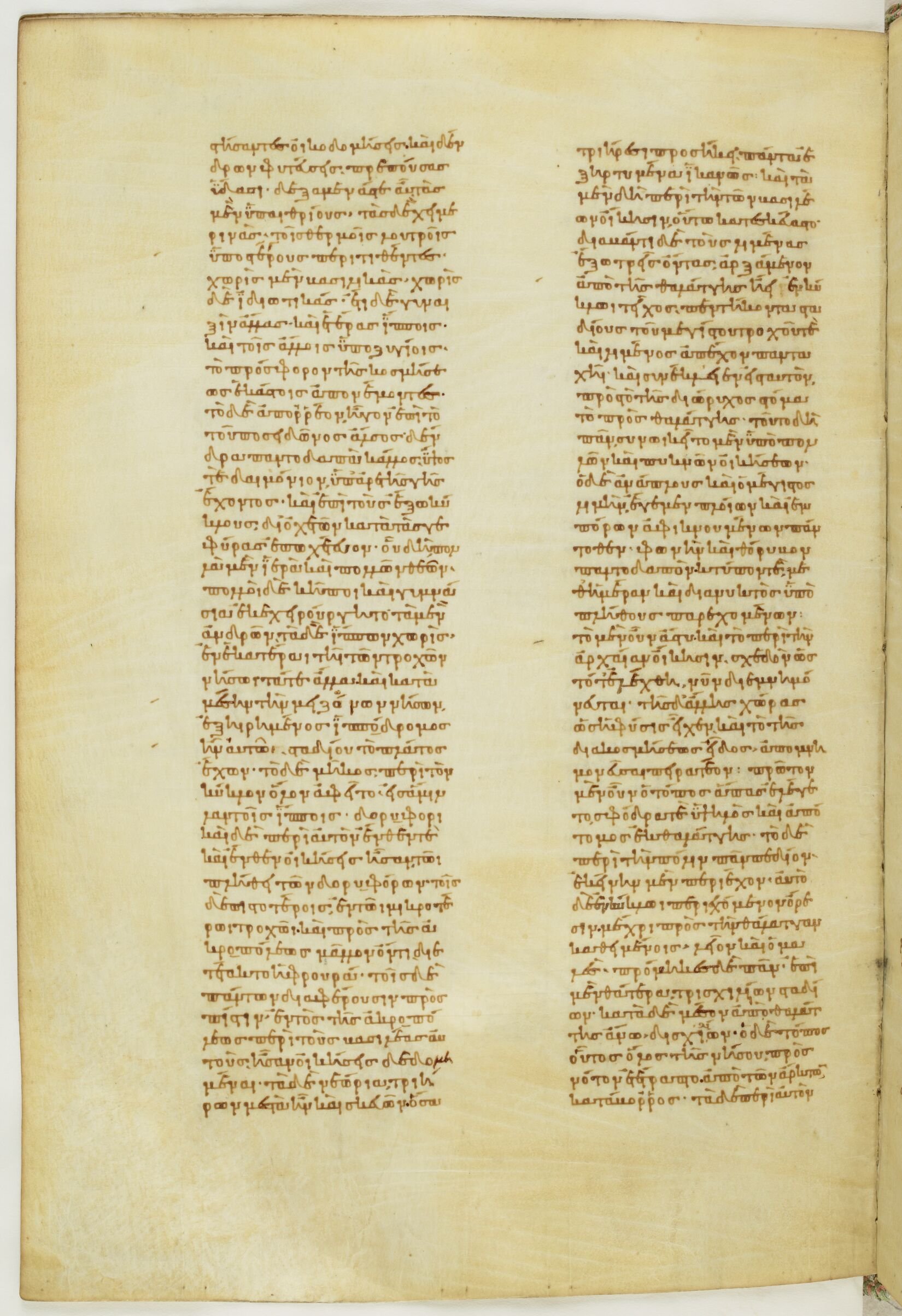
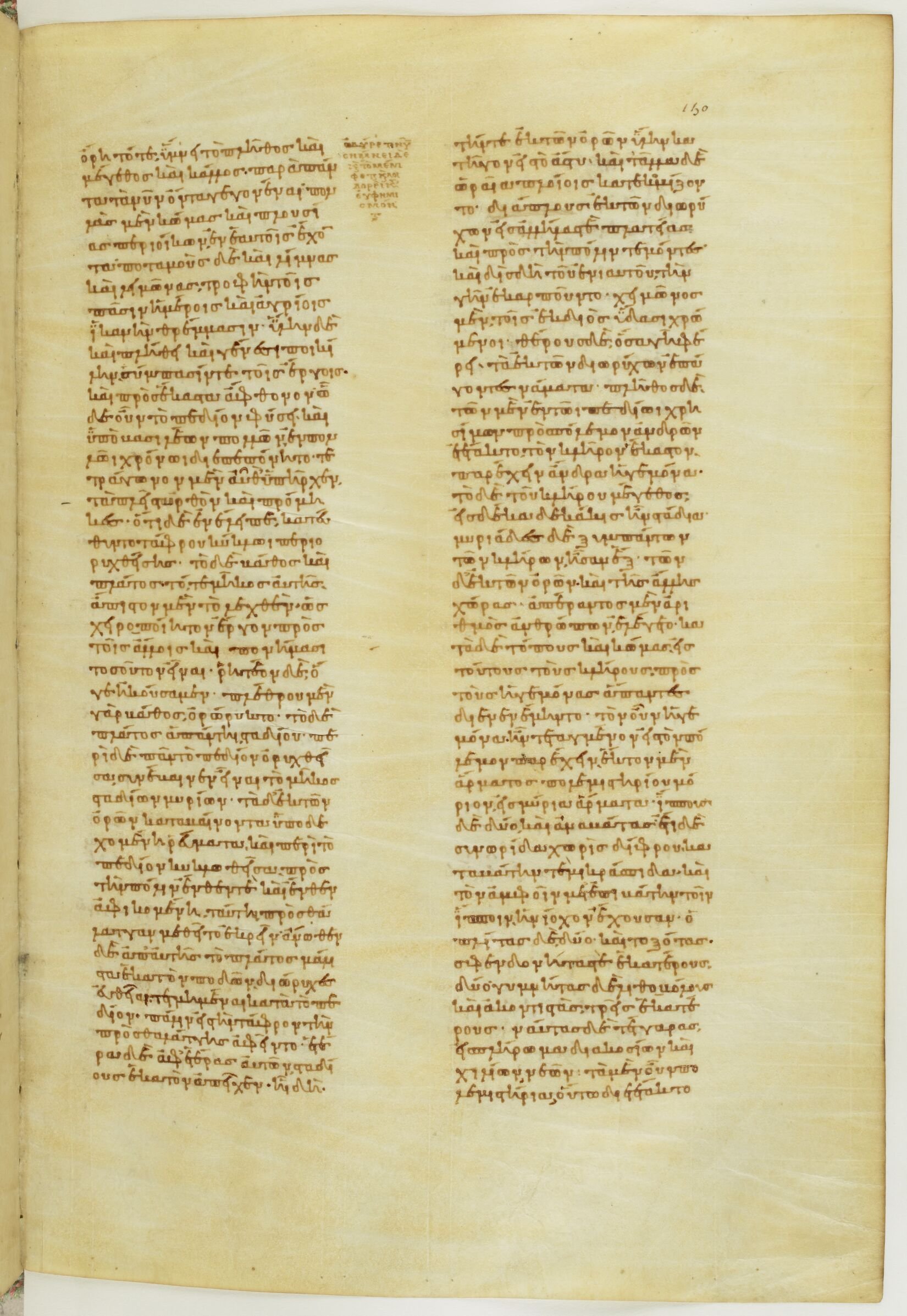
The manuscript is Paris, Bibliothèque nationale de France, grec 1807, known to editors as Plato A. It was copied in Constantinople around 850-875 by the scribe of the so-called philosophical collection, and is the oldest surviving medieval manuscript of the Timaeus and Critias (tetralogies VIII-IX: Clitophon, Republic, Timaeus, Critias, Minos, Laws, Epinomis, Letters). Each page has two columns of 44 lines. The Timaeus fills fol. 114r-144v and the Critias fol. 145r-151r.
On the manuscript this page of text runs over fol. 149v col. b to fol. 150r col. b. Each section below is linked to the folio side(s) that carry it. The mapping comes from reading the first words of every column on the images and finding them in Burnet's text: fol. 149v col. b begins ‹τριήρεσιν προσήκει, πάντα δὲ ἐξηρτυμένα ἱκανῶς› (Crit. 117d); fol. 150r col. a begins ‹ὄρη τότε ὑμνεῖτο πλῆθος καὶ μέγεθος› (Crit. 118b); fol. 150r col. b begins ‹τήν τε ἐκ τῶν ὀρῶν ὕλην› (Crit. 118d).
The Greek is John Burnet's critical text (Oxford, 1902), not a transcription of this manuscript; the scribe's spelling, accents and occasional readings differ from it. The English is R. G. Bury's Loeb translation (1929).
How was this verified? (Provenance)
Where on the image
Crit. 118a stands in Paris gr. 1807, fol. 149v col. b. Checked on the image (column openings read on the BnF photographs and found in Burnet's text, quoted in Burnet's spelling): fol. 149v col. b begins ‹τριήρεσιν προσήκει, πάντα δὲ ἐξηρτυμένα ἱκανῶς› (Crit. 117d).
ὡς ἡ φύσις εἶχεν καὶ τὸ τῆς διακοσμήσεως εἶδος, ἀπομνημονεῦσαι πειρατέον. πρῶτον μὲν οὖν ὁ τόπος ἅπας ἐλέγετο σφόδρα τε ὑψηλὸς καὶ ἀπότομος ἐκ θαλάττης, τὸ δὲ περὶ τὴν πόλιν πᾶν πεδίον, ἐκείνην μὲν περιέχον, αὐτὸ δὲ κύκλῳ περιεχόμενον ὄρεσιν μέχρι πρὸς τὴν θάλατταν καθειμένοις, λεῖον καὶ ὁμαλές, πρόμηκες δὲ πᾶν, ἐπὶ μὲν θάτερα τρισχιλίων σταδίων, κατὰ δὲ μέσον ἀπὸ θαλάττης ἄνω δισχιλίων.
what its natural character was, and in what fashion it was ordered. In the first place, then, according to the account, the whole region rose sheer out of the sea to a great height, but the part about the city was all a smooth plain, enclosing it round about, and being itself encircled by mountains which stretched as far as to the sea; and this plain had a level surface and was as a whole rectangular in shape, being 3000 stades long on either side and 2000 stades wide at its center, reckoning upwards from the sea. And this region,
Where on the image
Crit. 118b stands in Paris gr. 1807, fol. 149v col. b to fol. 150r col. a. Checked on the image (column openings read on the BnF photographs and found in Burnet's text, quoted in Burnet's spelling): fol. 149v col. b begins ‹τριήρεσιν προσήκει, πάντα δὲ ἐξηρτυμένα ἱκανῶς› (Crit. 117d); fol. 150r col. a begins ‹ὄρη τότε ὑμνεῖτο πλῆθος καὶ μέγεθος› (Crit. 118b).
ὁ δὲ τόπος οὗτος ὅλης τῆς νήσου πρὸς νότον ἐτέτραπτο, ἀπὸ τῶν ἄρκτων κατάβορρος. τὰ δὲ περὶ αὐτὸν ὄρη τότε ὑμνεῖτο πλῆθος καὶ μέγεθος καὶ κάλλος παρὰ πάντα τὰ νῦν ὄντα γεγονέναι, πολλὰς μὲν κώμας καὶ πλουσίας περιοίκων ἐν ἑαυτοῖς ἔχοντα, ποταμοὺς δὲ καὶ λίμνας καὶ λειμῶνας τροφὴν τοῖς πᾶσιν ἡμέροις καὶ ἀγρίοις ἱκανὴν θρέμμασιν, ὕλην δὲ καὶ πλήθει καὶ γένεσι ποικίλην σύμπασίν τε τοῖς ἔργοις καὶ πρὸς ἕκαστα ἄφθονον. ὧδε οὖν τὸ πεδίον φύσει
all along the island, faced towards the South and was sheltered from the Northern blasts. And the mountains which surrounded it were at that time celebrated as surpassing all that now exist in number, magnitude and beauty; for they had upon them many rich villages of country folk, and streams and lakes and meadows which furnished ample nutriment to all the animals both tame and wild, and timber of various sizes and descriptions, abundantly sufficient for the needs of all and every craft.
Where on the image
Crit. 118c stands in Paris gr. 1807, fol. 150r col. a. Checked on the image (column openings read on the BnF photographs and found in Burnet's text, quoted in Burnet's spelling): fol. 150r col. a begins ‹ὄρη τότε ὑμνεῖτο πλῆθος καὶ μέγεθος› (Crit. 118b).
καὶ ὑπὸ βασιλέων πολλῶν ἐν πολλῷ χρόνῳ διεπεπόνητο. τετράγωνον μὲν αὔθʼ ὑπῆρχεν τὰ πλεῖστʼ ὀρθὸν καὶ πρόμηκες, ὅτι δὲ ἐνέλειπε, κατηύθυντο τάφρου κύκλῳ περιορυχθείσης· τὸ δὲ βάθος καὶ πλάτος τό τε μῆκος αὐτῆς ἄπιστον μὲν λεχθέν, ὡς χειροποίητον ἔργον, πρὸς τοῖς ἄλλοις διαπονήμασι τοσοῦτον εἶναι, ῥητέον δὲ ὅ γε ἠκούσαμεν· πλέθρου μὲν γὰρ βάθος ὀρώρυκτο, τὸ δὲ πλάτος ἁπάντῃ σταδίου,
Now as a result of natural forces, together with the labors of many kings which extended over many ages, the condition of the plain was this. It was originally a quadrangle, rectilinear for the most part, and elongated; and what it lacked of this shape they made right by means of a trench dug round about it. Now, as regards the depth of this trench and its breadth and length, it seems incredible that it should be so large as the account states, considering that it was made by hand, and in addition to all the other operations, but none the less we must report what we heard: it was dug out to the depth of a plethrum and to a uniform breadth of a stade, and since it was dug round the whole plain
Where on the image
Crit. 118d stands in Paris gr. 1807, fol. 150r col. a to fol. 150r col. b. Checked on the image (column openings read on the BnF photographs and found in Burnet's text, quoted in Burnet's spelling): fol. 150r col. a begins ‹ὄρη τότε ὑμνεῖτο πλῆθος καὶ μέγεθος› (Crit. 118b); fol. 150r col. b begins ‹τήν τε ἐκ τῶν ὀρῶν ὕλην› (Crit. 118d).
περὶ δὲ πᾶν τὸ πεδίον ὀρυχθεῖσα συνέβαινεν εἶναι τὸ μῆκος σταδίων μυρίων. τὰ δʼ ἐκ τῶν ὀρῶν καταβαίνοντα ὑποδεχομένη ῥεύματα καὶ περὶ τὸ πεδίον κυκλωθεῖσα, πρὸς τὴν πόλιν ἔνθεν τε καὶ ἔνθεν ἀφικομένη, ταύτῃ πρὸς θάλατταν μεθεῖτο ἐκρεῖν. ἄνωθεν δὲ ἀπʼ αὐτῆς τὸ πλάτος μάλιστα ἑκατὸν ποδῶν διώρυχες εὐθεῖαι τετμημέναι κατὰ τὸ πεδίον πάλιν εἰς τὴν τάφρον τὴν πρὸς θαλάττης ἀφεῖντο, ἑτέρα δὲ ἀφʼ ἑτέρας αὐτῶν σταδίους ἑκατὸν ἀπεῖχεν· ᾗ δὴ τήν
its consequent length was 10,000 stades. It received the streams which came down from the mountains and after circling round the plain, and coming towards the city on this side and on that, it discharged them thereabouts into the sea. And on the inland side of the city channels were cut in straight lines, of about 100 feet in width, across the plain, and these discharged themselves into the trench on the seaward side, the distance between each being 100 stades. It was in this way that they conveyed to the city
Where on the image
Crit. 118e stands in Paris gr. 1807, fol. 150r col. b. Checked on the image (column openings read on the BnF photographs and found in Burnet's text, quoted in Burnet's spelling): fol. 150r col. b begins ‹τήν τε ἐκ τῶν ὀρῶν ὕλην› (Crit. 118d).
τε ἐκ τῶν ὀρῶν ὕλην κατῆγον εἰς τὸ ἄστυ καὶ τἆλλα δὲ ὡραῖα πλοίοις κατεκομίζοντο, διάπλους ἐκ τῶν διωρύχων εἰς ἀλλήλας τε πλαγίας καὶ πρὸς τὴν πόλιν τεμόντες. καὶ δὶς δὴ τοῦ ἐνιαυτοῦ τὴν γῆν ἐκαρποῦντο, χειμῶνος μὲν τοῖς ἐκ Διὸς ὕδασι χρώμενοι, θέρους δὲ ὅσα γῆ φέρει τὰ ἐκ τῶν διωρύχων ἐπάγοντες νάματα.
πλῆθος δέ, τῶν μὲν ἐν τῷ πεδίῳ χρησίμων πρὸς πόλεμον ἀνδρῶν ἐτέτακτο τὸν
the timber from the mountains and transported also on boats the seasons' products, by cutting transverse passages from one channel to the next and also to the city. And they cropped the land twice a year, making use of the rains from Heaven in the winter, and the waters that issue from the earth in summer, by conducting the streams from the trenches.
As regards their manpower, it was ordained that each allotment should furnish one man as leader of all the men in the plain who were fit to bear arms;
Notes
- Greek: John Burnet, Platonis Opera IV (Oxford, 1902), via Perseus canonical-greekLit; Burnet's text is a critical edition, so its wording can differ from the manuscript shown.
- English: R. G. Bury, Plato IX (Loeb Classical Library, 1929), via Perseus. Bury's footnotes are not reproduced. Quotation marks stand where Perseus marks quoted speech.
- Stephanus sections (a-e) are those of the 1578 Stephanus edition as given by Burnet and Bury; Bury's section breaks can fall a few words away from Burnet's because English word order differs.
Cite
Sources
- Source: Paris, BnF grec 1807 (Plato A, c. 850-875) fol. 149v-150r via BnF IIIF + Burnet's Greek (Perseus) + R. G. Bury's English (Loeb 1929, Perseus) (holding institution)
- Critical edition: Burnet, Platonis Opera IV (1902), via Perseus
← previous · → next · v cycle view · l back to library