Plato, Timaeus 22a-22e: the Egyptian priest: 'you Greeks are always children'; floods and conflagrations
Introduction
Stephanus page 22 of Plato's Timaeus (22a-22e): the Egyptian priest: 'you Greeks are always children'; floods and conflagrations.
Timaeus 20d-25d is Critias' first account of Atlantis: the story Solon was told by a priest at Sais in Egypt about an Athens of 9,000 years before, which defeated an invading power from the island of Atlantis beyond the Pillars of Heracles, after which the island sank into the sea. Plato returns to it at length in the Critias.
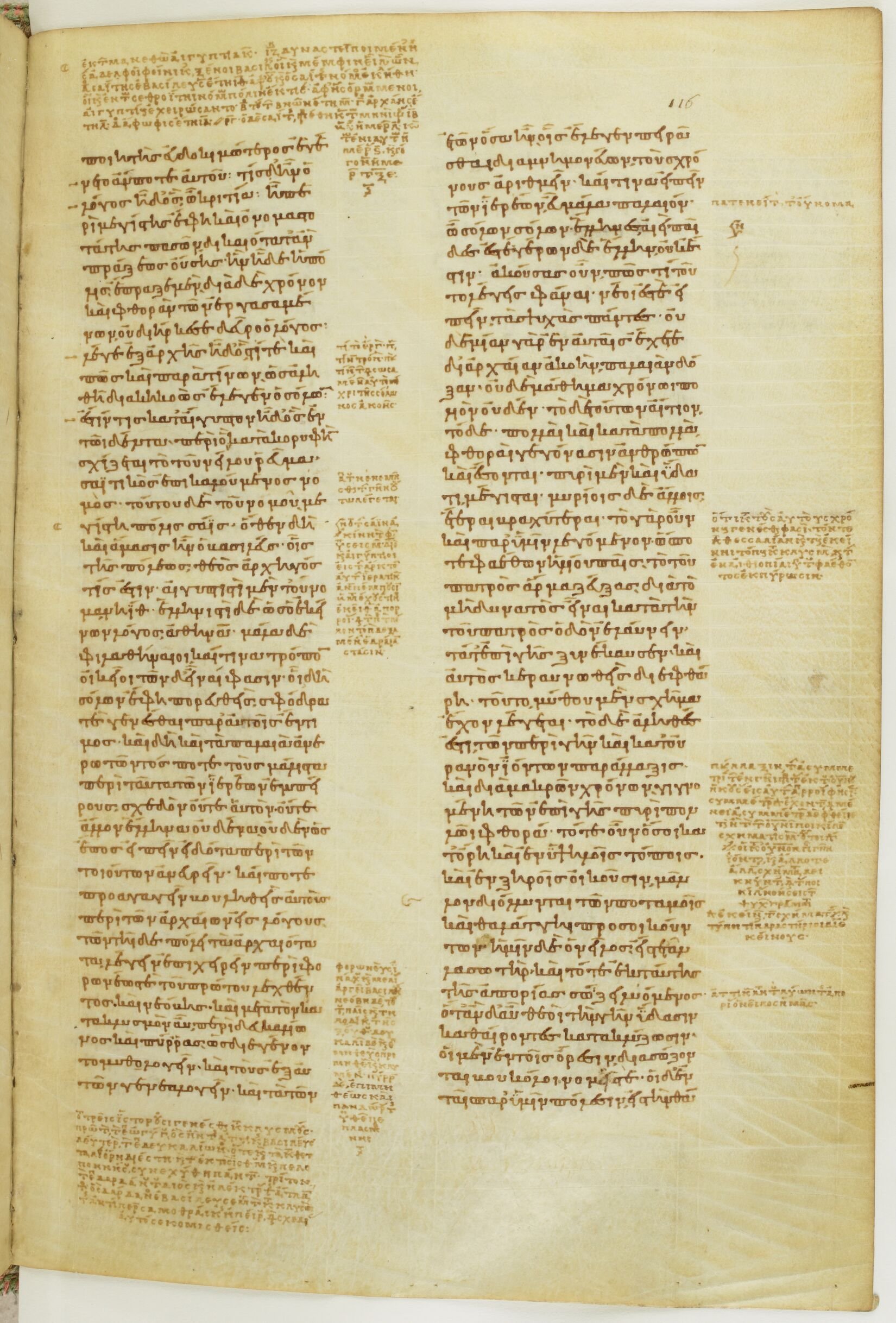
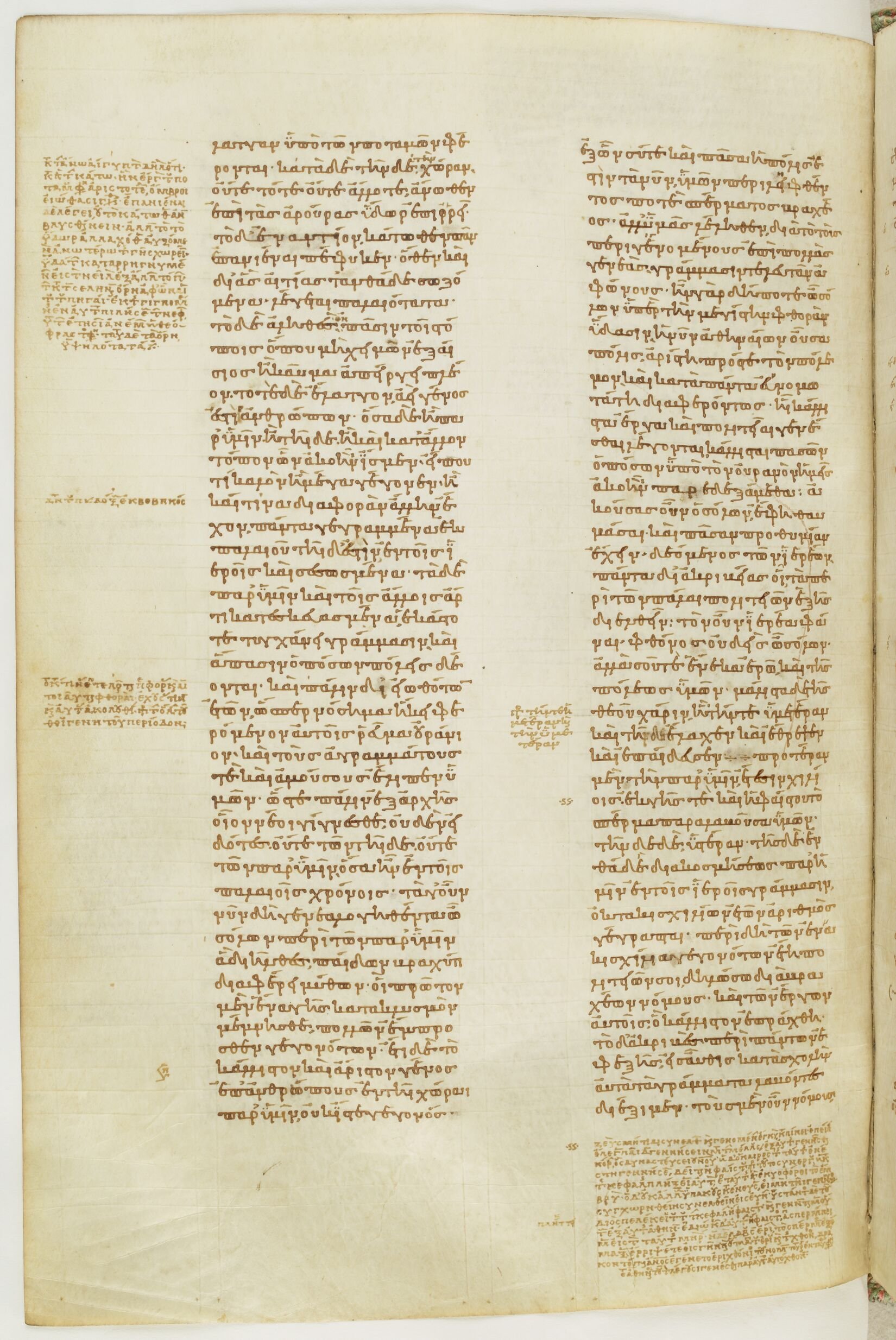
The manuscript is Paris, Bibliothèque nationale de France, grec 1807, known to editors as Plato A. It was copied in Constantinople around 850-875 by the scribe of the so-called philosophical collection, and is the oldest surviving medieval manuscript of the Timaeus and Critias (tetralogies VIII-IX: Clitophon, Republic, Timaeus, Critias, Minos, Laws, Epinomis, Letters). Each page has two columns of 44 lines. The Timaeus fills fol. 114r-144v and the Critias fol. 145r-151r.
On the manuscript this page of text runs over fol. 116r col. a to fol. 116v col. a. Each section below is linked to the folio side(s) that carry it. The mapping comes from reading the first words of every column on the images and finding them in Burnet's text: fol. 116r col. a begins ‹ποιητὴς εὐδοκιμώτερος ἐγένετο ἄν ποτε αὐτοῦ› (Tim. 21d); fol. 116r col. b begins ‹πειρᾶσθαι διαμνημονεύων τοὺς χρόνους ἀριθμεῖν· καί› (Tim. 22b); fol. 116v col. a begins ‹ὑπὸ τῶν ποταμῶν φέρονται· κατὰ δὲ› (Tim. 22e).
The Greek is John Burnet's critical text (Oxford, 1902), not a transcription of this manuscript; the scribe's spelling, accents and occasional readings differ from it. The English is R. G. Bury's Loeb translation (1929).
How was this verified? (Provenance)
Where on the image
Tim. 22a stands in Paris gr. 1807, fol. 116r col. a. Checked on the image (column openings read on the BnF photographs and found in Burnet's text, quoted in Burnet's spelling): fol. 116r col. a begins ‹ποιητὴς εὐδοκιμώτερος ἐγένετο ἄν ποτε αὐτοῦ› (Tim. 21d).
καὶ δὴ καὶ τὰ παλαιὰ ἀνερωτῶν ποτε τοὺς μάλιστα περὶ ταῦτα τῶν ἱερέων ἐμπείρους, σχεδὸν οὔτε αὑτὸν οὔτε ἄλλον Ἕλληνα οὐδένα οὐδὲν ὡς ἔπος εἰπεῖν εἰδότα περὶ τῶν τοιούτων ἀνευρεῖν. καί ποτε προαγαγεῖν βουληθεὶς αὐτοὺς περὶ τῶν ἀρχαίων εἰς λόγους, τῶν τῇδε τὰ ἀρχαιότατα λέγειν ἐπιχειρεῖν, περὶ Φορωνέως τε τοῦ πρώτου λεχθέντος καὶ Νιόβης, καὶ μετὰ τὸν κατακλυσμὸν αὖ περὶ Δευκαλίωνος
as were most versed in ancient lore about their early history, he discovered that neither he himself nor any other Greek knew anything at all, one might say, about such matters. And on one occasion, when he wished to draw them on to discourse on ancient history, he attempted to tell them the most ancient of our traditions, concerning Phoroneus, who was said to be the first man, and Niobe; and he went on to tell the legend about Deucalion and Pyrrha after the Flood, and how they survived it, and to give the geneology of their descendants;
Where on the image
Tim. 22b stands in Paris gr. 1807, fol. 116r col. a to fol. 116r col. b. Checked on the image (column openings read on the BnF photographs and found in Burnet's text, quoted in Burnet's spelling): fol. 116r col. a begins ‹ποιητὴς εὐδοκιμώτερος ἐγένετο ἄν ποτε αὐτοῦ› (Tim. 21d); fol. 116r col. b begins ‹πειρᾶσθαι διαμνημονεύων τοὺς χρόνους ἀριθμεῖν· καί› (Tim. 22b).
καὶ Πύρρας ὡς διεγένοντο μυθολογεῖν, καὶ τοὺς ἐξ αὐτῶν γενεαλογεῖν, καὶ τὰ τῶν ἐτῶν ὅσα ἦν οἷς ἔλεγεν πειρᾶσθαι διαμνημονεύων τοὺς χρόνους ἀριθμεῖν· καί τινα εἰπεῖν τῶν ἱερέων εὖ μάλα παλαιόν· ὦ Σόλων, Σόλων, Ἕλληνες ἀεὶ παῖδές ἐστε, γέρων δὲ Ἕλλην οὐκ ἔστιν. ἀκούσας οὖν, πῶς τί τοῦτο λέγεις; φάναι.νέοι ἐστέ, εἰπεῖν, τὰς ψυχὰς πάντες· οὐδεμίαν γὰρ ἐν αὐταῖς ἔχετε διʼ ἀρχαίαν ἀκοὴν παλαιὰν δόξαν οὐδὲ μάθημα χρόνῳ πολιὸν οὐδέν. τὸ
and by recounting the number of years occupied by the events mentioned he tried to calculate the periods of time. Whereupon one of the priests, a prodigiously old man, said, ‘O Solon, Solon, you Greeks are always children: there is not such a thing as an old Greek.’ And on hearing this he asked, ‘What mean you by this saying?’ And the priest replied, ‘You are young in soul, every one of you. For therein you possess not a single belief that is ancient and derived from old tradition, nor yet one science that is hoary with age.
Where on the image
Tim. 22c stands in Paris gr. 1807, fol. 116r col. b. Checked on the image (column openings read on the BnF photographs and found in Burnet's text, quoted in Burnet's spelling): fol. 116r col. b begins ‹πειρᾶσθαι διαμνημονεύων τοὺς χρόνους ἀριθμεῖν· καί› (Tim. 22b).
δὲ τούτων αἴτιον τόδε. πολλαὶ κατὰ πολλὰ φθοραὶ γεγόνασιν ἀνθρώπων καὶ ἔσονται, πυρὶ μὲν καὶ ὕδατι μέγισται, μυρίοις δὲ ἄλλοις ἕτεραι βραχύτεραι. τὸ γὰρ οὖν καὶ παρʼ ὑμῖν λεγόμενον, ὥς ποτε Φαέθων Ἡλίου παῖς τὸ τοῦ πατρὸς ἅρμα ζεύξας διὰ τὸ μὴ δυνατὸς εἶναι κατὰ τὴν τοῦ πατρὸς ὁδὸν ἐλαύνειν τά τʼ ἐπὶ γῆς συνέκαυσεν καὶ αὐτὸς κεραυνωθεὶς διεφθάρη, τοῦτο μύθου μὲν σχῆμα ἔχον λέγεται, τὸ δὲ
And this is the cause thereof: There have been and there will be many and divers destructions of mankind, of which the greatest are by fire and water, and lesser ones by countless other means. For in truth the story that is told in your country as well as ours, how once upon a time Phaethon, son of Helios, yoked his father’s chariot, and, because he was unable to drive it along the course taken by his father, burnt up all that was upon the earth and himself perished by a thunderbolt,—that story, as it is told, has the fashion of a legend, but the truth of it lies in
Where on the image
Tim. 22d stands in Paris gr. 1807, fol. 116r col. b. Checked on the image (column openings read on the BnF photographs and found in Burnet's text, quoted in Burnet's spelling): fol. 116r col. b begins ‹πειρᾶσθαι διαμνημονεύων τοὺς χρόνους ἀριθμεῖν· καί› (Tim. 22b).
ἀληθές ἐστι τῶν περὶ γῆν κατʼ οὐρανὸν ἰόντων παράλλαξις καὶ διὰ μακρῶν χρόνων γιγνομένη τῶν ἐπὶ γῆς πυρὶ πολλῷ φθορά. τότε οὖν ὅσοι κατʼ ὄρη καὶ ἐν ὑψηλοῖς τόποις καὶ ἐν ξηροῖς οἰκοῦσιν μᾶλλον διόλλυνται τῶν ποταμοῖς καὶ θαλάττῃ προσοικούντων· ἡμῖν δὲ ὁ Νεῖλος εἴς τε τἆλλα σωτὴρ καὶ τότε ἐκ ταύτης τῆς ἀπορίας σῴζει λυόμενος. ὅταν δʼ αὖ θεοὶ τὴν γῆν ὕδασιν καθαίροντες κατακλύζωσιν, οἱ μὲν ἐν τοῖς ὄρεσιν διασῴζονται βουκόλοι νομῆς τε, οἱ δʼ ἐν ταῖς
the occurrence of a shifting of the bodies in the heavens which move round the earth, and a destruction of the things on the earth by fierce fire, which recurs at long intervals. At such times all they that dwell on the mountains and in high and dry places suffer destruction more than those who dwell near to rivers or the sea; and in our case the Nile, our Saviour in other ways, saves us also at such times from this calamity by rising high. And when, on the other hand, the Gods purge the earth with a flood of waters, all the herdsmen and shepherds that are in the mountains are saved,
Where on the image
Tim. 22e stands in Paris gr. 1807, fol. 116r col. b to fol. 116v col. a. Checked on the image (column openings read on the BnF photographs and found in Burnet's text, quoted in Burnet's spelling): fol. 116r col. b begins ‹πειρᾶσθαι διαμνημονεύων τοὺς χρόνους ἀριθμεῖν· καί› (Tim. 22b); fol. 116v col. a begins ‹ὑπὸ τῶν ποταμῶν φέρονται· κατὰ δὲ› (Tim. 22e).
παρʼ ὑμῖν πόλεσιν εἰς τὴν θάλατταν ὑπὸ τῶν ποταμῶν φέρονται· κατὰ δὲ τήνδε χώραν οὔτε τότε οὔτε ἄλλοτε ἄνωθεν ἐπὶ τὰς ἀρούρας ὕδωρ ἐπιρρεῖ, τὸ δʼ ἐναντίον κάτωθεν πᾶν ἐπανιέναι πέφυκεν.
ὅθεν καὶ διʼ ἃς αἰτίας τἀνθάδε σῳζόμενα λέγεται παλαιότατα· τὸ δὲ ἀληθές, ἐν πᾶσιν τοῖς τόποις ὅπου μὴ χειμὼν ἐξαίσιος ἢ καῦμα ἀπείργει, πλέον,
but those in the cities of your land are swept into the sea by the streams; whereas In our country neither then nor at any other time does the water pour down over our fields from above, on the contrary it all tends naturally to well up from below.
Hence it is, for these reasons, that what is here preserved is reckoned to be most ancient; the truth being that in every place where there is no excessive heat or cold to prevent it there always exists some human stock, now more, now less in number.
Notes
- Greek: John Burnet, Platonis Opera IV (Oxford, 1902), via Perseus canonical-greekLit; Burnet's text is a critical edition, so its wording can differ from the manuscript shown.
- English: R. G. Bury, Plato IX (Loeb Classical Library, 1929), via Perseus. Bury's footnotes are not reproduced. Quotation marks stand where Perseus marks quoted speech.
- Stephanus sections (a-e) are those of the 1578 Stephanus edition as given by Burnet and Bury; Bury's section breaks can fall a few words away from Burnet's because English word order differs.
Cite
Sources
- Source: Paris, BnF grec 1807 (Plato A, c. 850-875) fol. 116r-116v via BnF IIIF + Burnet's Greek (Perseus) + R. G. Bury's English (Loeb 1929, Perseus) (holding institution)
- Critical edition: Burnet, Platonis Opera IV (1902), via Perseus
← previous · → next · v cycle view · l back to library