Plato, Timaeus 23a-23e: Egypt keeps the old records; the ancient Athens destroyed by flood
Introduction
Stephanus page 23 of Plato's Timaeus (23a-23e): Egypt keeps the old records; the ancient Athens destroyed by flood.
Timaeus 20d-25d is Critias' first account of Atlantis: the story Solon was told by a priest at Sais in Egypt about an Athens of 9,000 years before, which defeated an invading power from the island of Atlantis beyond the Pillars of Heracles, after which the island sank into the sea. Plato returns to it at length in the Critias.
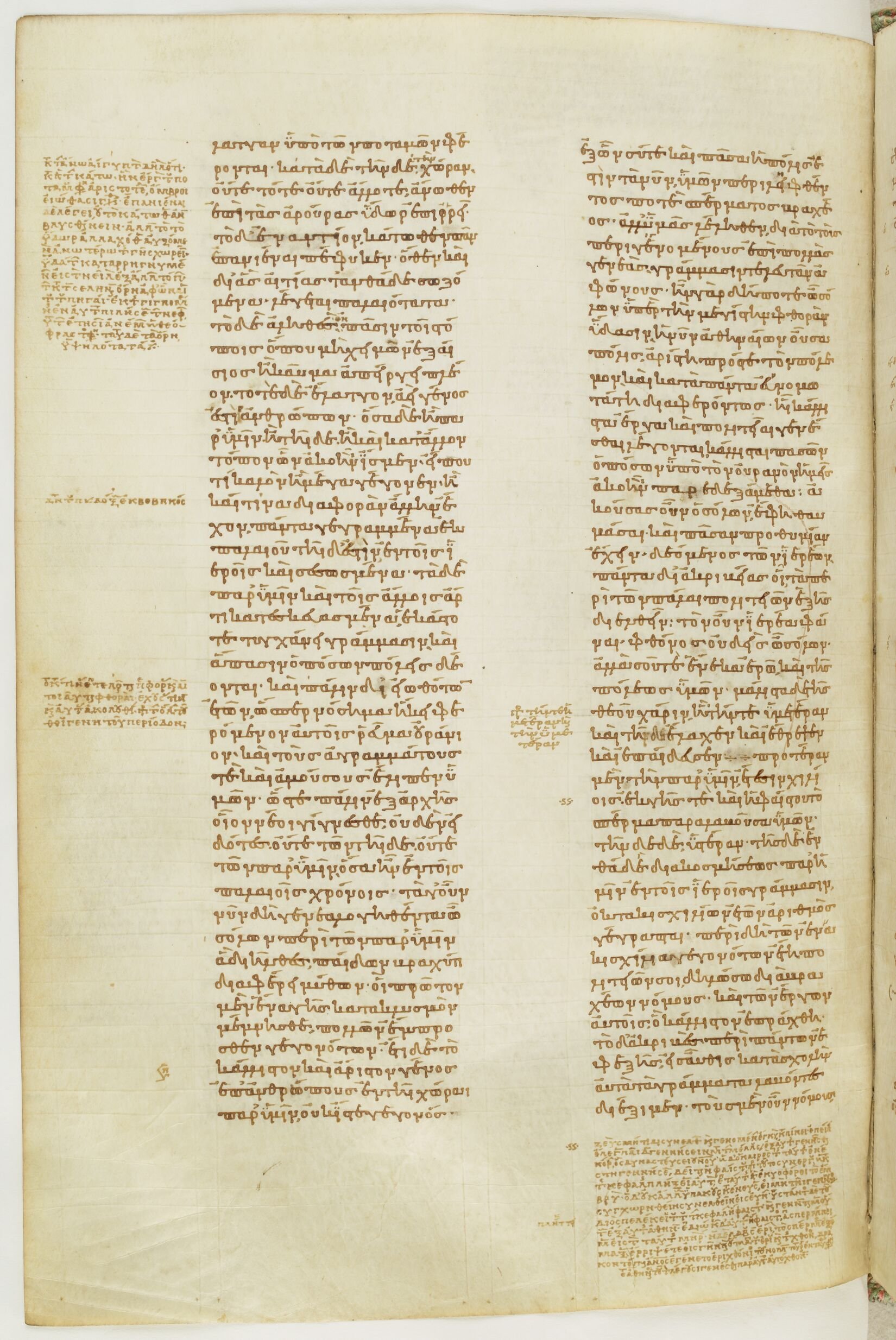
The manuscript is Paris, Bibliothèque nationale de France, grec 1807, known to editors as Plato A. It was copied in Constantinople around 850-875 by the scribe of the so-called philosophical collection, and is the oldest surviving medieval manuscript of the Timaeus and Critias (tetralogies VIII-IX: Clitophon, Republic, Timaeus, Critias, Minos, Laws, Epinomis, Letters). Each page has two columns of 44 lines. The Timaeus fills fol. 114r-144v and the Critias fol. 145r-151r.
On the manuscript this page of text runs over fol. 116v col. a to fol. 116v col. b. Each section below is linked to the folio side(s) that carry it. The mapping comes from reading the first words of every column on the images and finding them in Burnet's text: fol. 116v col. a begins ‹ὑπὸ τῶν ποταμῶν φέρονται· κατὰ δὲ› (Tim. 22e); fol. 116v col. b begins ‹ἐξ ὧν σύ τε καὶ πᾶσα› (Tim. 23b).
The Greek is John Burnet's critical text (Oxford, 1902), not a transcription of this manuscript; the scribe's spelling, accents and occasional readings differ from it. The English is R. G. Bury's Loeb translation (1929).
How was this verified? (Provenance)
Where on the image
Tim. 23a stands in Paris gr. 1807, fol. 116v col. a. Checked on the image (column openings read on the BnF photographs and found in Burnet's text, quoted in Burnet's spelling): fol. 116v col. a begins ‹ὑπὸ τῶν ποταμῶν φέρονται· κατὰ δὲ› (Tim. 22e).
τοτὲ δὲ ἔλαττον ἀεὶ γένος ἐστὶν ἀνθρώπων. ὅσα δὲ ἢ παρʼ ὑμῖν ἢ τῇδε ἢ καὶ κατʼ ἄλλον τόπον ὧν ἀκοῇ ἴσμεν, εἴ πού τι καλὸν ἢ μέγα γέγονεν ἢ καί τινα διαφορὰν ἄλλην ἔχον, πάντα γεγραμμένα ἐκ παλαιοῦ τῇδʼ ἐστὶν ἐν τοῖς ἱεροῖς καὶ σεσωσμένα· τὰ δὲ παρʼ ὑμῖν καὶ τοῖς ἄλλοις ἄρτι κατεσκευασμένα ἑκάστοτε τυγχάνει γράμμασι καὶ ἅπασιν ὁπόσων πόλεις δέονται, καὶ πάλιν διʼ εἰωθότων ἐτῶν ὥσπερ νόσημα ἥκει φερόμενον αὐτοῖς ῥεῦμα οὐράνιον καὶ τοὺς ἀγραμμάτους
And if any event has occurred that is noble or great or in any way conspicuous, whether it be in your country or in ours or in some other place of which we know by report, all such events are recorded from of old and preserved here in our temples; whereas your people and the others are but newly equipped, every time, with letters and all such arts as civilized States require and when, after the usual interval of years, like a plague, the flood from heaven comes sweeping down afresh upon your people,
Where on the image
Tim. 23b stands in Paris gr. 1807, fol. 116v col. a to fol. 116v col. b. Checked on the image (column openings read on the BnF photographs and found in Burnet's text, quoted in Burnet's spelling): fol. 116v col. a begins ‹ὑπὸ τῶν ποταμῶν φέρονται· κατὰ δὲ› (Tim. 22e); fol. 116v col. b begins ‹ἐξ ὧν σύ τε καὶ πᾶσα› (Tim. 23b).
τε καὶ ἀμούσους ἔλιπεν ὑμῶν, ὥστε πάλιν ἐξ ἀρχῆς οἷον νέοι γίγνεσθε, οὐδὲν εἰδότες οὔτε τῶν τῇδε οὔτε τῶν παρʼ ὑμῖν, ὅσα ἦν ἐν τοῖς παλαιοῖς χρόνοις. τὰ γοῦν νυνδὴ γενεαλογηθέντα, ὦ Σόλων, περὶ τῶν παρʼ ὑμῖν ἃ διῆλθες, παίδων βραχύ τι διαφέρει μύθων, οἳ πρῶτον μὲν ἕνα γῆς κατακλυσμὸν μέμνησθε πολλῶν ἔμπροσθεν γεγονότων, ἔτι δὲ τὸ κάλλιστον καὶ ἄριστον γένος ἐπʼ ἀνθρώπους ἐν τῇ χώρᾳ παρʼ ὑμῖν οὐκ ἴστε γεγονός, ἐξ ὧν σύ τε καὶ πᾶσα ἡ
it leaves none of you but the unlettered and uncultured, so that you become young as ever, with no knowledge of all that happened in old times in this land or in your own. Certainly the genealogies which you related just now, Solon, concerning the people of your country, are little better than children’s tales; for, in the first place, you remember but one deluge, though many had occurred previously; and next, you are ignorant of the fact that the noblest and most perfect race amongst men were born in the land where you now dwell, and from them both you yourself are sprung and the whole
Where on the image
Tim. 23c stands in Paris gr. 1807, fol. 116v col. b. Checked on the image (column openings read on the BnF photographs and found in Burnet's text, quoted in Burnet's spelling): fol. 116v col. b begins ‹ἐξ ὧν σύ τε καὶ πᾶσα› (Tim. 23b).
πόλις ἔστιν τὰ νῦν ὑμῶν, περιλειφθέντος ποτὲ σπέρματος βραχέος, ἀλλʼ ὑμᾶς λέληθεν διὰ τὸ τοὺς περιγενομένους ἐπὶ πολλὰς γενεὰς γράμμασιν τελευτᾶν ἀφώνους. ἦν γὰρ δή ποτε, ὦ Σόλων, ὑπὲρ τὴν μεγίστην φθορὰν ὕδασιν ἡ νῦν Ἀθηναίων οὖσα πόλις ἀρίστη πρός τε τὸν πόλεμον καὶ κατὰ πάντα εὐνομωτάτη διαφερόντως· ᾗ κάλλιστα ἔργα καὶ πολιτεῖαι γενέσθαι λέγονται κάλλισται πασῶν ὁπόσων ὑπὸ
of your existing city, out of some little seed that chanced to be left over; but this has escaped your notice because for many generations the survivors died with no power to express themselves in writing. For verily at one time, Solon, before the greatest destruction by water, what is now the Athenian State was the bravest in war and supremely well organized also in all other respects. It is said that it possessed the most splendid works of art and the noblest polity of any nation under heaven of which we have heard tell.’
Where on the image
Tim. 23d stands in Paris gr. 1807, fol. 116v col. b. Checked on the image (column openings read on the BnF photographs and found in Burnet's text, quoted in Burnet's spelling): fol. 116v col. b begins ‹ἐξ ὧν σύ τε καὶ πᾶσα› (Tim. 23b).
τὸν οὐρανὸν ἡμεῖς ἀκοὴν παρεδεξάμεθα. ἀκούσας οὖν ὁ Σόλων ἔφη θαυμάσαι καὶ πᾶσαν προθυμίαν σχεῖν δεόμενος τῶν ἱερέων πάντα διʼ ἀκριβείας οἱ τὰ περὶ τῶν πάλαι πολιτῶν ἑξῆς διελθεῖν. τὸν οὖν ἱερέα φάναι· φθόνος οὐδείς, ὦ Σόλων, ἀλλὰ σοῦ τε ἕνεκα ἐρῶ καὶ τῆς πόλεως ὑμῶν, μάλιστα δὲ τῆς θεοῦ χάριν, ἣ τήν τε ὑμετέραν καὶ τήνδε ἔλαχεν καὶ ἔθρεψεν καὶ ἐπαίδευσεν, προτέραν μὲν τὴν παρʼ
Upon hearing this, Solon said that he marvelled, and with the utmost eagerness requested the priest to recount for him in order and exactly all the facts about those citizens of old. The priest then said: ‘I begrudge you not the story, Solon; nay, I will tell it, both for your own sake and that of your city, and most of all for the sake of the Goddess who has adopted for her own both your land and this of ours, and has nurtured and trained them,—yours first by the space of a thousand years, when she had received the seed of you from Ge
Where on the image
Tim. 23e stands in Paris gr. 1807, fol. 116v col. b. Checked on the image (column openings read on the BnF photographs and found in Burnet's text, quoted in Burnet's spelling): fol. 116v col. b begins ‹ἐξ ὧν σύ τε καὶ πᾶσα› (Tim. 23b).
ὑμῖν ἔτεσιν χιλίοις, ἐκ Γῆς τε καὶ Ἡφαίστου τὸ σπέρμα παραλαβοῦσα ὑμῶν, τήνδε δὲ ὑστέραν. τῆς δὲ ἐνθάδε διακοσμήσεως παρʼ ἡμῖν ἐν τοῖς ἱεροῖς γράμμασιν ὀκτακισχιλίων ἐτῶν ἀριθμὸς γέγραπται. περὶ δὴ τῶν ἐνακισχίλια γεγονότων ἔτη πολιτῶν σοι δηλώσω διὰ βραχέων νόμους, καὶ τῶν ἔργων αὐτοῖς ὃ κάλλιστον ἐπράχθη·
τὸ δʼ ἀκριβὲς περὶ
and Hephaestus, and after that ours. And the duration of our civilization as set down in our sacred writings is 8000 years. Of the citizens, then, who lived 9000 years ago, I will declare to you briefly certain of their laws and the noblest of the deeds they performed:
Notes
- Greek: John Burnet, Platonis Opera IV (Oxford, 1902), via Perseus canonical-greekLit; Burnet's text is a critical edition, so its wording can differ from the manuscript shown.
- English: R. G. Bury, Plato IX (Loeb Classical Library, 1929), via Perseus. Bury's footnotes are not reproduced. Quotation marks stand where Perseus marks quoted speech.
- Stephanus sections (a-e) are those of the 1578 Stephanus edition as given by Burnet and Bury; Bury's section breaks can fall a few words away from Burnet's because English word order differs.
Cite
Sources
- Source: Paris, BnF grec 1807 (Plato A, c. 850-875) fol. 116v via BnF IIIF + Burnet's Greek (Perseus) + R. G. Bury's English (Loeb 1929, Perseus) (holding institution)
- Critical edition: Burnet, Platonis Opera IV (1902), via Perseus
← previous · → next · v cycle view · l back to library