Plato, Timaeus 24a-24e: the laws of ancient Athens compared with Egypt's; the power from the Atlantic Ocean
Introduction
Stephanus page 24 of Plato's Timaeus (24a-24e): the laws of ancient Athens compared with Egypt's; the power from the Atlantic Ocean.
Timaeus 20d-25d is Critias' first account of Atlantis: the story Solon was told by a priest at Sais in Egypt about an Athens of 9,000 years before, which defeated an invading power from the island of Atlantis beyond the Pillars of Heracles, after which the island sank into the sea. Plato returns to it at length in the Critias.
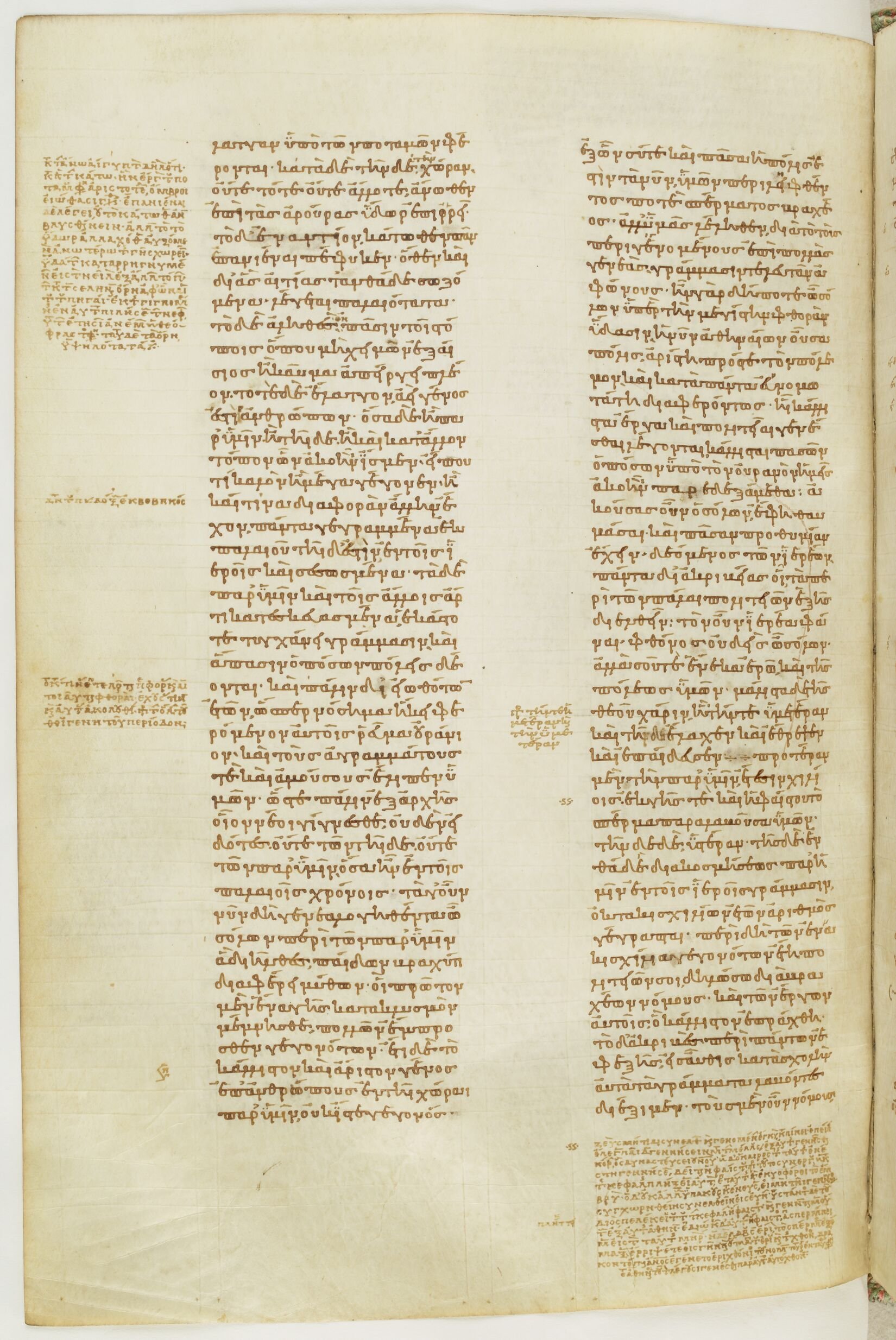
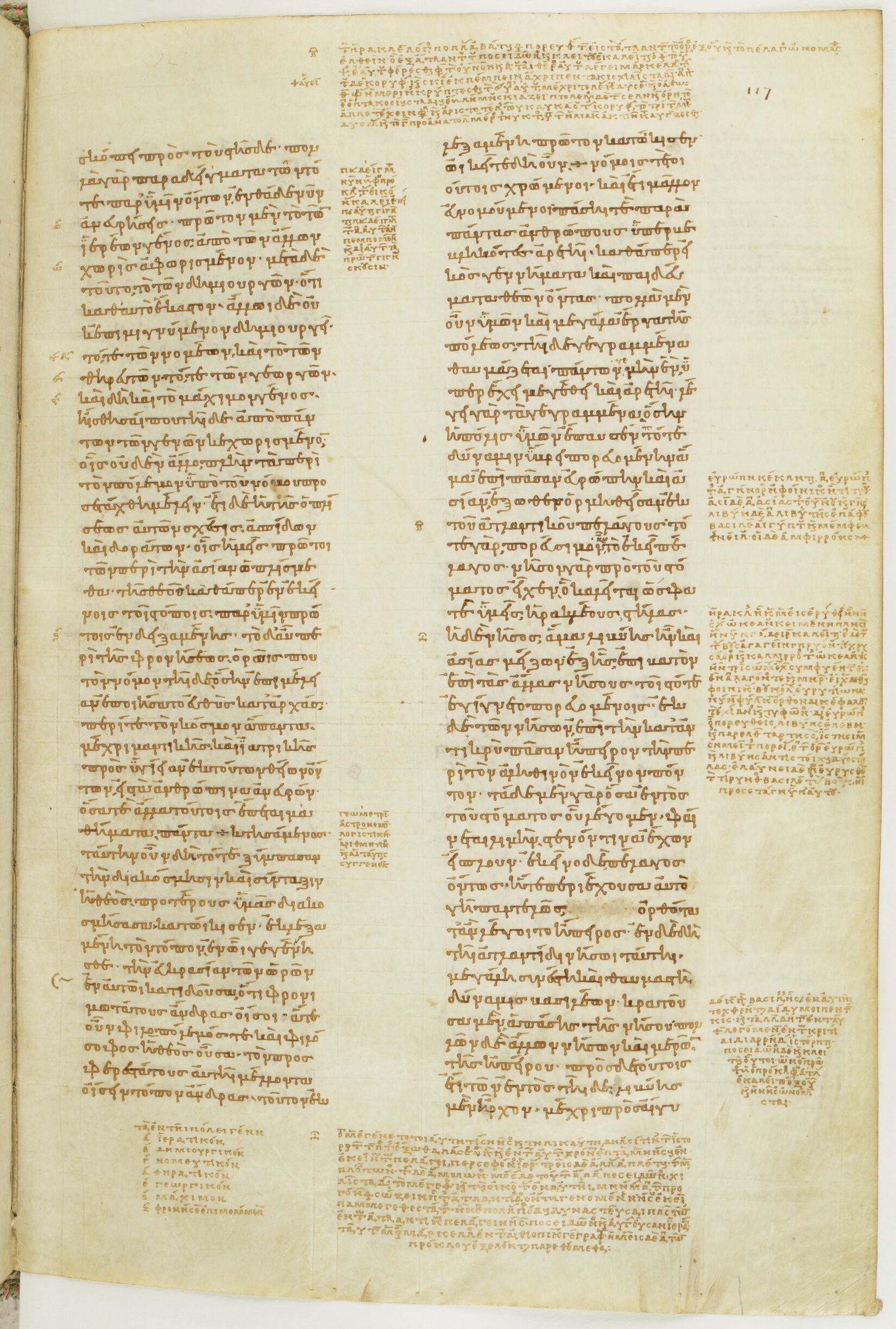
The manuscript is Paris, Bibliothèque nationale de France, grec 1807, known to editors as Plato A. It was copied in Constantinople around 850-875 by the scribe of the so-called philosophical collection, and is the oldest surviving medieval manuscript of the Timaeus and Critias (tetralogies VIII-IX: Clitophon, Republic, Timaeus, Critias, Minos, Laws, Epinomis, Letters). Each page has two columns of 44 lines. The Timaeus fills fol. 114r-144v and the Critias fol. 145r-151r.
On the manuscript this page of text runs over fol. 116v col. b to fol. 117r col. b. Each section below is linked to the folio side(s) that carry it. The mapping comes from reading the first words of every column on the images and finding them in Burnet's text: fol. 116v col. b begins ‹ἐξ ὧν σύ τε καὶ πᾶσα› (Tim. 23b); fol. 117r col. a begins ‹σκόπει πρὸς τοὺς τῇδε· πολλὰ γὰρ› (Tim. 24a); fol. 117r col. b begins ‹-εξαμένη πρῶτον κατῴκισεν. ᾠκεῖτε δὴ οὖν› (Tim. 24d).
The Greek is John Burnet's critical text (Oxford, 1902), not a transcription of this manuscript; the scribe's spelling, accents and occasional readings differ from it. The English is R. G. Bury's Loeb translation (1929).
How was this verified? (Provenance)
Where on the image
Tim. 24a stands in Paris gr. 1807, fol. 116v col. b to fol. 117r col. a. Checked on the image (column openings read on the BnF photographs and found in Burnet's text, quoted in Burnet's spelling): fol. 116v col. b begins ‹ἐξ ὧν σύ τε καὶ πᾶσα› (Tim. 23b); fol. 117r col. a begins ‹σκόπει πρὸς τοὺς τῇδε· πολλὰ γὰρ› (Tim. 24a).
πάντων ἐφεξῆς εἰς αὖθις κατὰ σχολὴν αὐτὰ τὰ γράμματα λαβόντες διέξιμεν. τοὺς μὲν οὖν νόμους σκόπει πρὸς τοὺς τῇδε· πολλὰ γὰρ παραδείγματα τῶν τότε παρʼ ὑμῖν ὄντων ἐνθάδε νῦν ἀνευρήσεις, πρῶτον μὲν τὸ τῶν ἱερέων γένος ἀπὸ τῶν ἄλλων χωρὶς ἀφωρισμένον, μετὰ δὲ τοῦτο τὸ τῶν δημιουργῶν, ὅτι καθʼ αὑτὸ ἕκαστον ἄλλῳ δὲ οὐκ ἐπιμειγνύμενον δημιουργεῖ, τό τε τῶν νομέων καὶ τὸ τῶν θηρευτῶν τό τε
the full account in precise order and detail we shall go through later at our leisure, taking the actual writings. To get a view of their laws, look at the laws here; for you will find existing here at the present time many examples of the laws which then existed in your city. You see, first, how the priestly class is separated off from the rest; next, the class of craftsmen, of which each sort works by itself without mixing with any other; then the classes of shepherds, hunters, and farmers, each distinct and separate. Moreover, the military class here,
Where on the image
Tim. 24b stands in Paris gr. 1807, fol. 117r col. a. Checked on the image (column openings read on the BnF photographs and found in Burnet's text, quoted in Burnet's spelling): fol. 117r col. a begins ‹σκόπει πρὸς τοὺς τῇδε· πολλὰ γὰρ› (Tim. 24a).
τῶν γεωργῶν. καὶ δὴ καὶ τὸ μάχιμον γένος ᾔσθησαί που τῇδε ἀπὸ πάντων τῶν γενῶν κεχωρισμένον, οἷς οὐδὲν ἄλλο πλὴν τὰ περὶ τὸν πόλεμον ὑπὸ τοῦ νόμου προσετάχθη μέλειν· ἔτι δὲ ἡ τῆς ὁπλίσεως αὐτῶν σχέσις ἀσπίδων καὶ δοράτων, οἷς ἡμεῖς πρῶτοι τῶν περὶ τὴν Ἀσίαν ὡπλίσμεθα, τῆς θεοῦ καθάπερ ἐν ἐκείνοις τοῖς τόποις παρʼ ὑμῖν πρώτοις ἐνδειξαμένης. τὸ δʼ αὖ περὶ τῆς φρονήσεως, ὁρᾷς που τὸν νόμον τῇδε ὅσην ἐπιμέλειαν ἐποιήσατο εὐθὺς κατʼ ἀρχὰς περί τε
as no doubt you have noticed, is kept apart from all the other classes, being enjoined by the law to devote itself solely to the work of training for war. A further feature is the character of their equipment with shields and spears; for we were the first of the peoples of Asia to adopt these weapons, it being the Goddess who instructed us, even as she instructed you first of all the dwellers in yonder lands. Again, with regard to wisdom, you perceive, no doubt, the law here—how much attention
Where on the image
Tim. 24c stands in Paris gr. 1807, fol. 117r col. a. Checked on the image (column openings read on the BnF photographs and found in Burnet's text, quoted in Burnet's spelling): fol. 117r col. a begins ‹σκόπει πρὸς τοὺς τῇδε· πολλὰ γὰρ› (Tim. 24a).
τὸν κόσμον, ἅπαντα μέχρι μαντικῆς καὶ ἰατρικῆς πρὸς ὑγίειαν ἐκ τούτων θείων ὄντων εἰς τὰ ἀνθρώπινα ἀνευρών, ὅσα τε ἄλλα τούτοις ἕπεται μαθήματα πάντα κτησάμενος. ταύτην οὖν δὴ τότε σύμπασαν τὴν διακόσμησιν καὶ σύνταξιν ἡ θεὸς προτέρους ὑμᾶς διακοσμήσασα κατῴκισεν, ἐκλεξαμένη τὸν τόπον ἐν ᾧ γεγένησθε, τὴν εὐκρασίαν τῶν ὡρῶν ἐν αὐτῷ κατιδοῦσα, ὅτι φρονιμωτάτους ἄνδρας οἴσοι· ἅτε οὖν φιλοπόλεμός
it has devoted from the very beginning to the Cosmic Order, by discovering all the effects which the divine causes produce upon human life, down to divination and the art of medicine which aims at health, and by its mastery also of all the other subsidiary studies. So when, at that time, the Goddess had furnished you, before all others, with all this orderly and regular system, she established your State, choosing the spot wherein you were born since she perceived therein a climate duly blended, and how that it would bring forth men of supreme wisdom.
Where on the image
Tim. 24d stands in Paris gr. 1807, fol. 117r col. a to fol. 117r col. b. Checked on the image (column openings read on the BnF photographs and found in Burnet's text, quoted in Burnet's spelling): fol. 117r col. a begins ‹σκόπει πρὸς τοὺς τῇδε· πολλὰ γὰρ› (Tim. 24a); fol. 117r col. b begins ‹-εξαμένη πρῶτον κατῴκισεν. ᾠκεῖτε δὴ οὖν› (Tim. 24d).
τε καὶ φιλόσοφος ἡ θεὸς οὖσα τὸν προσφερεστάτους αὐτῇ μέλλοντα οἴσειν τόπον ἄνδρας, τοῦτον ἐκλεξαμένη πρῶτον κατῴκισεν. ᾠκεῖτε δὴ οὖν νόμοις τε τοιούτοις χρώμενοι καὶ ἔτι μᾶλλον εὐνομούμενοι πάσῃ τε παρὰ πάντας ἀνθρώπους ὑπερβεβληκότες ἀρετῇ, καθάπερ εἰκὸς γεννήματα καὶ παιδεύματα θεῶν ὄντας. πολλὰ μὲν οὖν ὑμῶν καὶ μεγάλα ἔργα τῆς πόλεως τῇδε γεγραμμένα θαυμάζεται, πάντων μὴν
So it was that the Goddess, being herself both a lover of war and a lover of wisdom, chose the spot which was likely to bring forth men most like unto herself, and this first she established. Wherefore you lived under the rule of such laws as these,—yea, and laws still better,—and you surpassed all men in every virtue, as became those who were the offspring and nurslings of gods. Many, in truth, and great are the achievements of your State, which are a marvel to men as they are here recorded; but there is one which stands out above all
Where on the image
Tim. 24e stands in Paris gr. 1807, fol. 117r col. b. Checked on the image (column openings read on the BnF photographs and found in Burnet's text, quoted in Burnet's spelling): fol. 117r col. b begins ‹-εξαμένη πρῶτον κατῴκισεν. ᾠκεῖτε δὴ οὖν› (Tim. 24d).
ἓν ὑπερέχει μεγέθει καὶ ἀρετῇ· λέγει γὰρ τὰ γεγραμμένα ὅσην ἡ πόλις ὑμῶν ἔπαυσέν ποτε δύναμιν ὕβρει πορευομένην ἅμα ἐπὶ πᾶσαν Εὐρώπην καὶ Ἀσίαν, ἔξωθεν ὁρμηθεῖσαν ἐκ τοῦ Ἀτλαντικοῦ πελάγους.
τότε γὰρ πορεύσιμον ἦν τὸ ἐκεῖ πέλαγος· νῆσον γὰρ πρὸ τοῦ στόματος εἶχεν ὃ καλεῖτε, ὥς φατε, ὑμεῖς Ἡρακλέους στήλας, ἡ δὲ νῆσος ἅμα Λιβύης ἦν καὶ Ἀσίας μείζων, ἐξ ἧς ἐπιβατὸν ἐπὶ τὰς ἄλλας νήσους τοῖς τότε ἐγίγνετο πορευομένοις, ἐκ δὲ τῶν νήσων
both for magnitude and for nobleness. For it is related in our records how once upon a time your State stayed the course of a mighty host, which, starting from a distant point in the Atlantic ocean, was insolently advancing to attack the whole of Europe, and Asia to boot.
For the ocean there was at that time navigable; for in front of the mouth which you Greeks call, as you say, ’the pillars of Heracles,’ there lay an island which was larger than Libya and Asia together; and it was possible for the travellers of that time to cross from it to the other islands, and from the islands to the whole of the continent
Notes
- Greek: John Burnet, Platonis Opera IV (Oxford, 1902), via Perseus canonical-greekLit; Burnet's text is a critical edition, so its wording can differ from the manuscript shown.
- English: R. G. Bury, Plato IX (Loeb Classical Library, 1929), via Perseus. Bury's footnotes are not reproduced. Quotation marks stand where Perseus marks quoted speech.
- Stephanus sections (a-e) are those of the 1578 Stephanus edition as given by Burnet and Bury; Bury's section breaks can fall a few words away from Burnet's because English word order differs.
Cite
Sources
- Source: Paris, BnF grec 1807 (Plato A, c. 850-875) fol. 116v-117r via BnF IIIF + Burnet's Greek (Perseus) + R. G. Bury's English (Loeb 1929, Perseus) (holding institution)
- Critical edition: Burnet, Platonis Opera IV (1902), via Perseus
← previous · → next · v cycle view · l back to library