Plato, Timaeus 25a-25e: Atlantis, its empire and its defeat by Athens; the island sinks into the sea
Introduction
Stephanus page 25 of Plato's Timaeus (25a-25e): Atlantis, its empire and its defeat by Athens; the island sinks into the sea.
Timaeus 20d-25d is Critias' first account of Atlantis: the story Solon was told by a priest at Sais in Egypt about an Athens of 9,000 years before, which defeated an invading power from the island of Atlantis beyond the Pillars of Heracles, after which the island sank into the sea. Plato returns to it at length in the Critias.
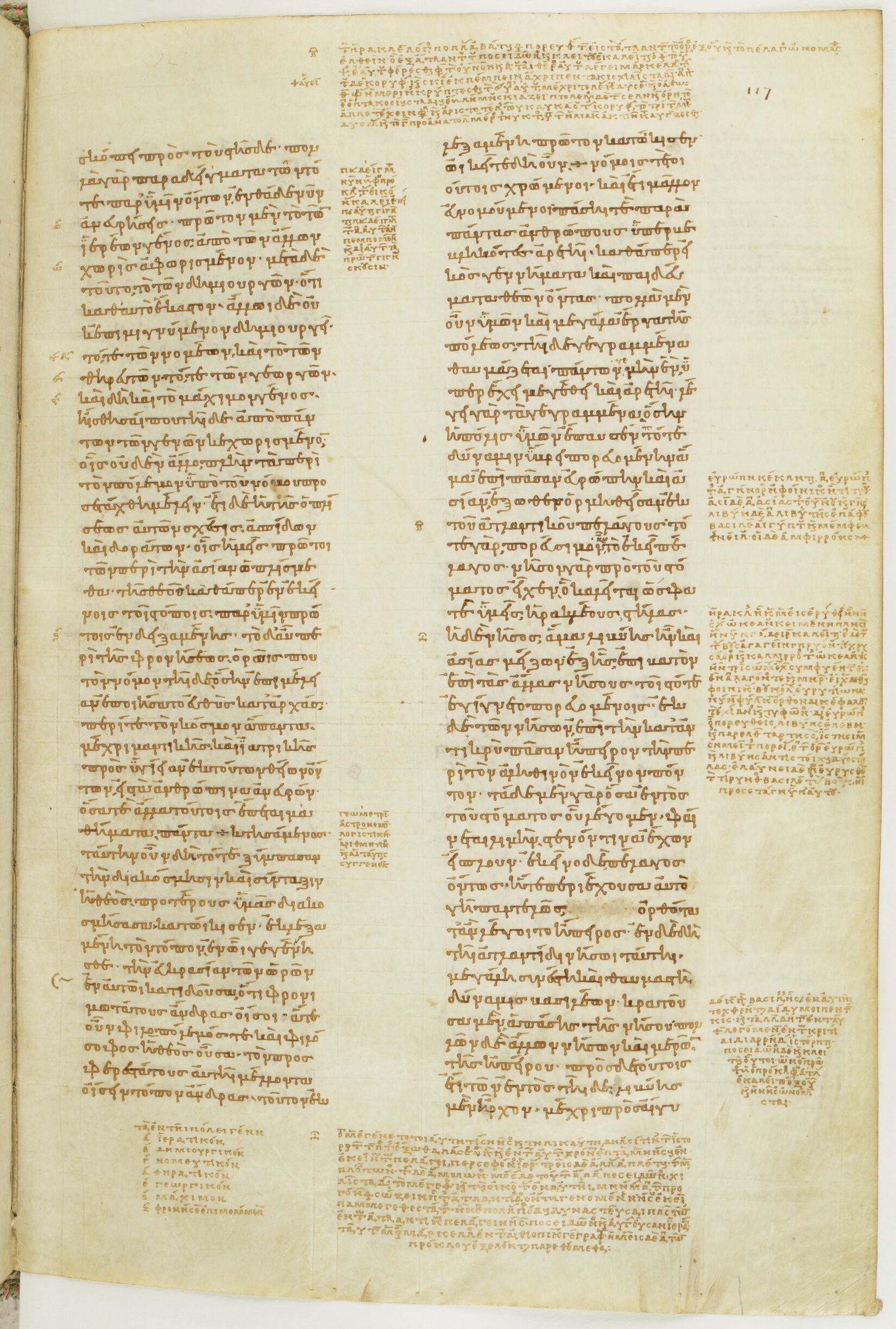
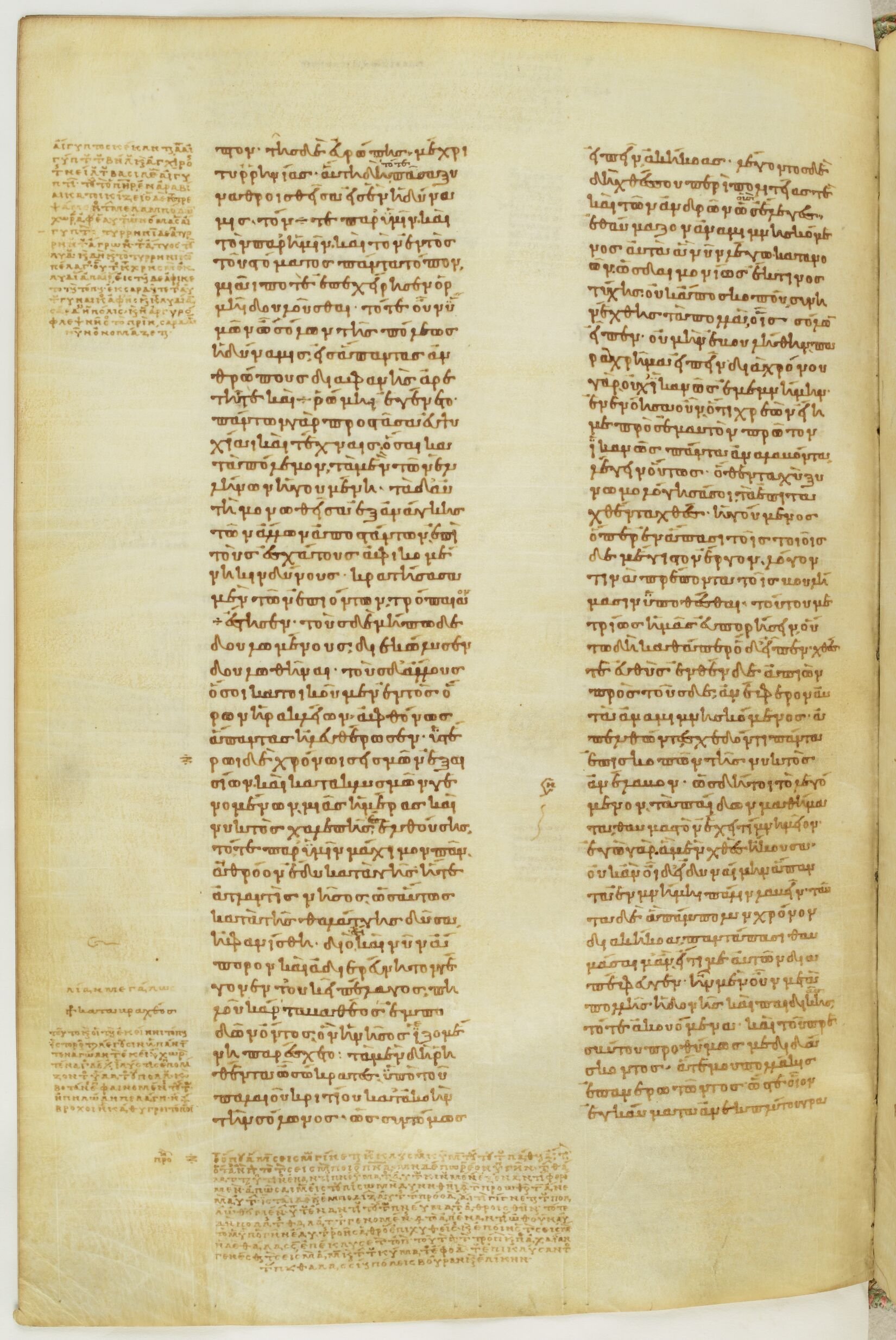
The manuscript is Paris, Bibliothèque nationale de France, grec 1807, known to editors as Plato A. It was copied in Constantinople around 850-875 by the scribe of the so-called philosophical collection, and is the oldest surviving medieval manuscript of the Timaeus and Critias (tetralogies VIII-IX: Clitophon, Republic, Timaeus, Critias, Minos, Laws, Epinomis, Letters). Each page has two columns of 44 lines. The Timaeus fills fol. 114r-144v and the Critias fol. 145r-151r.
On the manuscript this page of text runs over fol. 117r col. b to fol. 117v col. b. Each section below is linked to the folio side(s) that carry it. The mapping comes from reading the first words of every column on the images and finding them in Burnet's text: fol. 117r col. b begins ‹-εξαμένη πρῶτον κατῴκισεν. ᾠκεῖτε δὴ οὖν› (Tim. 24d); fol. 117v col. a begins ‹τῆς δὲ Εὐρώπης μέχρι Τυρρηνίας. αὕτη› (Tim. 25b); fol. 117v col. b begins ‹εἰπεῖν, ἀκήκοας· λέγοντος δὲ δὴ χθὲς› (Tim. 25e).
The Greek is John Burnet's critical text (Oxford, 1902), not a transcription of this manuscript; the scribe's spelling, accents and occasional readings differ from it. The English is R. G. Bury's Loeb translation (1929).
How was this verified? (Provenance)
Where on the image
Tim. 25a stands in Paris gr. 1807, fol. 117r col. b. Checked on the image (column openings read on the BnF photographs and found in Burnet's text, quoted in Burnet's spelling): fol. 117r col. b begins ‹-εξαμένη πρῶτον κατῴκισεν. ᾠκεῖτε δὴ οὖν› (Tim. 24d).
ἐπὶ τὴν καταντικρὺ πᾶσαν ἤπειρον τὴν περὶ τὸν ἀληθινὸν ἐκεῖνον πόντον. τάδε μὲν γάρ, ὅσα ἐντὸς τοῦ στόματος οὗ λέγομεν, φαίνεται λιμὴν στενόν τινα ἔχων εἴσπλουν· ἐκεῖνο δὲ πέλαγος ὄντως ἥ τε περιέχουσα αὐτὸ γῆ παντελῶς ἀληθῶς ὀρθότατʼ ἂν λέγοιτο ἤπειρος. ἐν δὲ δὴ τῇ Ἀτλαντίδι νήσῳ ταύτῃ μεγάλη συνέστη καὶ θαυμαστὴ δύναμις βασιλέων, κρατοῦσα μὲν ἁπάσης τῆς νήσου, πολλῶν δὲ ἄλλων νήσων καὶ μερῶν τῆς ἠπείρου· πρὸς δὲ τούτοις ἔτι τῶν ἐντὸς τῇδε
over against them which encompasses that veritable ocean. For all that we have here, lying within the mouth of which we speak, is evidently a haven having a narrow entrance; but that yonder is a real ocean, and the land surrounding it may most rightly be called, in the fullest and truest sense, a continent. Now in this island of Atlantis there existed a confederation of kings, of great and marvellous power, which held sway over all the island, and over many other islands also and parts of the continent; and, moreover,
Where on the image
Tim. 25b stands in Paris gr. 1807, fol. 117r col. b to fol. 117v col. a. Checked on the image (column openings read on the BnF photographs and found in Burnet's text, quoted in Burnet's spelling): fol. 117r col. b begins ‹-εξαμένη πρῶτον κατῴκισεν. ᾠκεῖτε δὴ οὖν› (Tim. 24d); fol. 117v col. a begins ‹τῆς δὲ Εὐρώπης μέχρι Τυρρηνίας. αὕτη› (Tim. 25b).
Λιβύης μὲν ἦρχον μέχρι πρὸς Αἴγυπτον, τῆς δὲ Εὐρώπης μέχρι Τυρρηνίας. αὕτη δὴ πᾶσα συναθροισθεῖσα εἰς ἓν ἡ δύναμις τόν τε παρʼ ὑμῖν καὶ τὸν παρʼ ἡμῖν καὶ τὸν ἐντὸς τοῦ στόματος πάντα τόπον μιᾷ ποτὲ ἐπεχείρησεν ὁρμῇ δουλοῦσθαι. τότε οὖν ὑμῶν, ὦ Σόλων, τῆς πόλεως ἡ δύναμις εἰς ἅπαντας ἀνθρώπους διαφανὴς ἀρετῇ τε καὶ ῥώμῃ ἐγένετο· πάντων γὰρ προστᾶσα εὐψυχίᾳ καὶ τέχναις ὅσαι κατὰ πόλεμον,
of the lands here within the Straits they ruled over Libya as far as Egypt, and over Europe as far as Tuscany. So this host, being all gathered together, made an attempt one time to enslave by one single onslaught both your country and ours and the whole of the territory within the Straits. And then it was, Solon, that the manhood of your State showed itself conspicuous for valor and might in the sight of all the world. For it stood pre-eminent above all
Where on the image
Tim. 25c stands in Paris gr. 1807, fol. 117v col. a. Checked on the image (column openings read on the BnF photographs and found in Burnet's text, quoted in Burnet's spelling): fol. 117v col. a begins ‹τῆς δὲ Εὐρώπης μέχρι Τυρρηνίας. αὕτη› (Tim. 25b).
τὰ μὲν τῶν Ἑλλήνων ἡγουμένη, τὰ δʼ αὐτὴ μονωθεῖσα ἐξ ἀνάγκης τῶν ἄλλων ἀποστάντων, ἐπὶ τοὺς ἐσχάτους ἀφικομένη κινδύνους, κρατήσασα μὲν τῶν ἐπιόντων τρόπαιον ἔστησεν, τοὺς δὲ μήπω δεδουλωμένους διεκώλυσεν δουλωθῆναι, τοὺς δʼ ἄλλους, ὅσοι κατοικοῦμεν ἐντὸς ὅρων Ἡρακλείων, ἀφθόνως ἅπαντας ἠλευθέρωσεν. ὑστέρῳ δὲ χρόνῳ σεισμῶν ἐξαισίων καὶ κατακλυσμῶν γενομένων, μιᾶς
in gallantry and all warlike arts, and acting partly as leader of the Greeks, and partly standing alone by itself when deserted by all others, after encountering the deadliest perils, it defeated the invaders and reared a trophy; whereby it saved from slavery such as were not as yet enslaved, and all the rest of us who dwell within the bounds of Heracles it ungrudgingly set free. But at a later time there occurred portentous earthquakes and floods,
Where on the image
Tim. 25d stands in Paris gr. 1807, fol. 117v col. a. Checked on the image (column openings read on the BnF photographs and found in Burnet's text, quoted in Burnet's spelling): fol. 117v col. a begins ‹τῆς δὲ Εὐρώπης μέχρι Τυρρηνίας. αὕτη› (Tim. 25b).
ἡμέρας καὶ νυκτὸς χαλεπῆς ἐπελθούσης, τό τε παρʼ ὑμῖν μάχιμον πᾶν ἁθρόον ἔδυ κατὰ γῆς, ἥ τε Ἀτλαντὶς νῆσος ὡσαύτως κατὰ τῆς θαλάττης δῦσα ἠφανίσθη· διὸ καὶ νῦν ἄπορον καὶ ἀδιερεύνητον γέγονεν τοὐκεῖ πέλαγος, πηλοῦ κάρτα βραχέος ἐμποδὼν ὄντος, ὃν ἡ νῆσος ἱζομένη παρέσχετο. τὰ μὲν δὴ ῥηθέντα, ὦ Σώκρατες, ὑπὸ τοῦ παλαιοῦ
and one grievous day and night befell them, when the whole body of your warriors was swallowed up by the earth, and the island of Atlantis in like manner was swallowed up by the sea and vanished; wherefore also the ocean at that spot has now become impassable and unsearchable, being blocked up by the shoal mud which the island created as it settled down.’” You have now heard, Socrates, in brief outline, the account given by the elder Critias of what he heard from Solon;
Where on the image
Tim. 25e stands in Paris gr. 1807, fol. 117v col. a to fol. 117v col. b. Checked on the image (column openings read on the BnF photographs and found in Burnet's text, quoted in Burnet's spelling): fol. 117v col. a begins ‹τῆς δὲ Εὐρώπης μέχρι Τυρρηνίας. αὕτη› (Tim. 25b); fol. 117v col. b begins ‹εἰπεῖν, ἀκήκοας· λέγοντος δὲ δὴ χθὲς› (Tim. 25e).
Κριτίου κατʼ ἀκοὴν τὴν Σόλωνος, ὡς συντόμως εἰπεῖν, ἀκήκοας· λέγοντος δὲ δὴ χθὲς σοῦ περὶ πολιτείας τε καὶ τῶν ἀνδρῶν οὓς ἔλεγες, ἐθαύμαζον ἀναμιμνῃσκόμενος αὐτὰ ἃ νῦν λέγω, κατανοῶν ὡς δαιμονίως ἔκ τινος τύχης οὐκ ἄπο σκοποῦ συνηνέχθης τὰ πολλὰ οἷς Σόλων εἶπεν.
οὐ μὴν
and when you were speaking yesterday about the State and the citizens you were describing, I marvelled as I called to mind the facts I am now relating, reflecting what a strange piece of fortune it was that your description coincided so exactly for the most part with Solon’s account.
I was loth, however,
Notes
- Greek: John Burnet, Platonis Opera IV (Oxford, 1902), via Perseus canonical-greekLit; Burnet's text is a critical edition, so its wording can differ from the manuscript shown.
- English: R. G. Bury, Plato IX (Loeb Classical Library, 1929), via Perseus. Bury's footnotes are not reproduced. Quotation marks stand where Perseus marks quoted speech.
- Stephanus sections (a-e) are those of the 1578 Stephanus edition as given by Burnet and Bury; Bury's section breaks can fall a few words away from Burnet's because English word order differs.
Cite
Sources
- Source: Paris, BnF grec 1807 (Plato A, c. 850-875) fol. 117r-117v via BnF IIIF + Burnet's Greek (Perseus) + R. G. Bury's English (Loeb 1929, Perseus) (holding institution)
- Critical edition: Burnet, Platonis Opera IV (1902), via Perseus
← previous · → next · v cycle view · l back to library