Plato, Timaeus 27a-27d: the order of the speeches; Timaeus' invocation; Being and Becoming
Introduction
Stephanus page 27 of Plato's Timaeus (27a-27d): the order of the speeches; Timaeus' invocation; Being and Becoming.
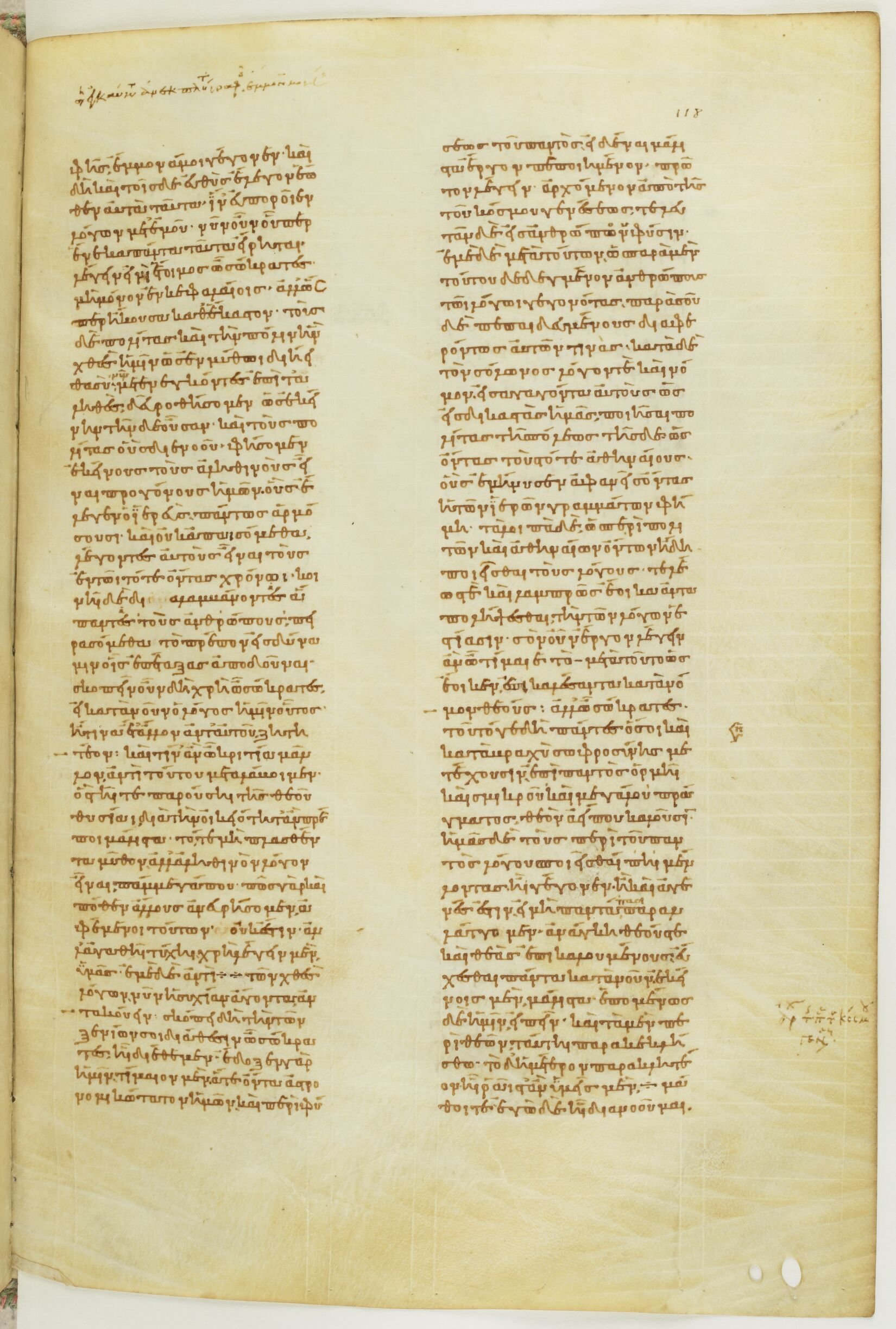
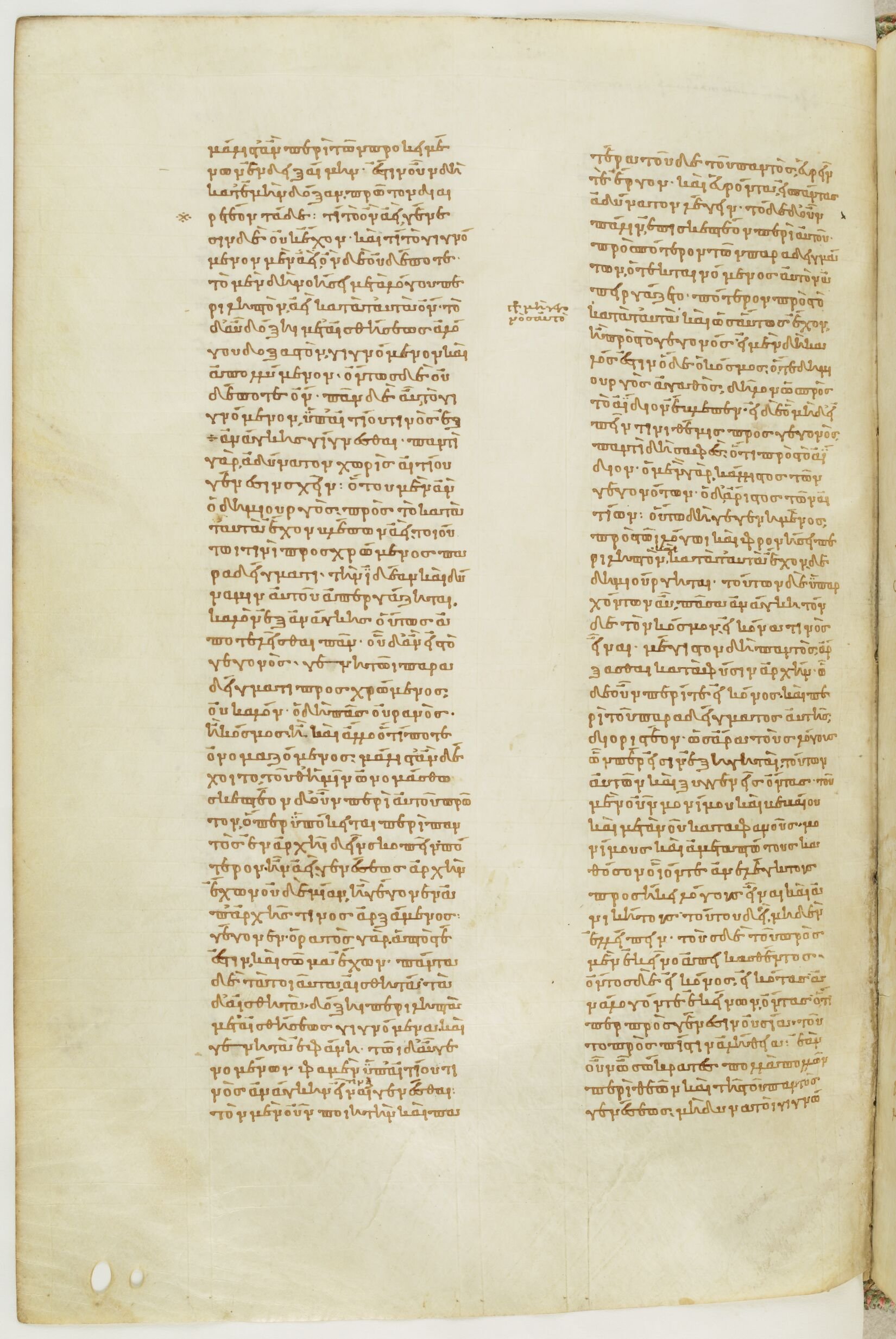
The manuscript is Paris, Bibliothèque nationale de France, grec 1807, known to editors as Plato A. It was copied in Constantinople around 850-875 by the scribe of the so-called philosophical collection, and is the oldest surviving medieval manuscript of the Timaeus and Critias (tetralogies VIII-IX: Clitophon, Republic, Timaeus, Critias, Minos, Laws, Epinomis, Letters). Each page has two columns of 44 lines. The Timaeus fills fol. 114r-144v and the Critias fol. 145r-151r.
On the manuscript this page of text runs over fol. 118r col. a to fol. 118v col. a. Each section below is linked to the folio side(s) that carry it. The mapping comes from reading the first words of every column on the images and finding them in Burnet's text: fol. 118r col. a begins ‹-φῆς ἔμμονά μοι γέγονεν· καὶ δὴ› (Tim. 26c); fol. 118r col. b begins ‹τοῦ παντὸς εἰδέναι μάλιστα ἔργον πεποιημένον› (Tim. 27a); fol. 118v col. a begins ‹μάλιστʼ ἂν περὶ τῶν προκειμένων ἐνδειξαίμην› (Tim. 27d).
The Greek is John Burnet's critical text (Oxford, 1902), not a transcription of this manuscript; the scribe's spelling, accents and occasional readings differ from it. The English is R. G. Bury's Loeb translation (1929).
How was this verified? (Provenance)
Where on the image
Tim. 27a stands in Paris gr. 1807, fol. 118r col. a to fol. 118r col. b. Checked on the image (column openings read on the BnF photographs and found in Burnet's text, quoted in Burnet's spelling): fol. 118r col. a begins ‹-φῆς ἔμμονά μοι γέγονεν· καὶ δὴ› (Tim. 26c); fol. 118r col. b begins ‹τοῦ παντὸς εἰδέναι μάλιστα ἔργον πεποιημένον› (Tim. 27a).
ἡσυχίαν ἄγοντα ἀντακούειν.
ΚΡ. σκόπει δὴ τὴν τῶν ξενίων σοι διάθεσιν, ὦ Σώκρατες, ᾗ διέθεμεν. ἔδοξεν γὰρ ἡμῖν Τίμαιον μέν, ἅτε ὄντα ἀστρονομικώτατον ἡμῶν καὶ περὶ φύσεως τοῦ παντὸς εἰδέναι μάλιστα ἔργον πεποιημένον, πρῶτον λέγειν ἀρχόμενον ἀπὸ τῆς τοῦ κόσμου γενέσεως, τελευτᾶν δὲ εἰς ἀνθρώπων φύσιν· ἐμὲ δὲ μετὰ τοῦτον, ὡς παρὰ μὲν τούτου δεδεγμένον ἀνθρώπους τῷ λόγῳ γεγονότας, παρὰ σοῦ δὲ πεπαιδευμένους διαφερόντως
keep silence in my turn and hearken.
Crit. Consider now, Socrates, the order of the feast as we have arranged it. Seeing that Timaeus is our best astronomer and has made it his special task to learn about the nature of the Universe, it seemed good to us that he should speak first, beginning with the origin of the Cosmos and ending with the generation of mankind. After him I am to follow, taking over from him mankind, already as it were created by his speech, and taking over from you
Where on the image
Tim. 27b stands in Paris gr. 1807, fol. 118r col. b. Checked on the image (column openings read on the BnF photographs and found in Burnet's text, quoted in Burnet's spelling): fol. 118r col. b begins ‹τοῦ παντὸς εἰδέναι μάλιστα ἔργον πεποιημένον› (Tim. 27a).
αὐτῶν τινας, κατὰ δὲ τὸν Σόλωνος λόγον τε καὶ νόμον εἰσαγαγόντα αὐτοὺς ὡς εἰς δικαστὰς ἡμᾶς ποιῆσαι πολίτας τῆς πόλεως τῆσδε ὡς ὄντας τοὺς τότε Ἀθηναίους, οὓς ἐμήνυσεν ἀφανεῖς ὄντας ἡ τῶν ἱερῶν γραμμάτων φήμη, τὰ λοιπὰ δὲ ὡς περὶ πολιτῶν καὶ Ἀθηναίων ὄντων ἤδη ποιεῖσθαι τοὺς λόγους.
ΣΩ. τελέως τε καὶ λαμπρῶς ἔοικα ἀνταπολήψεσθαι τὴν τῶν λόγων ἑστίασιν. σὸν οὖν ἔργον λέγειν ἄν, ὦ Τίμαιε, τὸ μετὰ τοῦτο, ὡς ἔοικεν, εἴη καλέσαντα κατὰ νόμον θεούς.
a select number of men superlatively well trained. Then, in accordance with the word and law of Solon, I am to bring these before ourselves, as before a court of judges, and make them citizens of this State of ours, regarding them as Athenians of that bygone age whose existence, so long forgotten, has been revealed to us by the record of the sacred writings; and thenceforward I am to proceed with my discourse as if I were speaking of men who already are citizens and men of Athens.
Soc. Bounteous and magnificent, methinks, is the feast of speech with which I am to be requited. So then, it will be your task, it seems, to speak next, when you have duly invoked the gods.
Where on the image
Tim. 27c stands in Paris gr. 1807, fol. 118r col. b. Checked on the image (column openings read on the BnF photographs and found in Burnet's text, quoted in Burnet's spelling): fol. 118r col. b begins ‹τοῦ παντὸς εἰδέναι μάλιστα ἔργον πεποιημένον› (Tim. 27a).
ΤΙ. ἀλλʼ, ὦ Σώκρατες, τοῦτό γε δὴ πάντες ὅσοι καὶ κατὰ βραχὺ σωφροσύνης μετέχουσιν, ἐπὶ παντὸς ὁρμῇ καὶ σμικροῦ καὶ μεγάλου πράγματος θεὸν ἀεί που καλοῦσιν· ἡμᾶς δὲ τοὺς περὶ τοῦ παντὸς λόγους ποιεῖσθαί πῃ μέλλοντας, ᾗ γέγονεν ἢ καὶ ἀγενές ἐστιν, εἰ μὴ παντάπασι παραλλάττομεν, ἀνάγκη θεούς τε καὶ θεὰς ἐπικαλουμένους εὔχεσθαι πάντα κατὰ νοῦν ἐκείνοις μὲν μάλιστα, ἑπομένως
Tim. Nay, as to that, Socrates, all men who possess even a small share of good sense call upon God always at the outset of every undertaking, be it small or great; we therefore who are purposing to deliver a discourse concerning the Universe, how it was created or haply is uncreate, must needs invoke Gods and Goddesses (if so be that we are not utterly demented), praying that all we say may be approved by them in the first place, and secondly by ourselves. Grant, then, that we have thus duly invoked the deities;
Where on the image
Tim. 27d stands in Paris gr. 1807, fol. 118r col. b to fol. 118v col. a. Checked on the image (column openings read on the BnF photographs and found in Burnet's text, quoted in Burnet's spelling): fol. 118r col. b begins ‹τοῦ παντὸς εἰδέναι μάλιστα ἔργον πεποιημένον› (Tim. 27a); fol. 118v col. a begins ‹μάλιστʼ ἂν περὶ τῶν προκειμένων ἐνδειξαίμην› (Tim. 27d).
δὲ ἡμῖν εἰπεῖν. καὶ τὰ μὲν περὶ θεῶν ταύτῃ παρακεκλήσθω· τὸ δʼ ἡμέτερον παρακλητέον, ᾗ ῥᾷστʼ ἂν ὑμεῖς μὲν μάθοιτε, ἐγὼ δὲ ᾗ διανοοῦμαι μάλιστʼ ἂν περὶ τῶν προκειμένων ἐνδειξαίμην.
ἔστιν οὖν δὴ κατʼ ἐμὴν δόξαν πρῶτον διαιρετέον τάδε· τί τὸ ὂν ἀεί, γένεσιν δὲ οὐκ ἔχον, καὶ τί τὸ γιγνόμενον μὲν
>ourselves we must also invoke so to proceed, that you may most easily learn and I may most clearly expound my views regarding the subject before us.
Now first of all we must, in my judgement, make the following distinction. What is that which is Existent always
Notes
- Greek: John Burnet, Platonis Opera IV (Oxford, 1902), via Perseus canonical-greekLit; Burnet's text is a critical edition, so its wording can differ from the manuscript shown.
- English: R. G. Bury, Plato IX (Loeb Classical Library, 1929), via Perseus. Bury's footnotes are not reproduced. Quotation marks stand where Perseus marks quoted speech.
- Stephanus sections (a-e) are those of the 1578 Stephanus edition as given by Burnet and Bury; Bury's section breaks can fall a few words away from Burnet's because English word order differs.
Cite
Sources
- Source: Paris, BnF grec 1807 (Plato A, c. 850-875) fol. 118r-118v via BnF IIIF + Burnet's Greek (Perseus) + R. G. Bury's English (Loeb 1929, Perseus) (holding institution)
- Critical edition: Burnet, Platonis Opera IV (1902), via Perseus
← previous · → next · v cycle view · l back to library