Plato, Timaeus 28a-28c: whatever becomes has a cause; the maker and father of the universe
Introduction
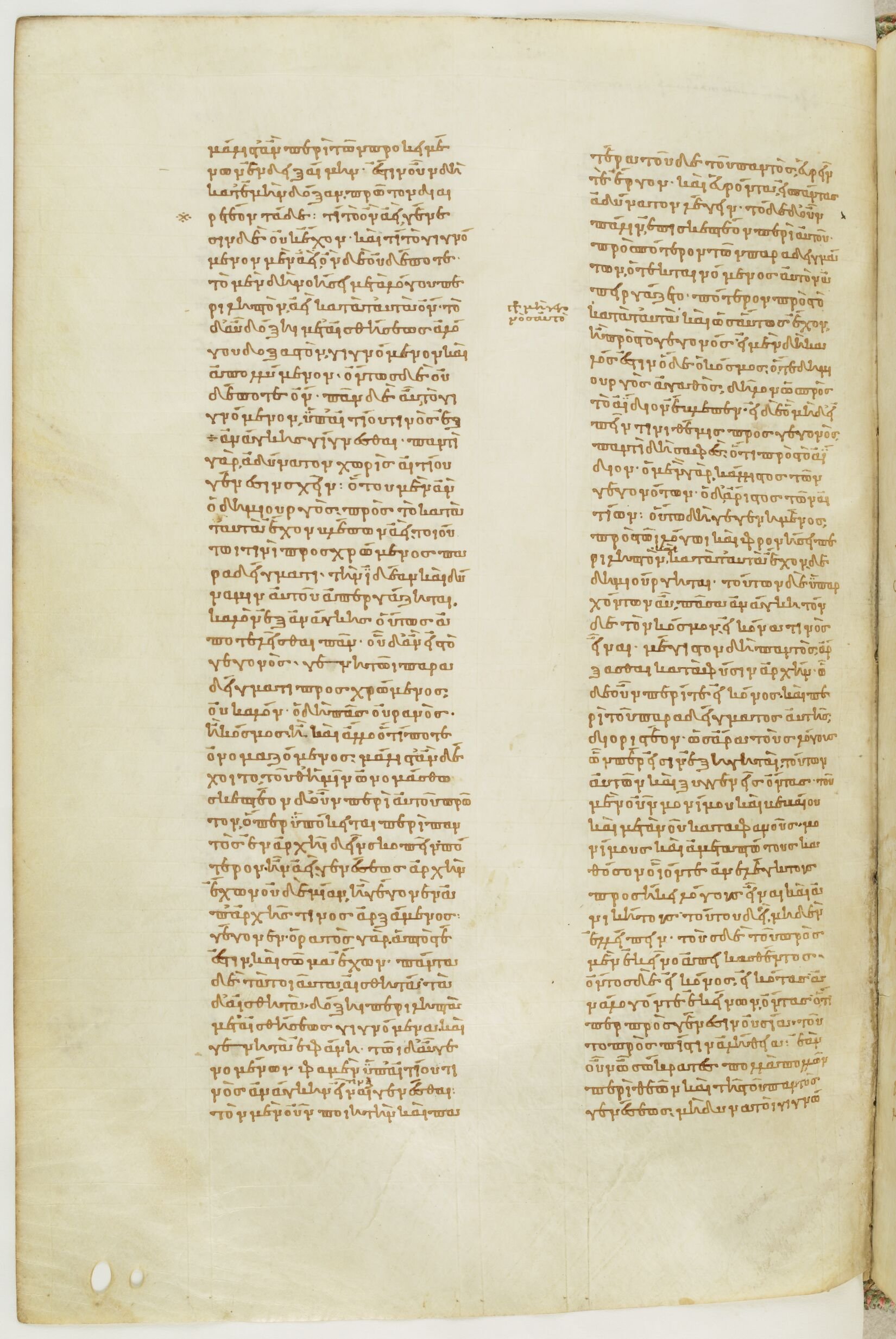
Stephanus page 28 of Plato's Timaeus (28a-28c): whatever becomes has a cause; the maker and father of the universe.
The manuscript is Paris, Bibliothèque nationale de France, grec 1807, known to editors as Plato A. It was copied in Constantinople around 850-875 by the scribe of the so-called philosophical collection, and is the oldest surviving medieval manuscript of the Timaeus and Critias (tetralogies VIII-IX: Clitophon, Republic, Timaeus, Critias, Minos, Laws, Epinomis, Letters). Each page has two columns of 44 lines. The Timaeus fills fol. 114r-144v and the Critias fol. 145r-151r.
On the manuscript this page of text runs over fol. 118v col. a to fol. 118v col. b. Each section below is linked to the folio side(s) that carry it. The mapping comes from reading the first words of every column on the images and finding them in Burnet's text: fol. 118v col. a begins ‹μάλιστʼ ἂν περὶ τῶν προκειμένων ἐνδειξαίμην› (Tim. 27d); fol. 118v col. b begins ‹-τέρα τοῦδε τοῦ παντὸς εὑρεῖν τε› (Tim. 28c).
The Greek is John Burnet's critical text (Oxford, 1902), not a transcription of this manuscript; the scribe's spelling, accents and occasional readings differ from it. The English is R. G. Bury's Loeb translation (1929).
How was this verified? (Provenance)
Where on the image
Tim. 28a stands in Paris gr. 1807, fol. 118v col. a. Checked on the image (column openings read on the BnF photographs and found in Burnet's text, quoted in Burnet's spelling): fol. 118v col. a begins ‹μάλιστʼ ἂν περὶ τῶν προκειμένων ἐνδειξαίμην› (Tim. 27d).
ἀεί, ὂν δὲ οὐδέποτε; τὸ μὲν δὴ νοήσει μετὰ λόγου περιληπτόν, ἀεὶ κατὰ ταὐτὰ ὄν, τὸ δʼ αὖ δόξῃ μετʼ αἰσθήσεως ἀλόγου δοξαστόν, γιγνόμενον καὶ ἀπολλύμενον, ὄντως δὲ οὐδέποτε ὄν. πᾶν δὲ αὖ τὸ γιγνόμενον ὑπʼ αἰτίου τινὸς ἐξ ἀνάγκης γίγνεσθαι· παντὶ γὰρ ἀδύνατον χωρὶς αἰτίου γένεσιν σχεῖν. ὅτου μὲν οὖν ἂν ὁ δημιουργὸς πρὸς τὸ κατὰ ταὐτὰ ἔχον βλέπων ἀεί, τοιούτῳ τινὶ προσχρώμενος παραδείγματι, τὴν ἰδέαν καὶ δύναμιν αὐτοῦ ἀπεργάζηται, καλὸν ἐξ ἀνάγκης
and has no Becoming? And what is that which is Becoming always and never is Existent? Now the one of these is apprehensible by thought with the aid of reasoning, since it is ever uniformly existent; whereas the other is an object of opinion with the aid of unreasoning sensation, since it becomes and perishes and is never really existent. Again, everything which becomes must of necessity become owing to some Cause; for without a cause it is impossible for anything to attain becoming. But when the artificer of any object, in forming its shape and quality, keeps his gaze fixed on that which is uniform, using a model of this kind, that object, executed in this way, must of necessity
Where on the image
Tim. 28b stands in Paris gr. 1807, fol. 118v col. a. Checked on the image (column openings read on the BnF photographs and found in Burnet's text, quoted in Burnet's spelling): fol. 118v col. a begins ‹μάλιστʼ ἂν περὶ τῶν προκειμένων ἐνδειξαίμην› (Tim. 27d).
οὕτως ἀποτελεῖσθαι πᾶν· οὗ δʼ ἂν εἰς γεγονός, γεννητῷ παραδείγματι προσχρώμενος, οὐ καλόν. ὁ δὴ πᾶς οὐρανὸς —ἢ κόσμος ἢ καὶ ἄλλο ὅτι ποτὲ ὀνομαζόμενος μάλιστʼ ἂν δέχοιτο, τοῦθʼ ἡμῖν ὠνομάσθω—σκεπτέον δʼ οὖν περὶ αὐτοῦ πρῶτον, ὅπερ ὑπόκειται περὶ παντὸς ἐν ἀρχῇ δεῖν σκοπεῖν, πότερον ἦν ἀεί, γενέσεως ἀρχὴν ἔχων οὐδεμίαν, ἢ γέγονεν, ἀπʼ ἀρχῆς τινος ἀρξάμενος. γέγονεν· ὁρατὸς γὰρ ἁπτός τέ ἐστιν καὶ σῶμα ἔχων, πάντα δὲ τὰ τοιαῦτα αἰσθητά, τὰ
be beautiful; but whenever he gazes at that which has come into existence and uses a created model, the object thus executed is not beautiful. Now the whole Heaven, or Cosmos, or if there is any other name which it specially prefers, by that let us call it,—so, be its name what it may, we must first investigate concerning it that primary question which has to be investigated at the outset in every case,—namely, whether it has existed always, having no beginning of generation, or whether it has come into existence, having begun from some beginning. It has come into existence; for it is visible and tangible and possessed of a body; and all such things are sensible
Where on the image
Tim. 28c stands in Paris gr. 1807, fol. 118v col. a to fol. 118v col. b. Checked on the image (column openings read on the BnF photographs and found in Burnet's text, quoted in Burnet's spelling): fol. 118v col. a begins ‹μάλιστʼ ἂν περὶ τῶν προκειμένων ἐνδειξαίμην› (Tim. 27d); fol. 118v col. b begins ‹-τέρα τοῦδε τοῦ παντὸς εὑρεῖν τε› (Tim. 28c).
δʼ αἰσθητά, δόξῃ περιληπτὰ μετʼ αἰσθήσεως, γιγνόμενα καὶ γεννητὰ ἐφάνη. τῷ δʼ αὖ γενομένῳ φαμὲν ὑπʼ αἰτίου τινὸς ἀνάγκην εἶναι γενέσθαι.
τὸν μὲν οὖν ποιητὴν καὶ πατέρα τοῦδε τοῦ παντὸς εὑρεῖν τε ἔργον καὶ εὑρόντα εἰς πάντας ἀδύνατον λέγειν· τόδε δʼ οὖν πάλιν ἐπισκεπτέον περὶ αὐτοῦ, πρὸς πότερον τῶν παραδειγμάτων ὁ τεκταινόμενος αὐτὸν
and things sensible, being apprehensible by opinion with the aid of sensation, come into existence, as we saw, and are generated. And that which has come into existence must necessarily, as we say, have come into existence by reason of some Cause.
Now to discover the Maker and Father of this Universe were a task indeed; and having discovered Him, to declare Him unto all men were a thing impossible. However, let us return and inquire further concerning the Cosmos,—after which of the Models did its Architect construct it?
Notes
- Greek: John Burnet, Platonis Opera IV (Oxford, 1902), via Perseus canonical-greekLit; Burnet's text is a critical edition, so its wording can differ from the manuscript shown.
- English: R. G. Bury, Plato IX (Loeb Classical Library, 1929), via Perseus. Bury's footnotes are not reproduced. Quotation marks stand where Perseus marks quoted speech.
- Stephanus sections (a-e) are those of the 1578 Stephanus edition as given by Burnet and Bury; Bury's section breaks can fall a few words away from Burnet's because English word order differs.
Cite
Sources
- Source: Paris, BnF grec 1807 (Plato A, c. 850-875) fol. 118v via BnF IIIF + Burnet's Greek (Perseus) + R. G. Bury's English (Loeb 1929, Perseus) (holding institution)
- Critical edition: Burnet, Platonis Opera IV (1902), via Perseus
← previous · → next · v cycle view · l back to library