Plato, Timaeus 29a-29e: the world is a copy of an eternal model; a likely account; the maker was good
Introduction
Stephanus page 29 of Plato's Timaeus (29a-29e): the world is a copy of an eternal model; a likely account; the maker was good.
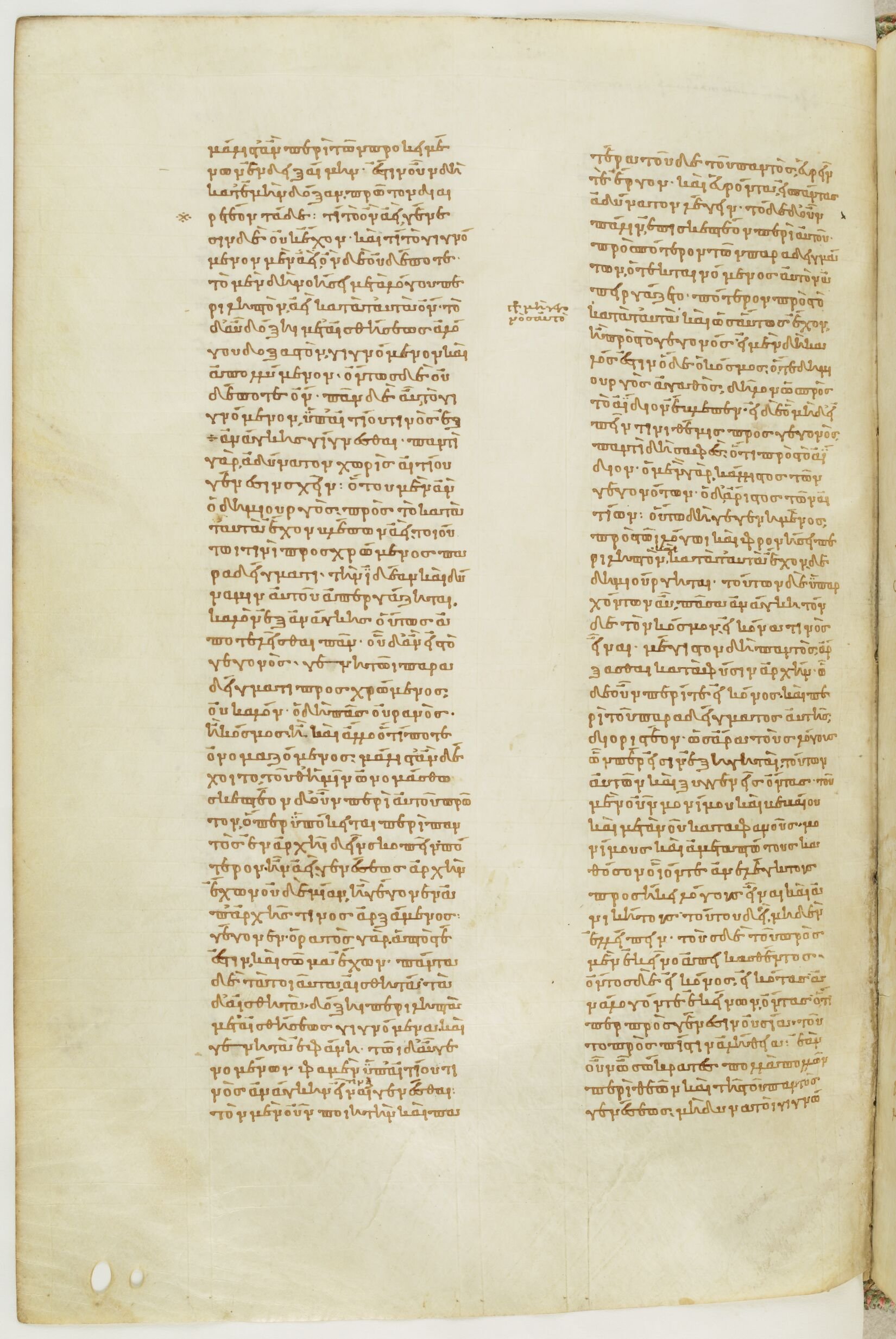
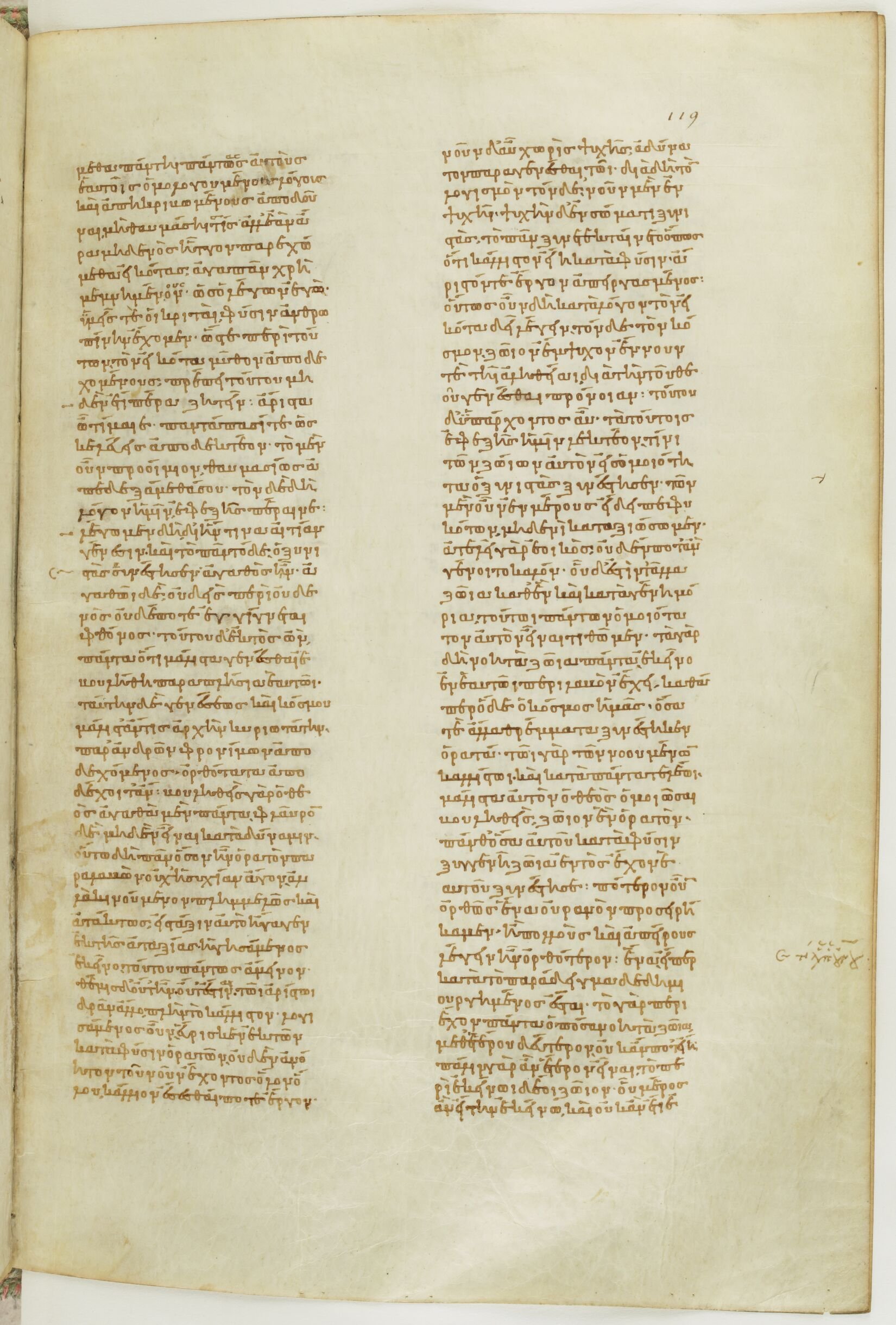
The manuscript is Paris, Bibliothèque nationale de France, grec 1807, known to editors as Plato A. It was copied in Constantinople around 850-875 by the scribe of the so-called philosophical collection, and is the oldest surviving medieval manuscript of the Timaeus and Critias (tetralogies VIII-IX: Clitophon, Republic, Timaeus, Critias, Minos, Laws, Epinomis, Letters). Each page has two columns of 44 lines. The Timaeus fills fol. 114r-144v and the Critias fol. 145r-151r.
On the manuscript this page of text runs over fol. 118v col. b to fol. 119r col. a. Each section below is linked to the folio side(s) that carry it. The mapping comes from reading the first words of every column on the images and finding them in Burnet's text: fol. 118v col. b begins ‹-τέρα τοῦδε τοῦ παντὸς εὑρεῖν τε› (Tim. 28c); fol. 119r col. a begins ‹πάντῃ πάντως αὐτοὺς ἑαυτοῖς ὁμολογουμένους λόγους› (Tim. 29c).
The Greek is John Burnet's critical text (Oxford, 1902), not a transcription of this manuscript; the scribe's spelling, accents and occasional readings differ from it. The English is R. G. Bury's Loeb translation (1929).
How was this verified? (Provenance)
Where on the image
Tim. 29a stands in Paris gr. 1807, fol. 118v col. b. Checked on the image (column openings read on the BnF photographs and found in Burnet's text, quoted in Burnet's spelling): fol. 118v col. b begins ‹-τέρα τοῦδε τοῦ παντὸς εὑρεῖν τε› (Tim. 28c).
ἀπηργάζετο, πότερον πρὸς τὸ κατὰ ταὐτὰ καὶ ὡσαύτως ἔχον ἢ πρὸς τὸ γεγονός. εἰ μὲν δὴ καλός ἐστιν ὅδε ὁ κόσμος ὅ τε δημιουργὸς ἀγαθός, δῆλον ὡς πρὸς τὸ ἀίδιον ἔβλεπεν· εἰ δὲ ὃ μηδʼ εἰπεῖν τινι θέμις, πρὸς γεγονός. παντὶ δὴ σαφὲς ὅτι πρὸς τὸ ἀίδιον· ὁ μὲν γὰρ κάλλιστος τῶν γεγονότων, ὁ δʼ ἄριστος τῶν αἰτίων. οὕτω δὴ γεγενημένος πρὸς τὸ λόγῳ καὶ φρονήσει περιληπτὸν καὶ κατὰ ταὐτὰ ἔχον δεδημιούργηται·
Was it after that which is self-identical and uniform, or after that which has come into existence; Now if so be that this Cosmos is beautiful and its Constructor good, it is plain that he fixed his gaze on the Eternal; but if otherwise (which is an impious supposition), his gaze was on that which has come into existence. But it is clear to everyone that his gaze was on the Eternal; for the Cosmos is the fairest of all that has come into existence, and He the best of all the Causes. So having in this wise come into existence, it has been constructed after the pattern of that which is apprehensible by reason and thought and is self-identical.
Where on the image
Tim. 29b stands in Paris gr. 1807, fol. 118v col. b. Checked on the image (column openings read on the BnF photographs and found in Burnet's text, quoted in Burnet's spelling): fol. 118v col. b begins ‹-τέρα τοῦδε τοῦ παντὸς εὑρεῖν τε› (Tim. 28c).
τούτων δὲ ὑπαρχόντων αὖ πᾶσα ἀνάγκη τόνδε τὸν κόσμον εἰκόνα τινὸς εἶναι. μέγιστον δὴ παντὸς ἄρξασθαι κατὰ φύσιν ἀρχήν. ὧδε οὖν περί τε εἰκόνος καὶ περὶ τοῦ παραδείγματος αὐτῆς διοριστέον, ὡς ἄρα τοὺς λόγους, ὧνπέρ εἰσιν ἐξηγηταί, τούτων αὐτῶν καὶ συγγενεῖς ὄντας· τοῦ μὲν οὖν μονίμου καὶ βεβαίου καὶ μετὰ νοῦ καταφανοῦς μονίμους καὶ ἀμεταπτώτους—καθʼ ὅσον οἷόν τε καὶ ἀνελέγκτοις προσήκει λόγοις εἶναι καὶ ἀνικήτοις, τούτου δεῖ
Again, if these premisses be granted, it is wholly necessary that this Cosmos should be a Copy of something. Now in regard to every matter it is most important to begin at the natural beginning. Accordingly, in dealing with a copy and its model, we must affirm that the accounts given will themselves be akin to the diverse objects which they serve to explain; those which deal with what is abiding and firm and discernible by the aid of thought will be abiding and unshakable; and in so far as it is possible and fitting for statements to be irrefutable and invincible,
Where on the image
Tim. 29c stands in Paris gr. 1807, fol. 118v col. b to fol. 119r col. a. Checked on the image (column openings read on the BnF photographs and found in Burnet's text, quoted in Burnet's spelling): fol. 118v col. b begins ‹-τέρα τοῦδε τοῦ παντὸς εὑρεῖν τε› (Tim. 28c); fol. 119r col. a begins ‹πάντῃ πάντως αὐτοὺς ἑαυτοῖς ὁμολογουμένους λόγους› (Tim. 29c).
μηδὲν ἐλλείπειν—τοὺς δὲ τοῦ πρὸς μὲν ἐκεῖνο ἀπεικασθέντος, ὄντος δὲ εἰκόνος εἰκότας ἀνὰ λόγον τε ἐκείνων ὄντας· ὅτιπερ πρὸς γένεσιν οὐσία, τοῦτο πρὸς πίστιν ἀλήθεια. ἐὰν οὖν, ὦ Σώκρατες, πολλὰ πολλῶν πέρι, θεῶν καὶ τῆς τοῦ παντὸς γενέσεως, μὴ δυνατοὶ γιγνώμεθα πάντῃ πάντως αὐτοὺς ἑαυτοῖς ὁμολογουμένους λόγους καὶ ἀπηκριβωμένους ἀποδοῦναι, μὴ θαυμάσῃς· ἀλλʼ ἐὰν ἄρα μηδενὸς ἧττον παρεχώμεθα εἰκότας, ἀγαπᾶν χρή, μεμνημένους ὡς ὁ λέγων ἐγὼ
they must in no wise fall short thereof; whereas the accounts of that which is copied after the likeness of that Model, and is itself a likeness, will be analogous thereto and possess likelihood; for I as Being is to Becoming, so is Truth to Belief. Wherefore, Socrates, if in our treatment of a great host of matters regarding the Gods and the generation of the Universe we prove unable to give accounts that are always in all respects self-consistent and perfectly exact, be not thou surprised; rather we should be content if we can furnish accounts that are inferior to none in likelihood, remembering that both I who speak
Where on the image
Tim. 29d stands in Paris gr. 1807, fol. 119r col. a. Checked on the image (column openings read on the BnF photographs and found in Burnet's text, quoted in Burnet's spelling): fol. 119r col. a begins ‹πάντῃ πάντως αὐτοὺς ἑαυτοῖς ὁμολογουμένους λόγους› (Tim. 29c).
ὑμεῖς τε οἱ κριταὶ φύσιν ἀνθρωπίνην ἔχομεν, ὥστε περὶ τούτων τὸν εἰκότα μῦθον ἀποδεχομένους πρέπει τούτου μηδὲν ἔτι πέρα ζητεῖν.
ΣΩ. ἄριστα, ὦ Τίμαιε, παντάπασί τε ὡς κελεύεις ἀποδεκτέον· τὸ μὲν οὖν προοίμιον θαυμασίως ἀπεδεξάμεθά σου, τὸν δὲ δὴ νόμον ἡμῖν ἐφεξῆς πέραινε.
ΤΙ. λέγωμεν δὴ διʼ ἥντινα αἰτίαν γένεσιν καὶ τὸ πᾶν
and you who judge are but human creatures, so that it becomes us to accept the likely account of these matters and forbear to search beyond it.
Soc. Excellent, Timaeus! We must by all means accept it, as you suggest; and certainly we have most cordially accepted your prelude; so now, we beg of you, proceed straight on with the main theme.
Tim. Let us now state the Cause wherefore He that constructed it
Where on the image
Tim. 29e stands in Paris gr. 1807, fol. 119r col. a. Checked on the image (column openings read on the BnF photographs and found in Burnet's text, quoted in Burnet's spelling): fol. 119r col. a begins ‹πάντῃ πάντως αὐτοὺς ἑαυτοῖς ὁμολογουμένους λόγους› (Tim. 29c).
τόδε ὁ συνιστὰς συνέστησεν. ἀγαθὸς ἦν, ἀγαθῷ δὲ οὐδεὶς περὶ οὐδενὸς οὐδέποτε ἐγγίγνεται φθόνος· τούτου δʼ ἐκτὸς ὢν πάντα ὅτι μάλιστα ἐβουλήθη γενέσθαι παραπλήσια ἑαυτῷ.
ταύτην δὴ γενέσεως καὶ κόσμου μάλιστʼ ἄν τις ἀρχὴν κυριωτάτην
constructed Becoming and the All. He was good, and in him that is good no envy ariseth ever concerning anything; and being devoid of envy He desired that all should be, so far as possible, like unto Himself.
This principle, then, we shall be wholly right in accepting from men of wisdom as being above all the supreme originating principle of Becoming and the Cosmos.
Notes
- Greek: John Burnet, Platonis Opera IV (Oxford, 1902), via Perseus canonical-greekLit; Burnet's text is a critical edition, so its wording can differ from the manuscript shown.
- English: R. G. Bury, Plato IX (Loeb Classical Library, 1929), via Perseus. Bury's footnotes are not reproduced. Quotation marks stand where Perseus marks quoted speech.
- Stephanus sections (a-e) are those of the 1578 Stephanus edition as given by Burnet and Bury; Bury's section breaks can fall a few words away from Burnet's because English word order differs.
Cite
Sources
- Source: Paris, BnF grec 1807 (Plato A, c. 850-875) fol. 118v-119r via BnF IIIF + Burnet's Greek (Perseus) + R. G. Bury's English (Loeb 1929, Perseus) (holding institution)
- Critical edition: Burnet, Platonis Opera IV (1902), via Perseus
← previous · → next · v cycle view · l back to library