Plato, Timaeus 30a-30d: order out of disorder; the world a living creature with soul and reason
Introduction
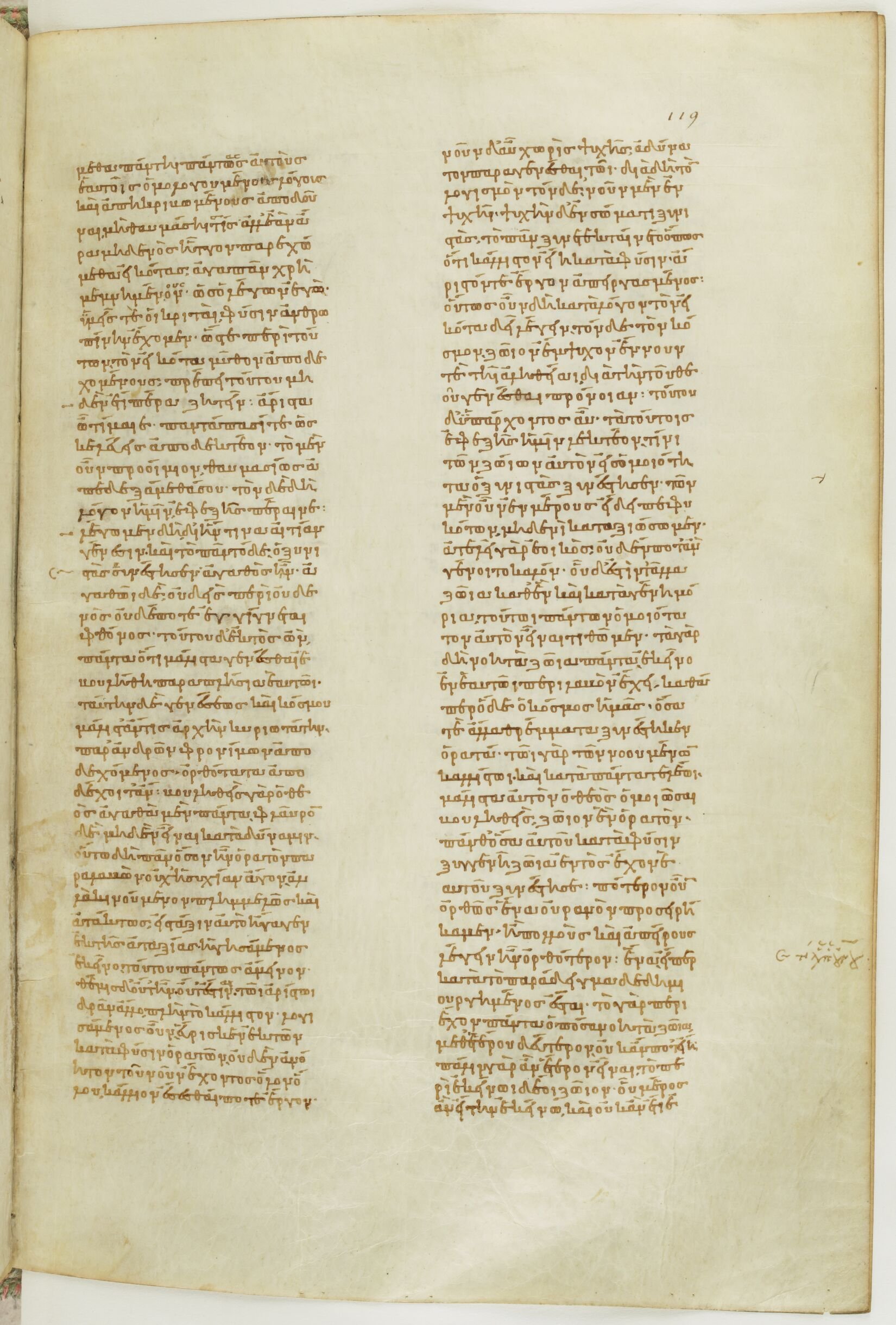
Stephanus page 30 of Plato's Timaeus (30a-30d): order out of disorder; the world a living creature with soul and reason.
The manuscript is Paris, Bibliothèque nationale de France, grec 1807, known to editors as Plato A. It was copied in Constantinople around 850-875 by the scribe of the so-called philosophical collection, and is the oldest surviving medieval manuscript of the Timaeus and Critias (tetralogies VIII-IX: Clitophon, Republic, Timaeus, Critias, Minos, Laws, Epinomis, Letters). Each page has two columns of 44 lines. The Timaeus fills fol. 114r-144v and the Critias fol. 145r-151r.
On the manuscript this page of text runs over fol. 119r col. a to fol. 119r col. b. Each section below is linked to the folio side(s) that carry it. The mapping comes from reading the first words of every column on the images and finding them in Burnet's text: fol. 119r col. a begins ‹πάντῃ πάντως αὐτοὺς ἑαυτοῖς ὁμολογουμένους λόγους› (Tim. 29c); fol. 119r col. b begins ‹νοῦν δʼ αὖ χωρὶς ψυχῆς ἀδύνατον› (Tim. 30b).
The Greek is John Burnet's critical text (Oxford, 1902), not a transcription of this manuscript; the scribe's spelling, accents and occasional readings differ from it. The English is R. G. Bury's Loeb translation (1929).
How was this verified? (Provenance)
Where on the image
Tim. 30a stands in Paris gr. 1807, fol. 119r col. a. Checked on the image (column openings read on the BnF photographs and found in Burnet's text, quoted in Burnet's spelling): fol. 119r col. a begins ‹πάντῃ πάντως αὐτοὺς ἑαυτοῖς ὁμολογουμένους λόγους› (Tim. 29c).
παρʼ ἀνδρῶν φρονίμων ἀποδεχόμενος ὀρθότατα ἀποδέχοιτʼ ἄν. βουληθεὶς γὰρ ὁ θεὸς ἀγαθὰ μὲν πάντα, φλαῦρον δὲ μηδὲν εἶναι κατὰ δύναμιν, οὕτω δὴ πᾶν ὅσον ἦν ὁρατὸν παραλαβὼν οὐχ ἡσυχίαν ἄγον ἀλλὰ κινούμενον πλημμελῶς καὶ ἀτάκτως, εἰς τάξιν αὐτὸ ἤγαγεν ἐκ τῆς ἀταξίας, ἡγησάμενος ἐκεῖνο τούτου πάντως ἄμεινον. θέμις δʼ οὔτʼ ἦν οὔτʼ ἔστιν τῷ ἀρίστῳ δρᾶν ἄλλο πλὴν τὸ κάλλιστον·
For God desired that, so far as possible, all things should be good and nothing evil; wherefore, when He took over all that was visible, seeing that it was not in a state of rest but in a state of discordant and disorderly motion, He brought it into order out of disorder, deeming that the former state is in all ways better than the latter. For Him who is most good it neither was nor is permissible to perform any action save what is most fair. As He reflected, therefore, He perceived that of such creatures as are by nature visible,
Where on the image
Tim. 30b stands in Paris gr. 1807, fol. 119r col. a to fol. 119r col. b. Checked on the image (column openings read on the BnF photographs and found in Burnet's text, quoted in Burnet's spelling): fol. 119r col. a begins ‹πάντῃ πάντως αὐτοὺς ἑαυτοῖς ὁμολογουμένους λόγους› (Tim. 29c); fol. 119r col. b begins ‹νοῦν δʼ αὖ χωρὶς ψυχῆς ἀδύνατον› (Tim. 30b).
λογισάμενος οὖν ηὕρισκεν ἐκ τῶν κατὰ φύσιν ὁρατῶν οὐδὲν ἀνόητον τοῦ νοῦν ἔχοντος ὅλον ὅλου κάλλιον ἔσεσθαί ποτε ἔργον, νοῦν δʼ αὖ χωρὶς ψυχῆς ἀδύνατον παραγενέσθαι τῳ. διὰ δὴ τὸν λογισμὸν τόνδε νοῦν μὲν ἐν ψυχῇ, ψυχὴν δʼ ἐν σώματι συνιστὰς τὸ πᾶν συνετεκταίνετο, ὅπως ὅτι κάλλιστον εἴη κατὰ φύσιν ἄριστόν τε ἔργον ἀπειργασμένος. οὕτως οὖν δὴ κατὰ λόγον τὸν εἰκότα δεῖ λέγειν τόνδε τὸν κόσμον ζῷον ἔμψυχον ἔννουν τε τῇ ἀληθείᾳ διὰ τὴν τοῦ θεοῦ
none that is irrational will be fairer, comparing wholes with wholes, than the rational; and further, that reason cannot possibly belong to any apart from Soul. So because of this reflection He constructed reason within soul and soul within body as He fashioned the All, that so the work He was executing might be of its nature most fair and most good. Thus, then, in accordance with the likely account, we must declare that this Cosmos has verily come into existence as a Living Creature endowed with soul and reason owing to the providence of God.
Where on the image
Tim. 30c stands in Paris gr. 1807, fol. 119r col. b. Checked on the image (column openings read on the BnF photographs and found in Burnet's text, quoted in Burnet's spelling): fol. 119r col. b begins ‹νοῦν δʼ αὖ χωρὶς ψυχῆς ἀδύνατον› (Tim. 30b).
γενέσθαι πρόνοιαν. τούτου δʼ ὑπάρχοντος αὖ τὰ τούτοις ἐφεξῆς ἡμῖν λεκτέον, τίνι τῶν ζῴων αὐτὸν εἰς ὁμοιότητα ὁ συνιστὰς συνέστησεν. τῶν μὲν οὖν ἐν μέρους εἴδει πεφυκότων μηδενὶ καταξιώσωμεν —ἀτελεῖ γὰρ ἐοικὸς οὐδέν ποτʼ ἂν γένοιτο καλόν—οὗ δʼ ἔστιν τἆλλα ζῷα καθʼ ἓν καὶ κατὰ γένη μόρια, τούτῳ πάντων ὁμοιότατον αὐτὸν εἶναι τιθῶμεν. τὰ γὰρ δὴ νοητὰ ζῷα πάντα ἐκεῖνο ἐν ἑαυτῷ περιλαβὸν ἔχει, καθάπερ ὅδε ὁ
This being established, we must declare that which comes next in order. In the semblance of which of the living Creatures did the Constructor of the cosmos construct it? We shall not deign to accept any of those which belong by nature to the category of parts; for nothing that resembles the imperfect would ever become fair. But we shall affirm that the Cosmos, more than aught else, resembles most closely that Living Creature of which all other living creatures, severally and generically, are portions. For that Living Creature embraces and contains within itself all the intelligible Living Creatures, just as this Universe contains us and all the other visible living creatures
Where on the image
Tim. 30d stands in Paris gr. 1807, fol. 119r col. b. Checked on the image (column openings read on the BnF photographs and found in Burnet's text, quoted in Burnet's spelling): fol. 119r col. b begins ‹νοῦν δʼ αὖ χωρὶς ψυχῆς ἀδύνατον› (Tim. 30b).
κόσμος ἡμᾶς ὅσα τε ἄλλα θρέμματα συνέστηκεν ὁρατά.
τῷ γὰρ τῶν νοουμένων καλλίστῳ καὶ κατὰ πάντα τελέῳ μάλιστα αὐτὸν ὁ θεὸς ὁμοιῶσαι βουληθεὶς ζῷον ἓν ὁρατόν, πάνθʼ ὅσα
that have been fashioned.
For since God desired to make it resemble most closely that intelligible Creature which is fairest of all and in all ways most perfect, He constructed it as a Living Creature, one and visible, containing within itself all the living creatures which are by nature akin to itself.
Notes
- Greek: John Burnet, Platonis Opera IV (Oxford, 1902), via Perseus canonical-greekLit; Burnet's text is a critical edition, so its wording can differ from the manuscript shown.
- English: R. G. Bury, Plato IX (Loeb Classical Library, 1929), via Perseus. Bury's footnotes are not reproduced. Quotation marks stand where Perseus marks quoted speech.
- Stephanus sections (a-e) are those of the 1578 Stephanus edition as given by Burnet and Bury; Bury's section breaks can fall a few words away from Burnet's because English word order differs.
Cite
Sources
- Source: Paris, BnF grec 1807 (Plato A, c. 850-875) fol. 119r via BnF IIIF + Burnet's Greek (Perseus) + R. G. Bury's English (Loeb 1929, Perseus) (holding institution)
- Critical edition: Burnet, Platonis Opera IV (1902), via Perseus
← previous · → next · v cycle view · l back to library