Plato, Timaeus 31a-31c: one world, not many; the body of the world made of fire and earth
Introduction
Stephanus page 31 of Plato's Timaeus (31a-31c): one world, not many; the body of the world made of fire and earth.
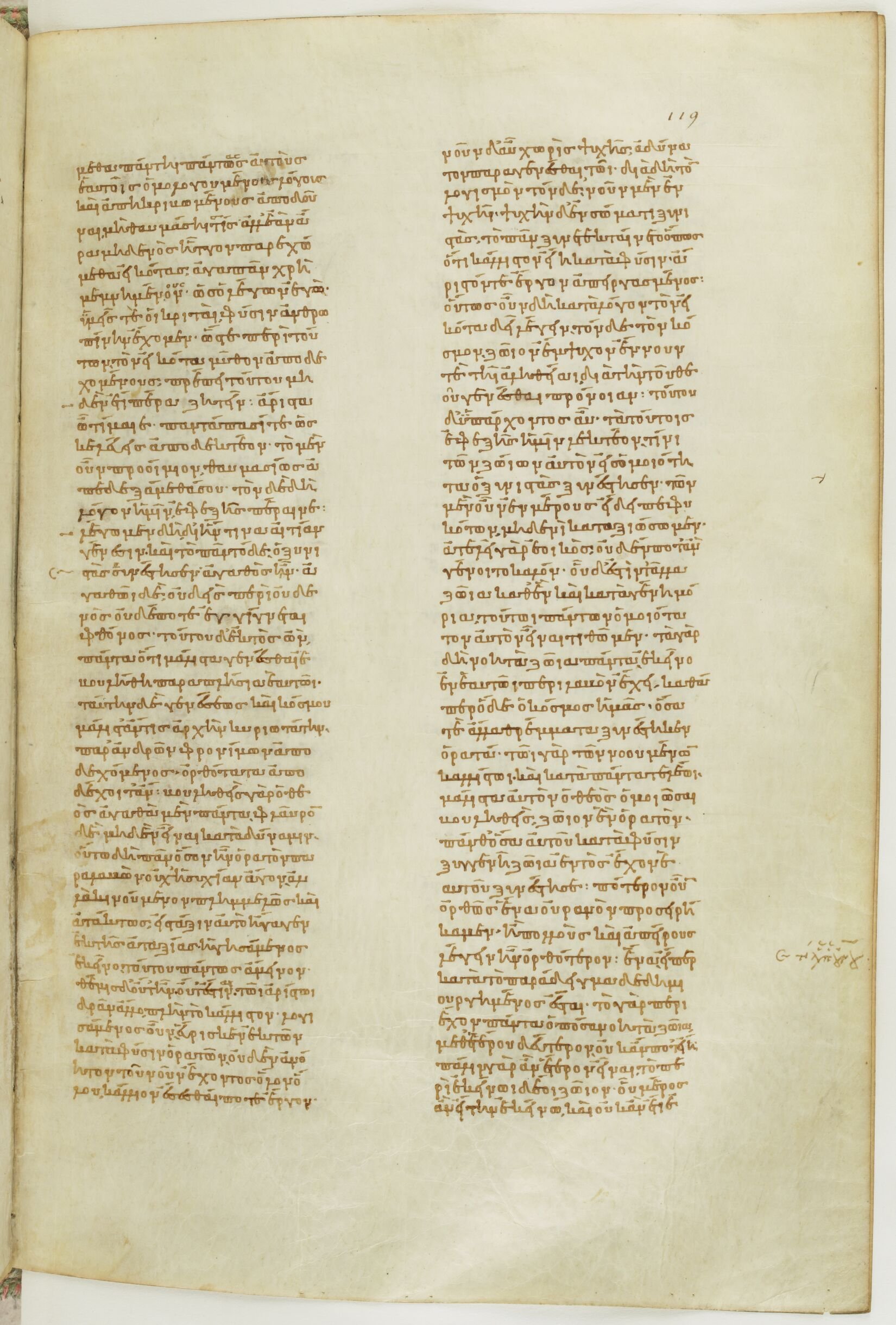
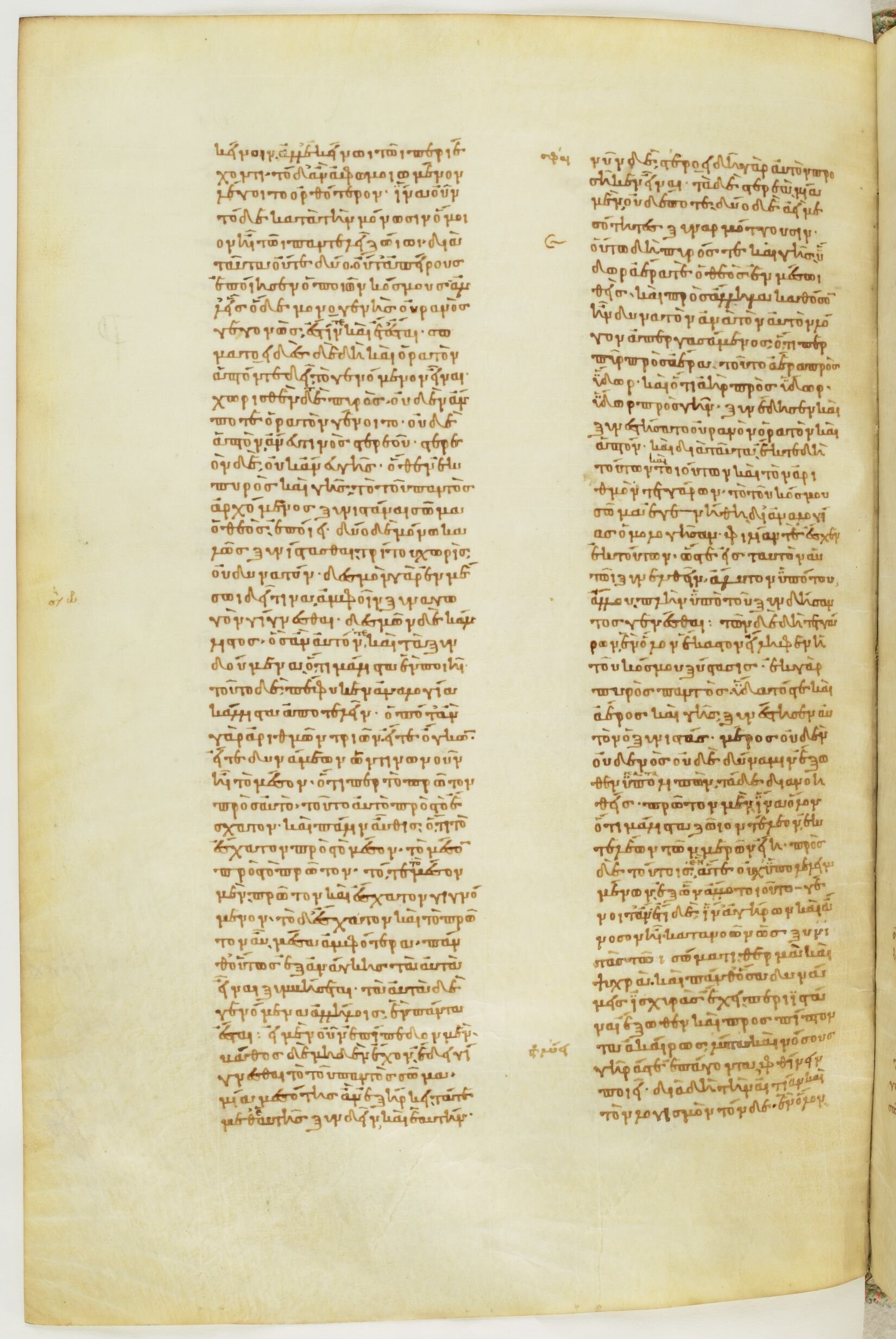
The manuscript is Paris, Bibliothèque nationale de France, grec 1807, known to editors as Plato A. It was copied in Constantinople around 850-875 by the scribe of the so-called philosophical collection, and is the oldest surviving medieval manuscript of the Timaeus and Critias (tetralogies VIII-IX: Clitophon, Republic, Timaeus, Critias, Minos, Laws, Epinomis, Letters). Each page has two columns of 44 lines. The Timaeus fills fol. 114r-144v and the Critias fol. 145r-151r.
On the manuscript this page of text runs over fol. 119r col. b to fol. 119v col. a. Each section below is linked to the folio side(s) that carry it. The mapping comes from reading the first words of every column on the images and finding them in Burnet's text: fol. 119r col. b begins ‹νοῦν δʼ αὖ χωρὶς ψυχῆς ἀδύνατον› (Tim. 30b); fol. 119v col. a begins ‹ἐκείνῳ τῷ περιέχοντι τόδʼ ἂν ἀφωμοιωμένον› (Tim. 31a).
The Greek is John Burnet's critical text (Oxford, 1902), not a transcription of this manuscript; the scribe's spelling, accents and occasional readings differ from it. The English is R. G. Bury's Loeb translation (1929).
How was this verified? (Provenance)
Where on the image
Tim. 31a stands in Paris gr. 1807, fol. 119r col. b to fol. 119v col. a. Checked on the image (column openings read on the BnF photographs and found in Burnet's text, quoted in Burnet's spelling): fol. 119r col. b begins ‹νοῦν δʼ αὖ χωρὶς ψυχῆς ἀδύνατον› (Tim. 30b); fol. 119v col. a begins ‹ἐκείνῳ τῷ περιέχοντι τόδʼ ἂν ἀφωμοιωμένον› (Tim. 31a).
αὐτοῦ κατὰ φύσιν συγγενῆ ζῷα ἐντὸς ἔχον ἑαυτοῦ, συνέστησε. πότερον οὖν ὀρθῶς ἕνα οὐρανὸν προσειρήκαμεν, ἢ πολλοὺς καὶ ἀπείρους λέγειν ἦν ὀρθότερον; ἕνα, εἴπερ κατὰ τὸ παράδειγμα δεδημιουργημένος ἔσται. τὸ γὰρ περιέχον πάντα ὁπόσα νοητὰ ζῷα μεθʼ ἑτέρου δεύτερον οὐκ ἄν ποτʼ εἴη· πάλιν γὰρ ἂν ἕτερον εἶναι τὸ περὶ ἐκείνω δέοι ζῷον, οὗ μέρος ἂν εἴτην ἐκείνω, καὶ οὐκ ἂν ἔτι ἐκείνοιν ἀλλʼ ἐκείνῳ τῷ περιέχοντι τόδʼ ἂν ἀφωμοιωμένον λέγοιτο ὀρθότερον. ἵνα
Are we right, then, in describing the Heaven as one, or would it be more correct to speak of heavens as many or infinite in number? One it must be termed, if it is to be framed after its Pattern. For that which embraces all intelligible Living Creatures could never be second, with another beside it; for if so, there must needs exist yet another Living Creature, which should embrace them both, and of which they two would each be a part; in which case this Universe could no longer be rightly described as modelled on these two, but rather on that third Creature which contains them both.
Where on the image
Tim. 31b stands in Paris gr. 1807, fol. 119v col. a. Checked on the image (column openings read on the BnF photographs and found in Burnet's text, quoted in Burnet's spelling): fol. 119v col. a begins ‹ἐκείνῳ τῷ περιέχοντι τόδʼ ἂν ἀφωμοιωμένον› (Tim. 31a).
οὖν τόδε κατὰ τὴν μόνωσιν ὅμοιον ᾖ τῷ παντελεῖ ζῴῳ, διὰ ταῦτα οὔτε δύο οὔτʼ ἀπείρους ἐποίησεν ὁ ποιῶν κόσμους, ἀλλʼ εἷς ὅδε μονογενὴς οὐρανὸς γεγονὼς ἔστιν καὶ ἔτʼ ἔσται. σωματοειδὲς δὲ δὴ καὶ ὁρατὸν ἁπτόν τε δεῖ τὸ γενόμενον εἶναι, χωρισθὲν δὲ πυρὸς οὐδὲν ἄν ποτε ὁρατὸν γένοιτο, οὐδὲ ἁπτὸν ἄνευ τινὸς στερεοῦ, στερεὸν δὲ οὐκ ἄνευ γῆς· ὅθεν ἐκ πυρὸς καὶ γῆς τὸ τοῦ παντὸς ἀρχόμενος συνιστάναι σῶμα ὁ θεὸς ἐποίει. δύο δὲ μόνω καλῶς συνίστασθαι τρίτου χωρὶς
Wherefore, in order that this Creature might resemble the all perfect Living Creature in respect of its uniqueness, for this reason its Maker made neither two Universes nor an infinite number, but there is and will continue to be this one generated Heaven, unique of its kind. Now that which has come into existence must needs be of bodily form, visible and tangible; yet without fire nothing could ever become visible, nor tangible without some solidity, nor solid without earth. Hence, in beginning to construct the body of the All, God was making it of fire and earth. But it is not possible that two things alone should be conjoined without a third;
Where on the image
Tim. 31c stands in Paris gr. 1807, fol. 119v col. a. Checked on the image (column openings read on the BnF photographs and found in Burnet's text, quoted in Burnet's spelling): fol. 119v col. a begins ‹ἐκείνῳ τῷ περιέχοντι τόδʼ ἂν ἀφωμοιωμένον› (Tim. 31a).
οὐ δυνατόν· δεσμὸν γὰρ ἐν μέσῳ δεῖ τινα ἀμφοῖν συναγωγὸν γίγνεσθαι. δεσμῶν δὲ κάλλιστος ὃς ἂν αὑτὸν καὶ τὰ συνδούμενα ὅτι μάλιστα ἓν ποιῇ, τοῦτο δὲ πέφυκεν ἀναλογία κάλλιστα ἀποτελεῖν.
ὁπόταν γὰρ ἀριθμῶν τριῶν εἴτε ὄγκων
for there must needs be some intermediary bond to connect the two. And the fairest of bonds is that which most perfectly unites into one both itself and the things which it binds together; and to effect this in the fairest manner is the natural property of proportion.
For whenever the middle term of any three numbers, cubic or square,
Notes
- Greek: John Burnet, Platonis Opera IV (Oxford, 1902), via Perseus canonical-greekLit; Burnet's text is a critical edition, so its wording can differ from the manuscript shown.
- English: R. G. Bury, Plato IX (Loeb Classical Library, 1929), via Perseus. Bury's footnotes are not reproduced. Quotation marks stand where Perseus marks quoted speech.
- Stephanus sections (a-e) are those of the 1578 Stephanus edition as given by Burnet and Bury; Bury's section breaks can fall a few words away from Burnet's because English word order differs.
Cite
Sources
- Source: Paris, BnF grec 1807 (Plato A, c. 850-875) fol. 119r-119v via BnF IIIF + Burnet's Greek (Perseus) + R. G. Bury's English (Loeb 1929, Perseus) (holding institution)
- Critical edition: Burnet, Platonis Opera IV (1902), via Perseus
← previous · → next · v cycle view · l back to library