Plato, Timaeus 32a-32d: proportion: air and water placed between fire and earth
Introduction
Stephanus page 32 of Plato's Timaeus (32a-32d): proportion: air and water placed between fire and earth.
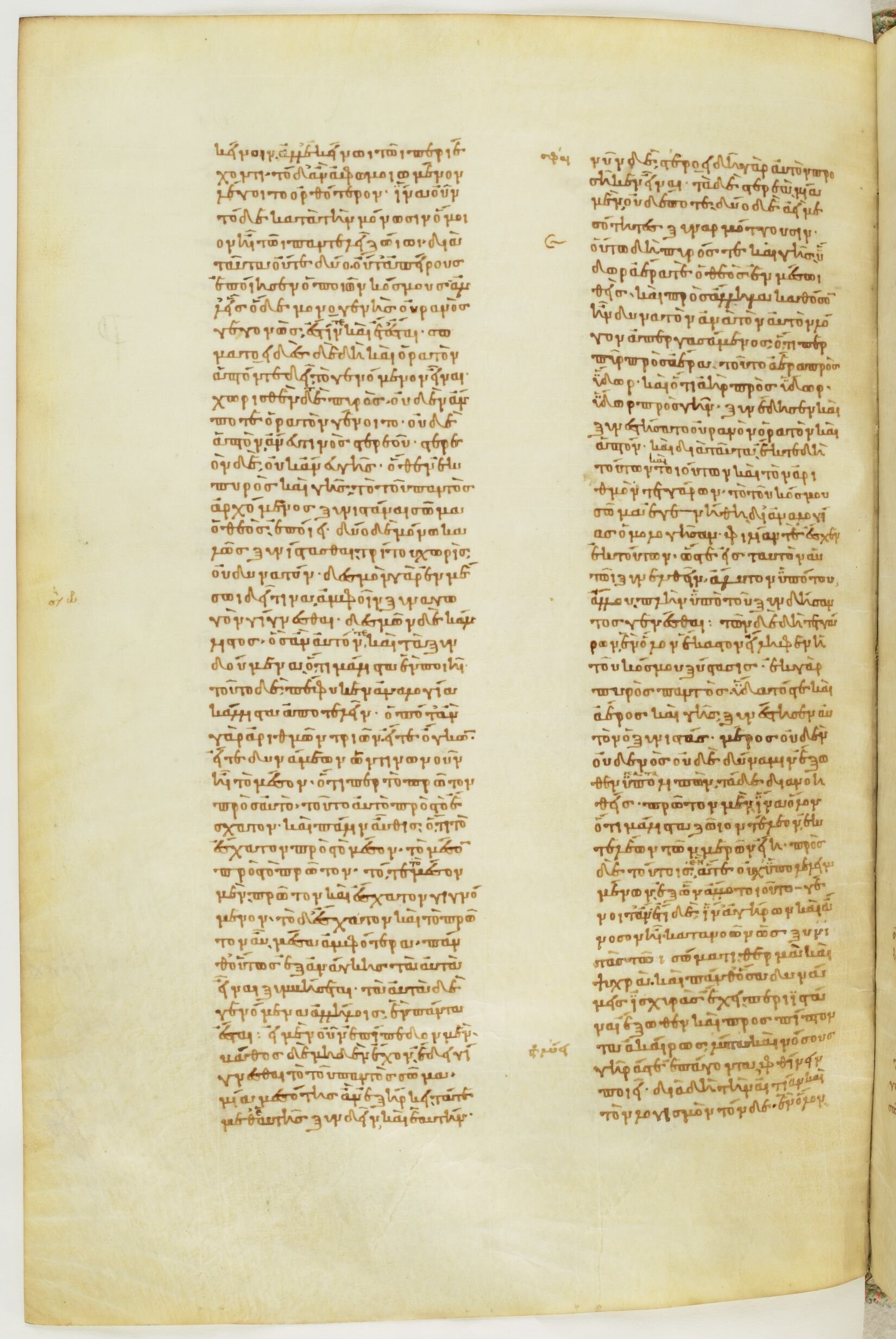
The manuscript is Paris, Bibliothèque nationale de France, grec 1807, known to editors as Plato A. It was copied in Constantinople around 850-875 by the scribe of the so-called philosophical collection, and is the oldest surviving medieval manuscript of the Timaeus and Critias (tetralogies VIII-IX: Clitophon, Republic, Timaeus, Critias, Minos, Laws, Epinomis, Letters). Each page has two columns of 44 lines. The Timaeus fills fol. 114r-144v and the Critias fol. 145r-151r.
On the manuscript this page of text runs over fol. 119v col. a to fol. 119v col. b. Each section below is linked to the folio side(s) that carry it. The mapping comes from reading the first words of every column on the images and finding them in Burnet's text: fol. 119v col. a begins ‹ἐκείνῳ τῷ περιέχοντι τόδʼ ἂν ἀφωμοιωμένον› (Tim. 31a); fol. 119v col. b begins ‹νῦν δὲ στερεοειδῆ γὰρ αὐτὸν προσῆκεν› (Tim. 32b).
The Greek is John Burnet's critical text (Oxford, 1902), not a transcription of this manuscript; the scribe's spelling, accents and occasional readings differ from it. The English is R. G. Bury's Loeb translation (1929).
How was this verified? (Provenance)
Where on the image
Tim. 32a stands in Paris gr. 1807, fol. 119v col. a. Checked on the image (column openings read on the BnF photographs and found in Burnet's text, quoted in Burnet's spelling): fol. 119v col. a begins ‹ἐκείνῳ τῷ περιέχοντι τόδʼ ἂν ἀφωμοιωμένον› (Tim. 31a).
εἴτε δυνάμεων ὡντινωνοῦν ᾖ τὸ μέσον, ὅτιπερ τὸ πρῶτον πρὸς αὐτό, τοῦτο αὐτὸ πρὸς τὸ ἔσχατον, καὶ πάλιν αὖθις, ὅτι τὸ ἔσχατον πρὸς τὸ μέσον, τὸ μέσον πρὸς τὸ πρῶτον, τότε τὸ μέσον μὲν πρῶτον καὶ ἔσχατον γιγνόμενον, τὸ δʼ ἔσχατον καὶ τὸ πρῶτον αὖ μέσα ἀμφότερα, πάνθʼ οὕτως ἐξ ἀνάγκης τὰ αὐτὰ εἶναι συμβήσεται, τὰ αὐτὰ δὲ γενόμενα ἀλλήλοις ἓν πάντα ἔσται. εἰ μὲν οὖν ἐπίπεδον μέν, βάθος δὲ μηδὲν ἔχον ἔδει γίγνεσθαι τὸ τοῦ παντὸς σῶμα, μία μεσότης ἂν ἐξήρκει
is such that as the first term is to it, so is it to the last term, and again, conversely, as the last term is to the middle, so is the middle to the first,—then the middle term becomes in turn the first and the last, while the first and last become in turn middle terms, and the necessary consequence will be that all the terms are interchangeable, and being interchangeable they all form a unity. Now if the body of the All
Where on the image
Tim. 32b stands in Paris gr. 1807, fol. 119v col. a to fol. 119v col. b. Checked on the image (column openings read on the BnF photographs and found in Burnet's text, quoted in Burnet's spelling): fol. 119v col. a begins ‹ἐκείνῳ τῷ περιέχοντι τόδʼ ἂν ἀφωμοιωμένον› (Tim. 31a); fol. 119v col. b begins ‹νῦν δὲ στερεοειδῆ γὰρ αὐτὸν προσῆκεν› (Tim. 32b).
τά τε μεθʼ αὑτῆς συνδεῖν καὶ ἑαυτήν, νῦν δὲ στερεοειδῆ γὰρ αὐτὸν προσῆκεν εἶναι, τὰ δὲ στερεὰ μία μὲν οὐδέποτε, δύο δὲ ἀεὶ μεσότητες συναρμόττουσιν· οὕτω δὴ πυρός τε καὶ γῆς ὕδωρ ἀέρα τε ὁ θεὸς ἐν μέσῳ θείς, καὶ πρὸς ἄλληλα καθʼ ὅσον ἦν δυνατὸν ἀνὰ τὸν αὐτὸν λόγον ἀπεργασάμενος, ὅτιπερ πῦρ πρὸς ἀέρα, τοῦτο ἀέρα πρὸς ὕδωρ, καὶ ὅτι ἀὴρ πρὸς ὕδωρ, ὕδωρ πρὸς γῆν, συνέδησεν καὶ συνεστήσατο οὐρανὸν ὁρατὸν καὶ ἁπτόν. καὶ διὰ ταῦτα ἔκ τε δὴ τούτων τοιούτων
had had to come into existence as a plane surface, having no depth, one middle term would have sufficed to bind together both itself and its fellow-terms; but now it is otherwise: for it behoved it to be solid of shape, and what brings solids into unison is never one middle term alone but always two. Thus it was that in the midst between fire and earth God set water and air, and having bestowed upon them so far as possible a like ratio one towards another—air being to water as fire to air, and water being to earth as air to water, —he joined together and constructed a Heaven visible and tangible. For these reasons
Where on the image
Tim. 32c stands in Paris gr. 1807, fol. 119v col. b. Checked on the image (column openings read on the BnF photographs and found in Burnet's text, quoted in Burnet's spelling): fol. 119v col. b begins ‹νῦν δὲ στερεοειδῆ γὰρ αὐτὸν προσῆκεν› (Tim. 32b).
καὶ τὸν ἀριθμὸν τεττάρων τὸ τοῦ κόσμου σῶμα ἐγεννήθη διʼ ἀναλογίας ὁμολογῆσαν, φιλίαν τε ἔσχεν ἐκ τούτων, ὥστε εἰς ταὐτὸν αὑτῷ συνελθὸν ἄλυτον ὑπό του ἄλλου πλὴν ὑπὸ τοῦ συνδήσαντος γενέσθαι. τῶν δὲ δὴ τεττάρων ἓν ὅλον ἕκαστον εἴληφεν ἡ τοῦ κόσμου σύστασις. ἐκ γὰρ πυρὸς παντὸς ὕδατός τε καὶ ἀέρος καὶ γῆς συνέστησεν αὐτὸν ὁ συνιστάς, μέρος οὐδὲν οὐδενὸς οὐδὲ δύναμιν ἔξωθεν ὑπολιπών, τάδε διανοηθείς,
and out of these materials, such in kind and four in number, the body of the Cosmos was harmonized by proportion and brought into existence. These conditions secured for it Amity, so that being united in identity with itself it became indissoluble by any agent other than Him who had bound it together. Now of the four elements the construction of the Cosmos had taken up the whole of every one. For its Constructor had constructed it of all the fire and water and air and earth that existed, leaving over, outside it, no single particle or potency of any one of these elements. And these were his intentions:
Where on the image
Tim. 32d stands in Paris gr. 1807, fol. 119v col. b. Checked on the image (column openings read on the BnF photographs and found in Burnet's text, quoted in Burnet's spelling): fol. 119v col. b begins ‹νῦν δὲ στερεοειδῆ γὰρ αὐτὸν προσῆκεν› (Tim. 32b).
πρῶτον μὲν ἵνα ὅλον ὅτι μάλιστα ζῷον τέλεον ἐκ τελέων
first, that it might be, so far as possible, a Living Creature, perfect and whole, with all its parts perfect;
and next, that it might be One,
Notes
- Greek: John Burnet, Platonis Opera IV (Oxford, 1902), via Perseus canonical-greekLit; Burnet's text is a critical edition, so its wording can differ from the manuscript shown.
- English: R. G. Bury, Plato IX (Loeb Classical Library, 1929), via Perseus. Bury's footnotes are not reproduced. Quotation marks stand where Perseus marks quoted speech.
- Stephanus sections (a-e) are those of the 1578 Stephanus edition as given by Burnet and Bury; Bury's section breaks can fall a few words away from Burnet's because English word order differs.
Cite
Sources
- Source: Paris, BnF grec 1807 (Plato A, c. 850-875) fol. 119v via BnF IIIF + Burnet's Greek (Perseus) + R. G. Bury's English (Loeb 1929, Perseus) (holding institution)
- Critical edition: Burnet, Platonis Opera IV (1902), via Perseus
← previous · → next · v cycle view · l back to library