Plato, Timaeus 33a-33d: the world uses all four elements; its spherical shape
Introduction
Stephanus page 33 of Plato's Timaeus (33a-33d): the world uses all four elements; its spherical shape.
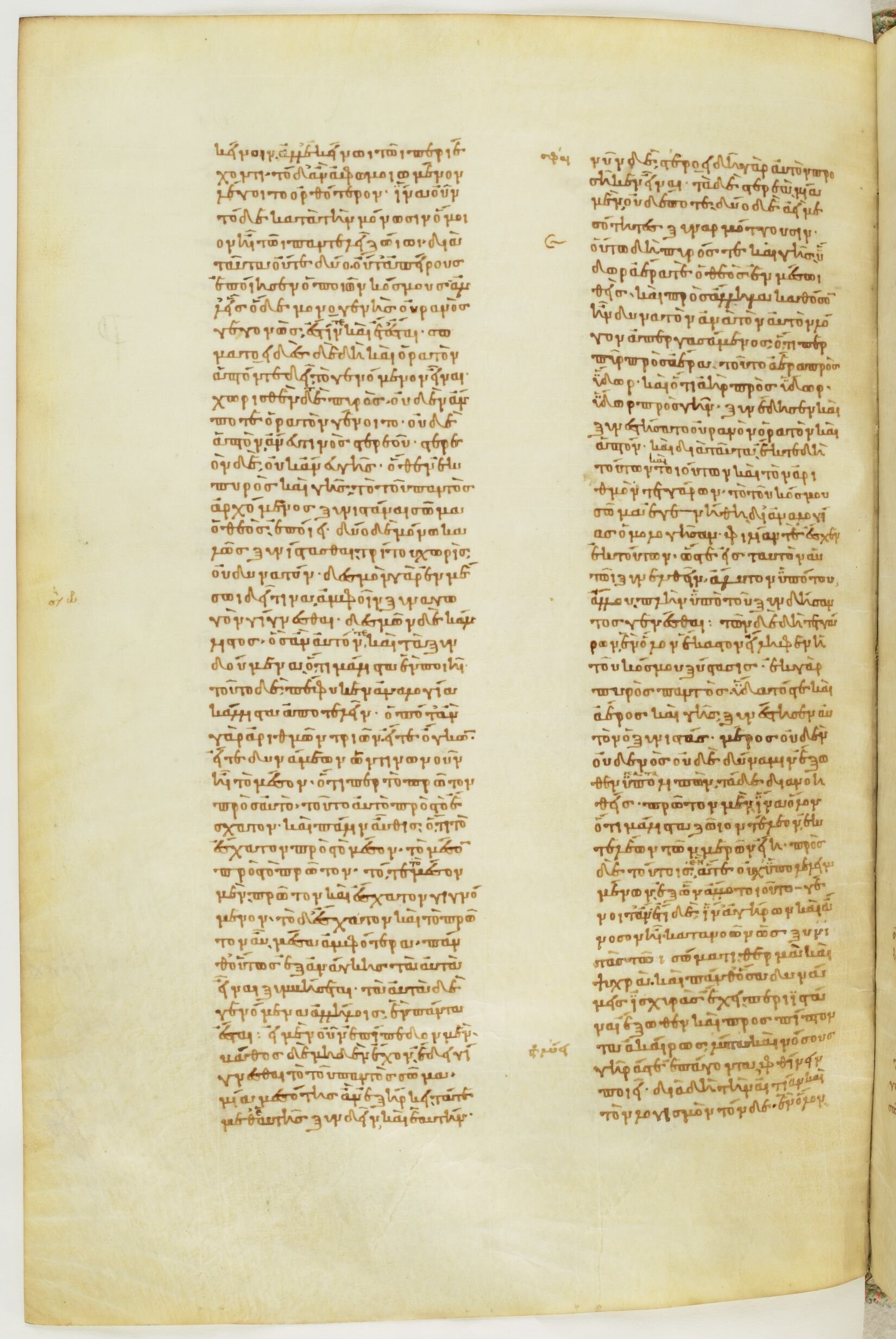
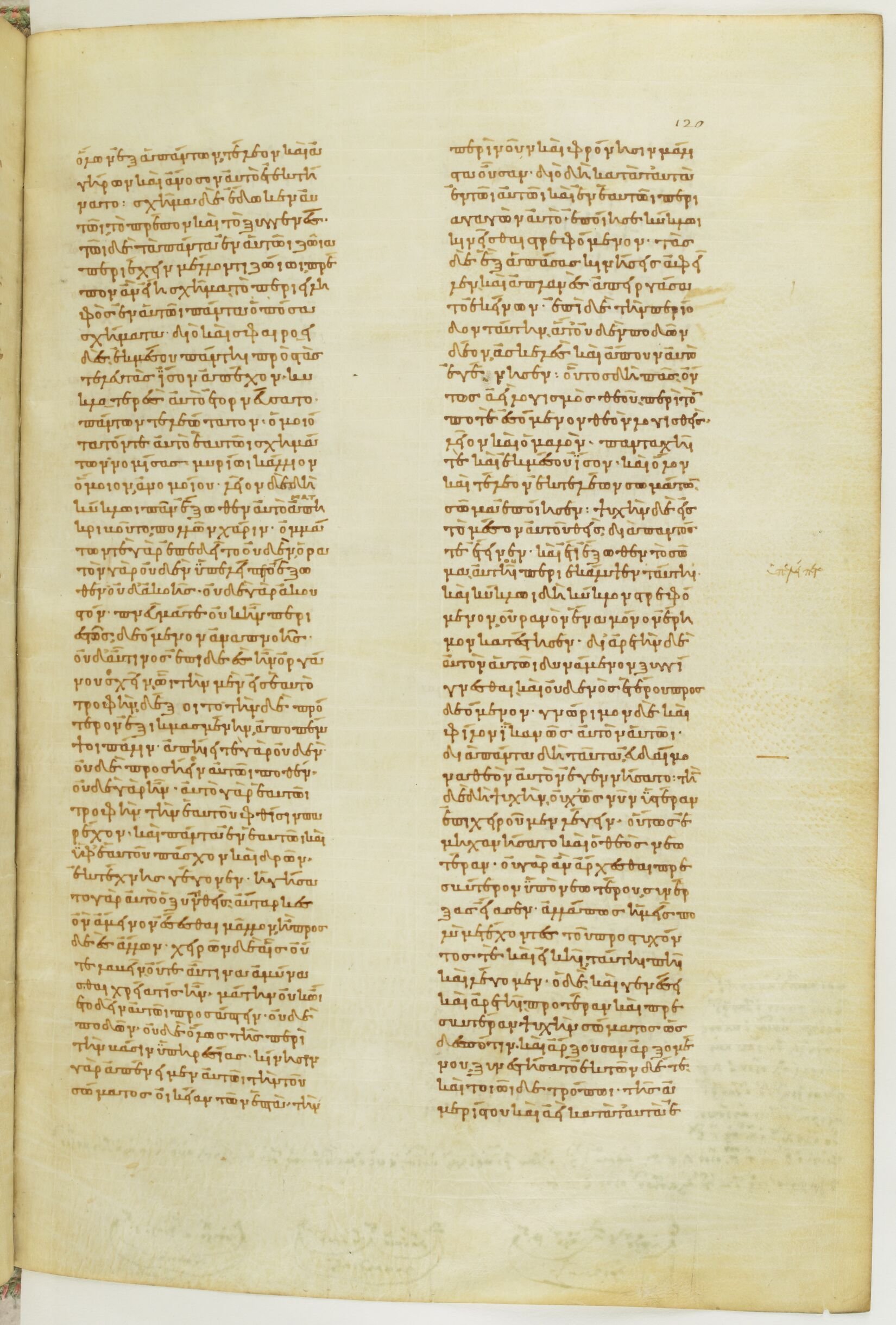
The manuscript is Paris, Bibliothèque nationale de France, grec 1807, known to editors as Plato A. It was copied in Constantinople around 850-875 by the scribe of the so-called philosophical collection, and is the oldest surviving medieval manuscript of the Timaeus and Critias (tetralogies VIII-IX: Clitophon, Republic, Timaeus, Critias, Minos, Laws, Epinomis, Letters). Each page has two columns of 44 lines. The Timaeus fills fol. 114r-144v and the Critias fol. 145r-151r.
On the manuscript this page of text runs over fol. 119v col. b to fol. 120r col. a. Each section below is linked to the folio side(s) that carry it. The mapping comes from reading the first words of every column on the images and finding them in Burnet's text: fol. 119v col. b begins ‹νῦν δὲ στερεοειδῆ γὰρ αὐτὸν προσῆκεν› (Tim. 32b); fol. 120r col. a begins ‹ἐξ ἁπάντων τέλεον καὶ ἀγήρων καὶ› (Tim. 33a).
The Greek is John Burnet's critical text (Oxford, 1902), not a transcription of this manuscript; the scribe's spelling, accents and occasional readings differ from it. The English is R. G. Bury's Loeb translation (1929).
How was this verified? (Provenance)
Where on the image
Tim. 33a stands in Paris gr. 1807, fol. 119v col. b to fol. 120r col. a. Checked on the image (column openings read on the BnF photographs and found in Burnet's text, quoted in Burnet's spelling): fol. 119v col. b begins ‹νῦν δὲ στερεοειδῆ γὰρ αὐτὸν προσῆκεν› (Tim. 32b); fol. 120r col. a begins ‹ἐξ ἁπάντων τέλεον καὶ ἀγήρων καὶ› (Tim. 33a).
τῶν μερῶν εἴη,
πρὸς δὲ τούτοις ἕν, ἅτε οὐχ ὑπολελειμμένων ἐξ ὧν ἄλλο τοιοῦτον γένοιτʼ ἄν, ἔτι δὲ ἵνʼ ἀγήρων καὶ ἄνοσον ᾖ, κατανοῶν ὡς συστάτῳ σώματι θερμὰ καὶ ψυχρὰ καὶ πάνθʼ ὅσα δυνάμεις ἰσχυρὰς ἔχει περιιστάμενα ἔξωθεν καὶ προσπίπτοντα ἀκαίρως λύει καὶ νόσους γῆράς τε ἐπάγοντα φθίνειν ποιεῖ. διὰ δὴ τὴν αἰτίαν καὶ τὸν λογισμὸν τόνδε ἕνα ὅλον ὅλων ἐξ ἁπάντων τέλεον καὶ ἀγήρων καὶ ἄνοσον
inasmuch as there was nothing left over out of which another like Creature might come into existence; and further, that it might be secure from age and ailment, since He perceived that when heat and cold, and all things which have violent potencies, surround a composite body from without and collide with it they dissolve it unduly and make it to waste away by bringing upon it ailments and age. Wherefore, because of this reasoning, He fashioned it to be One single Whole, compounded of all wholes, perfect and ageless and unailing.
Where on the image
Tim. 33b stands in Paris gr. 1807, fol. 120r col. a. Checked on the image (column openings read on the BnF photographs and found in Burnet's text, quoted in Burnet's spelling): fol. 120r col. a begins ‹ἐξ ἁπάντων τέλεον καὶ ἀγήρων καὶ› (Tim. 33a).
αὐτὸν ἐτεκτήνατο. σχῆμα δὲ ἔδωκεν αὐτῷ τὸ πρέπον καὶ τὸ συγγενές. τῷ δὲ τὰ πάντα ἐν αὑτῷ ζῷα περιέχειν μέλλοντι ζῴῳ πρέπον ἂν εἴη σχῆμα τὸ περιειληφὸς ἐν αὑτῷ πάντα ὁπόσα σχήματα· διὸ καὶ σφαιροειδές, ἐκ μέσου πάντῃ πρὸς τὰς τελευτὰς ἴσον ἀπέχον, κυκλοτερὲς αὐτὸ ἐτορνεύσατο, πάντων τελεώτατον ὁμοιότατόν τε αὐτὸ ἑαυτῷ σχημάτων, νομίσας μυρίῳ κάλλιον ὅμοιον ἀνομοίου. λεῖον δὲ δὴ κύκλῳ
And he bestowed on it the shape which was befitting and akin. Now for that Living Creature which is designed to embrace within itself all living creatures the fitting shape will be that which comprises within itself all the shapes there are; wherefore He wrought it into a round, in the shape of a sphere, equidistant in all directions from the center to the extremities, which of all shapes is the most perfect and the most self-similar, since He deemed that the similar is infinitely fairer than the dissimilar. And on the outside round about, it was all made smooth with great exactness, and that for many reasons.
Where on the image
Tim. 33c stands in Paris gr. 1807, fol. 120r col. a. Checked on the image (column openings read on the BnF photographs and found in Burnet's text, quoted in Burnet's spelling): fol. 120r col. a begins ‹ἐξ ἁπάντων τέλεον καὶ ἀγήρων καὶ› (Tim. 33a).
πᾶν ἔξωθεν αὐτὸ ἀπηκριβοῦτο πολλῶν χάριν. ὀμμάτων τε γὰρ ἐπεδεῖτο οὐδέν, ὁρατὸν γὰρ οὐδὲν ὑπελείπετο ἔξωθεν, οὐδʼ ἀκοῆς, οὐδὲ γὰρ ἀκουστόν· πνεῦμά τε οὐκ ἦν περιεστὸς δεόμενον ἀναπνοῆς, οὐδʼ αὖ τινος ἐπιδεὲς ἦν ὀργάνου σχεῖν ᾧ τὴν μὲν εἰς ἑαυτὸ τροφὴν δέξοιτο, τὴν δὲ πρότερον ἐξικμασμένην ἀποπέμψοι πάλιν. ἀπῄει τε γὰρ οὐδὲν οὐδὲ προσῄειν αὐτῷ ποθεν—οὐδὲ γὰρ ἦν—αὐτὸ γὰρ ἑαυτῷ τροφὴν τὴν ἑαυτοῦ φθίσιν παρέχον καὶ πάντα ἐν ἑαυτῷ καὶ ὑφʼ
For of eyes it had no need, since outside of it there was nothing visible left over; nor yet of hearing, since neither was there anything audible; nor was there any air surrounding it which called for respiration; nor, again, did it need any organ whereby it might receive the food that entered and evacuate what remained undigested. For nothing went out from it or came into it from any side, since nothing existed; for it was so designed as to supply its own wastage as food for itself,
Where on the image
Tim. 33d stands in Paris gr. 1807, fol. 120r col. a. Checked on the image (column openings read on the BnF photographs and found in Burnet's text, quoted in Burnet's spelling): fol. 120r col. a begins ‹ἐξ ἁπάντων τέλεον καὶ ἀγήρων καὶ› (Tim. 33a).
ἑαυτοῦ πάσχον καὶ δρῶν ἐκ τέχνης γέγονεν· ἡγήσατο γὰρ αὐτὸ ὁ συνθεὶς αὔταρκες ὂν ἄμεινον ἔσεσθαι μᾶλλον ἢ προσδεὲς ἄλλων. χειρῶν δέ, αἷς οὔτε λαβεῖν οὔτε αὖ τινα ἀμύνασθαι χρεία τις ἦν, μάτην οὐκ ᾤετο δεῖν αὐτῷ προσάπτειν, οὐδὲ ποδῶν οὐδὲ ὅλως τῆς περὶ τὴν βάσιν
and to experience by its own agency and within itself all actions and passions, since He that had constructed it deemed that it would be better if it were self-sufficing rather than in need of other things. Hands, too, He thought He ought not to attach unto it uselessly, seeing they were not required either for grasping or for repelling anyone; nor yet feet, nor any instruments of locomotion whatsoever.
Notes
- Greek: John Burnet, Platonis Opera IV (Oxford, 1902), via Perseus canonical-greekLit; Burnet's text is a critical edition, so its wording can differ from the manuscript shown.
- English: R. G. Bury, Plato IX (Loeb Classical Library, 1929), via Perseus. Bury's footnotes are not reproduced. Quotation marks stand where Perseus marks quoted speech.
- Stephanus sections (a-e) are those of the 1578 Stephanus edition as given by Burnet and Bury; Bury's section breaks can fall a few words away from Burnet's because English word order differs.
Cite
Sources
- Source: Paris, BnF grec 1807 (Plato A, c. 850-875) fol. 119v-120r via BnF IIIF + Burnet's Greek (Perseus) + R. G. Bury's English (Loeb 1929, Perseus) (holding institution)
- Critical edition: Burnet, Platonis Opera IV (1902), via Perseus
← previous · → next · v cycle view · l back to library