Plato, Timaeus 34a-34c: the rotation of the world; the world soul
Introduction
Stephanus page 34 of Plato's Timaeus (34a-34c): the rotation of the world; the world soul.
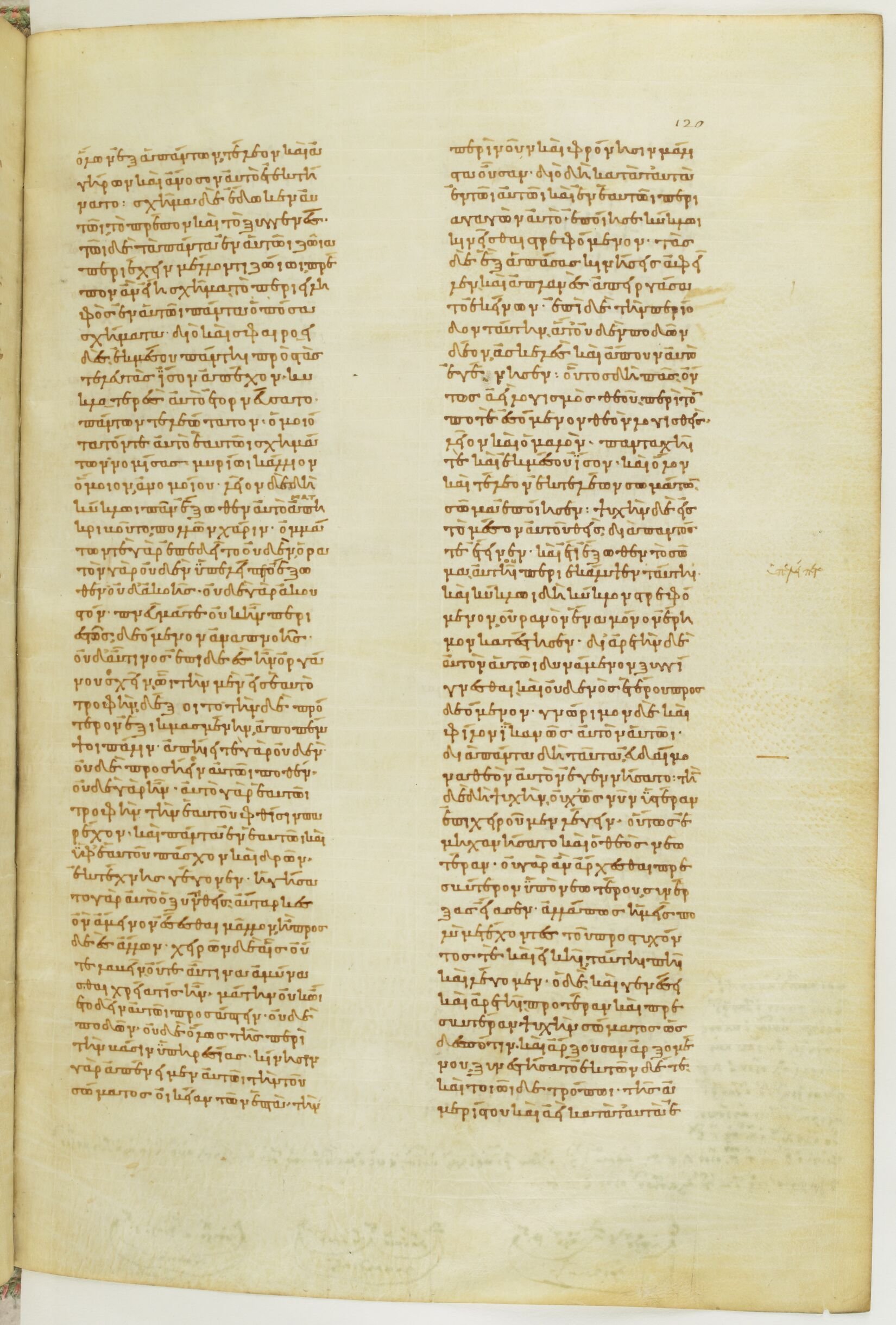
The manuscript is Paris, Bibliothèque nationale de France, grec 1807, known to editors as Plato A. It was copied in Constantinople around 850-875 by the scribe of the so-called philosophical collection, and is the oldest surviving medieval manuscript of the Timaeus and Critias (tetralogies VIII-IX: Clitophon, Republic, Timaeus, Critias, Minos, Laws, Epinomis, Letters). Each page has two columns of 44 lines. The Timaeus fills fol. 114r-144v and the Critias fol. 145r-151r.
On the manuscript this page of text runs over fol. 120r col. a to fol. 120r col. b. Each section below is linked to the folio side(s) that carry it. The mapping comes from reading the first words of every column on the images and finding them in Burnet's text: fol. 120r col. a begins ‹ἐξ ἁπάντων τέλεον καὶ ἀγήρων καὶ› (Tim. 33a); fol. 120r col. b begins ‹περὶ νοῦν καὶ φρόνησιν μάλιστα οὖσαν› (Tim. 34a).
The Greek is John Burnet's critical text (Oxford, 1902), not a transcription of this manuscript; the scribe's spelling, accents and occasional readings differ from it. The English is R. G. Bury's Loeb translation (1929).
How was this verified? (Provenance)
Where on the image
Tim. 34a stands in Paris gr. 1807, fol. 120r col. a to fol. 120r col. b. Checked on the image (column openings read on the BnF photographs and found in Burnet's text, quoted in Burnet's spelling): fol. 120r col. a begins ‹ἐξ ἁπάντων τέλεον καὶ ἀγήρων καὶ› (Tim. 33a); fol. 120r col. b begins ‹περὶ νοῦν καὶ φρόνησιν μάλιστα οὖσαν› (Tim. 34a).
ὑπηρεσίας.
κίνησιν γὰρ ἀπένειμεν αὐτῷ τὴν τοῦ σώματος οἰκείαν, τῶν ἑπτὰ τὴν περὶ νοῦν καὶ φρόνησιν μάλιστα οὖσαν· διὸ δὴ κατὰ ταὐτὰ ἐν τῷ αὐτῷ καὶ ἐν ἑαυτῷ περιαγαγὼν αὐτὸ ἐποίησε κύκλῳ κινεῖσθαι στρεφόμενον, τὰς δὲ ἓξ ἁπάσας κινήσεις ἀφεῖλεν καὶ ἀπλανὲς ἀπηργάσατο ἐκείνων. ἐπὶ δὲ τὴν περίοδον ταύτην ἅτʼ οὐδὲν ποδῶν δέον ἀσκελὲς καὶ ἄπουν αὐτὸ ἐγέννησεν. οὗτος δὴ πᾶς ὄντος ἀεὶ λογισμὸς θεοῦ περὶ τὸν ποτὲ
For movement He assigned unto it that which is proper to its body, namely, that one of the seven motions which specially belongs to reason and intelligence; wherefore He spun it round uniformly in the same spot and within itself and made it move revolving in a circle; and all the other six motions He took away and fashioned it free from their aberrations. And seeing that for this revolving motion it had no need of feet, He begat it legless and footless. Such, then, was the sum of the reasoning of the ever-existing God concerning the god
Where on the image
Tim. 34b stands in Paris gr. 1807, fol. 120r col. b. Checked on the image (column openings read on the BnF photographs and found in Burnet's text, quoted in Burnet's spelling): fol. 120r col. b begins ‹περὶ νοῦν καὶ φρόνησιν μάλιστα οὖσαν› (Tim. 34a).
ἐσόμενον θεὸν λογισθεὶς λεῖον καὶ ὁμαλὸν πανταχῇ τε ἐκ μέσου ἴσον καὶ ὅλον καὶ τέλεον ἐκ τελέων σωμάτων σῶμα ἐποίησεν· ψυχὴν δὲ εἰς τὸ μέσον αὐτοῦ θεὶς διὰ παντός τε ἔτεινεν καὶ ἔτι ἔξωθεν τὸ σῶμα αὐτῇ περιεκάλυψεν, καὶ κύκλῳ δὴ κύκλον στρεφόμενον οὐρανὸν ἕνα μόνον ἔρημον κατέστησεν, διʼ ἀρετὴν δὲ αὐτὸν αὑτῷ δυνάμενον συγγίγνεσθαι καὶ οὐδενὸς ἑτέρου προσδεόμενον, γνώριμον δὲ καὶ φίλον ἱκανῶς αὐτὸν αὑτῷ. διὰ πάντα δὴ ταῦτα εὐδαίμονα θεὸν αὐτὸν ἐγεννήσατο. τὴν δὲ δὴ ψυχὴν οὐχ ὡς νῦν ὑστέραν ἐπιχειροῦμεν λέγειν,
which was one day to be existent, whereby He made it smooth and even and equal on all sides from the center, a whole and perfect body compounded of perfect bodies, And in the midst thereof He set Soul, which He stretched throughout the whole of it, and therewith He enveloped also the exterior of its body; and as a Circle revolving in a circle He established one sole and solitary Heaven, able of itself because of its excellence to company with itself and needing none other beside, sufficing unto itself as acquaintance and friend. And because of all this He generated it to be a blessed God. Now as regards the Soul, although we are essaying to describe it after the body,
Where on the image
Tim. 34c stands in Paris gr. 1807, fol. 120r col. b. Checked on the image (column openings read on the BnF photographs and found in Burnet's text, quoted in Burnet's spelling): fol. 120r col. b begins ‹περὶ νοῦν καὶ φρόνησιν μάλιστα οὖσαν› (Tim. 34a).
οὕτως ἐμηχανήσατο καὶ ὁ θεὸς νεωτέραν—οὐ γὰρ ἂν ἄρχεσθαι πρεσβύτερον ὑπὸ νεωτέρου συνέρξας εἴασεν—ἀλλά πως ἡμεῖς πολὺ μετέχοντες τοῦ προστυχόντος τε καὶ εἰκῇ ταύτῃ πῃ καὶ λέγομεν, ὁ δὲ καὶ γενέσει καὶ ἀρετῇ προτέραν καὶ πρεσβυτέραν ψυχὴν σώματος ὡς δεσπότιν καὶ ἄρξουσαν ἀρξομένου
God did not likewise plan it to be younger than the body; for, when uniting them, He would not have permitted the elder to be ruled by the younger; but as for us men, even as we ourselves partake largely of the accidental and casual, so also do our words. God, however, constructed Soul to be older than Body and prior in birth and excellence, since she was to be the mistress and ruler and it the ruled; and, He made her of the materials
Notes
- Greek: John Burnet, Platonis Opera IV (Oxford, 1902), via Perseus canonical-greekLit; Burnet's text is a critical edition, so its wording can differ from the manuscript shown.
- English: R. G. Bury, Plato IX (Loeb Classical Library, 1929), via Perseus. Bury's footnotes are not reproduced. Quotation marks stand where Perseus marks quoted speech.
- Stephanus sections (a-e) are those of the 1578 Stephanus edition as given by Burnet and Bury; Bury's section breaks can fall a few words away from Burnet's because English word order differs.
Cite
Sources
- Source: Paris, BnF grec 1807 (Plato A, c. 850-875) fol. 120r via BnF IIIF + Burnet's Greek (Perseus) + R. G. Bury's English (Loeb 1929, Perseus) (holding institution)
- Critical edition: Burnet, Platonis Opera IV (1902), via Perseus
← previous · → next · v cycle view · l back to library