Plato, Timaeus 35a-35c: the soul compounded of Same, Different and Being; the first divisions
Introduction
Stephanus page 35 of Plato's Timaeus (35a-35c): the soul compounded of Same, Different and Being; the first divisions.
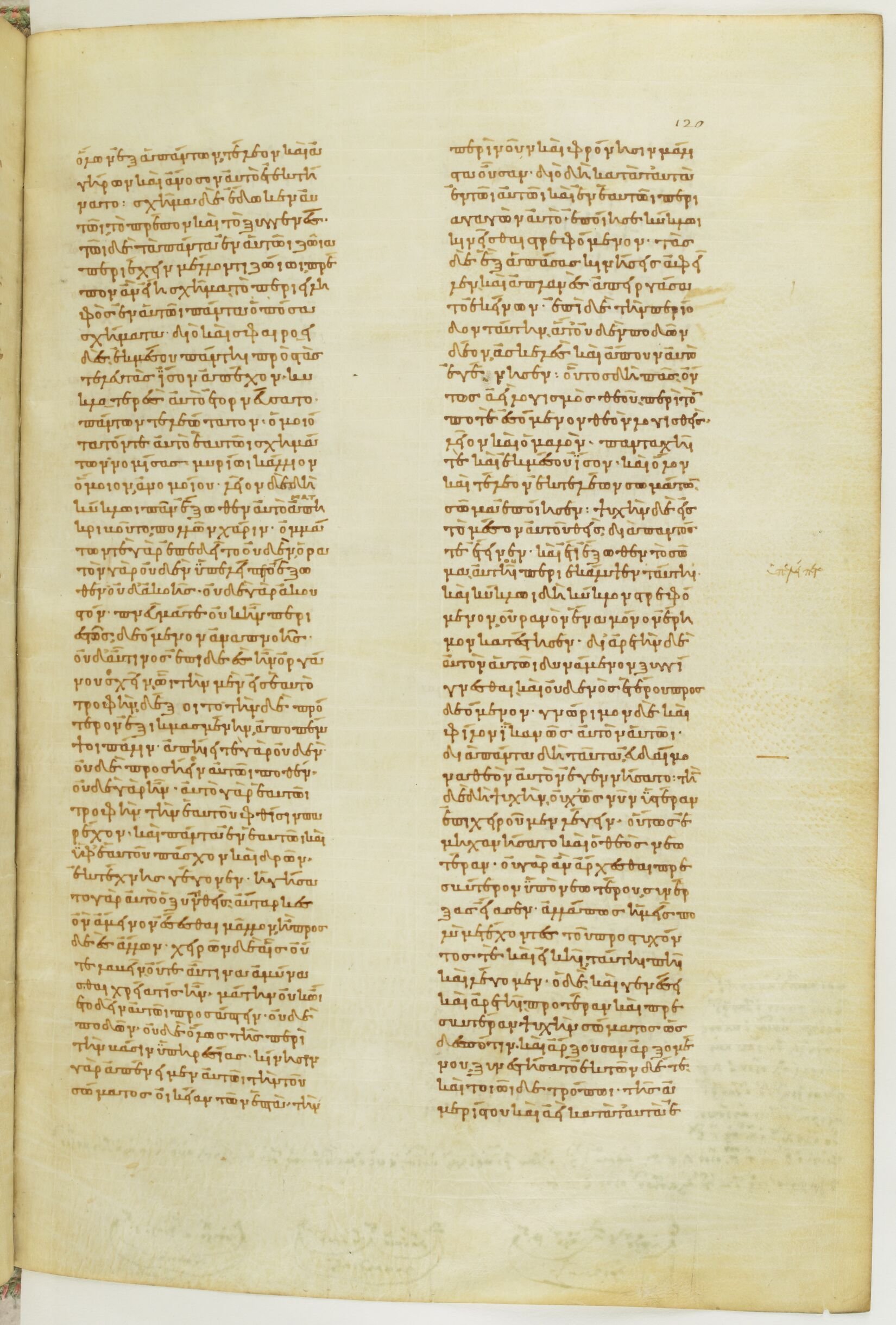
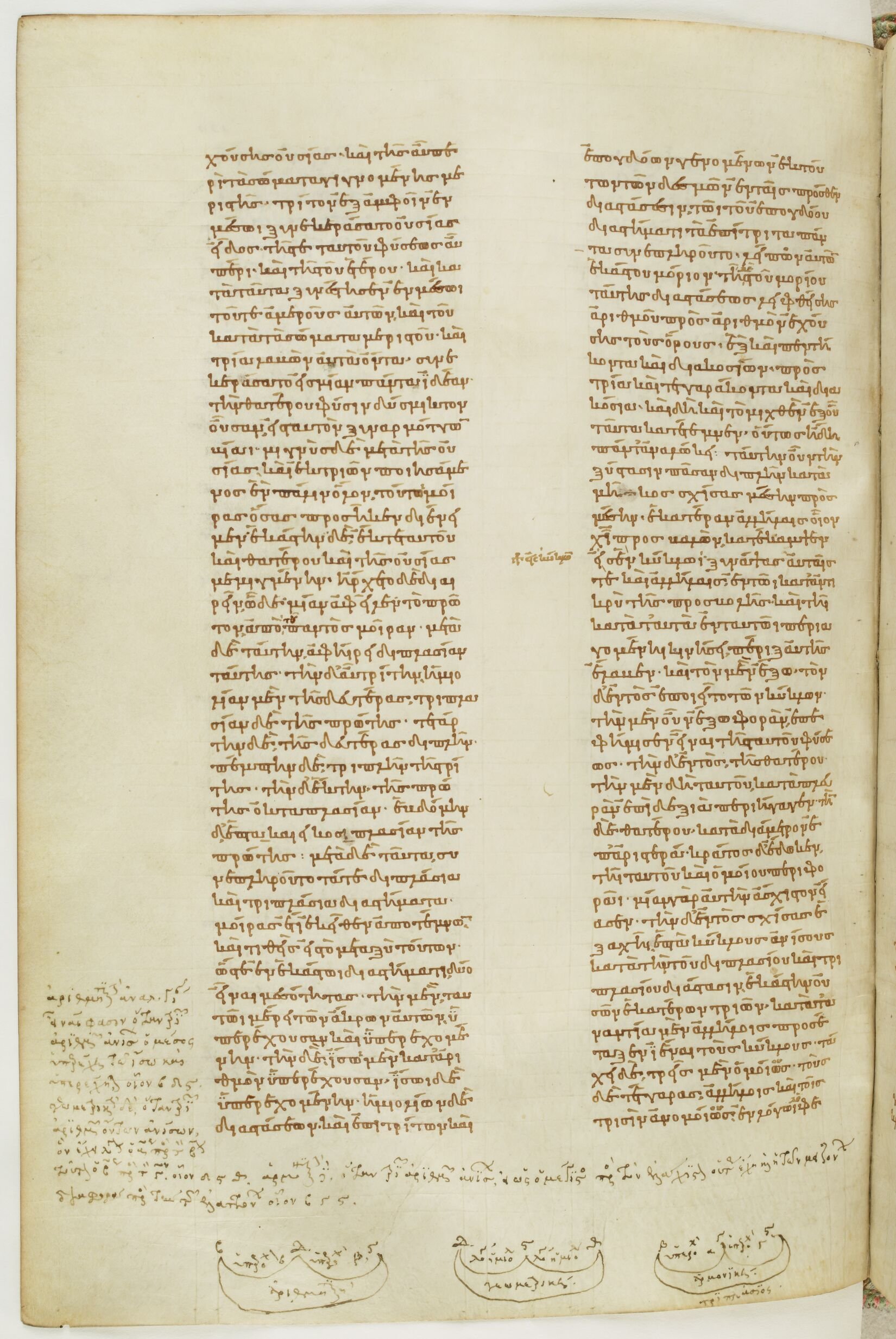
The manuscript is Paris, Bibliothèque nationale de France, grec 1807, known to editors as Plato A. It was copied in Constantinople around 850-875 by the scribe of the so-called philosophical collection, and is the oldest surviving medieval manuscript of the Timaeus and Critias (tetralogies VIII-IX: Clitophon, Republic, Timaeus, Critias, Minos, Laws, Epinomis, Letters). Each page has two columns of 44 lines. The Timaeus fills fol. 114r-144v and the Critias fol. 145r-151r.
On the manuscript this page of text runs over fol. 120r col. b to fol. 120v col. a. Each section below is linked to the folio side(s) that carry it. The mapping comes from reading the first words of every column on the images and finding them in Burnet's text: fol. 120r col. b begins ‹περὶ νοῦν καὶ φρόνησιν μάλιστα οὖσαν› (Tim. 34a); fol. 120v col. a begins ‹-χούσης οὐσίας καὶ τῆς αὖ περὶ› (Tim. 35a).
The Greek is John Burnet's critical text (Oxford, 1902), not a transcription of this manuscript; the scribe's spelling, accents and occasional readings differ from it. The English is R. G. Bury's Loeb translation (1929).
How was this verified? (Provenance)
Where on the image
Tim. 35a stands in Paris gr. 1807, fol. 120r col. b to fol. 120v col. a. Checked on the image (column openings read on the BnF photographs and found in Burnet's text, quoted in Burnet's spelling): fol. 120r col. b begins ‹περὶ νοῦν καὶ φρόνησιν μάλιστα οὖσαν› (Tim. 34a); fol. 120v col. a begins ‹-χούσης οὐσίας καὶ τῆς αὖ περὶ› (Tim. 35a).
συνεστήσατο ἐκ τῶνδέ τε καὶ τοιῷδε τρόπῳ.
τῆς ἀμερίστου καὶ ἀεὶ κατὰ ταὐτὰ ἐχούσης οὐσίας καὶ τῆς αὖ περὶ τὰ σώματα γιγνομένης μεριστῆς τρίτον ἐξ ἀμφοῖν ἐν μέσῳ συνεκεράσατο οὐσίας εἶδος, τῆς τε ταὐτοῦ φύσεως αὖ πέρι καὶ τῆς τοῦ ἑτέρου, καὶ κατὰ ταὐτὰ συνέστησεν ἐν μέσῳ τοῦ τε ἀμεροῦς αὐτῶν καὶ τοῦ κατὰ τὰ σώματα μεριστοῦ· καὶ τρία λαβὼν αὐτὰ ὄντα συνεκεράσατο εἰς μίαν πάντα ἰδέαν, τὴν θατέρου φύσιν δύσμεικτον οὖσαν εἰς ταὐτὸν συναρμόττων βίᾳ.
and in the fashion which I shall now describe.
Midway between the Being which is indivisible and remains always the same and the Being which is transient and divisible in bodies, He blended a third form of Being compounded out of the twain, that is to say, out of the Same and the Other; and in like manner He compounded it midway between that one of them which is indivisible and that one which is divisible in bodies. And He took the three of them, and blent them all together into one form, by forcing the Other into union with the Same, in spite of its being naturally difficult to mix.
Where on the image
Tim. 35b stands in Paris gr. 1807, fol. 120v col. a. Checked on the image (column openings read on the BnF photographs and found in Burnet's text, quoted in Burnet's spelling): fol. 120v col. a begins ‹-χούσης οὐσίας καὶ τῆς αὖ περὶ› (Tim. 35a).
μειγνὺς δὲ μετὰ τῆς οὐσίας καὶ ἐκ τριῶν ποιησάμενος ἕν, πάλιν ὅλον τοῦτο μοίρας ὅσας προσῆκεν διένειμεν, ἑκάστην δὲ ἔκ τε ταὐτοῦ καὶ θατέρου καὶ τῆς οὐσίας μεμειγμένην. ἤρχετο δὲ διαιρεῖν ὧδε. μίαν ἀφεῖλεν τὸ πρῶτον ἀπὸ παντὸς μοῖραν, μετὰ δὲ ταύτην ἀφῄρει διπλασίαν ταύτης, τὴν δʼ αὖ τρίτην ἡμιολίαν μὲν τῆς δευτέρας, τριπλασίαν δὲ τῆς πρώτης, τετάρτην δὲ τῆς δευτέρας διπλῆν, πέμπτην δὲ τριπλῆν τῆς
And when with the aid of Being He had mixed them, and had made of them one out of three, straightway He began to distribute the whole thereof into so many portions as was meet; and each portion was a mixture of the Same, of the Other, and of Being. And He began making the division thus: First He took one portion from the whole; then He took a portion double of this; then a third portion, half as much again as the second portion, that is, three times as much as the first; he fourth portion He took was twice as much as the second; the fifth three times as much as the third;
Where on the image
Tim. 35c stands in Paris gr. 1807, fol. 120v col. a. Checked on the image (column openings read on the BnF photographs and found in Burnet's text, quoted in Burnet's spelling): fol. 120v col. a begins ‹-χούσης οὐσίας καὶ τῆς αὖ περὶ› (Tim. 35a).
τρίτης, τὴν δʼ ἕκτην τῆς πρώτης ὀκταπλασίαν, ἑβδόμην δʼ ἑπτακαιεικοσιπλασίαν τῆς πρώτης·
μετὰ δὲ ταῦτα συνεπληροῦτο
the sixth eight times as much as the first; and the seventh twenty-seven times as much as the first.
Notes
- Greek: John Burnet, Platonis Opera IV (Oxford, 1902), via Perseus canonical-greekLit; Burnet's text is a critical edition, so its wording can differ from the manuscript shown.
- English: R. G. Bury, Plato IX (Loeb Classical Library, 1929), via Perseus. Bury's footnotes are not reproduced. Quotation marks stand where Perseus marks quoted speech.
- Stephanus sections (a-e) are those of the 1578 Stephanus edition as given by Burnet and Bury; Bury's section breaks can fall a few words away from Burnet's because English word order differs.
Cite
Sources
- Source: Paris, BnF grec 1807 (Plato A, c. 850-875) fol. 120r-120v via BnF IIIF + Burnet's Greek (Perseus) + R. G. Bury's English (Loeb 1929, Perseus) (holding institution)
- Critical edition: Burnet, Platonis Opera IV (1902), via Perseus
← previous · → next · v cycle view · l back to library