Plato, Timaeus 36a-36e: the harmonic intervals; the circles of the Same and the Different
Introduction
Stephanus page 36 of Plato's Timaeus (36a-36e): the harmonic intervals; the circles of the Same and the Different.
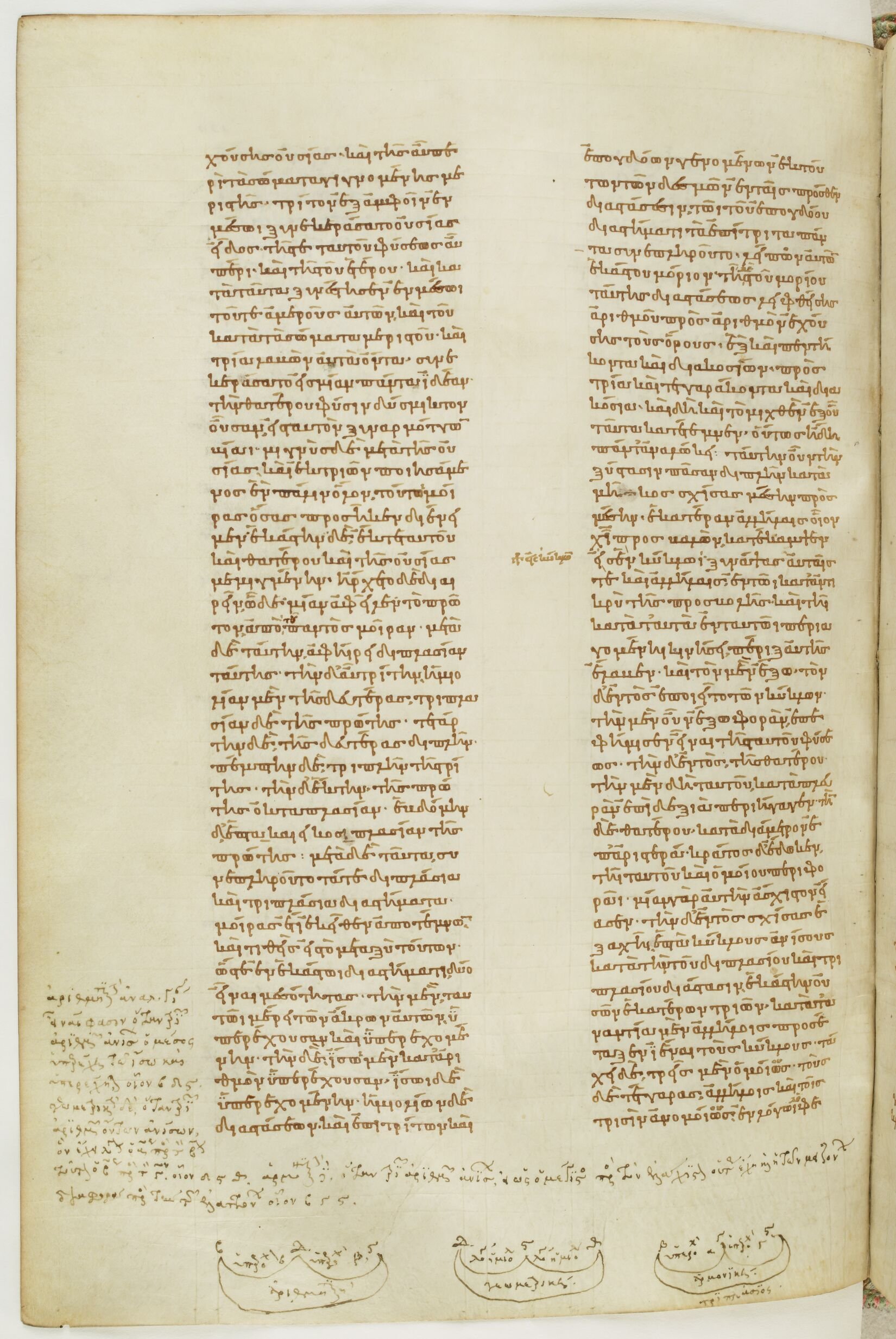
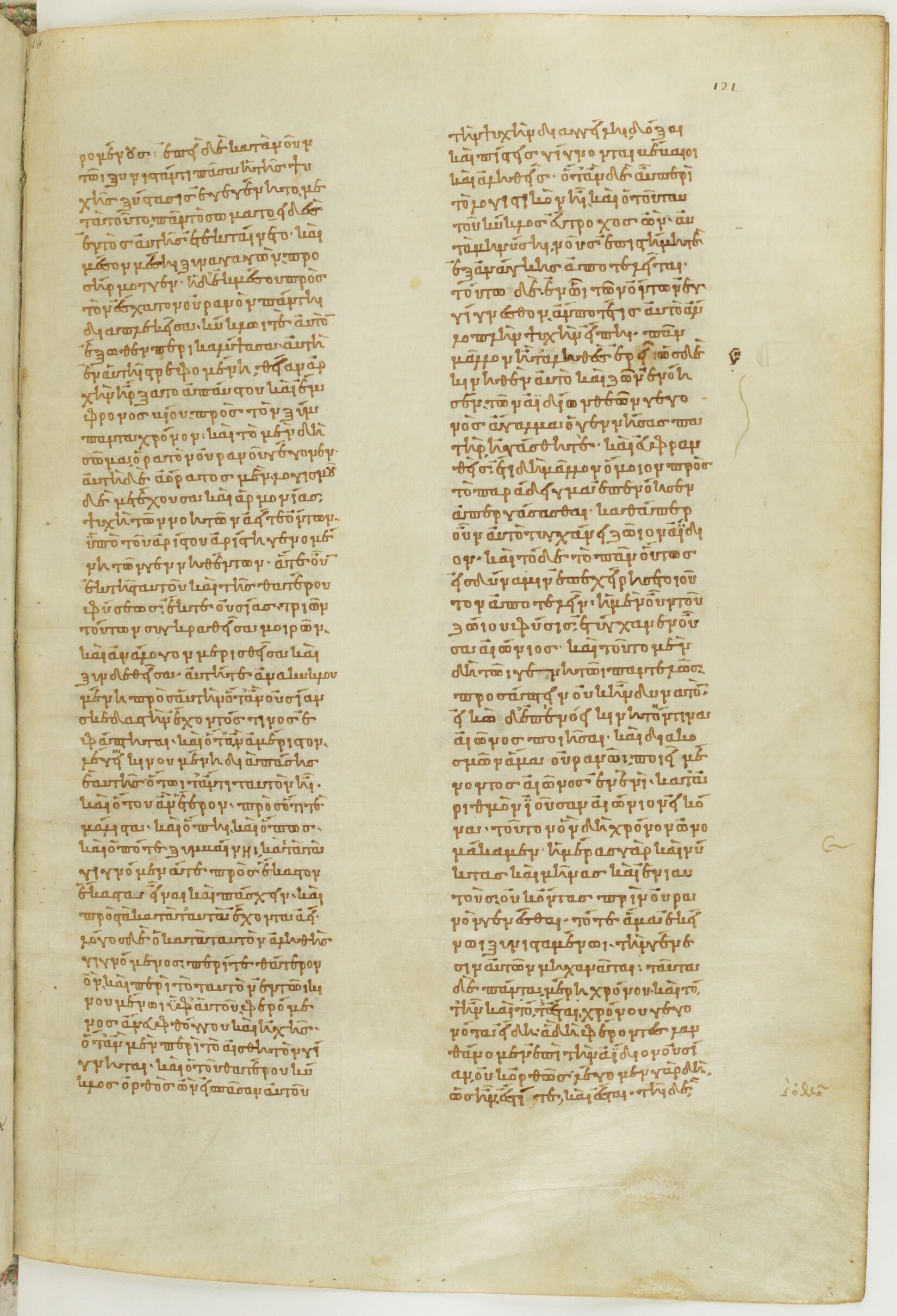
The manuscript is Paris, Bibliothèque nationale de France, grec 1807, known to editors as Plato A. It was copied in Constantinople around 850-875 by the scribe of the so-called philosophical collection, and is the oldest surviving medieval manuscript of the Timaeus and Critias (tetralogies VIII-IX: Clitophon, Republic, Timaeus, Critias, Minos, Laws, Epinomis, Letters). Each page has two columns of 44 lines. The Timaeus fills fol. 114r-144v and the Critias fol. 145r-151r.
On the manuscript this page of text runs over fol. 120v col. a to fol. 121r col. a. Each section below is linked to the folio side(s) that carry it. The mapping comes from reading the first words of every column on the images and finding them in Burnet's text: fol. 120v col. a begins ‹-χούσης οὐσίας καὶ τῆς αὖ περὶ› (Tim. 35a); fol. 120v col. b begins ‹τούτων τῶν δεσμῶν ἐν ταῖς πρόσθεν› (Tim. 36a); fol. 121r col. a begins ‹ἐπεὶ δὲ κατὰ νοῦν τῷ συνιστάντι› (Tim. 36d).
The Greek is John Burnet's critical text (Oxford, 1902), not a transcription of this manuscript; the scribe's spelling, accents and occasional readings differ from it. The English is R. G. Bury's Loeb translation (1929).
How was this verified? (Provenance)
Where on the image
Tim. 36a stands in Paris gr. 1807, fol. 120v col. a to fol. 120v col. b. Checked on the image (column openings read on the BnF photographs and found in Burnet's text, quoted in Burnet's spelling): fol. 120v col. a begins ‹-χούσης οὐσίας καὶ τῆς αὖ περὶ› (Tim. 35a); fol. 120v col. b begins ‹τούτων τῶν δεσμῶν ἐν ταῖς πρόσθεν› (Tim. 36a).
τά τε διπλάσια καὶ τριπλάσια διαστήματα, μοίρας ἔτι ἐκεῖθεν ἀποτέμνων καὶ τιθεὶς εἰς τὸ μεταξὺ τούτων, ὥστε ἐν ἑκάστῳ διαστήματι δύο εἶναι μεσότητας, τὴν μὲν ταὐτῷ μέρει τῶν ἄκρων αὐτῶν ὑπερέχουσαν καὶ ὑπερεχομένην, τὴν δὲ ἴσῳ μὲν κατʼ ἀριθμὸν ὑπερέχουσαν, ἴσῳ δὲ ὑπερεχομένην. ἡμιολίων δὲ διαστάσεων καὶ ἐπιτρίτων καὶ ἐπογδόων γενομένων ἐκ τούτων τῶν δεσμῶν ἐν ταῖς πρόσθεν διαστάσεσιν,
After that He went on to fill up the intervals in the series of the powers of 2 and the intervals in the series of powers of 3 in the following manner: He cut off yet further portions from the original mixture, and set them in between the portions above rehearsed, so as to place two Means in each interval, —one a Mean which exceeded its Extremes and was by them exceeded by the same proportional part or fraction of each of the Extremes respectively; the other a Mean which exceeded one Extreme by the same number or integer as it was exceeded by its other Extreme. And whereas the insertion of these links formed fresh intervals in the former intervals, that is to say, intervals of 3:2 and 4:3 and 9:8, He went on to fill up the 4:3 intervals with 9:8 intervals.
Where on the image
Tim. 36b stands in Paris gr. 1807, fol. 120v col. b. Checked on the image (column openings read on the BnF photographs and found in Burnet's text, quoted in Burnet's spelling): fol. 120v col. b begins ‹τούτων τῶν δεσμῶν ἐν ταῖς πρόσθεν› (Tim. 36a).
τῷ τοῦ ἐπογδόου διαστήματι τὰ ἐπίτριτα πάντα συνεπληροῦτο, λείπων αὐτῶν ἑκάστου μόριον, τῆς τοῦ μορίου ταύτης διαστάσεως λειφθείσης ἀριθμοῦ πρὸς ἀριθμὸν ἐχούσης τοὺς ὅρους ἓξ καὶ πεντήκοντα καὶ διακοσίων πρὸς τρία καὶ τετταράκοντα καὶ διακόσια. καὶ δὴ καὶ τὸ μειχθέν, ἐξ οὗ ταῦτα κατέτεμνεν, οὕτως ἤδη πᾶν κατανηλώκει. ταύτην οὖν τὴν σύστασιν πᾶσαν διπλῆν κατὰ μῆκος σχίσας, μέσην πρὸς μέσην ἑκατέραν ἀλλήλαις οἷον χεῖ προσβαλὼν κατέκαμψεν
This still left over in each case a fraction, which is represented by the terms of the numerical ratio 256:243. And thus the mixture, from which He had been cutting these portions off, was now all spent. Next, He split all this that He had put together into two parts lengthwise; and then He laid the twain one against the other, the middle of one to the middle of the other, like a great cross;
Where on the image
Tim. 36c stands in Paris gr. 1807, fol. 120v col. b. Checked on the image (column openings read on the BnF photographs and found in Burnet's text, quoted in Burnet's spelling): fol. 120v col. b begins ‹τούτων τῶν δεσμῶν ἐν ταῖς πρόσθεν› (Tim. 36a).
εἰς ἓν κύκλῳ, συνάψας αὑταῖς τε καὶ ἀλλήλαις ἐν τῷ καταντικρὺ τῆς προσβολῆς, καὶ τῇ κατὰ ταὐτὰ ἐν ταὐτῷ περιαγομένῃ κινήσει πέριξ αὐτὰς ἔλαβεν, καὶ τὸν μὲν ἔξω, τὸν δʼ ἐντὸς ἐποιεῖτο τῶν κύκλων. τὴν μὲν οὖν ἔξω φορὰν ἐπεφήμισεν εἶναι τῆς ταὐτοῦ φύσεως, τὴν δʼ ἐντὸς τῆς θατέρου. τὴν μὲν δὴ ταὐτοῦ κατὰ πλευρὰν ἐπὶ δεξιὰ περιήγαγεν, τὴν δὲ θατέρου κατὰ διάμετρον ἐπʼ ἀριστερά, κράτος δʼ ἔδωκεν τῇ
and bent either of them into a circle, and join them, each to itself and also to the other, at a point opposite to where they had first been laid together. And He compassed them about with the motion that revolves in the same spot continually, and He made the one circle outer and the other inner. And the outer motion He ordained to be the Motion of the Same, and the inner motion the Motion of the Other. And He made the Motion of the Same to be toward the right along the side, and the Motion of the Other to be toward the left along the diagonal; and He gave the sovranty
Where on the image
Tim. 36d stands in Paris gr. 1807, fol. 120v col. b to fol. 121r col. a. Checked on the image (column openings read on the BnF photographs and found in Burnet's text, quoted in Burnet's spelling): fol. 120v col. b begins ‹τούτων τῶν δεσμῶν ἐν ταῖς πρόσθεν› (Tim. 36a); fol. 121r col. a begins ‹ἐπεὶ δὲ κατὰ νοῦν τῷ συνιστάντι› (Tim. 36d).
ταὐτοῦ καὶ ὁμοίου περιφορᾷ· μίαν γὰρ αὐτὴν ἄσχιστον εἴασεν, τὴν δʼ ἐντὸς σχίσας ἑξαχῇ ἑπτὰ κύκλους ἀνίσους κατὰ τὴν τοῦ διπλασίου καὶ τριπλασίου διάστασιν ἑκάστην, οὐσῶν ἑκατέρων τριῶν, κατὰ τἀναντία μὲν ἀλλήλοις προσέταξεν ἰέναι τοὺς κύκλους, τάχει δὲ τρεῖς μὲν ὁμοίως, τοὺς δὲ τέτταρας ἀλλήλοις καὶ τοῖς τρισὶν ἀνομοίως, ἐν λόγῳ δὲ φερομένους. ἐπεὶ δὲ κατὰ νοῦν τῷ συνιστάντι πᾶσα ἡ τῆς ψυχῆς σύστασις ἐγεγένητο, μετὰ τοῦτο πᾶν τὸ σωματοειδὲς ἐντὸς
to the Revolution of the Same and of the Uniform. For this alone He suffered to remain uncloven, whereas He split the inner Revolution in six places into seven unequal circles, according to each of the intervals of the double and triple intervals, three double and three triple. These two circles then He appointed to go in contrary directions; and of the seven circles into which He split the inner circle, He appointed three to revolve at an equal speed, the other four to go at speeds equal neither with each other nor with the speed of the aforesaid three, yet moving at speeds the ratios of which one to another are those of natural integers. And when the construction of the Soul had all been completed to the satisfaction of its Constructor, then He fabricated within it all the Corporeal,
Where on the image
Tim. 36e stands in Paris gr. 1807, fol. 121r col. a. Checked on the image (column openings read on the BnF photographs and found in Burnet's text, quoted in Burnet's spelling): fol. 121r col. a begins ‹ἐπεὶ δὲ κατὰ νοῦν τῷ συνιστάντι› (Tim. 36d).
αὐτῆς ἐτεκταίνετο καὶ μέσον μέσῃ συναγαγὼν προσήρμοττεν· ἡ δʼ ἐκ μέσου πρὸς τὸν ἔσχατον οὐρανὸν πάντῃ διαπλακεῖσα κύκλῳ τε αὐτὸν ἔξωθεν περικαλύψασα, αὐτὴ ἐν αὑτῇ στρεφομένη, θείαν ἀρχὴν ἤρξατο ἀπαύστου καὶ ἔμφρονος βίου πρὸς τὸν σύμπαντα χρόνον.
καὶ τὸ μὲν δὴ σῶμα ὁρατὸν οὐρανοῦ γέγονεν, αὐτὴ δὲ ἀόρατος μέν, λογισμοῦ δὲ μετέχουσα καὶ
and uniting them center to center He made them fit together. And the Soul, being woven throughout the Heaven every way from the center to the extremity, and enveloping it in a circle from without, and herself revolving within herself, began a divine beginning of unceasing and intelligent life lasting throughout all time.
And whereas the body of the Heaven is visible, the Soul is herself invisible but partakes in reasoning and in harmony,
Notes
- Greek: John Burnet, Platonis Opera IV (Oxford, 1902), via Perseus canonical-greekLit; Burnet's text is a critical edition, so its wording can differ from the manuscript shown.
- English: R. G. Bury, Plato IX (Loeb Classical Library, 1929), via Perseus. Bury's footnotes are not reproduced. Quotation marks stand where Perseus marks quoted speech.
- Stephanus sections (a-e) are those of the 1578 Stephanus edition as given by Burnet and Bury; Bury's section breaks can fall a few words away from Burnet's because English word order differs.
Cite
Sources
- Source: Paris, BnF grec 1807 (Plato A, c. 850-875) fol. 120v-121r via BnF IIIF + Burnet's Greek (Perseus) + R. G. Bury's English (Loeb 1929, Perseus) (holding institution)
- Critical edition: Burnet, Platonis Opera IV (1902), via Perseus
← previous · → next · v cycle view · l back to library