Plato, Timaeus 37a-37e: the knowledge of the world soul; time, the moving image of eternity
Introduction
Stephanus page 37 of Plato's Timaeus (37a-37e): the knowledge of the world soul; time, the moving image of eternity.
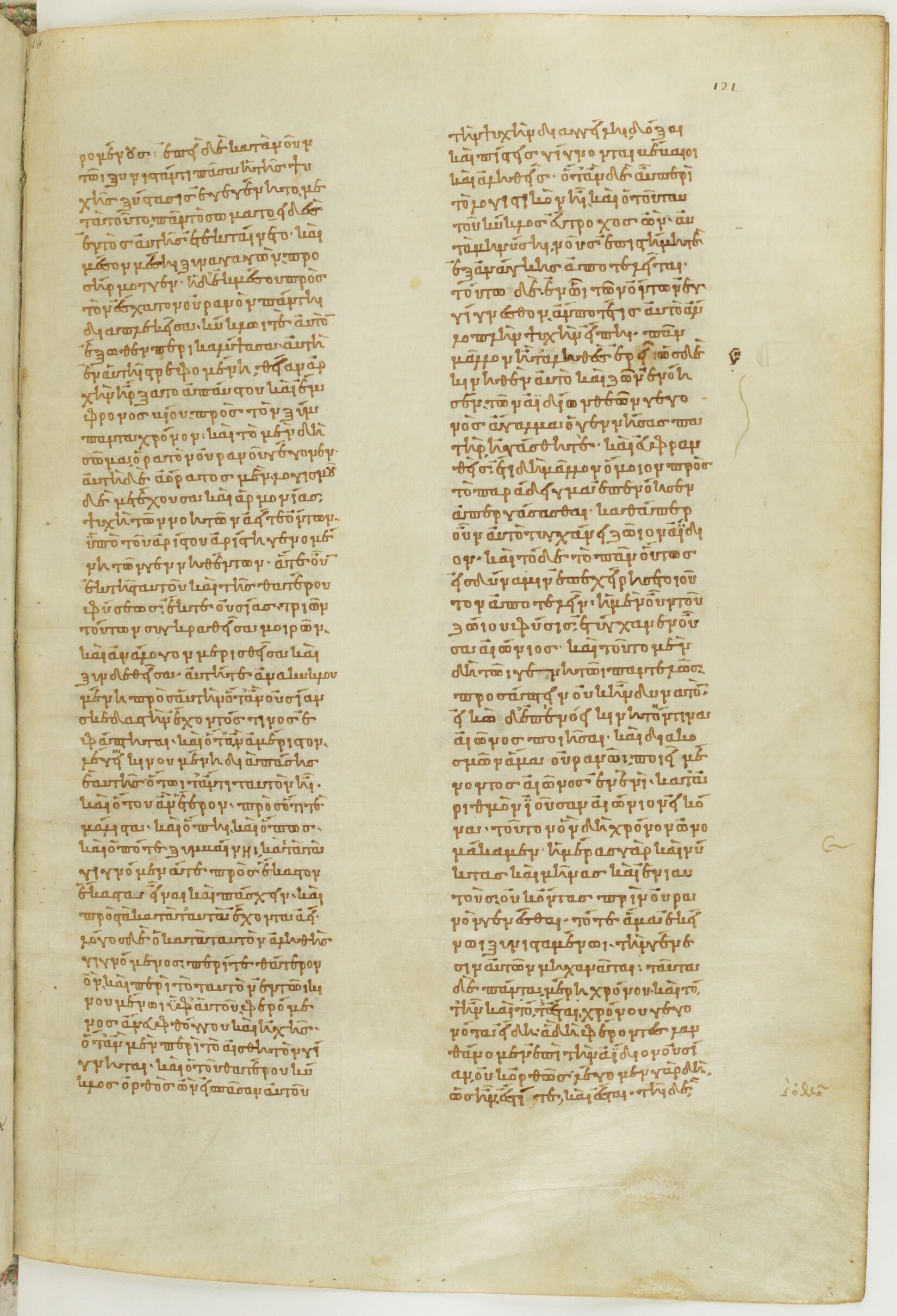
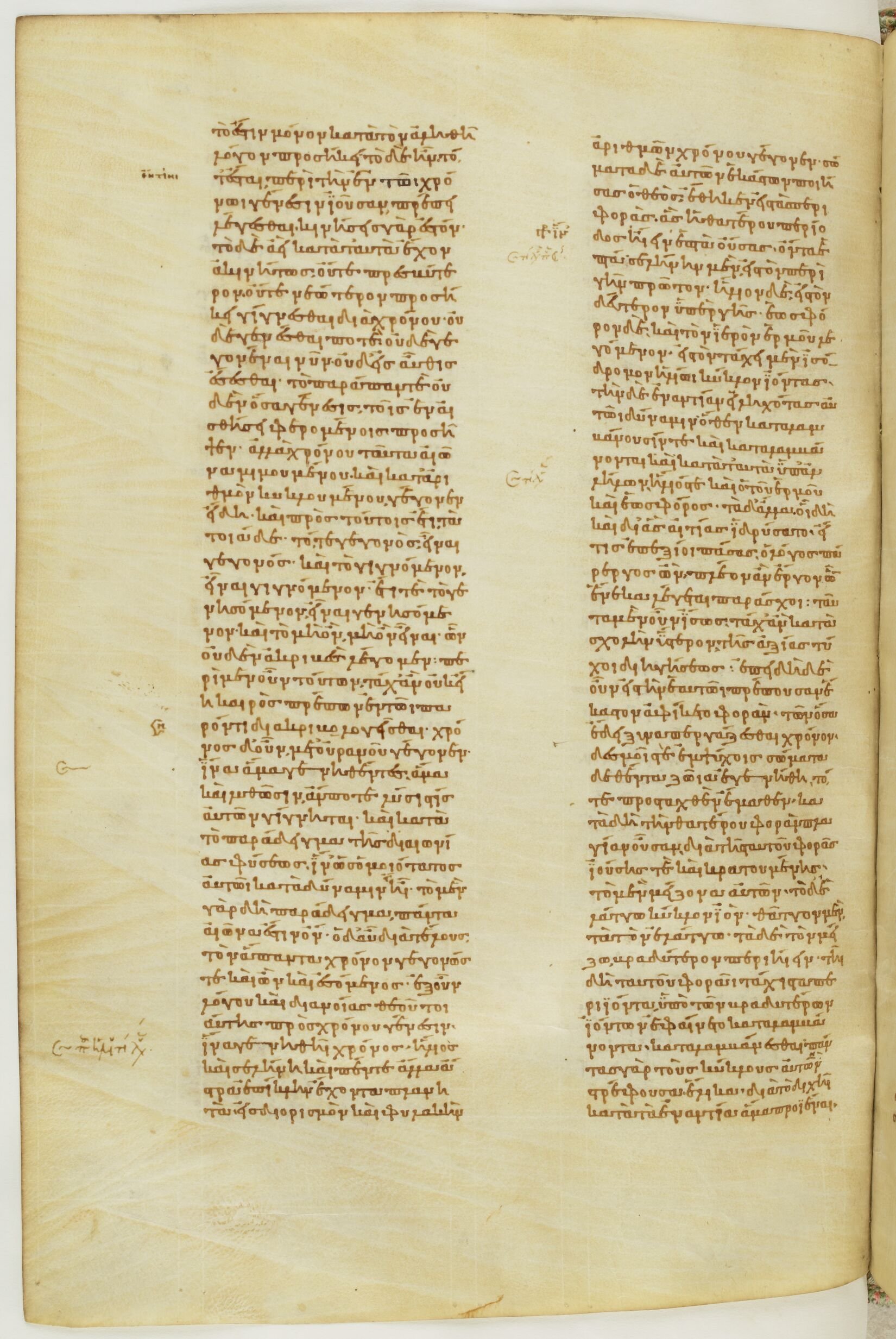
The manuscript is Paris, Bibliothèque nationale de France, grec 1807, known to editors as Plato A. It was copied in Constantinople around 850-875 by the scribe of the so-called philosophical collection, and is the oldest surviving medieval manuscript of the Timaeus and Critias (tetralogies VIII-IX: Clitophon, Republic, Timaeus, Critias, Minos, Laws, Epinomis, Letters). Each page has two columns of 44 lines. The Timaeus fills fol. 114r-144v and the Critias fol. 145r-151r.
On the manuscript this page of text runs over fol. 121r col. a to fol. 121v col. a. Each section below is linked to the folio side(s) that carry it. The mapping comes from reading the first words of every column on the images and finding them in Burnet's text: fol. 121r col. a begins ‹ἐπεὶ δὲ κατὰ νοῦν τῷ συνιστάντι› (Tim. 36d); fol. 121r col. b begins ‹ψυχὴν διαγγείλῃ, δόξαι καὶ πίστεις γίγνονται› (Tim. 37b); fol. 121v col. a begins ‹τὸ ἔστιν μόνον κατὰ τὸν ἀληθῆ› (Tim. 37e).
The Greek is John Burnet's critical text (Oxford, 1902), not a transcription of this manuscript; the scribe's spelling, accents and occasional readings differ from it. The English is R. G. Bury's Loeb translation (1929).
How was this verified? (Provenance)
Where on the image
Tim. 37a stands in Paris gr. 1807, fol. 121r col. a. Checked on the image (column openings read on the BnF photographs and found in Burnet's text, quoted in Burnet's spelling): fol. 121r col. a begins ‹ἐπεὶ δὲ κατὰ νοῦν τῷ συνιστάντι› (Tim. 36d).
ἁρμονίας ψυχή, τῶν νοητῶν ἀεί τε ὄντων ὑπὸ τοῦ ἀρίστου ἀρίστη γενομένη τῶν γεννηθέντων. ἅτε οὖν ἐκ τῆς ταὐτοῦ καὶ τῆς θατέρου φύσεως ἔκ τε οὐσίας τριῶν τούτων συγκραθεῖσα μοιρῶν, καὶ ἀνὰ λόγον μερισθεῖσα καὶ συνδεθεῖσα, αὐτή τε ἀνακυκλουμένη πρὸς αὑτήν, ὅταν οὐσίαν σκεδαστὴν ἔχοντός τινος ἐφάπτηται καὶ ὅταν ἀμέριστον, λέγει κινουμένη διὰ πάσης ἑαυτῆς ὅτῳ τʼ ἄν τι ταὐτὸν ᾖ καὶ ὅτου ἂν
having come into existence by the agency of the best of things intelligible and ever-existing as the best of things generated. Inasmuch, then, as she is a compound, blended of the natures of the Same and the Other and Being, these three portions, and is proportionately divided and bound together, and revolves back upon herself, whenever she touches anything which has its substance dispersed or anything which has its substance undivided she is moved throughout her whole being and announces what the object is identical with
Where on the image
Tim. 37b stands in Paris gr. 1807, fol. 121r col. a to fol. 121r col. b. Checked on the image (column openings read on the BnF photographs and found in Burnet's text, quoted in Burnet's spelling): fol. 121r col. a begins ‹ἐπεὶ δὲ κατὰ νοῦν τῷ συνιστάντι› (Tim. 36d); fol. 121r col. b begins ‹ψυχὴν διαγγείλῃ, δόξαι καὶ πίστεις γίγνονται› (Tim. 37b).
ἕτερον, πρὸς ὅτι τε μάλιστα καὶ ὅπῃ καὶ ὅπως καὶ ὁπότε συμβαίνει κατὰ τὰ γιγνόμενά τε πρὸς ἕκαστον ἕκαστα εἶναι καὶ πάσχειν καὶ πρὸς τὰ κατὰ ταὐτὰ ἔχοντα ἀεί. λόγος δὲ ὁ κατὰ ταὐτὸν ἀληθὴς γιγνόμενος περί τε θάτερον ὂν καὶ περὶ τὸ ταὐτόν, ἐν τῷ κινουμένῳ ὑφʼ αὑτοῦ φερόμενος ἄνευ φθόγγου καὶ ἠχῆς, ὅταν μὲν περὶ τὸ αἰσθητὸν γίγνηται καὶ ὁ τοῦ θατέρου κύκλος ὀρθὸς ἰὼν εἰς πᾶσαν αὐτοῦ τὴν ψυχὴν διαγγείλῃ, δόξαι καὶ πίστεις γίγνονται βέβαιοι καὶ ἀληθεῖς,
and from what it is different, and in what relation, where and how and when, it comes about that each thing exists and is acted upon by others both in the sphere of the Becoming and in that of the ever-uniform. And her announcement, being identically true concerning both the Other and the Same, is borne through the self-moved without speech or sound; and whenever it is concerned with the sensible, and the circle of the Other moving in straight course proclaims it to the whole of its Soul, opinions and beliefs arise which are firm and true; and again, when it is concerned with the rational,
Where on the image
Tim. 37c stands in Paris gr. 1807, fol. 121r col. b. Checked on the image (column openings read on the BnF photographs and found in Burnet's text, quoted in Burnet's spelling): fol. 121r col. b begins ‹ψυχὴν διαγγείλῃ, δόξαι καὶ πίστεις γίγνονται› (Tim. 37b).
ὅταν δὲ αὖ περὶ τὸ λογιστικὸν ᾖ καὶ ὁ τοῦ ταὐτοῦ κύκλος εὔτροχος ὢν αὐτὰ μηνύσῃ, νοῦς ἐπιστήμη τε ἐξ ἀνάγκης ἀποτελεῖται· τούτω δὲ ἐν ᾧ τῶν ὄντων ἐγγίγνεσθον, ἄν ποτέ τις αὐτὸ ἄλλο πλὴν ψυχὴν εἴπῃ, πᾶν μᾶλλον ἢ τἀληθὲς ἐρεῖ. ὡς δὲ κινηθὲν αὐτὸ καὶ ζῶν ἐνόησεν τῶν ἀιδίων θεῶν γεγονὸς ἄγαλμα ὁ γεννήσας πατήρ, ἠγάσθη τε καὶ εὐφρανθεὶς ἔτι δὴ μᾶλλον ὅμοιον πρὸς τὸ παράδειγμα ἐπενόησεν ἀπεργάσασθαι.
and the circle of the Same, spinning truly, declares the facts, reason and knowledge of necessity result. But should anyone assert that the substance in which these two states arise is something other than Soul, his assertion will be anything rather than the truth. And when the Father that engendered it perceived it in motion and alive, a thing of joy to the eternal gods, He too rejoiced; and being well-pleased He designed to make it resemble its Model
Where on the image
Tim. 37d stands in Paris gr. 1807, fol. 121r col. b. Checked on the image (column openings read on the BnF photographs and found in Burnet's text, quoted in Burnet's spelling): fol. 121r col. b begins ‹ψυχὴν διαγγείλῃ, δόξαι καὶ πίστεις γίγνονται› (Tim. 37b).
καθάπερ οὖν αὐτὸ τυγχάνει ζῷον ἀίδιον ὄν, καὶ τόδε τὸ πᾶν οὕτως εἰς δύναμιν ἐπεχείρησε τοιοῦτον ἀποτελεῖν. ἡ μὲν οὖν τοῦ ζῴου φύσις ἐτύγχανεν οὖσα αἰώνιος, καὶ τοῦτο μὲν δὴ τῷ γεννητῷ παντελῶς προσάπτειν οὐκ ἦν δυνατόν· εἰκὼ δʼ ἐπενόει κινητόν τινα αἰῶνος ποιῆσαι, καὶ διακοσμῶν ἅμα οὐρανὸν ποιεῖ μένοντος αἰῶνος ἐν ἑνὶ κατʼ ἀριθμὸν ἰοῦσαν αἰώνιον εἰκόνα, τοῦτον ὃν δὴ χρόνον ὠνομάκαμεν.
still more closely. Accordingly, seeing that that Model is an eternal Living Creature, He set about making this Universe, so far as He could, of a like kind. But inasmuch as the nature of the Living Creature was eternal, this quality it was impossible to attach in its entirety to what is generated; wherefore He planned to make a movable image of Eternity, and, as He set in order the Heaven, of that Eternity which abides in unity He made an eternal image, moving according to number, even that which we have named Time.
Where on the image
Tim. 37e stands in Paris gr. 1807, fol. 121r col. b to fol. 121v col. a. Checked on the image (column openings read on the BnF photographs and found in Burnet's text, quoted in Burnet's spelling): fol. 121r col. b begins ‹ψυχὴν διαγγείλῃ, δόξαι καὶ πίστεις γίγνονται› (Tim. 37b); fol. 121v col. a begins ‹τὸ ἔστιν μόνον κατὰ τὸν ἀληθῆ› (Tim. 37e).
ἡμέρας γὰρ καὶ νύκτας καὶ μῆνας καὶ ἐνιαυτούς, οὐκ ὄντας πρὶν οὐρανὸν γενέσθαι, τότε ἅμα ἐκείνῳ συνισταμένῳ τὴν γένεσιν αὐτῶν μηχανᾶται· ταῦτα δὲ πάντα μέρη χρόνου, καὶ τό τʼ ἦν τό τʼ ἔσται χρόνου γεγονότα εἴδη, ἃ δὴ φέροντες λανθάνομεν ἐπὶ τὴν ἀίδιον οὐσίαν οὐκ ὀρθῶς.
λέγομεν γὰρ δὴ ὡς ἦν ἔστιν τε καὶ ἔσται, τῇ δὲ τὸ ἔστιν μόνον κατὰ τὸν
For simultaneously with the construction of the Heaven He contrived the production of days and nights and months and years, which existed not before the Heaven came into being. And these are all portions of Time; even as Was and Shall be are generated forms of Time, although we apply them wrongly, without noticing, to Eternal Being.
For we say that it is or was or will be, whereas, in truth of speech, is alone
Notes
- Greek: John Burnet, Platonis Opera IV (Oxford, 1902), via Perseus canonical-greekLit; Burnet's text is a critical edition, so its wording can differ from the manuscript shown.
- English: R. G. Bury, Plato IX (Loeb Classical Library, 1929), via Perseus. Bury's footnotes are not reproduced. Quotation marks stand where Perseus marks quoted speech.
- Stephanus sections (a-e) are those of the 1578 Stephanus edition as given by Burnet and Bury; Bury's section breaks can fall a few words away from Burnet's because English word order differs.
Cite
Sources
- Source: Paris, BnF grec 1807 (Plato A, c. 850-875) fol. 121r-121v via BnF IIIF + Burnet's Greek (Perseus) + R. G. Bury's English (Loeb 1929, Perseus) (holding institution)
- Critical edition: Burnet, Platonis Opera IV (1902), via Perseus
← previous · → next · v cycle view · l back to library