Plato, Timaeus 38a-38e: was, is and will be; sun, moon and planets made to mark time
Introduction
Stephanus page 38 of Plato's Timaeus (38a-38e): was, is and will be; sun, moon and planets made to mark time.
The manuscript is Paris, Bibliothèque nationale de France, grec 1807, known to editors as Plato A. It was copied in Constantinople around 850-875 by the scribe of the so-called philosophical collection, and is the oldest surviving medieval manuscript of the Timaeus and Critias (tetralogies VIII-IX: Clitophon, Republic, Timaeus, Critias, Minos, Laws, Epinomis, Letters). Each page has two columns of 44 lines. The Timaeus fills fol. 114r-144v and the Critias fol. 145r-151r.
On the manuscript this page of text runs over fol. 121v col. a to fol. 121v col. b. Each section below is linked to the folio side(s) that carry it. The mapping comes from reading the first words of every column on the images and finding them in Burnet's text: fol. 121v col. a begins ‹τὸ ἔστιν μόνον κατὰ τὸν ἀληθῆ› (Tim. 37e); fol. 121v col. b begins ‹ἀριθμῶν χρόνου γέγονεν· σώματα δὲ αὐτῶν› (Tim. 38c).
The Greek is John Burnet's critical text (Oxford, 1902), not a transcription of this manuscript; the scribe's spelling, accents and occasional readings differ from it. The English is R. G. Bury's Loeb translation (1929).
How was this verified? (Provenance)
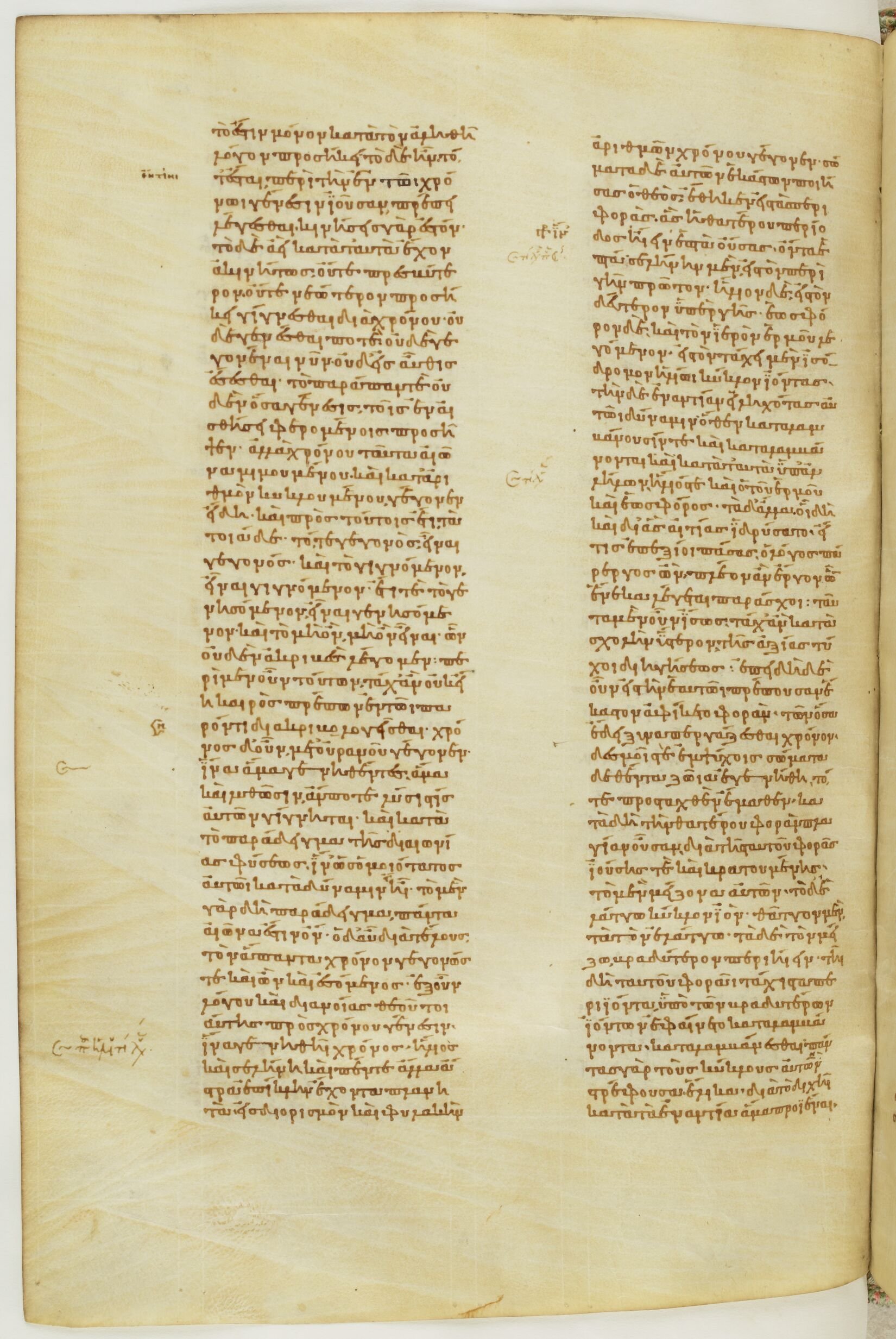
Where on the image
Tim. 38a stands in Paris gr. 1807, fol. 121v col. a. Checked on the image (column openings read on the BnF photographs and found in Burnet's text, quoted in Burnet's spelling): fol. 121v col. a begins ‹τὸ ἔστιν μόνον κατὰ τὸν ἀληθῆ› (Tim. 37e).
ἀληθῆ λόγον προσήκει, τὸ δὲ ἦν τό τʼ ἔσται περὶ τὴν ἐν χρόνῳ γένεσιν ἰοῦσαν πρέπει λέγεσθαι—κινήσεις γάρ ἐστον, τὸ δὲ ἀεὶ κατὰ ταὐτὰ ἔχον ἀκινήτως οὔτε πρεσβύτερον οὔτε νεώτερον προσήκει γίγνεσθαι διὰ χρόνου οὐδὲ γενέσθαι ποτὲ οὐδὲ γεγονέναι νῦν οὐδʼ εἰς αὖθις ἔσεσθαι, τὸ παράπαν τε οὐδὲν ὅσα γένεσις τοῖς ἐν αἰσθήσει φερομένοις προσῆψεν, ἀλλὰ χρόνου ταῦτα αἰῶνα μιμουμένου καὶ κατʼ ἀριθμὸν κυκλουμένου γέγονεν εἴδη—καὶ πρὸς τούτοις ἔτι τὰ τοιάδε,
is the appropriate term; was and will be, on the other hand, are terms properly applicable to the Becoming which proceeds in Time, since both of these are motions; but it belongs not to that which is ever changeless in its uniformity to become either older or younger through time, nor ever to have become so, nor to be so now, nor to be about to be so hereafter, nor in general to be subject to any of the conditions which Becoming has attached to the things which move in the world of Sense, these being generated forms of Time, which imitates Eternity and circles round according to number. And besides these we make use of the following expressions,—
Where on the image
Tim. 38b stands in Paris gr. 1807, fol. 121v col. a. Checked on the image (column openings read on the BnF photographs and found in Burnet's text, quoted in Burnet's spelling): fol. 121v col. a begins ‹τὸ ἔστιν μόνον κατὰ τὸν ἀληθῆ› (Tim. 37e).
τό τε γεγονὸς εἶναι γεγονὸς καὶ τὸ γιγνόμενον εἶναι γιγνόμενον, ἔτι τε τὸ γενησόμενον εἶναι γενησόμενον καὶ τὸ μὴ ὂν μὴ ὂν εἶναι, ὧν οὐδὲν ἀκριβὲς λέγομεν. περὶ μὲν οὖν τούτων τάχʼ ἂν οὐκ εἴη καιρὸς πρέπων ἐν τῷ παρόντι διακριβολογεῖσθαι. χρόνος δʼ οὖν μετʼ οὐρανοῦ γέγονεν, ἵνα ἅμα γεννηθέντες ἅμα καὶ λυθῶσιν, ἄν ποτε λύσις τις αὐτῶν γίγνηται, καὶ κατὰ τὸ παράδειγμα τῆς διαιωνίας φύσεως, ἵνʼ ὡς ὁμοιότατος
that what is become is become, and what is becoming is becoming, and what is about to become is about to become, and what is non-existent is non-existent; but none of these expressions is accurate. But the present is not, perhaps, a fitting occasion for an exact discussion of these matters. Time, then, came into existence along with the Heaven, to the end that having been generated together they might also be dissolved together, if ever a dissolution of them should take place; and it was made after the pattern of the Eternal Nature, to the end that it might be as like thereto as possible; for whereas the pattern is existent through all eternity,
Where on the image
Tim. 38c stands in Paris gr. 1807, fol. 121v col. a to fol. 121v col. b. Checked on the image (column openings read on the BnF photographs and found in Burnet's text, quoted in Burnet's spelling): fol. 121v col. a begins ‹τὸ ἔστιν μόνον κατὰ τὸν ἀληθῆ› (Tim. 37e); fol. 121v col. b begins ‹ἀριθμῶν χρόνου γέγονεν· σώματα δὲ αὐτῶν› (Tim. 38c).
αὐτῷ κατὰ δύναμιν ᾖ· τὸ μὲν γὰρ δὴ παράδειγμα πάντα αἰῶνά ἐστιν ὄν, ὁ δʼ αὖ διὰ τέλους τὸν ἅπαντα χρόνον γεγονώς τε καὶ ὢν καὶ ἐσόμενος. ἐξ οὖν λόγου καὶ διανοίας θεοῦ τοιαύτης πρὸς χρόνου γένεσιν, ἵνα γεννηθῇ χρόνος, ἥλιος καὶ σελήνη καὶ πέντε ἄλλα ἄστρα, ἐπίκλην ἔχοντα πλανητά, εἰς διορισμὸν καὶ φυλακὴν ἀριθμῶν χρόνου γέγονεν· σώματα δὲ αὐτῶν ἑκάστων ποιήσας ὁ θεὸς ἔθηκεν εἰς τὰς περιφορὰς ἃς ἡ θατέρου περίοδος ᾔειν, ἑπτὰ οὔσας ὄντα
the copy, on the other hand, is through all time, continually having existed, existing, and being about to exist. Wherefore, as a consequence of this reasoning and design on the part of God, with a view to the generation of Time, the sun and moon and five other stars, which bear the appellation of planets, came into existence for the determining and preserving of the numbers of Time. And when God had made the bodies of each of them He placed them in the orbits along which the revolution of the Other was moving, seven orbits for the seven bodies..
Where on the image
Tim. 38d stands in Paris gr. 1807, fol. 121v col. b. Checked on the image (column openings read on the BnF photographs and found in Burnet's text, quoted in Burnet's spelling): fol. 121v col. b begins ‹ἀριθμῶν χρόνου γέγονεν· σώματα δὲ αὐτῶν› (Tim. 38c).
ἑπτά, σελήνην μὲν εἰς τὸν περὶ γῆν πρῶτον, ἥλιον δὲ εἰς τὸν δεύτερον ὑπὲρ γῆς, ἑωσφόρον δὲ καὶ τὸν ἱερὸν Ἑρμοῦ λεγόμενον εἰς τὸν τάχει μὲν ἰσόδρομον ἡλίῳ κύκλον ἰόντας, τὴν δὲ ἐναντίαν εἰληχότας αὐτῷ δύναμιν· ὅθεν καταλαμβάνουσίν τε καὶ καταλαμβάνονται κατὰ ταὐτὰ ὑπʼ ἀλλήλων ἥλιός τε καὶ ὁ τοῦ Ἑρμοῦ καὶ ἑωσφόρος. τὰ δʼ ἄλλα οἷ δὴ καὶ διʼ ἃς αἰτίας ἱδρύσατο, εἴ τις ἐπεξίοι πάσας, ὁ λόγος
The Moon He placed in the first circle around the Earth, the Sun in the second above the Earth; and the Morning Star and the Star called Sacred to Hermes He placed in those circles which move in an orbit equal to the Sun in velocity, but endowed with a power contrary thereto; whence it is that the Sun and the Star of Hermes and the Morning Star regularly overtake and are overtaken by one another. As to the rest of the stars, were one to describe in detail the positions in which He set them, and all the reasons therefor,
Where on the image
Tim. 38e stands in Paris gr. 1807, fol. 121v col. b. Checked on the image (column openings read on the BnF photographs and found in Burnet's text, quoted in Burnet's spelling): fol. 121v col. b begins ‹ἀριθμῶν χρόνου γέγονεν· σώματα δὲ αὐτῶν› (Tim. 38c).
πάρεργος ὢν πλέον ἂν ἔργον ὧν ἕνεκα λέγεται παράσχοι. ταῦτα μὲν οὖν ἴσως τάχʼ ἂν κατὰ σχολὴν ὕστερον τῆς ἀξίας τύχοι διηγήσεως·
ἐπειδὴ δὲ οὖν εἰς τὴν ἑαυτῷ πρέπουσαν ἕκαστον ἀφίκετο φορὰν τῶν ὅσα ἔδει συναπεργάζεσθαι χρόνον, δεσμοῖς τε ἐμψύχοις σώματα δεθέντα ζῷα ἐγεννήθη τό τε προσταχθὲν ἔμαθεν, κατὰ δὴ τὴν θατέρου φορὰν
the description, though but subsidiary, would prove a heavier task than the main argument which it subserves. Later on, perhaps, at our leisure these points may receive the attention they merit.
So when each of the bodies whose co-operation was required for the making of Time had arrived in its proper orbit; and when they had been generated as living creatures, having their bodies bound with living bonds,
Notes
- Greek: John Burnet, Platonis Opera IV (Oxford, 1902), via Perseus canonical-greekLit; Burnet's text is a critical edition, so its wording can differ from the manuscript shown.
- English: R. G. Bury, Plato IX (Loeb Classical Library, 1929), via Perseus. Bury's footnotes are not reproduced. Quotation marks stand where Perseus marks quoted speech.
- Stephanus sections (a-e) are those of the 1578 Stephanus edition as given by Burnet and Bury; Bury's section breaks can fall a few words away from Burnet's because English word order differs.
Cite
Sources
- Source: Paris, BnF grec 1807 (Plato A, c. 850-875) fol. 121v via BnF IIIF + Burnet's Greek (Perseus) + R. G. Bury's English (Loeb 1929, Perseus) (holding institution)
- Critical edition: Burnet, Platonis Opera IV (1902), via Perseus
← previous · → next · v cycle view · l back to library