Plato, Timaeus 39a-39e: the motions of the planets; day, month and year; the perfect year
Introduction
Stephanus page 39 of Plato's Timaeus (39a-39e): the motions of the planets; day, month and year; the perfect year.
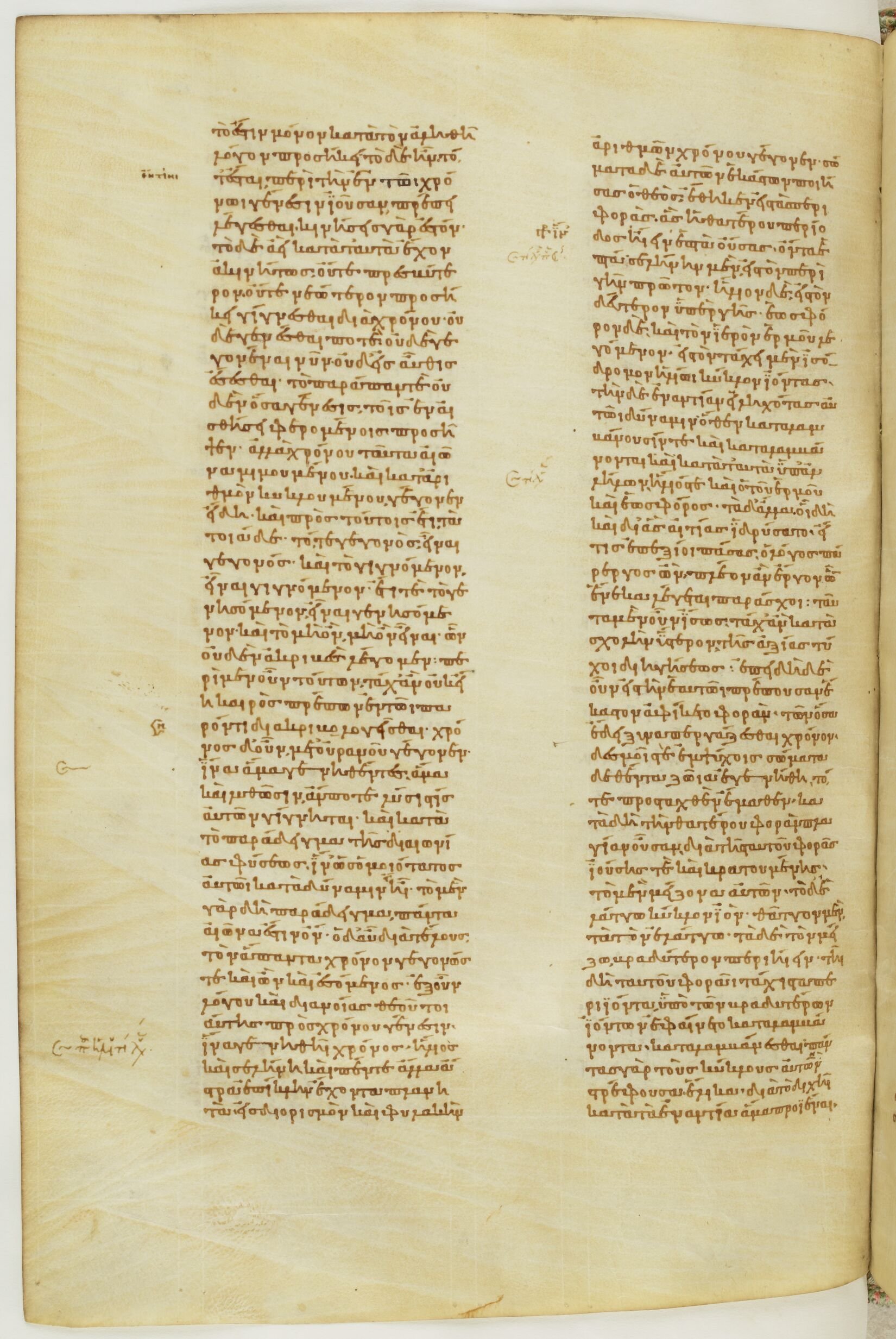
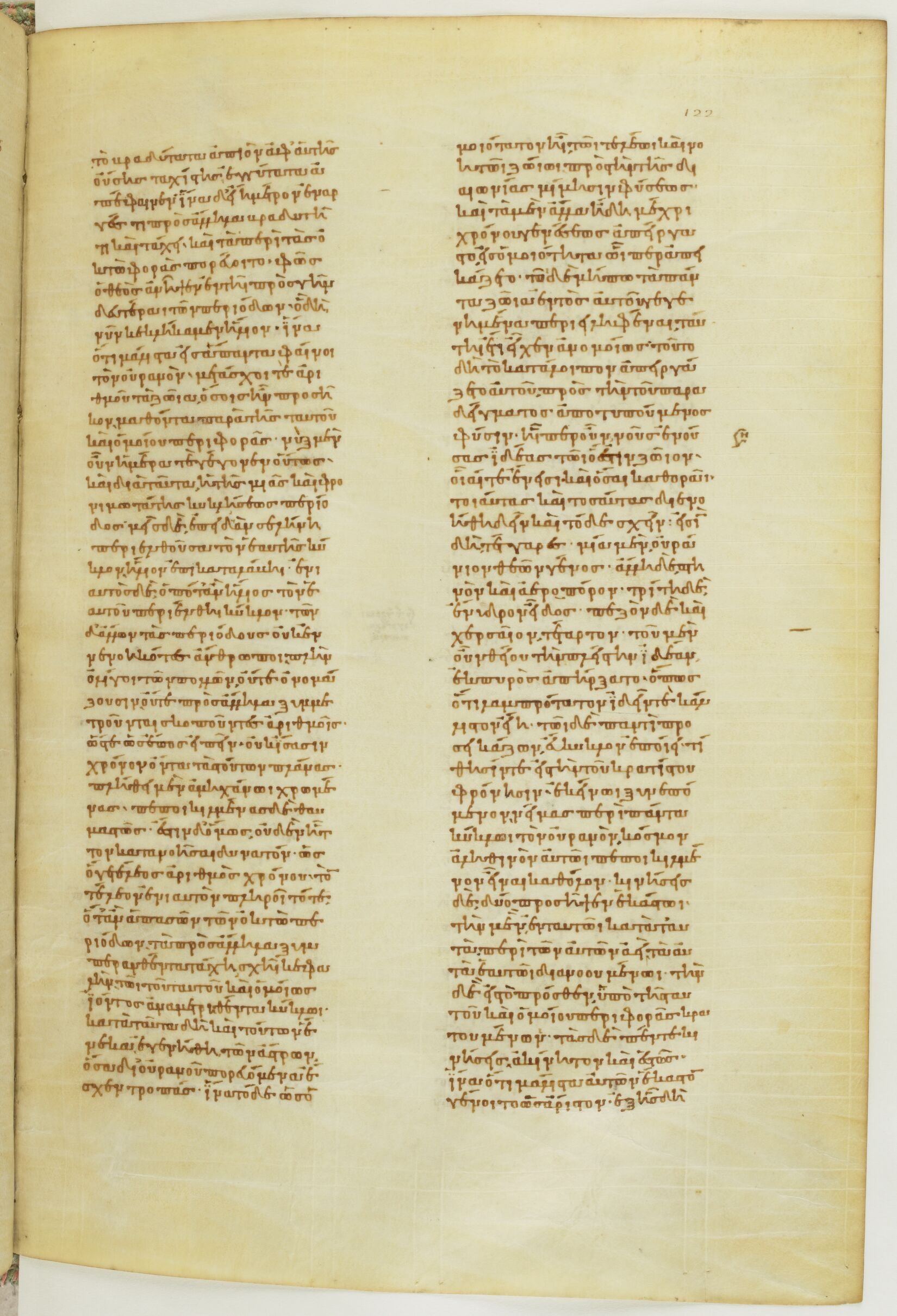
The manuscript is Paris, Bibliothèque nationale de France, grec 1807, known to editors as Plato A. It was copied in Constantinople around 850-875 by the scribe of the so-called philosophical collection, and is the oldest surviving medieval manuscript of the Timaeus and Critias (tetralogies VIII-IX: Clitophon, Republic, Timaeus, Critias, Minos, Laws, Epinomis, Letters). Each page has two columns of 44 lines. The Timaeus fills fol. 114r-144v and the Critias fol. 145r-151r.
On the manuscript this page of text runs over fol. 121v col. b to fol. 122r col. b. Each section below is linked to the folio side(s) that carry it. The mapping comes from reading the first words of every column on the images and finding them in Burnet's text: fol. 121v col. b begins ‹ἀριθμῶν χρόνου γέγονεν· σώματα δὲ αὐτῶν› (Tim. 38c); fol. 122r col. a begins ‹τὸ βραδύτατα ἀπιὸν ἀφʼ αὑτῆς οὔσης› (Tim. 39b); fol. 122r col. b begins ‹-μοιότατον ᾖ τῷ τελέῳ καὶ νοητῷ› (Tim. 39e).
The Greek is John Burnet's critical text (Oxford, 1902), not a transcription of this manuscript; the scribe's spelling, accents and occasional readings differ from it. The English is R. G. Bury's Loeb translation (1929).
How was this verified? (Provenance)
Where on the image
Tim. 39a stands in Paris gr. 1807, fol. 121v col. b. Checked on the image (column openings read on the BnF photographs and found in Burnet's text, quoted in Burnet's spelling): fol. 121v col. b begins ‹ἀριθμῶν χρόνου γέγονεν· σώματα δὲ αὐτῶν› (Tim. 38c).
πλαγίαν οὖσαν, διὰ τῆς ταὐτοῦ φορᾶς ἰούσης τε καὶ κρατουμένης, τὸ μὲν μείζονα αὐτῶν, τὸ δʼ ἐλάττω κύκλον ἰόν, θᾶττον μὲν τὰ τὸν ἐλάττω, τὰ δὲ τὸν μείζω βραδύτερον περιῄειν. τῇ δὴ ταὐτοῦ φορᾷ τὰ τάχιστα περιιόντα ὑπὸ τῶν βραδύτερον ἰόντων ἐφαίνετο καταλαμβάνοντα καταλαμβάνεσθαι· πάντας γὰρ τοὺς κύκλους αὐτῶν στρέφουσα ἕλικα διὰ τὸ διχῇ κατὰ
and had learnt their appointed duties; then they kept revolving around the circuit of the Other, which is transverse and passes through the circuit of the Same and is dominated thereby; and part of them moved in a greater, part in a smaller circle, those in the smaller moving more quickly and those in the greater more slowly. And because of the motion of the Same, the stars which revolved most quickly appeared to be overtaken by those which moved most slowly, although in truth they overtook them;
Where on the image
Tim. 39b stands in Paris gr. 1807, fol. 121v col. b to fol. 122r col. a. Checked on the image (column openings read on the BnF photographs and found in Burnet's text, quoted in Burnet's spelling): fol. 121v col. b begins ‹ἀριθμῶν χρόνου γέγονεν· σώματα δὲ αὐτῶν› (Tim. 38c); fol. 122r col. a begins ‹τὸ βραδύτατα ἀπιὸν ἀφʼ αὑτῆς οὔσης› (Tim. 39b).
τὰ ἐναντία ἅμα προϊέναι τὸ βραδύτατα ἀπιὸν ἀφʼ αὑτῆς οὔσης ταχίστης ἐγγύτατα ἀπέφαινεν. ἵνα δʼ εἴη μέτρον ἐναργές τι πρὸς ἄλληλα βραδυτῆτι καὶ τάχει καὶ τὰ περὶ τὰς ὀκτὼ φορὰς πορεύοιτο, φῶς ὁ θεὸς ἀνῆψεν ἐν τῇ πρὸς γῆν δευτέρᾳ τῶν περιόδων, ὃ δὴ νῦν κεκλήκαμεν ἥλιον, ἵνα ὅτι μάλιστα εἰς ἅπαντα φαίνοι τὸν οὐρανὸν μετάσχοι τε ἀριθμοῦ τὰ ζῷα ὅσοις ἦν προσῆκον, μαθόντα παρὰ τῆς ταὐτοῦ καὶ ὁμοίου
for, because of their simultaneous progress in two opposite directions, the motion of the Same, which is the swiftest of all motions, twisted all their circles into spirals and thus caused the body which moves away from it most slowly to appear the nearest. And in order that there might be a clear measure of the relative speeds, slow and quick, with which they travelled round their eight orbits, in that circle which is second from the earth God kindled a light which now we call the Sun, to the end that it might shine, so far as possible, throughout the whole Heaven, and that all the living creatures entitled thereto might participate in number, learning it from the revolution of the Same and Similar.
Where on the image
Tim. 39c stands in Paris gr. 1807, fol. 122r col. a. Checked on the image (column openings read on the BnF photographs and found in Burnet's text, quoted in Burnet's spelling): fol. 122r col. a begins ‹τὸ βραδύτατα ἀπιὸν ἀφʼ αὑτῆς οὔσης› (Tim. 39b).
περιφορᾶς. νὺξ μὲν οὖν ἡμέρα τε γέγονεν οὕτως καὶ διὰ ταῦτα, ἡ τῆς μιᾶς καὶ φρονιμωτάτης κυκλήσεως περίοδος· μεὶς δὲ ἐπειδὰν σελήνη περιελθοῦσα τὸν ἑαυτῆς κύκλον ἥλιον ἐπικαταλάβῃ, ἐνιαυτὸς δὲ ὁπόταν ἥλιος τὸν ἑαυτοῦ περιέλθῃ κύκλον. τῶν δʼ ἄλλων τὰς περιόδους οὐκ ἐννενοηκότες ἄνθρωποι, πλὴν ὀλίγοι τῶν πολλῶν, οὔτε ὀνομάζουσιν οὔτε πρὸς ἄλληλα συμμετροῦνται σκοποῦντες ἀριθμοῖς, ὥστε ὡς ἔπος
In this wise and for these reasons were generated Night and Day, which are the revolution of the one and most intelligent circuit; and Month, every time that the Moon having completed her own orbit overtakes the Sun; and Year, as often as the Sun has completed his own orbit. Of the other stars the revolutions have not been discovered by men (save for a few out of the many); wherefore they have no names for them, nor do they compute and compare their relative measurements, so that they are not aware, as a rule,
Where on the image
Tim. 39d stands in Paris gr. 1807, fol. 122r col. a. Checked on the image (column openings read on the BnF photographs and found in Burnet's text, quoted in Burnet's spelling): fol. 122r col. a begins ‹τὸ βραδύτατα ἀπιὸν ἀφʼ αὑτῆς οὔσης› (Tim. 39b).
εἰπεῖν οὐκ ἴσασιν χρόνον ὄντα τὰς τούτων πλάνας, πλήθει μὲν ἀμηχάνῳ χρωμένας, πεποικιλμένας δὲ θαυμαστῶς· ἔστιν δʼ ὅμως οὐδὲν ἧττον κατανοῆσαι δυνατὸν ὡς ὅ γε τέλεος ἀριθμὸς χρόνου τὸν τέλεον ἐνιαυτὸν πληροῖ τότε, ὅταν ἁπασῶν τῶν ὀκτὼ περιόδων τὰ πρὸς ἄλληλα συμπερανθέντα τάχη σχῇ κεφαλὴν τῷ τοῦ ταὐτοῦ καὶ ὁμοίως ἰόντος ἀναμετρηθέντα κύκλῳ. κατὰ ταῦτα δὴ καὶ τούτων ἕνεκα ἐγεννήθη τῶν ἄστρων ὅσα διʼ οὐρανοῦ πορευόμενα ἔσχεν τροπάς, ἵνα τόδε
that the wanderings of these bodies, which are hard to calculate and of wondrous complexity, constitute Time. Nevertheless, it is still quite possible to perceive that the complete number of Time fulfils the Complete Year when all the eight circuits, with their relative speeds, finish together and come to a head, when measured by the revolution of the Same and Similarly-moving. In this wise and for these reasons were generated all those stars which turn themselves about as they travel through Heaven, to the end that this Universe might be as similar as possible to the perfect and intelligible Living Creature in respect of its imitation of the Eternal
Where on the image
Tim. 39e stands in Paris gr. 1807, fol. 122r col. a to fol. 122r col. b. Checked on the image (column openings read on the BnF photographs and found in Burnet's text, quoted in Burnet's spelling): fol. 122r col. a begins ‹τὸ βραδύτατα ἀπιὸν ἀφʼ αὑτῆς οὔσης› (Tim. 39b); fol. 122r col. b begins ‹-μοιότατον ᾖ τῷ τελέῳ καὶ νοητῷ› (Tim. 39e).
ὡς ὁμοιότατον ᾖ τῷ τελέῳ καὶ νοητῷ ζῴῳ πρὸς τὴν τῆς διαιωνίας μίμησιν φύσεως. καὶ τὰ μὲν ἄλλα ἤδη μέχρι χρόνου γενέσεως ἀπείργαστο εἰς ὁμοιότητα ᾧπερ ἀπεικάζετο, τὸ δὲ μήπω τὰ πάντα ζῷα ἐντὸς αὑτοῦ γεγενημένα περιειληφέναι, ταύτῃ ἔτι εἶχεν ἀνομοίως. τοῦτο δὴ τὸ κατάλοιπον ἀπηργάζετο αὐτοῦ πρὸς τὴν τοῦ παραδείγματος ἀποτυπούμενος φύσιν. ᾗπερ οὖν νοῦς ἐνούσας ἰδέας τῷ ὃ ἔστιν ζῷον, οἷαί τε ἔνεισι καὶ ὅσαι, καθορᾷ, τοιαύτας καὶ τοσαύτας διενοήθη δεῖν καὶ τόδε σχεῖν.
εἰσὶν δὴ τέτταρες, μία μὲν οὐράνιον θεῶν γένος, ἄλλη δὲ
Nature thereof. Now in all other respects this World had already, with the birth of Time, been wrought in the similitude of that whereunto it was being likened, but inasmuch as it did not as yet contain generated within it the whole range of living creatures, therein it was still dissimilar. So this part of the work which was still undone He completed by molding it after the nature of the Model. According, then, as Reason perceives Forms existing in the Absolute Living Creature, such and so many as exist therein did He deem that this World also should possess.
And these Forms are four,—one the heavenly kind of gods;
Notes
- Greek: John Burnet, Platonis Opera IV (Oxford, 1902), via Perseus canonical-greekLit; Burnet's text is a critical edition, so its wording can differ from the manuscript shown.
- English: R. G. Bury, Plato IX (Loeb Classical Library, 1929), via Perseus. Bury's footnotes are not reproduced. Quotation marks stand where Perseus marks quoted speech.
- Stephanus sections (a-e) are those of the 1578 Stephanus edition as given by Burnet and Bury; Bury's section breaks can fall a few words away from Burnet's because English word order differs.
Cite
Sources
- Source: Paris, BnF grec 1807 (Plato A, c. 850-875) fol. 121v-122r via BnF IIIF + Burnet's Greek (Perseus) + R. G. Bury's English (Loeb 1929, Perseus) (holding institution)
- Critical edition: Burnet, Platonis Opera IV (1902), via Perseus
← previous · → next · v cycle view · l back to library