Plato, Timaeus 43a-43e: the soul enters the body; the six motions disturb its circles
Introduction
Stephanus page 43 of Plato's Timaeus (43a-43e): the soul enters the body; the six motions disturb its circles.
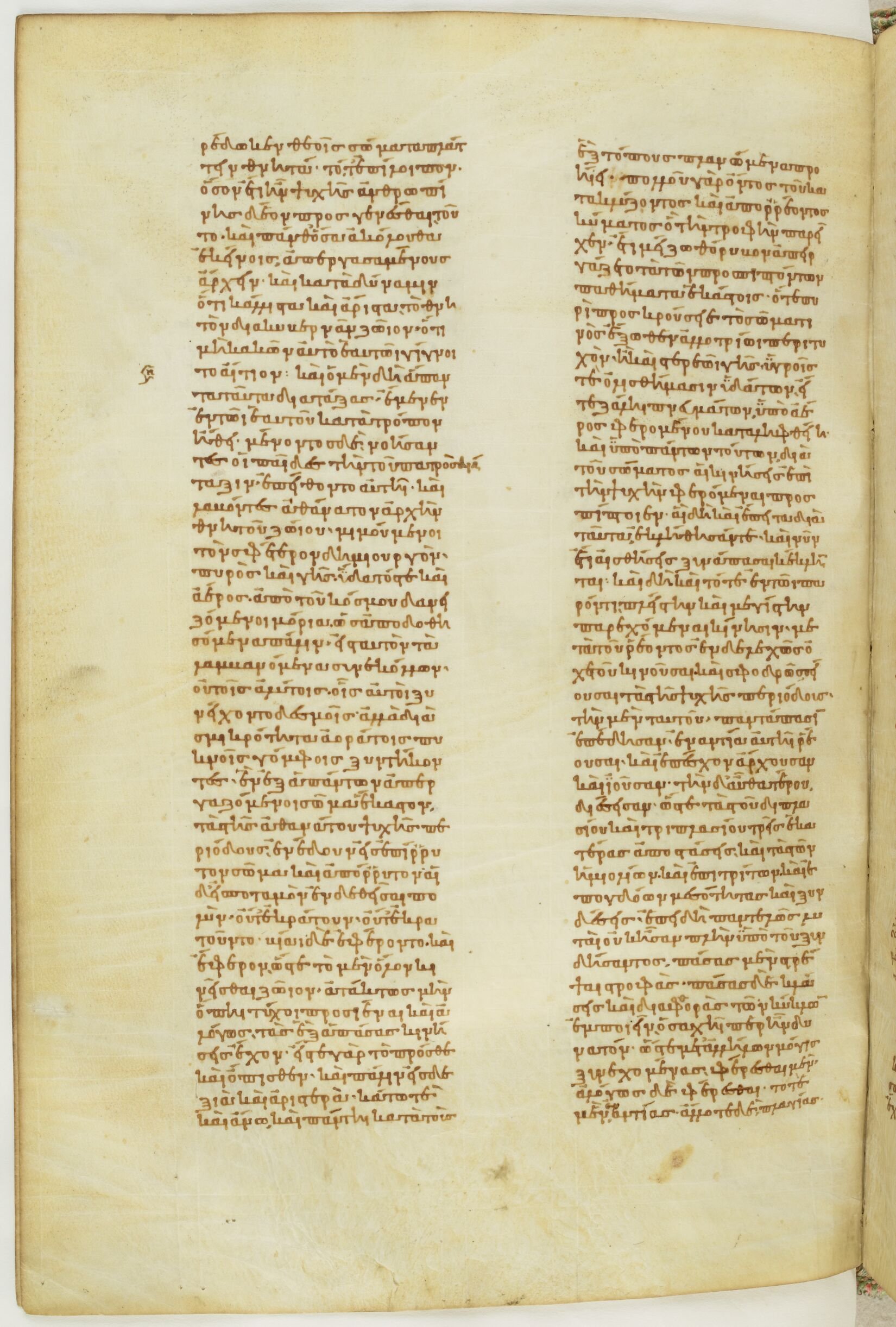
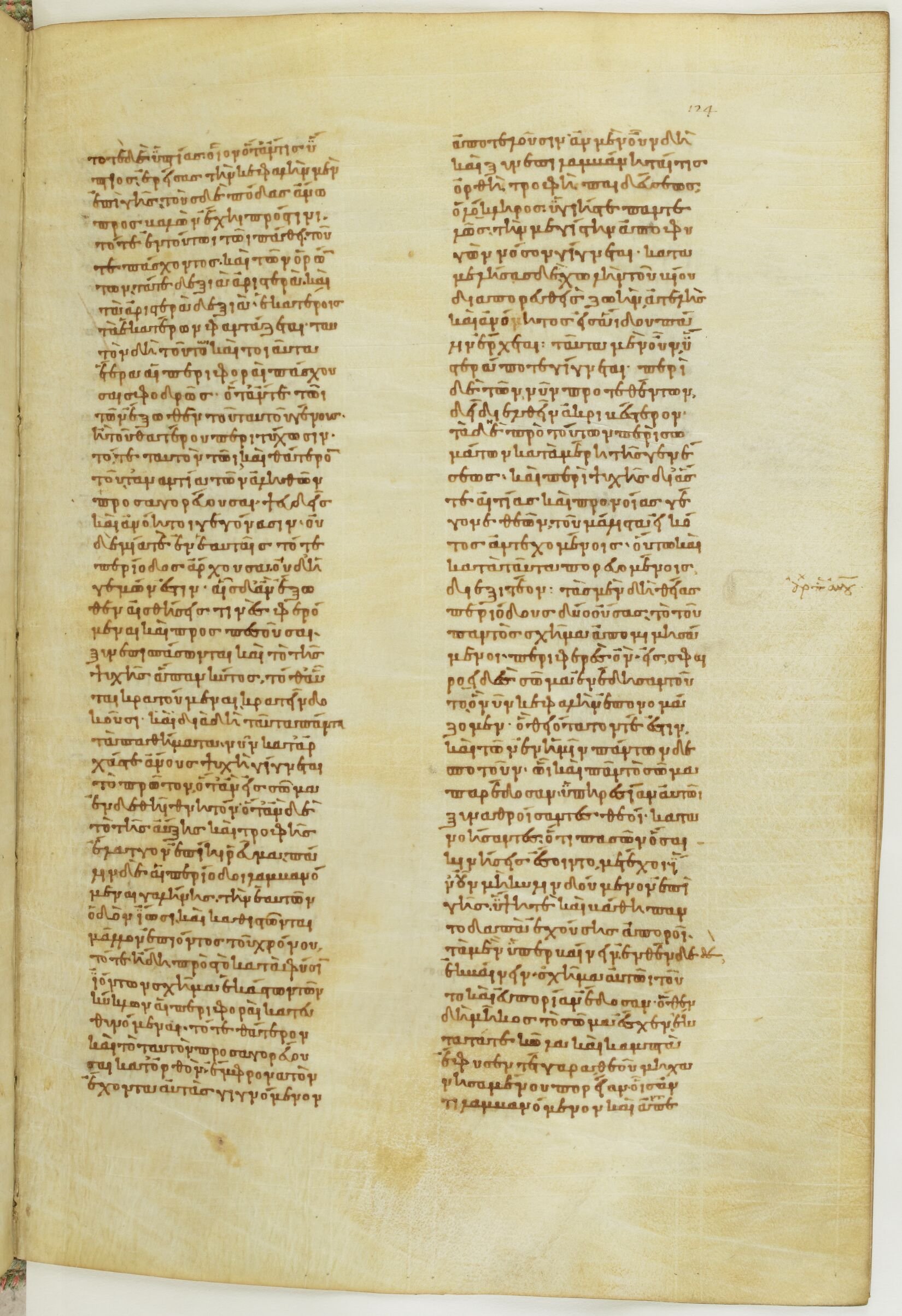
The manuscript is Paris, Bibliothèque nationale de France, grec 1807, known to editors as Plato A. It was copied in Constantinople around 850-875 by the scribe of the so-called philosophical collection, and is the oldest surviving medieval manuscript of the Timaeus and Critias (tetralogies VIII-IX: Clitophon, Republic, Timaeus, Critias, Minos, Laws, Epinomis, Letters). Each page has two columns of 44 lines. The Timaeus fills fol. 114r-144v and the Critias fol. 145r-151r.
On the manuscript this page of text runs over fol. 123v col. a to fol. 124r col. a. Each section below is linked to the folio side(s) that carry it. The mapping comes from reading the first words of every column on the images and finding them in Burnet's text: fol. 123v col. a begins ‹-ρέδωκεν θεοῖς σώματα πλάττειν θνητά, τό› (Tim. 42d); fol. 123v col. b begins ‹ἓξ τόπους πλανώμενα προῄειν. πολλοῦ γὰρ› (Tim. 43b); fol. 124r col. a begins ‹τοτὲ δὲ ὑπτίας· οἷον ὅταν τις› (Tim. 43e).
The Greek is John Burnet's critical text (Oxford, 1902), not a transcription of this manuscript; the scribe's spelling, accents and occasional readings differ from it. The English is R. G. Bury's Loeb translation (1929).
How was this verified? (Provenance)
Where on the image
Tim. 43a stands in Paris gr. 1807, fol. 123v col. a. Checked on the image (column openings read on the BnF photographs and found in Burnet's text, quoted in Burnet's spelling): fol. 123v col. a begins ‹-ρέδωκεν θεοῖς σώματα πλάττειν θνητά, τό› (Tim. 42d).
μόρια ὡς ἀποδοθησόμενα πάλιν, εἰς ταὐτὸν τὰ λαμβανόμενα συνεκόλλων, οὐ τοῖς ἀλύτοις οἷς αὐτοὶ συνείχοντο δεσμοῖς, ἀλλὰ διὰ σμικρότητα ἀοράτοις πυκνοῖς γόμφοις συντήκοντες, ἓν ἐξ ἁπάντων ἀπεργαζόμενοι σῶμα ἕκαστον, τὰς τῆς ἀθανάτου ψυχῆς περιόδους ἐνέδουν εἰς ἐπίρρυτον σῶμα καὶ ἀπόρρυτον. αἱ δʼ εἰς ποταμὸν ἐνδεθεῖσαι πολὺν οὔτʼ ἐκράτουν οὔτʼ ἐκρατοῦντο, βίᾳ δὲ ἐφέροντο καὶ ἔφερον, ὥστε τὸ
as if meaning to pay them back, and the portions so taken they cemented together; but it was not with those indissoluble bonds wherewith they themselves were joined that they fastened together the portions but with numerous pegs, invisible for smallness; and thus they constructed out of them all each several body, and within bodies subject to inflow and outflow they bound the revolutions of the immortal Soul. The souls, then, being thus bound within a mighty river neither mastered it nor were mastered, but with violence they rolled along and were rolled along themselves,
Where on the image
Tim. 43b stands in Paris gr. 1807, fol. 123v col. a to fol. 123v col. b. Checked on the image (column openings read on the BnF photographs and found in Burnet's text, quoted in Burnet's spelling): fol. 123v col. a begins ‹-ρέδωκεν θεοῖς σώματα πλάττειν θνητά, τό› (Tim. 42d); fol. 123v col. b begins ‹ἓξ τόπους πλανώμενα προῄειν. πολλοῦ γὰρ› (Tim. 43b).
μὲν ὅλον κινεῖσθαι ζῷον, ἀτάκτως μὴν ὅπῃ τύχοι προϊέναι καὶ ἀλόγως, τὰς ἓξ ἁπάσας κινήσεις ἔχον· εἴς τε γὰρ τὸ πρόσθε καὶ ὄπισθεν καὶ πάλιν εἰς δεξιὰ καὶ ἀριστερὰ κάτω τε καὶ ἄνω καὶ πάντῃ κατὰ τοὺς ἓξ τόπους πλανώμενα προῄειν. πολλοῦ γὰρ ὄντος τοῦ κατακλύζοντος καὶ ἀπορρέοντος κύματος ὃ τὴν τροφὴν παρεῖχεν, ἔτι μείζω θόρυβον ἀπηργάζετο τὰ τῶν προσπιπτόντων παθήματα ἑκάστοις, ὅτε
so that the whole of the living creature was moved, but in such a random way that its progress was disorderly and irrational, since it partook of all the six motions: for it progressed forwards and backwards, and again to right and to left, and upwards and downwards, wandering every way in all the six directions. For while the flood which foamed in and streamed out, as it supplied the food, was immense, still greater was the tumult produced
Where on the image
Tim. 43c stands in Paris gr. 1807, fol. 123v col. b. Checked on the image (column openings read on the BnF photographs and found in Burnet's text, quoted in Burnet's spelling): fol. 123v col. b begins ‹ἓξ τόπους πλανώμενα προῄειν. πολλοῦ γὰρ› (Tim. 43b).
πυρὶ προσκρούσειε τὸ σῶμά τινος ἔξωθεν ἀλλοτρίῳ περιτυχὸν ἢ καὶ στερεῷ γῆς πάγῳ ὑγροῖς τε ὀλισθήμασιν ὑδάτων, εἴτε ζάλῃ πνευμάτων ὑπὸ ἀέρος φερομένων καταληφθείη, καὶ ὑπὸ πάντων τούτων διὰ τοῦ σώματος αἱ κινήσεις ἐπὶ τὴν ψυχὴν φερόμεναι προσπίπτοιεν· αἳ δὴ καὶ ἔπειτα διὰ ταῦτα ἐκλήθησάν τε καὶ νῦν ἔτι αἰσθήσεις συνάπασαι κέκληνται. καὶ δὴ καὶ τότε ἐν τῷ παρόντι πλείστην καὶ μεγίστην παρεχόμεναι κίνησιν, μετὰ τοῦ ῥέοντος ἐνδελεχῶς
within each creature as a result of the colliding bodies, when the body of a creature happened to meet and collide with alien fire from without, or with a solid lump of earth or liquid glidings of waters, or when it was overtaken by a tempest of winds driven by air, and when the motions due to all these causes rushing through the body impinged upon the Soul. And for these reasons all such motions were then termed Sensations, and are still so termed today. Moreover, since at that time they were causing, for the moment, constant and widespread motion, joining with the perpetually flowing stream
Where on the image
Tim. 43d stands in Paris gr. 1807, fol. 123v col. b. Checked on the image (column openings read on the BnF photographs and found in Burnet's text, quoted in Burnet's spelling): fol. 123v col. b begins ‹ἓξ τόπους πλανώμενα προῄειν. πολλοῦ γὰρ› (Tim. 43b).
ὀχετοῦ κινοῦσαι καὶ σφοδρῶς σείουσαι τὰς τῆς ψυχῆς περιόδους, τὴν μὲν ταὐτοῦ παντάπασιν ἐπέδησαν ἐναντία αὐτῇ ῥέουσαι καὶ ἐπέσχον ἄρχουσαν καὶ ἰοῦσαν, τὴν δʼ αὖ θατέρου διέσεισαν, ὥστε τὰς τοῦ διπλασίου καὶ τριπλασίου τρεῖς ἑκατέρας ἀποστάσεις καὶ τὰς τῶν ἡμιολίων καὶ ἐπιτρίτων καὶ ἐπογδόων μεσότητας καὶ συνδέσεις, ἐπειδὴ παντελῶς λυταὶ οὐκ ἦσαν πλὴν ὑπὸ τοῦ συνδήσαντος, πάσας μὲν
in moving and violently shaking the revolutions of the Soul, they totally blocked the course of the Same by flowing contrary thereto, and hindered it thereby in its ruling and its going; while, on the other hand, they so shook up the course of the Other that in the three several intervals of the double and the triple, and in the mean terms and binding links of the 3/2, 4/3 and 9/8,—these being not wholly dissoluble save by Him who had bound them together,—they produced all manner of twistings, and caused
Where on the image
Tim. 43e stands in Paris gr. 1807, fol. 123v col. b to fol. 124r col. a. Checked on the image (column openings read on the BnF photographs and found in Burnet's text, quoted in Burnet's spelling): fol. 123v col. b begins ‹ἓξ τόπους πλανώμενα προῄειν. πολλοῦ γὰρ› (Tim. 43b); fol. 124r col. a begins ‹τοτὲ δὲ ὑπτίας· οἷον ὅταν τις› (Tim. 43e).
στρέψαι στροφάς, πάσας δὲ κλάσεις καὶ διαφθορὰς τῶν κύκλων ἐμποιεῖν, ὁσαχῇπερ ἦν δυνατόν, ὥστε μετʼ ἀλλήλων μόγις συνεχομένας φέρεσθαι μέν, ἀλόγως δὲ φέρεσθαι, τοτὲ μὲν ἀντίας, ἄλλοτε δὲ πλαγίας, τοτὲ δὲ ὑπτίας· οἷον ὅταν τις ὕπτιος ἐρείσας τὴν κεφαλὴν μὲν ἐπὶ γῆς, τοὺς δὲ πόδας ἄνω προσβαλὼν ἔχῃ πρός τινι, τότε ἐν τούτῳ τῷ πάθει τοῦ τε πάσχοντος καὶ τῶν ὁρώντων τά τε δεξιὰ ἀριστερὰ καὶ τὰ ἀριστερὰ δεξιὰ ἑκατέροις τὰ ἑκατέρων φαντάζεται.
ταὐτὸν δὴ τοῦτο καὶ τοιαῦτα ἕτερα αἱ περιφοραὶ πάσχουσαι σφοδρῶς,
in their circles fractures and disruptions of every possible kind, with the result that, as they barely held together one with another, they moved indeed but moved irrationally, being at one time reversed, at another oblique, and again upside down. Suppose, for example, that a man is in an upside down position, with his head resting on the earth and his feet touching something above, then, in this position of the man relative to that of the onlookers, his right will appear left to them, and his left right, and so will theirs to him.
This, and such like, are just what the revolutions of the Soul experience with intensity;
Notes
- Greek: John Burnet, Platonis Opera IV (Oxford, 1902), via Perseus canonical-greekLit; Burnet's text is a critical edition, so its wording can differ from the manuscript shown.
- English: R. G. Bury, Plato IX (Loeb Classical Library, 1929), via Perseus. Bury's footnotes are not reproduced. Quotation marks stand where Perseus marks quoted speech.
- Stephanus sections (a-e) are those of the 1578 Stephanus edition as given by Burnet and Bury; Bury's section breaks can fall a few words away from Burnet's because English word order differs.
Cite
Sources
- Source: Paris, BnF grec 1807 (Plato A, c. 850-875) fol. 123v-124r via BnF IIIF + Burnet's Greek (Perseus) + R. G. Bury's English (Loeb 1929, Perseus) (holding institution)
- Critical edition: Burnet, Platonis Opera IV (1902), via Perseus
← previous · → next · v cycle view · l back to library