Plato, Timaeus 44a-44e: how the soul regains its reason; the head and the body
Introduction
Stephanus page 44 of Plato's Timaeus (44a-44e): how the soul regains its reason; the head and the body.
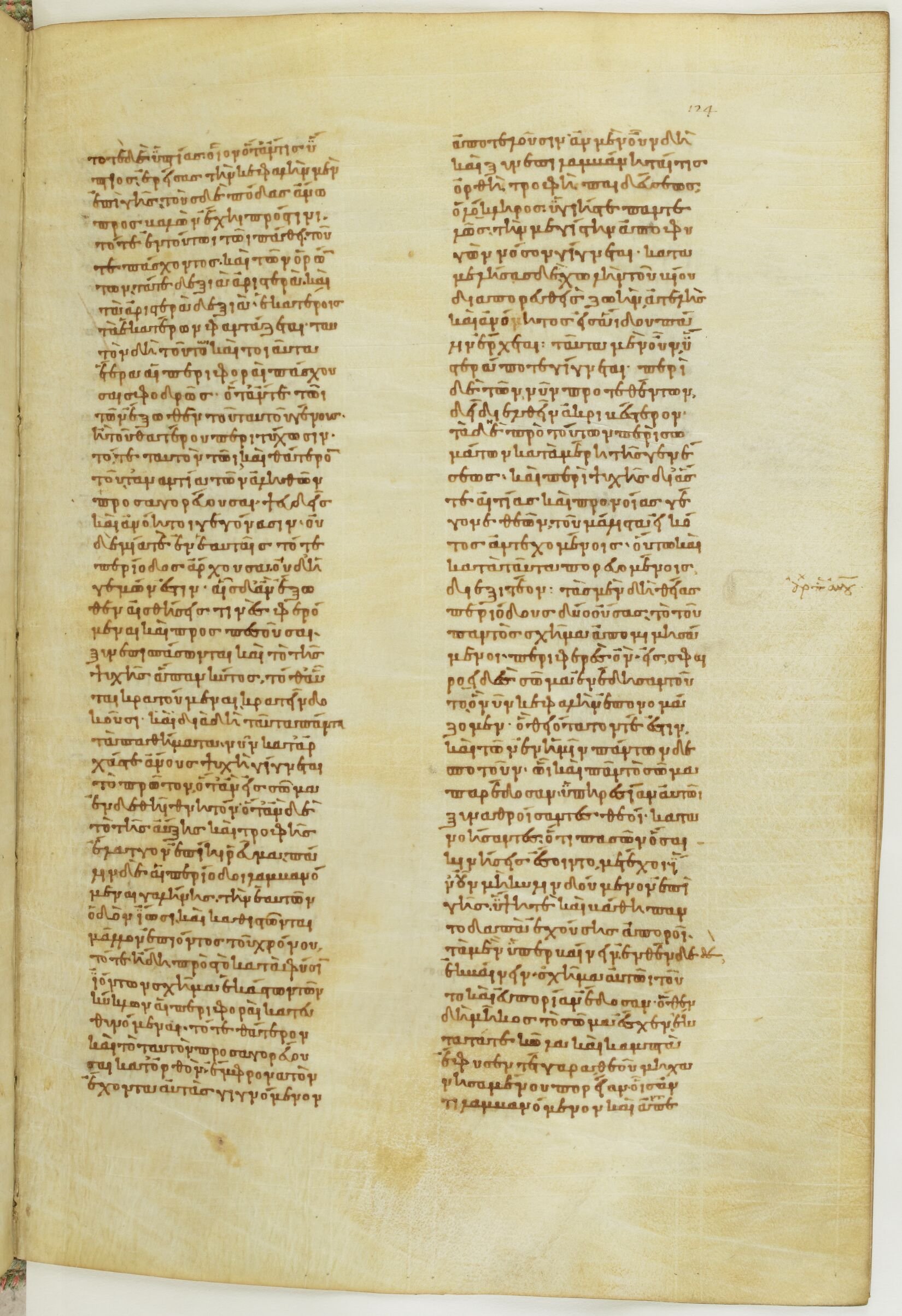
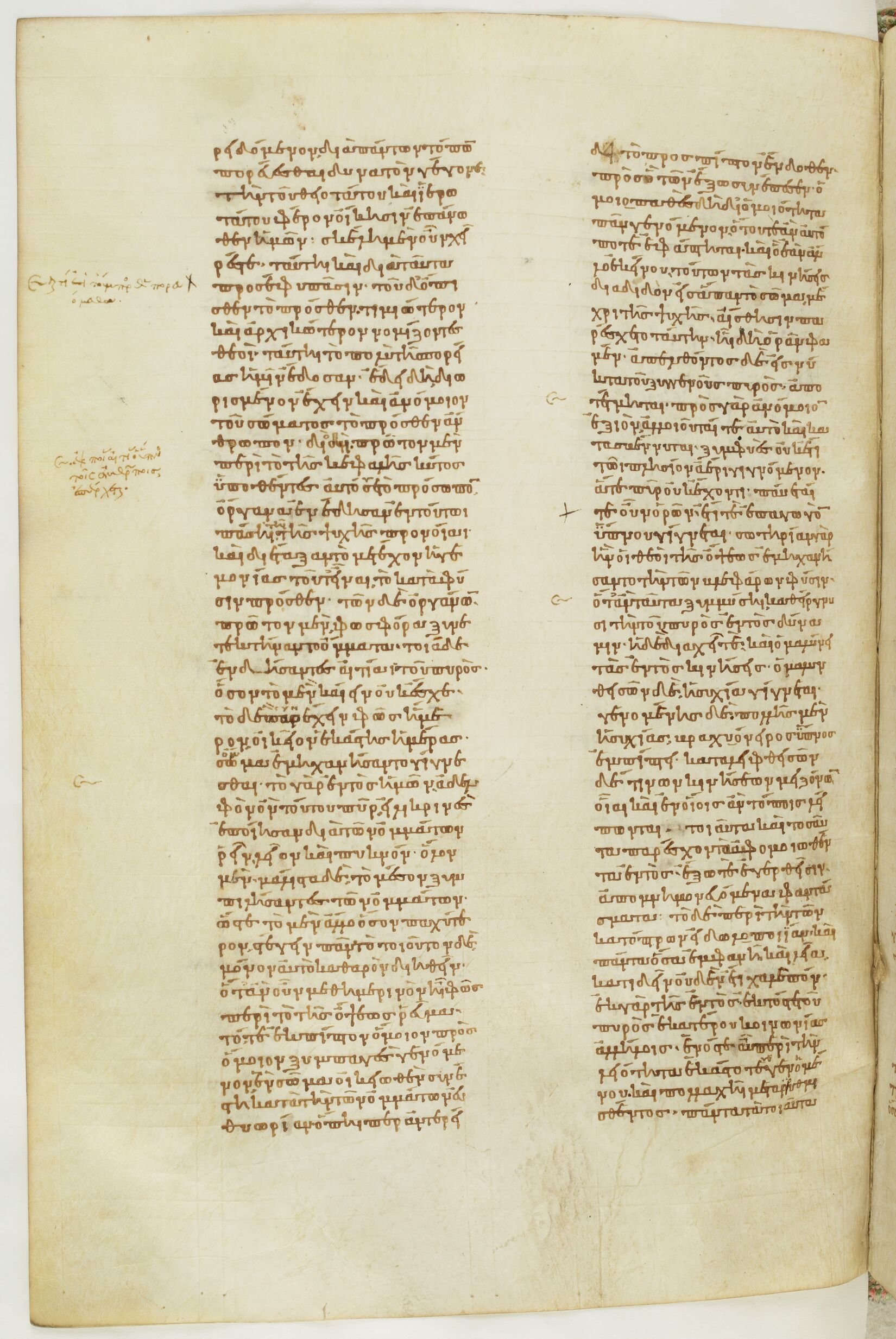
The manuscript is Paris, Bibliothèque nationale de France, grec 1807, known to editors as Plato A. It was copied in Constantinople around 850-875 by the scribe of the so-called philosophical collection, and is the oldest surviving medieval manuscript of the Timaeus and Critias (tetralogies VIII-IX: Clitophon, Republic, Timaeus, Critias, Minos, Laws, Epinomis, Letters). Each page has two columns of 44 lines. The Timaeus fills fol. 114r-144v and the Critias fol. 145r-151r.
On the manuscript this page of text runs over fol. 124r col. a to fol. 124v col. a. Each section below is linked to the folio side(s) that carry it. The mapping comes from reading the first words of every column on the images and finding them in Burnet's text: fol. 124r col. a begins ‹τοτὲ δὲ ὑπτίας· οἷον ὅταν τις› (Tim. 43e); fol. 124r col. b begins ‹ἀποτελοῦσιν. ἂν μὲν οὖν δὴ καὶ› (Tim. 44b); fol. 124v col. a begins ‹-ρειδόμενον διὰ πάντων τόπων πορεύεσθαι δυνατὸν› (Tim. 44e).
The Greek is John Burnet's critical text (Oxford, 1902), not a transcription of this manuscript; the scribe's spelling, accents and occasional readings differ from it. The English is R. G. Bury's Loeb translation (1929).
How was this verified? (Provenance)
Where on the image
Tim. 44a stands in Paris gr. 1807, fol. 124r col. a. Checked on the image (column openings read on the BnF photographs and found in Burnet's text, quoted in Burnet's spelling): fol. 124r col. a begins ‹τοτὲ δὲ ὑπτίας· οἷον ὅταν τις› (Tim. 43e).
ὅταν τέ τῳ τῶν ἔξωθεν τοῦ ταὐτοῦ γένους ἢ τοῦ θατέρου περιτύχωσιν, τότε ταὐτόν τῳ καὶ θάτερόν του τἀναντία τῶν ἀληθῶν προσαγορεύουσαι ψευδεῖς καὶ ἀνόητοι γεγόνασιν, οὐδεμία τε ἐν αὐταῖς τότε περίοδος ἄρχουσα οὐδʼ ἡγεμών ἐστιν· αἷς δʼ ἂν ἔξωθεν αἰσθήσεις τινὲς φερόμεναι καὶ προσπεσοῦσαι συνεπισπάσωνται καὶ τὸ τῆς ψυχῆς ἅπαν κύτος, τόθʼ αὗται κρατούμεναι κρατεῖν δοκοῦσι. καὶ διὰ δὴ ταῦτα πάντα τὰ παθήματα νῦν κατʼ ἀρχάς τε ἄνους ψυχὴ γίγνεται
and every time they happen upon any external object, whether it be of the class of the Same or of the Other, they proclaim it to be the same as something or other than something contrary to the truth, and thereby prove themselves false and foolish, and devoid, at such times, of any revolution that rules and guides. And whenever external sensations in their movement collide with these revolutions and sweep along with them also the whole vessel of the Soul, then the revolutions, though actually mastered, appear to have the mastery. Hence it comes about that, because of all these affections, now as in the beginning,
Where on the image
Tim. 44b stands in Paris gr. 1807, fol. 124r col. a to fol. 124r col. b. Checked on the image (column openings read on the BnF photographs and found in Burnet's text, quoted in Burnet's spelling): fol. 124r col. a begins ‹τοτὲ δὲ ὑπτίας· οἷον ὅταν τις› (Tim. 43e); fol. 124r col. b begins ‹ἀποτελοῦσιν. ἂν μὲν οὖν δὴ καὶ› (Tim. 44b).
τὸ πρῶτον, ὅταν εἰς σῶμα ἐνδεθῇ θνητόν. ὅταν δὲ τὸ τῆς αὔξης καὶ τροφῆς ἔλαττον ἐπίῃ ῥεῦμα, πάλιν δὲ αἱ περίοδοι λαμβανόμεναι γαλήνης τὴν ἑαυτῶν ὁδὸν ἴωσι καὶ καθιστῶνται μᾶλλον ἐπιόντος τοῦ χρόνου, τότε ἤδη πρὸς τὸ κατὰ φύσιν ἰόντων σχῆμα ἑκάστων τῶν κύκλων αἱ περιφοραὶ κατευθυνόμεναι, τό τε θάτερον καὶ τὸ ταὐτὸν προσαγορεύουσαι κατʼ ὀρθόν, ἔμφρονα τὸν ἔχοντα αὐτὰς γιγνόμενον ἀποτελοῦσιν. ἂν μὲν οὖν δὴ καὶ συνεπιλαμβάνηταί τις ὀρθὴ τροφὴ παιδεύσεως,
so often as the Soul is bound within a mortal body it becomes at the first irrational. But as soon as the stream of increase and nutriment enters in less volume, and the revolutions calm down and pursue their own path, becoming more stable as time proceeds, then at length, as the several circles move each according to its natural track, their revolutions are straightened out and they announce the Same and the Other aright, and thereby they render their possessor intelligent. And if so be
Where on the image
Tim. 44c stands in Paris gr. 1807, fol. 124r col. b. Checked on the image (column openings read on the BnF photographs and found in Burnet's text, quoted in Burnet's spelling): fol. 124r col. b begins ‹ἀποτελοῦσιν. ἂν μὲν οὖν δὴ καὶ› (Tim. 44b).
ὁλόκληρος ὑγιής τε παντελῶς, τὴν μεγίστην ἀποφυγὼν νόσον, γίγνεται· καταμελήσας δέ, χωλὴν τοῦ βίου διαπορευθεὶς ζωήν, ἀτελὴς καὶ ἀνόητος εἰς Ἅιδου πάλιν ἔρχεται. ταῦτα μὲν οὖν ὕστερά ποτε γίγνεται· περὶ δὲ τῶν νῦν προτεθέντων δεῖ διελθεῖν ἀκριβέστερον, τὰ δὲ πρὸ τούτων, περὶ σωμάτων κατὰ μέρη τῆς γενέσεως καὶ περὶ ψυχῆς, διʼ ἅς τε αἰτίας καὶ προνοίας γέγονε θεῶν, τοῦ μάλιστα
that this state of his soul be reinforced by right educational training, the man becomes wholly sound and faultless, having escaped the worst of maladies; but if he has been wholly negligent therein, after passing a lame existence in life he returns again unperfected and unreasoning to Hades. These results, however, come about at a later time. Regarding the subjects now before us, we must give a more exact exposition; and also regarding the subjects anterior to these, namely, the generation of bodies in their several parts, and the causes and divine counsels whereby the Soul has come into existence, we must hold fast to the most probable account,
Where on the image
Tim. 44d stands in Paris gr. 1807, fol. 124r col. b. Checked on the image (column openings read on the BnF photographs and found in Burnet's text, quoted in Burnet's spelling): fol. 124r col. b begins ‹ἀποτελοῦσιν. ἂν μὲν οὖν δὴ καὶ› (Tim. 44b).
εἰκότος ἀντεχομένοις, οὕτω καὶ κατὰ ταῦτα πορευομένοις διεξιτέον. τὰς μὲν δὴ θείας περιόδους δύο οὔσας, τὸ τοῦ παντὸς σχῆμα ἀπομιμησάμενοι περιφερὲς ὄν, εἰς σφαιροειδὲς σῶμα ἐνέδησαν, τοῦτο ὃ νῦν κεφαλὴν ἐπονομάζομεν, ὃ θειότατόν τέ ἐστιν καὶ τῶν ἐν ἡμῖν πάντων δεσποτοῦν· ᾧ καὶ πᾶν τὸ σῶμα παρέδοσαν ὑπηρεσίαν αὐτῷ συναθροίσαντες θεοί, κατανοήσαντες ὅτι πασῶν ὅσαι κινήσεις ἔσοιντο μετέχοι. ἵνʼ οὖν μὴ κυλινδούμενον ἐπὶ γῆς ὕψη τε καὶ βάθη παντοδαπὰ
and proceed accordingly, in the exposition now to be given. The divine revolutions, which are two, they bound within a sphere-shaped body, in imitation of the spherical form of the All, which body we now call the head, it being the most divine part and reigning over all the parts within us. To it the gods delivered over the whole of the body they had assembled to be its servant, having formed the notion that it should partake in all the motions which were to be.
Where on the image
Tim. 44e stands in Paris gr. 1807, fol. 124r col. b to fol. 124v col. a. Checked on the image (column openings read on the BnF photographs and found in Burnet's text, quoted in Burnet's spelling): fol. 124r col. b begins ‹ἀποτελοῦσιν. ἂν μὲν οὖν δὴ καὶ› (Tim. 44b); fol. 124v col. a begins ‹-ρειδόμενον διὰ πάντων τόπων πορεύεσθαι δυνατὸν› (Tim. 44e).
ἐχούσης ἀποροῖ τὰ μὲν ὑπερβαίνειν, ἔνθεν δὲ ἐκβαίνειν, ὄχημα αὐτῷ τοῦτο καὶ εὐπορίαν ἔδοσαν·
ὅθεν δὴ μῆκος τὸ σῶμα ἔσχεν, ἐκτατά τε κῶλα καὶ καμπτὰ ἔφυσεν τέτταρα θεοῦ μηχανησαμένου πορείαν, οἷς ἀντιλαμβανόμενον καὶ ἀπερειδόμενον διὰ πάντων τόπων πορεύεσθαι δυνατὸν γέγονε,
In order, then, that it should not go rolling upon the earth, which has all manner of heights and hollows, and be at a loss how to climb over the one and climb out of the other, they bestowed upon it the body as a vehicle and means of transport.
And for this reason the body acquired length, and, by God’s contriving, shot forth four limbs, extensible and flexible,
Notes
- Greek: John Burnet, Platonis Opera IV (Oxford, 1902), via Perseus canonical-greekLit; Burnet's text is a critical edition, so its wording can differ from the manuscript shown.
- English: R. G. Bury, Plato IX (Loeb Classical Library, 1929), via Perseus. Bury's footnotes are not reproduced. Quotation marks stand where Perseus marks quoted speech.
- Stephanus sections (a-e) are those of the 1578 Stephanus edition as given by Burnet and Bury; Bury's section breaks can fall a few words away from Burnet's because English word order differs.
Cite
Sources
- Source: Paris, BnF grec 1807 (Plato A, c. 850-875) fol. 124r-124v via BnF IIIF + Burnet's Greek (Perseus) + R. G. Bury's English (Loeb 1929, Perseus) (holding institution)
- Critical edition: Burnet, Platonis Opera IV (1902), via Perseus
← previous · → next · v cycle view · l back to library