Plato, Timaeus 45a-45e: limbs, face and eyes; how vision works
Introduction
Stephanus page 45 of Plato's Timaeus (45a-45e): limbs, face and eyes; how vision works.
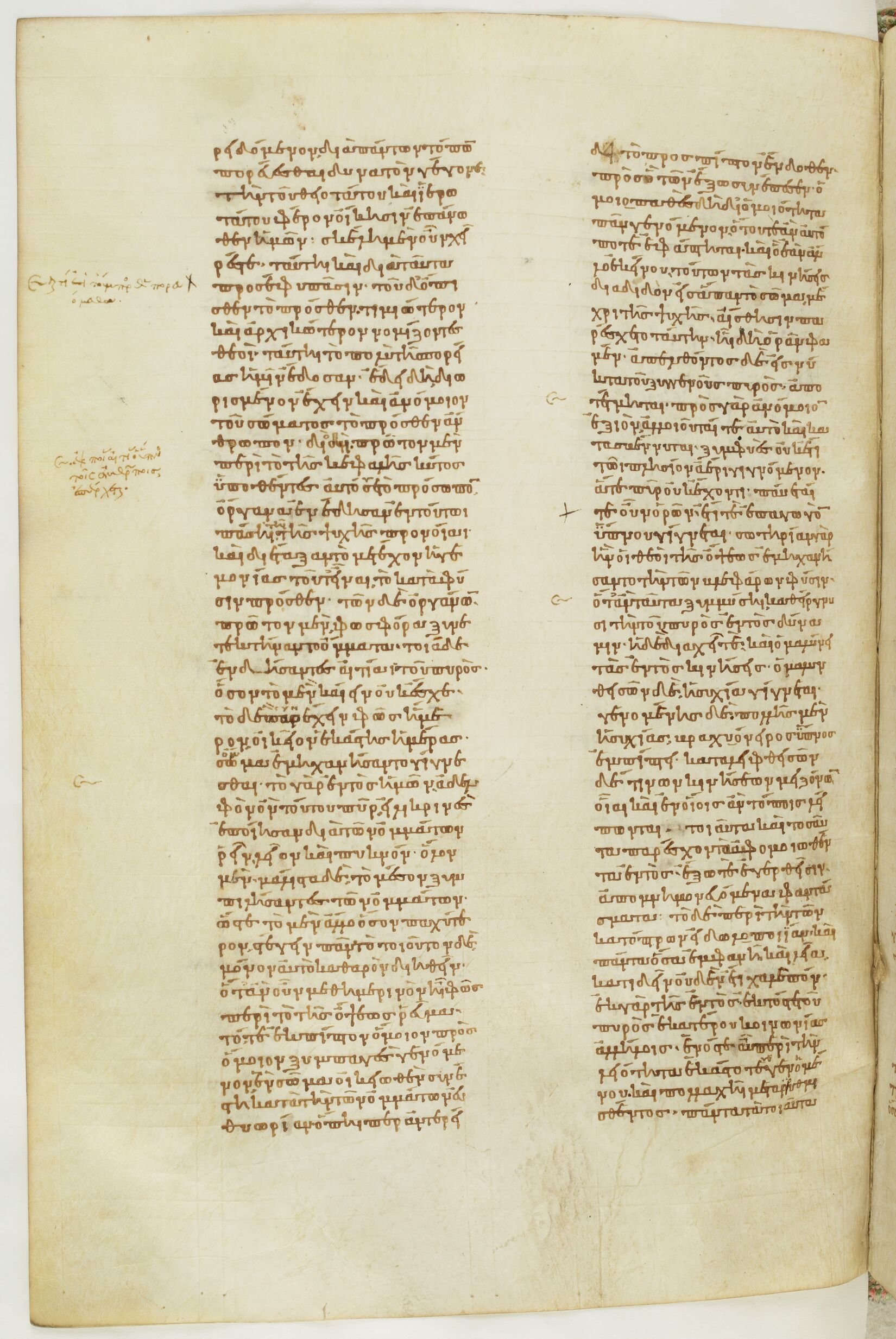
The manuscript is Paris, Bibliothèque nationale de France, grec 1807, known to editors as Plato A. It was copied in Constantinople around 850-875 by the scribe of the so-called philosophical collection, and is the oldest surviving medieval manuscript of the Timaeus and Critias (tetralogies VIII-IX: Clitophon, Republic, Timaeus, Critias, Minos, Laws, Epinomis, Letters). Each page has two columns of 44 lines. The Timaeus fills fol. 114r-144v and the Critias fol. 145r-151r.
On the manuscript this page of text runs over fol. 124v col. a to fol. 124v col. b. Each section below is linked to the folio side(s) that carry it. The mapping comes from reading the first words of every column on the images and finding them in Burnet's text: fol. 124v col. a begins ‹-ρειδόμενον διὰ πάντων τόπων πορεύεσθαι δυνατὸν› (Tim. 44e); fol. 124v col. b begins ‹-δῃ τὸ προσπῖπτον ἔνδοθεν πρὸς ὃ› (Tim. 45c).
The Greek is John Burnet's critical text (Oxford, 1902), not a transcription of this manuscript; the scribe's spelling, accents and occasional readings differ from it. The English is R. G. Bury's Loeb translation (1929).
How was this verified? (Provenance)
Where on the image
Tim. 45a stands in Paris gr. 1807, fol. 124v col. a. Checked on the image (column openings read on the BnF photographs and found in Burnet's text, quoted in Burnet's spelling): fol. 124v col. a begins ‹-ρειδόμενον διὰ πάντων τόπων πορεύεσθαι δυνατὸν› (Tim. 44e).
τὴν τοῦ θειοτάτου καὶ ἱερωτάτου φέρον οἴκησιν ἐπάνωθεν ἡμῶν. σκέλη μὲν οὖν χεῖρές τε ταύτῃ καὶ διὰ ταῦτα προσέφυ πᾶσιν· τοῦ δʼ ὄπισθεν τὸ πρόσθεν τιμιώτερον καὶ ἀρχικώτερον νομίζοντες θεοὶ ταύτῃ τὸ πολὺ τῆς πορείας ἡμῖν ἔδοσαν. ἔδει δὴ διωρισμένον ἔχειν καὶ ἀνόμοιον τοῦ σώματος τὸ πρόσθεν ἄνθρωπον. διὸ πρῶτον μὲν περὶ τὸ τῆς κεφαλῆς κύτος, ὑποθέντες αὐτόσε τὸ πρόσωπον, ὄργανα ἐνέδησαν
to serve as instruments of transport, so that grasping with these and’ supported thereon it was enabled to travel through all places, bearing aloft the chamber of our most divine and holy part. In this wise and for these reasons were legs and hands attached to all men; and inasmuch as they demand the forepart superior to the hinder part in honor and dignity, the Gods gave us the most part of our going in this direction. Thus it was necessary that man should have the forepart of his body distinct and dissimilar. Wherefore, dealing first with the vessel of the head, they set the face in the front thereof
Where on the image
Tim. 45b stands in Paris gr. 1807, fol. 124v col. a. Checked on the image (column openings read on the BnF photographs and found in Burnet's text, quoted in Burnet's spelling): fol. 124v col. a begins ‹-ρειδόμενον διὰ πάντων τόπων πορεύεσθαι δυνατὸν› (Tim. 44e).
τούτῳ πάσῃ τῇ τῆς ψυχῆς προνοίᾳ, καὶ διέταξαν τὸ μετέχον ἡγεμονίας τοῦτʼ εἶναι, τὸ κατὰ φύσιν πρόσθεν· τῶν δὲ ὀργάνων πρῶτον μὲν φωσφόρα συνετεκτήναντο ὄμματα, τοιᾷδε ἐνδήσαντες αἰτίᾳ. τοῦ πυρὸς ὅσον τὸ μὲν κάειν οὐκ ἔσχε, τὸ δὲ παρέχειν φῶς ἥμερον, οἰκεῖον ἑκάστης ἡμέρας, σῶμα ἐμηχανήσαντο γίγνεσθαι. τὸ γὰρ ἐντὸς ἡμῶν ἀδελφὸν ὂν τούτου πῦρ εἰλικρινὲς ἐποίησαν διὰ τῶν ὀμμάτων ῥεῖν λεῖον καὶ πυκνὸν ὅλον μέν, μάλιστα δὲ τὸ μέσον συμπιλήσαντες
and bound within it organs for all the forethought of the Soul; and they ordained that this, which is the natural front, should be the leading part. And of the organs they constructed first light-bearing eyes, and these they fixed in the face for the reason following. They contrived that all such fire as had the property not of burning but of giving a mild light should form a body akin to the light of every day. For they caused the pure fire within us, which is akin to that of day, to flow through the eyes in a smooth and dense stream;
Where on the image
Tim. 45c stands in Paris gr. 1807, fol. 124v col. a to fol. 124v col. b. Checked on the image (column openings read on the BnF photographs and found in Burnet's text, quoted in Burnet's spelling): fol. 124v col. a begins ‹-ρειδόμενον διὰ πάντων τόπων πορεύεσθαι δυνατὸν› (Tim. 44e); fol. 124v col. b begins ‹-δῃ τὸ προσπῖπτον ἔνδοθεν πρὸς ὃ› (Tim. 45c).
τῶν ὀμμάτων, ὥστε τὸ μὲν ἄλλο ὅσον παχύτερον στέγειν πᾶν, τὸ τοιοῦτον δὲ μόνον αὐτὸ καθαρὸν διηθεῖν. ὅταν οὖν μεθημερινὸν ᾖ φῶς περὶ τὸ τῆς ὄψεως ῥεῦμα, τότε ἐκπῖπτον ὅμοιον πρὸς ὅμοιον, συμπαγὲς γενόμενον, ἓν σῶμα οἰκειωθὲν συνέστη κατὰ τὴν τῶν ὀμμάτων εὐθυωρίαν, ὅπῃπερ ἂν ἀντερείδῃ τὸ προσπῖπτον ἔνδοθεν πρὸς ὃ τῶν ἔξω συνέπεσεν. ὁμοιοπαθὲς δὴ διʼ ὁμοιότητα πᾶν γενόμενον, ὅτου τε ἂν αὐτό
and they compressed the whole substance, and especially the center, of the eyes, so that they occluded all other fire that was coarser and allowed only this pure kind of fire to filter through. So whenever the stream of vision is surrounded by midday light, it flows out like unto like, and coalescing therewith it forms one kindred substance along the path of the eyes’ vision, wheresoever the fire which streams from within collides with an obstructing object without. And this substance, having all become similar in its properties because of its similar nature,
Where on the image
Tim. 45d stands in Paris gr. 1807, fol. 124v col. b. Checked on the image (column openings read on the BnF photographs and found in Burnet's text, quoted in Burnet's spelling): fol. 124v col. b begins ‹-δῃ τὸ προσπῖπτον ἔνδοθεν πρὸς ὃ› (Tim. 45c).
ποτε ἐφάπτηται καὶ ὃ ἂν ἄλλο ἐκείνου, τούτων τὰς κινήσεις διαδιδὸν εἰς ἅπαν τὸ σῶμα μέχρι τῆς ψυχῆς αἴσθησιν παρέσχετο ταύτην ᾗ δὴ ὁρᾶν φαμεν. ἀπελθόντος δὲ εἰς νύκτα τοῦ συγγενοῦς πυρὸς ἀποτέτμηται· πρὸς γὰρ ἀνόμοιον ἐξιὸν ἀλλοιοῦταί τε αὐτὸ καὶ κατασβέννυται, συμφυὲς οὐκέτι τῷ πλησίον ἀέρι γιγνόμενον, ἅτε πῦρ οὐκ ἔχοντι. παύεταί τε οὖν ὁρῶν, ἔτι τε ἐπαγωγὸν ὕπνου γίγνεται· σωτηρίαν γὰρ ἣν οἱ θεοὶ τῆς ὄψεως ἐμηχανήσαντο, τὴν τῶν βλεφάρων
distributes the motions of every object it touches, or whereby it is touched, throughout all the body even unto the Soul, and brings about that sensation which we now term seeing. But when the kindred fire vanishes into night, the inner fire is cut off; for when it issues forth into what is dissimilar it becomes altered in itself and is quenched, seeing that it is no longer of like nature with the adjoining air, since that air is devoid of fire. Wherefore it leaves off seeing, and becomes also an inducement to sleep. For the eyelids —whose structure the Gods devised
Where on the image
Tim. 45e stands in Paris gr. 1807, fol. 124v col. b. Checked on the image (column openings read on the BnF photographs and found in Burnet's text, quoted in Burnet's spelling): fol. 124v col. b begins ‹-δῃ τὸ προσπῖπτον ἔνδοθεν πρὸς ὃ› (Tim. 45c).
φύσιν, ὅταν ταῦτα συμμύσῃ, καθείργνυσι τὴν τοῦ πυρὸς ἐντὸς δύναμιν, ἡ δὲ διαχεῖ τε καὶ ὁμαλύνει τὰς ἐντὸς κινήσεις, ὁμαλυνθεισῶν δὲ ἡσυχία γίγνεται, γενομένης δὲ πολλῆς μὲν ἡσυχίας βραχυόνειρος ὕπνος ἐμπίπτει,
καταλειφθεισῶν δέ τινων κινήσεων μειζόνων, οἷαι καὶ ἐν οἵοις ἂν τόποις λείπωνται,
as a safeguard for the vision,—when they are shut close, curb the power of the inner fire; which power dissipates and allays the inward motions, and upon their allaying quiet ensues; and when this quiet has become intense there falls upon us a sleep that is well-nigh dreamless;
but when some greater motions are still left behind, according to their nature and the positions they occupy
Notes
- Greek: John Burnet, Platonis Opera IV (Oxford, 1902), via Perseus canonical-greekLit; Burnet's text is a critical edition, so its wording can differ from the manuscript shown.
- English: R. G. Bury, Plato IX (Loeb Classical Library, 1929), via Perseus. Bury's footnotes are not reproduced. Quotation marks stand where Perseus marks quoted speech.
- Stephanus sections (a-e) are those of the 1578 Stephanus edition as given by Burnet and Bury; Bury's section breaks can fall a few words away from Burnet's because English word order differs.
Cite
Sources
- Source: Paris, BnF grec 1807 (Plato A, c. 850-875) fol. 124v via BnF IIIF + Burnet's Greek (Perseus) + R. G. Bury's English (Loeb 1929, Perseus) (holding institution)
- Critical edition: Burnet, Platonis Opera IV (1902), via Perseus
← previous · → next · v cycle view · l back to library