Plato, Timaeus 46a-46e: dreams and mirrors; auxiliary causes
Introduction
Stephanus page 46 of Plato's Timaeus (46a-46e): dreams and mirrors; auxiliary causes.
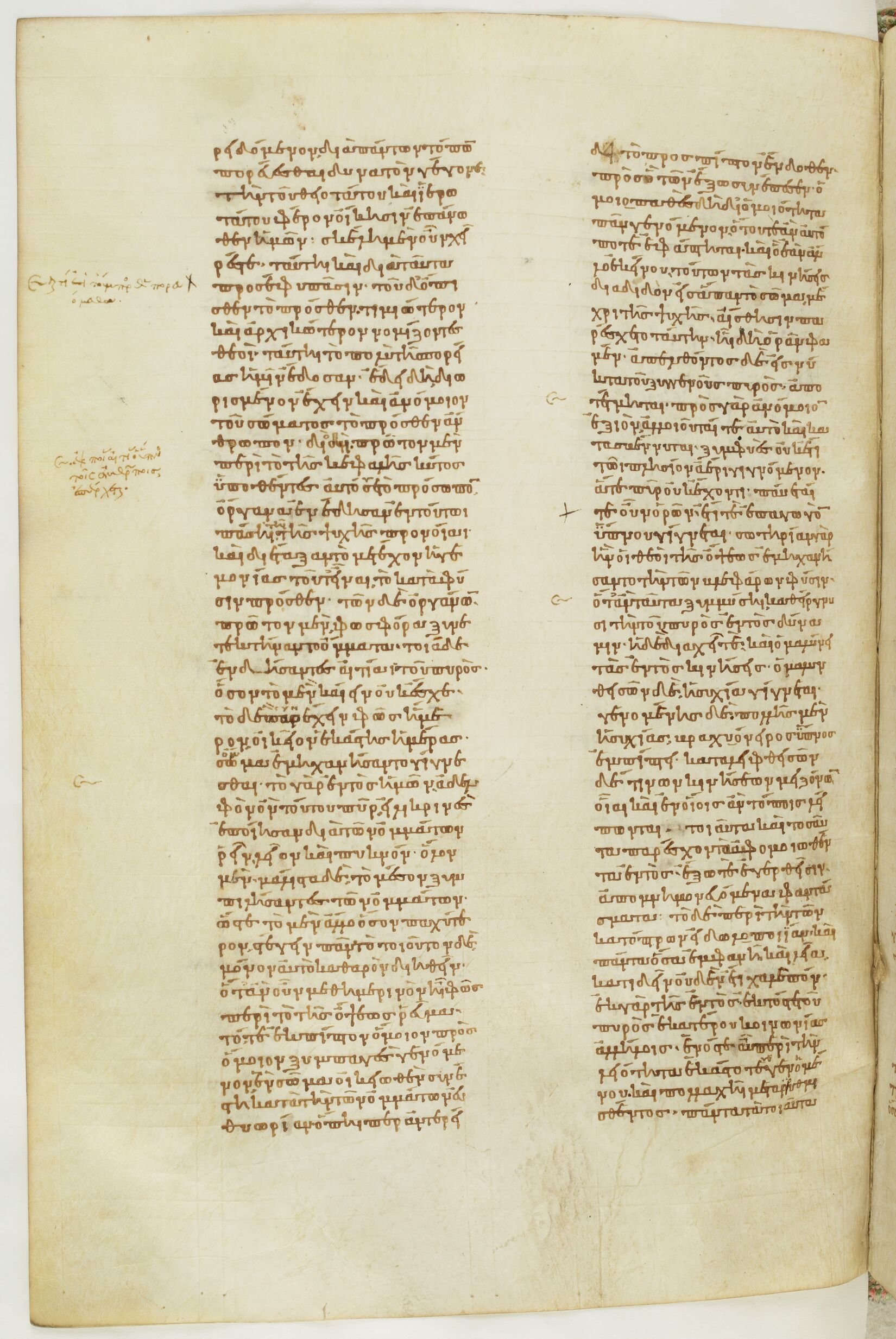
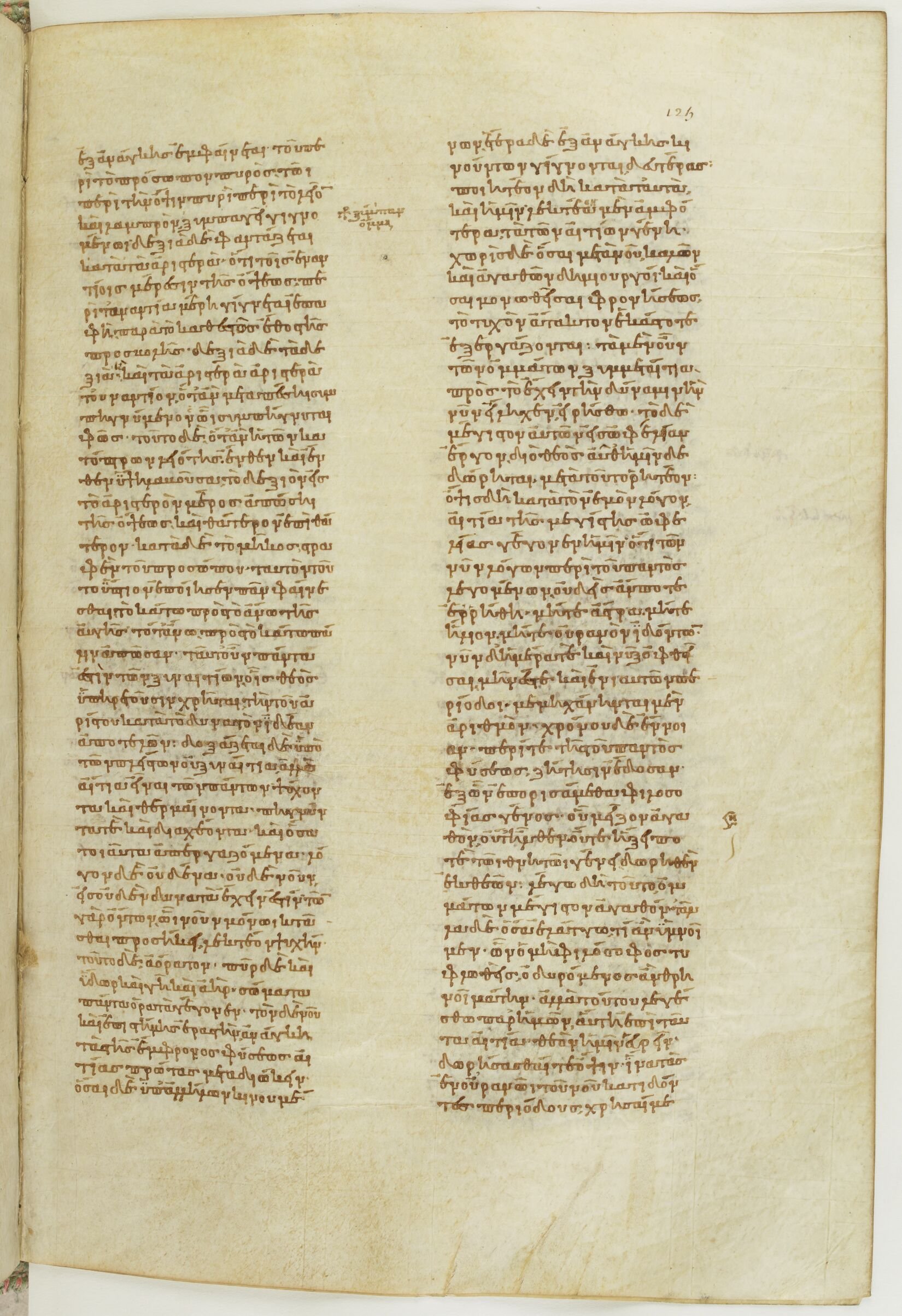
The manuscript is Paris, Bibliothèque nationale de France, grec 1807, known to editors as Plato A. It was copied in Constantinople around 850-875 by the scribe of the so-called philosophical collection, and is the oldest surviving medieval manuscript of the Timaeus and Critias (tetralogies VIII-IX: Clitophon, Republic, Timaeus, Critias, Minos, Laws, Epinomis, Letters). Each page has two columns of 44 lines. The Timaeus fills fol. 114r-144v and the Critias fol. 145r-151r.
On the manuscript this page of text runs over fol. 124v col. b to fol. 125r col. b. Each section below is linked to the folio side(s) that carry it. The mapping comes from reading the first words of every column on the images and finding them in Burnet's text: fol. 124v col. b begins ‹-δῃ τὸ προσπῖπτον ἔνδοθεν πρὸς ὃ› (Tim. 45c); fol. 125r col. a begins ‹ἐξ ἀνάγκης ἐμφαίνεται, τοῦ περὶ τὸ› (Tim. 46b); fol. 125r col. b begins ‹-νων, ἕτερα δὲ κατὰ ἀνάγκης κινούντων› (Tim. 46e).
The Greek is John Burnet's critical text (Oxford, 1902), not a transcription of this manuscript; the scribe's spelling, accents and occasional readings differ from it. The English is R. G. Bury's Loeb translation (1929).
How was this verified? (Provenance)
Where on the image
Tim. 46a stands in Paris gr. 1807, fol. 124v col. b. Checked on the image (column openings read on the BnF photographs and found in Burnet's text, quoted in Burnet's spelling): fol. 124v col. b begins ‹-δῃ τὸ προσπῖπτον ἔνδοθεν πρὸς ὃ› (Tim. 45c).
τοιαῦτα καὶ τοσαῦτα παρέσχοντο ἀφομοιωθέντα ἐντὸς ἔξω τε ἐγερθεῖσιν ἀπομνημονευόμενα φαντάσματα. τὸ δὲ περὶ τὴν τῶν κατόπτρων εἰδωλοποιίαν καὶ πάντα ὅσα ἐμφανῆ καὶ λεῖα, κατιδεῖν οὐδὲν ἔτι χαλεπόν. ἐκ γὰρ τῆς ἐντὸς ἐκτός τε τοῦ πυρὸς ἑκατέρου κοινωνίας ἀλλήλοις, ἑνός τε αὖ περὶ τὴν λειότητα ἑκάστοτε γενομένου καὶ πολλαχῇ μεταρρυθμισθέντος,
such and so great are the images they produce, which images are copied within and are remembered by the sleepers when they awake out of the dream. And it is no longer difficult to perceive the truth about the formation of images in mirrors and in bright and smooth surfaces of every kind. It is from the combination with each other of the inner and the outer fires, every time that they unite on the smooth surface and are variously deflected,
Where on the image
Tim. 46b stands in Paris gr. 1807, fol. 124v col. b to fol. 125r col. a. Checked on the image (column openings read on the BnF photographs and found in Burnet's text, quoted in Burnet's spelling): fol. 124v col. b begins ‹-δῃ τὸ προσπῖπτον ἔνδοθεν πρὸς ὃ› (Tim. 45c); fol. 125r col. a begins ‹ἐξ ἀνάγκης ἐμφαίνεται, τοῦ περὶ τὸ› (Tim. 46b).
πάντα τὰ τοιαῦτα ἐξ ἀνάγκης ἐμφαίνεται, τοῦ περὶ τὸ πρόσωπον πυρὸς τῷ περὶ τὴν ὄψιν πυρὶ περὶ τὸ λεῖον καὶ λαμπρὸν συμπαγοῦς γιγνομένου. δεξιὰ δὲ φαντάζεται τὰ ἀριστερά, ὅτι τοῖς ἐναντίοις μέρεσιν τῆς ὄψεως περὶ τἀναντία μέρη γίγνεται ἐπαφὴ παρὰ τὸ καθεστὸς ἔθος τῆς προσβολῆς· δεξιὰ δὲ τὰ δεξιὰ καὶ τὰ ἀριστερὰ ἀριστερὰ τοὐναντίον, ὅταν μεταπέσῃ συμπηγνύμενον ᾧ συμπήγνυται φῶς,
that all such reflections necessarily result, owing to the fire of the reflected face coalescing with the fire of the vision on the smooth and bright surface. And left appears as right, because contact takes place between opposite portions of the visual stream and opposite portions of the object, contrary to the regular mode of collision. Contrariwise, right appears as right and left as left whenever the fire changes sides on coalescing with the object
Where on the image
Tim. 46c stands in Paris gr. 1807, fol. 125r col. a. Checked on the image (column openings read on the BnF photographs and found in Burnet's text, quoted in Burnet's spelling): fol. 125r col. a begins ‹ἐξ ἀνάγκης ἐμφαίνεται, τοῦ περὶ τὸ› (Tim. 46b).
τοῦτο δέ, ὅταν ἡ τῶν κατόπτρων λειότης, ἔνθεν καὶ ἔνθεν ὕψη λαβοῦσα, τὸ δεξιὸν εἰς τὸ ἀριστερὸν μέρος ἀπώσῃ τῆς ὄψεως καὶ θάτερον ἐπὶ θάτερον. κατὰ δὲ τὸ μῆκος στραφὲν τοῦ προσώπου ταὐτὸν τοῦτο ὕπτιον ἐποίησεν πᾶν φαίνεσθαι, τὸ κάτω πρὸς τὸ ἄνω τῆς αὐγῆς τό τʼ ἄνω πρὸς τὸ κάτω πάλιν ἀπῶσαν. ταῦτʼ οὖν πάντα ἔστιν τῶν συναιτίων οἷς θεὸς ὑπηρετοῦσιν χρῆται τὴν τοῦ ἀρίστου κατὰ τὸ δυνατὸν ἰδέαν
wherewith it coalesces; and this occurs whenever the smooth surface of the mirrors, being elevated on this side and on that, repels the right portion of the visual stream to the left and the left to the right. And when this same mirror is turned lengthwise to the face it makes the whole face appear upside down, since it repels the bottom of the ray to the top, and conversely the top to the bottom. Now all these are among the auxiliary Causes which God employs as his ministers in perfecting, so far as possible,
Where on the image
Tim. 46d stands in Paris gr. 1807, fol. 125r col. a. Checked on the image (column openings read on the BnF photographs and found in Burnet's text, quoted in Burnet's spelling): fol. 125r col. a begins ‹ἐξ ἀνάγκης ἐμφαίνεται, τοῦ περὶ τὸ› (Tim. 46b).
ἀποτελῶν· δοξάζεται δὲ ὑπὸ τῶν πλείστων οὐ συναίτια ἀλλὰ αἴτια εἶναι τῶν πάντων, ψύχοντα καὶ θερμαίνοντα πηγνύντα τε καὶ διαχέοντα καὶ ὅσα τοιαῦτα ἀπεργαζόμενα. λόγον δὲ οὐδένα οὐδὲ νοῦν εἰς οὐδὲν δυνατὰ ἔχειν ἐστίν. τῶν γὰρ ὄντων ᾧ νοῦν μόνῳ κτᾶσθαι προσήκει, λεκτέον ψυχήν—τοῦτο δὲ ἀόρατον, πῦρ δὲ καὶ ὕδωρ καὶ γῆ καὶ ἀὴρ σώματα πάντα ὁρατὰ γέγονεν—τὸν δὲ νοῦ καὶ ἐπιστήμης ἐραστὴν ἀνάγκη τὰς τῆς ἔμφρονος φύσεως αἰτίας πρώτας
the Form of the Most Good; but by the most of men they are supposed to be not auxiliary but primary causes of all things—cooling and heating, solidifying and dissolving, and producing all such effects. Yet they are incapable of possessing reason and thought for any purpose. For, as we must affirm, the one and only existing thing which has the property of acquiring thought is Soul; and Soul is invisible, whereas fire and water and earth and air are all visible bodies; and the lover of thought and knowledge must needs pursue first
Where on the image
Tim. 46e stands in Paris gr. 1807, fol. 125r col. a to fol. 125r col. b. Checked on the image (column openings read on the BnF photographs and found in Burnet's text, quoted in Burnet's spelling): fol. 125r col. a begins ‹ἐξ ἀνάγκης ἐμφαίνεται, τοῦ περὶ τὸ› (Tim. 46b); fol. 125r col. b begins ‹-νων, ἕτερα δὲ κατὰ ἀνάγκης κινούντων› (Tim. 46e).
μεταδιώκειν, ὅσαι δὲ ὑπʼ ἄλλων μὲν κινουμένων, ἕτερα δὲ κατὰ ἀνάγκης κινούντων γίγνονται, δευτέρας. ποιητέον δὴ κατὰ ταῦτα καὶ ἡμῖν· λεκτέα μὲν ἀμφότερα τὰ τῶν αἰτιῶν γένη, χωρὶς δὲ ὅσαι μετὰ νοῦ καλῶν καὶ ἀγαθῶν δημιουργοὶ καὶ ὅσαι μονωθεῖσαι φρονήσεως τὸ τυχὸν ἄτακτον ἑκάστοτε ἐξεργάζονται.
τὰ μὲν οὖν τῶν ὀμμάτων συμμεταίτια πρὸς τὸ σχεῖν τὴν δύναμιν ἣν νῦν εἴληχεν εἰρήσθω· τὸ δὲ μέγιστον αὐτῶν εἰς ὠφελίαν ἔργον, διʼ ὃ θεὸς αὔθʼ ἡμῖν
the causes which belong to the Intelligent Nature, and put second all such as are of the class of things which are moved by others, and themselves, in turn, move others because they cannot help it. And we also must act likewise. We must declare both kinds of Causes, but keep distinct those which, with the aid of thought, are artificers of things fair and good, and all those which are devoid of intelligence and produce always accidental and irregular effects.
Now regarding the auxiliary causes which have helped the eyes to acquire the power which they now possess, let this statement suffice. Next we must declare the most important
Notes
- Greek: John Burnet, Platonis Opera IV (Oxford, 1902), via Perseus canonical-greekLit; Burnet's text is a critical edition, so its wording can differ from the manuscript shown.
- English: R. G. Bury, Plato IX (Loeb Classical Library, 1929), via Perseus. Bury's footnotes are not reproduced. Quotation marks stand where Perseus marks quoted speech.
- Stephanus sections (a-e) are those of the 1578 Stephanus edition as given by Burnet and Bury; Bury's section breaks can fall a few words away from Burnet's because English word order differs.
Cite
Sources
- Source: Paris, BnF grec 1807 (Plato A, c. 850-875) fol. 124v-125r via BnF IIIF + Burnet's Greek (Perseus) + R. G. Bury's English (Loeb 1929, Perseus) (holding institution)
- Critical edition: Burnet, Platonis Opera IV (1902), via Perseus
← previous · → next · v cycle view · l back to library