Plato, Timaeus 47a-47e: the purpose of sight, hearing and voice
Introduction
Stephanus page 47 of Plato's Timaeus (47a-47e): the purpose of sight, hearing and voice.
The manuscript is Paris, Bibliothèque nationale de France, grec 1807, known to editors as Plato A. It was copied in Constantinople around 850-875 by the scribe of the so-called philosophical collection, and is the oldest surviving medieval manuscript of the Timaeus and Critias (tetralogies VIII-IX: Clitophon, Republic, Timaeus, Critias, Minos, Laws, Epinomis, Letters). Each page has two columns of 44 lines. The Timaeus fills fol. 114r-144v and the Critias fol. 145r-151r.
On the manuscript this page of text runs over fol. 125r col. b to fol. 125v col. a. Each section below is linked to the folio side(s) that carry it. The mapping comes from reading the first words of every column on the images and finding them in Burnet's text: fol. 125r col. b begins ‹-νων, ἕτερα δὲ κατὰ ἀνάγκης κινούντων› (Tim. 46e); fol. 125v col. a begins ‹ἐπὶ τὰς περιφορὰς τὰς τῆς παρʼ› (Tim. 47b).
The Greek is John Burnet's critical text (Oxford, 1902), not a transcription of this manuscript; the scribe's spelling, accents and occasional readings differ from it. The English is R. G. Bury's Loeb translation (1929).
How was this verified? (Provenance)
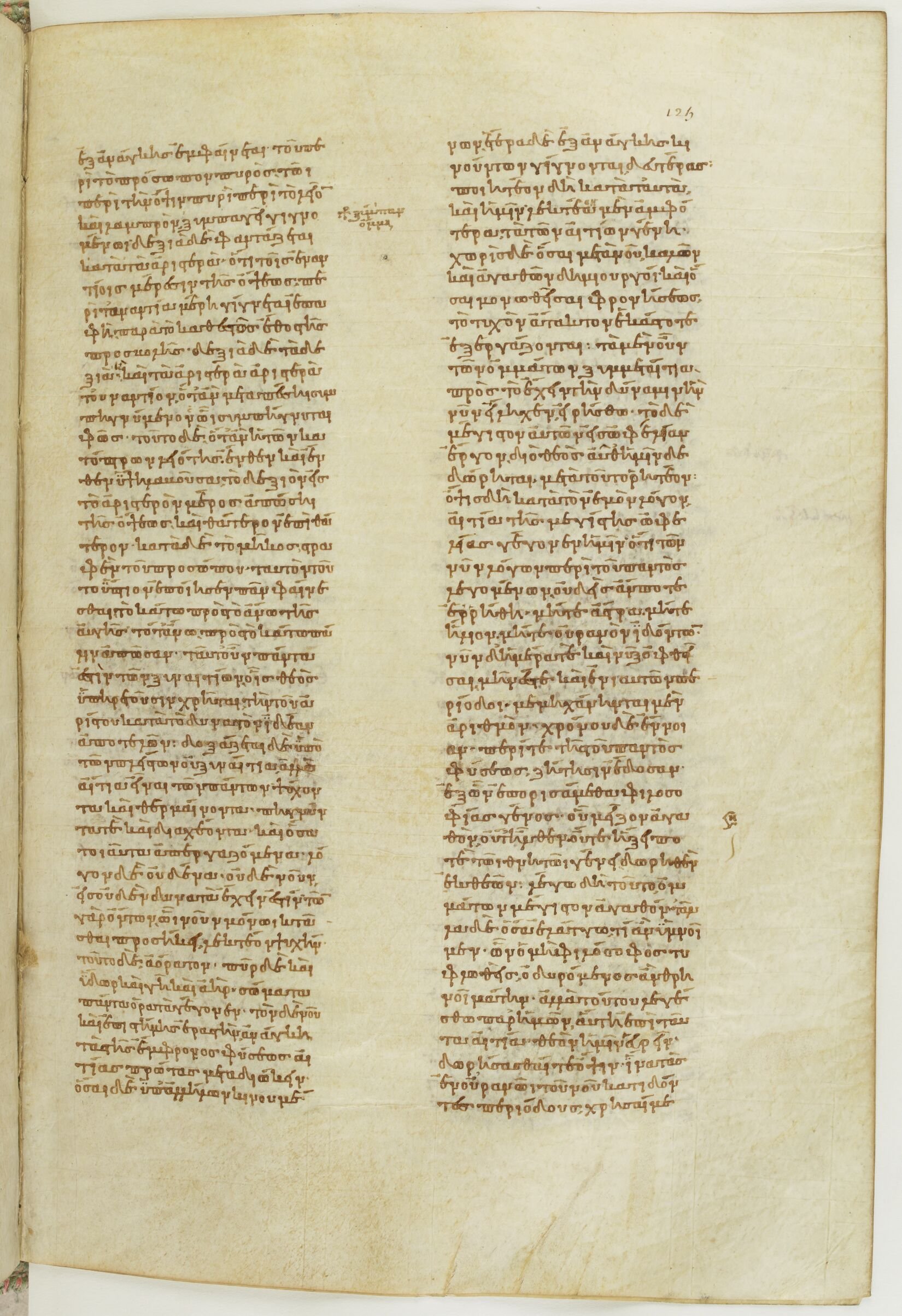
Where on the image
Tim. 47a stands in Paris gr. 1807, fol. 125r col. b. Checked on the image (column openings read on the BnF photographs and found in Burnet's text, quoted in Burnet's spelling): fol. 125r col. b begins ‹-νων, ἕτερα δὲ κατὰ ἀνάγκης κινούντων› (Tim. 46e).
δεδώρηται, μετὰ τοῦτο ῥητέον. ὄψις δὴ κατὰ τὸν ἐμὸν λόγον αἰτία τῆς μεγίστης ὠφελίας γέγονεν ἡμῖν, ὅτι τῶν νῦν λόγων περὶ τοῦ παντὸς λεγομένων οὐδεὶς ἄν ποτε ἐρρήθη μήτε ἄστρα μήτε ἥλιον μήτε οὐρανὸν ἰδόντων. νῦν δʼ ἡμέρα τε καὶ νὺξ ὀφθεῖσαι μῆνές τε καὶ ἐνιαυτῶν περίοδοι καὶ ἰσημερίαι καὶ τροπαὶ μεμηχάνηνται μὲν ἀριθμόν, χρόνου δὲ ἔννοιαν περί τε τῆς τοῦ παντὸς φύσεως ζήτησιν ἔδοσαν· ἐξ ὧν
benefit effected by them, for the sake of which God bestowed them upon us. Vision, in my view, is the cause of the greatest benefit to us, inasmuch as none of the accounts now given concerning the Universe would ever have been given if men had not seen the stars or the sun or the heaven. But as it is, the vision of day and night and of months and circling years has created the art of number and has given us not only the notion of Time but also means of research into the nature of the Universe. From these we have procured Philosophy in all its range,
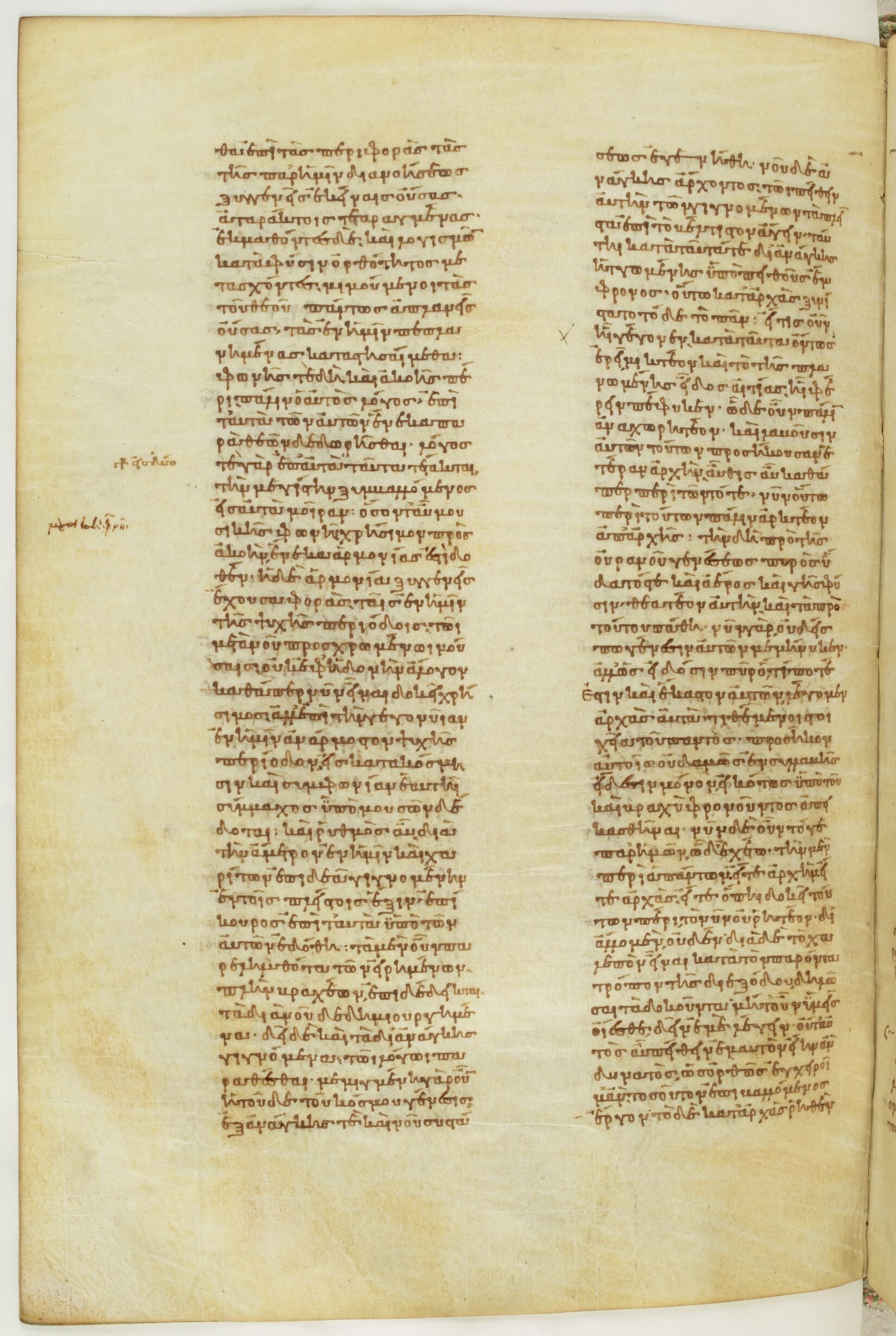
Where on the image
Tim. 47b stands in Paris gr. 1807, fol. 125r col. b to fol. 125v col. a. Checked on the image (column openings read on the BnF photographs and found in Burnet's text, quoted in Burnet's spelling): fol. 125r col. b begins ‹-νων, ἕτερα δὲ κατὰ ἀνάγκης κινούντων› (Tim. 46e); fol. 125v col. a begins ‹ἐπὶ τὰς περιφορὰς τὰς τῆς παρʼ› (Tim. 47b).
ἐπορισάμεθα φιλοσοφίας γένος, οὗ μεῖζον ἀγαθὸν οὔτʼ ἦλθεν οὔτε ἥξει ποτὲ τῷ θνητῷ γένει δωρηθὲν ἐκ θεῶν. λέγω δὴ τοῦτο ὀμμάτων μέγιστον ἀγαθόν· τἆλλα δὲ ὅσα ἐλάττω τί ἂν ὑμνοῖμεν, ὧν ὁ μὴ φιλόσοφος τυφλωθεὶς ὀδυρόμενος ἂν θρηνοῖ μάτην; ἀλλὰ τούτου λεγέσθω παρʼ ἡμῶν αὕτη ἐπὶ ταῦτα αἰτία, θεὸν ἡμῖν ἀνευρεῖν δωρήσασθαί τε ὄψιν, ἵνα τὰς ἐν οὐρανῷ τοῦ νοῦ κατιδόντες περιόδους χρησαίμεθα ἐπὶ τὰς περιφορὰς τὰς τῆς παρʼ ἡμῖν διανοήσεως, συγγενεῖς
than which no greater boon ever has come or will come, by divine bestowal, unto the race of mortals. This I affirm to be the greatest good of eyesight. As for all the lesser goods, why should we celebrate them? He that is no philosopher when deprived of the sight thereof may utter vain lamentations! But the cause and purpose of that best good, as we must maintain, is this,—that God devised and bestowed upon us vision to the end that we might behold the revolutions of Reason in the Heaven and use them for the revolvings of the reasoning that is within us, these being akin to those,
Where on the image
Tim. 47c stands in Paris gr. 1807, fol. 125v col. a. Checked on the image (column openings read on the BnF photographs and found in Burnet's text, quoted in Burnet's spelling): fol. 125v col. a begins ‹ἐπὶ τὰς περιφορὰς τὰς τῆς παρʼ› (Tim. 47b).
ἐκείναις οὔσας, ἀταράκτοις τεταραγμένας, ἐκμαθόντες δὲ καὶ λογισμῶν κατὰ φύσιν ὀρθότητος μετασχόντες, μιμούμενοι τὰς τοῦ θεοῦ πάντως ἀπλανεῖς οὔσας, τὰς ἐν ἡμῖν πεπλανημένας καταστησαίμεθα. φωνῆς τε δὴ καὶ ἀκοῆς πέρι πάλιν ὁ αὐτὸς λόγος, ἐπὶ ταὐτὰ τῶν αὐτῶν ἕνεκα παρὰ θεῶν δεδωρῆσθαι. λόγος τε γὰρ ἐπʼ αὐτὰ ταῦτα τέτακται, τὴν μεγίστην συμβαλλόμενος εἰς αὐτὰ μοῖραν, ὅσον τʼ αὖ μουσικῆς
the perturbable to the imperturbable; and that, through learning and sharing in calculations which are correct by their nature, by imitation of the absolutely unvarying revolutions of the God we might stabilize the variable revolutions within ourselves. Concerning sound also and hearing, once more we make the same declaration, that they were bestowed by the Gods with the same object and for the same reasons; for it was for these same purposes that speech was ordained, and it makes the greatest contribution thereto; music too, in so far as it uses audible sound,
Where on the image
Tim. 47d stands in Paris gr. 1807, fol. 125v col. a. Checked on the image (column openings read on the BnF photographs and found in Burnet's text, quoted in Burnet's spelling): fol. 125v col. a begins ‹ἐπὶ τὰς περιφορὰς τὰς τῆς παρʼ› (Tim. 47b).
φωνῇ χρήσιμον πρὸς ἀκοὴν ἕνεκα ἁρμονίας ἐστὶ δοθέν. ἡ δὲ ἁρμονία, συγγενεῖς ἔχουσα φορὰς ταῖς ἐν ἡμῖν τῆς ψυχῆς περιόδοις, τῷ μετὰ νοῦ προσχρωμένῳ Μούσαις οὐκ ἐφʼ ἡδονὴν ἄλογον καθάπερ νῦν εἶναι δοκεῖ χρήσιμος, ἀλλʼ ἐπὶ τὴν γεγονυῖαν ἐν ἡμῖν ἀνάρμοστον ψυχῆς περίοδον εἰς κατακόσμησιν καὶ συμφωνίαν ἑαυτῇ σύμμαχος ὑπὸ Μουσῶν δέδοται· καὶ ῥυθμὸς αὖ διὰ τὴν ἄμετρον ἐν ἡμῖν καὶ χαρίτων
was bestowed for the sake of harmony. And harmony, which has motions akin to the revolutions of the Soul within us, was given by the Muses to him who makes intelligent use of the Muses, not as an aid to irrational pleasure, as is now supposed, but as an auxiliary to the inner revolution of the Soul, when it has lost its harmony, to assist in restoring it to order and concord with itself. And because of the unmodulated condition,
Where on the image
Tim. 47e stands in Paris gr. 1807, fol. 125v col. a. Checked on the image (column openings read on the BnF photographs and found in Burnet's text, quoted in Burnet's spelling): fol. 125v col. a begins ‹ἐπὶ τὰς περιφορὰς τὰς τῆς παρʼ› (Tim. 47b).
ἐπιδεᾶ γιγνομένην ἐν τοῖς πλείστοις ἕξιν ἐπίκουρος ἐπὶ ταὐτὰ ὑπὸ τῶν αὐτῶν ἐδόθη. τὰ μὲν οὖν παρεληλυθότα τῶν εἰρημένων πλὴν βραχέων ἐπιδέδεικται τὰ διὰ νοῦ δεδημιουργημένα· δεῖ δὲ καὶ τὰ διʼ ἀνάγκης γιγνόμενα τῷ λόγῳ παραθέσθαι.
μεμειγμένη γὰρ
deficient in grace, which exists in most of us, Rhythm also was bestowed upon us to be our helper by the same deities and for the same ends. The foregoing part of our discourse, save for a small portion, has been an exposition of the operations of Reason; but we must also furnish an account of what comes into existence through Necessity.
Notes
- Greek: John Burnet, Platonis Opera IV (Oxford, 1902), via Perseus canonical-greekLit; Burnet's text is a critical edition, so its wording can differ from the manuscript shown.
- English: R. G. Bury, Plato IX (Loeb Classical Library, 1929), via Perseus. Bury's footnotes are not reproduced. Quotation marks stand where Perseus marks quoted speech.
- Stephanus sections (a-e) are those of the 1578 Stephanus edition as given by Burnet and Bury; Bury's section breaks can fall a few words away from Burnet's because English word order differs.
Cite
Sources
- Source: Paris, BnF grec 1807 (Plato A, c. 850-875) fol. 125r-125v via BnF IIIF + Burnet's Greek (Perseus) + R. G. Bury's English (Loeb 1929, Perseus) (holding institution)
- Critical edition: Burnet, Platonis Opera IV (1902), via Perseus
← previous · → next · v cycle view · l back to library