Plato, Timaeus 48a-48e: Reason and Necessity; a new beginning
Introduction
Stephanus page 48 of Plato's Timaeus (48a-48e): Reason and Necessity; a new beginning.
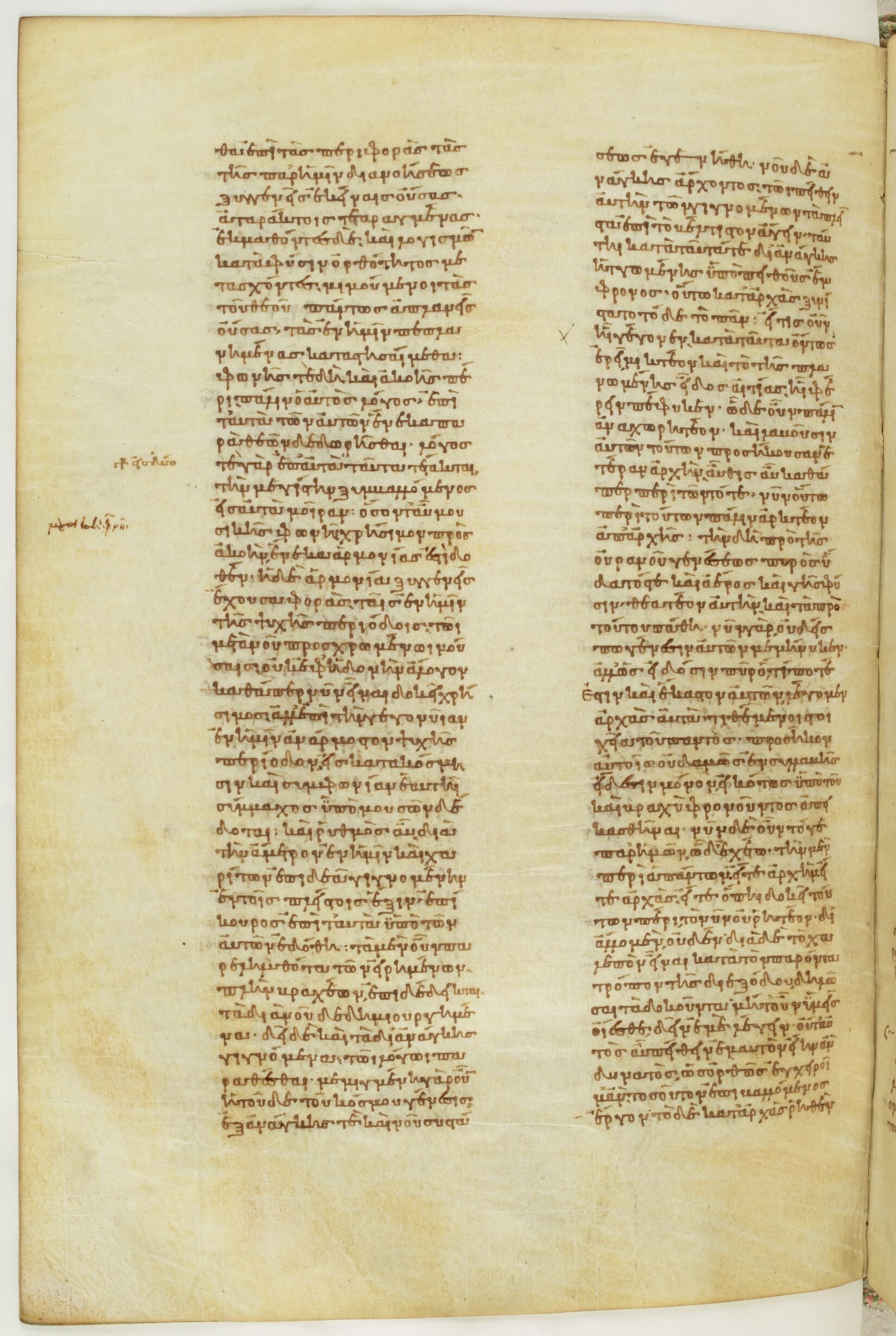
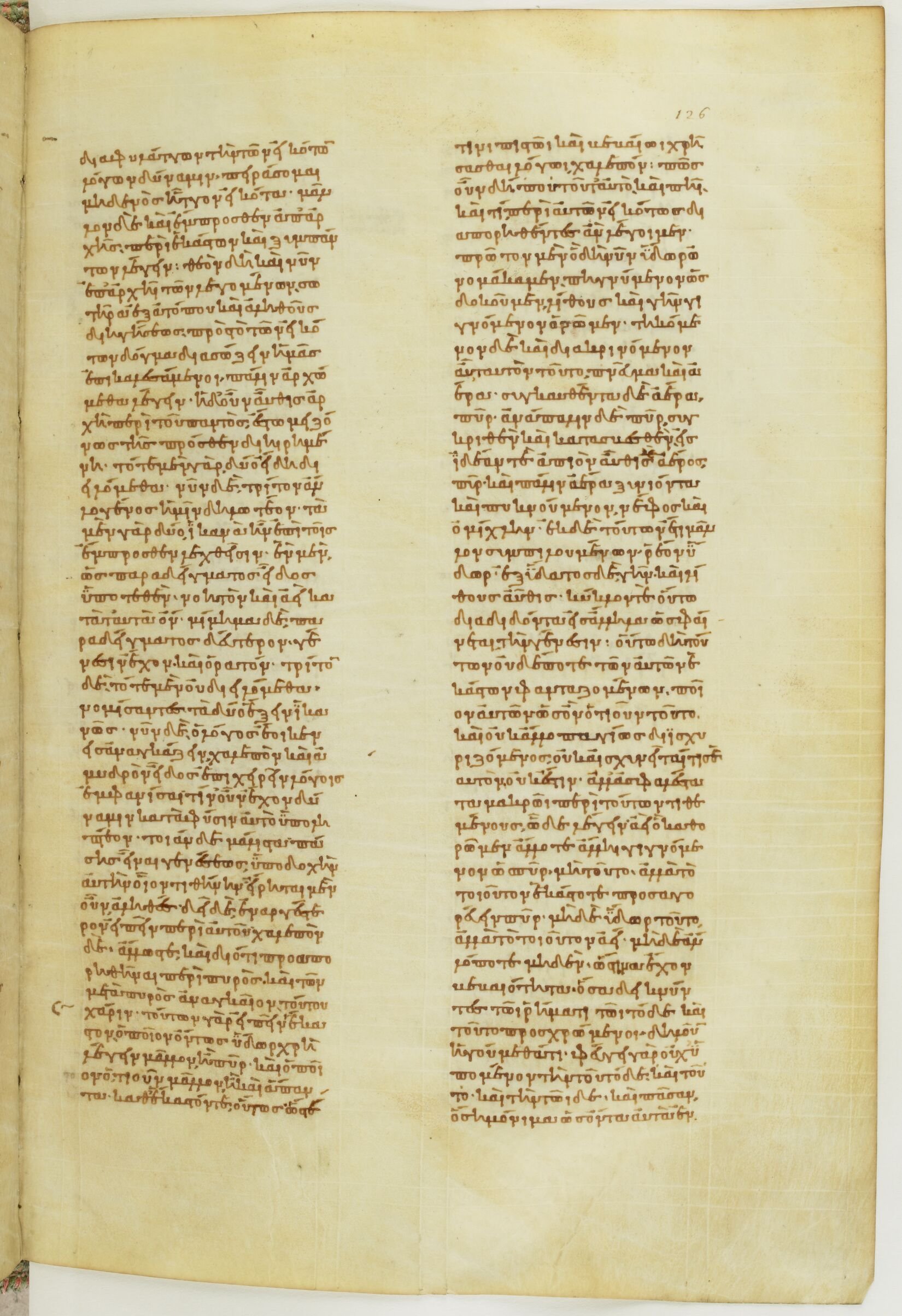
The manuscript is Paris, Bibliothèque nationale de France, grec 1807, known to editors as Plato A. It was copied in Constantinople around 850-875 by the scribe of the so-called philosophical collection, and is the oldest surviving medieval manuscript of the Timaeus and Critias (tetralogies VIII-IX: Clitophon, Republic, Timaeus, Critias, Minos, Laws, Epinomis, Letters). Each page has two columns of 44 lines. The Timaeus fills fol. 114r-144v and the Critias fol. 145r-151r.
On the manuscript this page of text runs over fol. 125v col. a to fol. 126r col. a. Each section below is linked to the folio side(s) that carry it. The mapping comes from reading the first words of every column on the images and finding them in Burnet's text: fol. 125v col. a begins ‹ἐπὶ τὰς περιφορὰς τὰς τῆς παρʼ› (Tim. 47b); fol. 125v col. b begins ‹συστάσεως ἐγεννήθη· νοῦ δὲ ἀνάγκης ἄρχοντος› (Tim. 48a); fol. 126r col. a begins ‹διαφυλάττων, τὴν τῶν εἰκότων λόγων δύναμιν› (Tim. 48d).
The Greek is John Burnet's critical text (Oxford, 1902), not a transcription of this manuscript; the scribe's spelling, accents and occasional readings differ from it. The English is R. G. Bury's Loeb translation (1929).
How was this verified? (Provenance)
Where on the image
Tim. 48a stands in Paris gr. 1807, fol. 125v col. a to fol. 125v col. b. Checked on the image (column openings read on the BnF photographs and found in Burnet's text, quoted in Burnet's spelling): fol. 125v col. a begins ‹ἐπὶ τὰς περιφορὰς τὰς τῆς παρʼ› (Tim. 47b); fol. 125v col. b begins ‹συστάσεως ἐγεννήθη· νοῦ δὲ ἀνάγκης ἄρχοντος› (Tim. 48a).
οὖν ἡ τοῦδε τοῦ κόσμου γένεσις ἐξ ἀνάγκης τε καὶ νοῦ συστάσεως ἐγεννήθη· νοῦ δὲ ἀνάγκης ἄρχοντος τῷ πείθειν αὐτὴν τῶν γιγνομένων τὰ πλεῖστα ἐπὶ τὸ βέλτιστον ἄγειν, ταύτῃ κατὰ ταῦτά τε διʼ ἀνάγκης ἡττωμένης ὑπὸ πειθοῦς ἔμφρονος οὕτω κατʼ ἀρχὰς συνίστατο τόδε τὸ πᾶν. εἴ τις οὖν ᾗ γέγονεν κατὰ ταῦτα ὄντως ἐρεῖ, μεικτέον καὶ τὸ τῆς πλανωμένης εἶδος αἰτίας, ᾗ φέρειν πέφυκεν· ὧδε οὖν πάλιν
For, in truth, this Cosmos in its origin was generated as a compound, from the combination of Necessity and Reason. And inasmuch as Reason was controlling Necessity by persuading her to conduct to the best end the most part of the things coming into existence, thus and thereby it came about, through Necessity yielding to intelligent persuasion, that this Universe of ours was being in this wise constructed at the beginning. Wherefore if one is to declare how it actually came into being on this wise, he must include also the form of the Errant Cause, in the way that it really acts. To this point, therefore, we must return,
Where on the image
Tim. 48b stands in Paris gr. 1807, fol. 125v col. b. Checked on the image (column openings read on the BnF photographs and found in Burnet's text, quoted in Burnet's spelling): fol. 125v col. b begins ‹συστάσεως ἐγεννήθη· νοῦ δὲ ἀνάγκης ἄρχοντος› (Tim. 48a).
ἀναχωρητέον, καὶ λαβοῦσιν αὐτῶν τούτων προσήκουσαν ἑτέραν ἀρχὴν αὖθις αὖ, καθάπερ περὶ τῶν τότε νῦν οὕτω περὶ τούτων πάλιν ἀρκτέον ἀπʼ ἀρχῆς. τὴν δὴ πρὸ τῆς οὐρανοῦ γενέσεως πυρὸς ὕδατός τε καὶ ἀέρος καὶ γῆς φύσιν θεατέον αὐτὴν καὶ τὰ πρὸ τούτου πάθη· νῦν γὰρ οὐδείς πω γένεσιν αὐτῶν μεμήνυκεν, ἀλλʼ ὡς εἰδόσιν πῦρ ὅτι ποτέ ἐστιν καὶ ἕκαστον αὐτῶν λέγομεν ἀρχὰς αὐτὰ τιθέμενοι στοιχεῖα τοῦ παντός, προσῆκον αὐτοῖς οὐδʼ ἂν ὡς ἐν συλλαβῆς
and taking once again a fresh starting point suitable to the matter we must make a fresh start in dealing therewith, just as we did with our previous subjects. We must gain a view of the real nature of fire and water, air and earth, as it was before the birth of Heaven, and the properties they had before that time; for at present no one has as yet declared their generation, but we assume that men know what fire is, and each of these things, and we call them principles and presume that they are elements of the Universe, although in truth they do not so much as deserve to be likened with any likelihood,
Where on the image
Tim. 48c stands in Paris gr. 1807, fol. 125v col. b. Checked on the image (column openings read on the BnF photographs and found in Burnet's text, quoted in Burnet's spelling): fol. 125v col. b begins ‹συστάσεως ἐγεννήθη· νοῦ δὲ ἀνάγκης ἄρχοντος› (Tim. 48a).
εἴδεσιν μόνον εἰκότως ὑπὸ τοῦ καὶ βραχὺ φρονοῦντος ἀπεικασθῆναι. νῦν δὲ οὖν τό γε παρʼ ἡμῶν ὧδε ἐχέτω· τὴν μὲν περὶ ἁπάντων εἴτε ἀρχὴν εἴτε ἀρχὰς εἴτε ὅπῃ δοκεῖ τούτων πέρι τὸ νῦν οὐ ῥητέον, διʼ ἄλλο μὲν οὐδέν, διὰ δὲ τὸ χαλεπὸν εἶναι κατὰ τὸν παρόντα τρόπον τῆς διεξόδου δηλῶσαι τὰ δοκοῦντα, μήτʼ οὖν ὑμεῖς οἴεσθε δεῖν ἐμὲ λέγειν, οὔτʼ αὐτὸς αὖ πείθειν ἐμαυτὸν εἴην ἂν δυνατὸς ὡς ὀρθῶς ἐγχειροῖμʼ
by the man who has even a grain of sense, to the class of syllables. For the present, however, let our procedure be as follows. We shall not now expound the principle of all things—or their principles, or whatever term we use concerning them; and that solely for this reason, that it is difficult for us to explain our views while keeping to our present method of exposition. You, therefore, ought not to suppose that I should expound them, while as for me—I should never be able to convince myself that I should be right in attempting to undertake so great a task. Strictly adhering, then,
Where on the image
Tim. 48d stands in Paris gr. 1807, fol. 125v col. b to fol. 126r col. a. Checked on the image (column openings read on the BnF photographs and found in Burnet's text, quoted in Burnet's spelling): fol. 125v col. b begins ‹συστάσεως ἐγεννήθη· νοῦ δὲ ἀνάγκης ἄρχοντος› (Tim. 48a); fol. 126r col. a begins ‹διαφυλάττων, τὴν τῶν εἰκότων λόγων δύναμιν› (Tim. 48d).
ἂν τοσοῦτον ἐπιβαλλόμενος ἔργον· τὸ δὲ κατʼ ἀρχὰς ῥηθὲν διαφυλάττων, τὴν τῶν εἰκότων λόγων δύναμιν, πειράσομαι μηδενὸς ἧττον εἰκότα, μᾶλλον δέ, καὶ ἔμπροσθεν ἀπʼ ἀρχῆς περὶ ἑκάστων καὶ συμπάντων λέγειν. θεὸν δὴ καὶ νῦν ἐπʼ ἀρχῇ τῶν λεγομένων σωτῆρα ἐξ ἀτόπου καὶ ἀήθους διηγήσεως πρὸς τὸ τῶν εἰκότων δόγμα διασῴζειν ἡμᾶς
to what we previously affirmed, the import of the likely account, I will essay (as I did before) to give as likely an exposition as any other (nay, more so), regarding both particular things and the totality of things from the very beginning. And as before, so now, at the commencement of our account, we must call upon God the Saviour to bring us safe through a novel and unwonted exposition
Where on the image
Tim. 48e stands in Paris gr. 1807, fol. 126r col. a. Checked on the image (column openings read on the BnF photographs and found in Burnet's text, quoted in Burnet's spelling): fol. 126r col. a begins ‹διαφυλάττων, τὴν τῶν εἰκότων λόγων δύναμιν› (Tim. 48d).
ἐπικαλεσάμενοι πάλιν ἀρχώμεθα λέγειν. ἡ δʼ οὖν αὖθις ἀρχὴ περὶ τοῦ παντὸς ἔστω μειζόνως τῆς πρόσθεν διῃρημένη· τότε μὲν γὰρ δύο εἴδη διειλόμεθα, νῦν δὲ τρίτον ἄλλο γένος ἡμῖν δηλωτέον.
τὰ μὲν γὰρ δύο ἱκανὰ ἦν ἐπὶ τοῖς ἔμπροσθεν λεχθεῖσιν, ἓν μὲν ὡς παραδείγματος εἶδος ὑποτεθέν, νοητὸν καὶ ἀεὶ κατὰ ταὐτὰ ὄν, μίμημα δὲ
to a conclusion based on likelihood, and thus begin our account once more. We must, however, in beginning our fresh account of the Universe make more distinctions than we did before; for whereas then we distinguished two Forms, we must now declare another third kind.
For our former exposition those two were sufficient, one of them being assumed as a Model Form, intelligible and ever uniformly existent,
Notes
- Greek: John Burnet, Platonis Opera IV (Oxford, 1902), via Perseus canonical-greekLit; Burnet's text is a critical edition, so its wording can differ from the manuscript shown.
- English: R. G. Bury, Plato IX (Loeb Classical Library, 1929), via Perseus. Bury's footnotes are not reproduced. Quotation marks stand where Perseus marks quoted speech.
- Stephanus sections (a-e) are those of the 1578 Stephanus edition as given by Burnet and Bury; Bury's section breaks can fall a few words away from Burnet's because English word order differs.
Cite
Sources
- Source: Paris, BnF grec 1807 (Plato A, c. 850-875) fol. 125v-126r via BnF IIIF + Burnet's Greek (Perseus) + R. G. Bury's English (Loeb 1929, Perseus) (holding institution)
- Critical edition: Burnet, Platonis Opera IV (1902), via Perseus
← previous · → next · v cycle view · l back to library