Plato, Timaeus 49a-49e: the receptacle, nurse of all becoming; the elements pass into one another
Introduction
Stephanus page 49 of Plato's Timaeus (49a-49e): the receptacle, nurse of all becoming; the elements pass into one another.
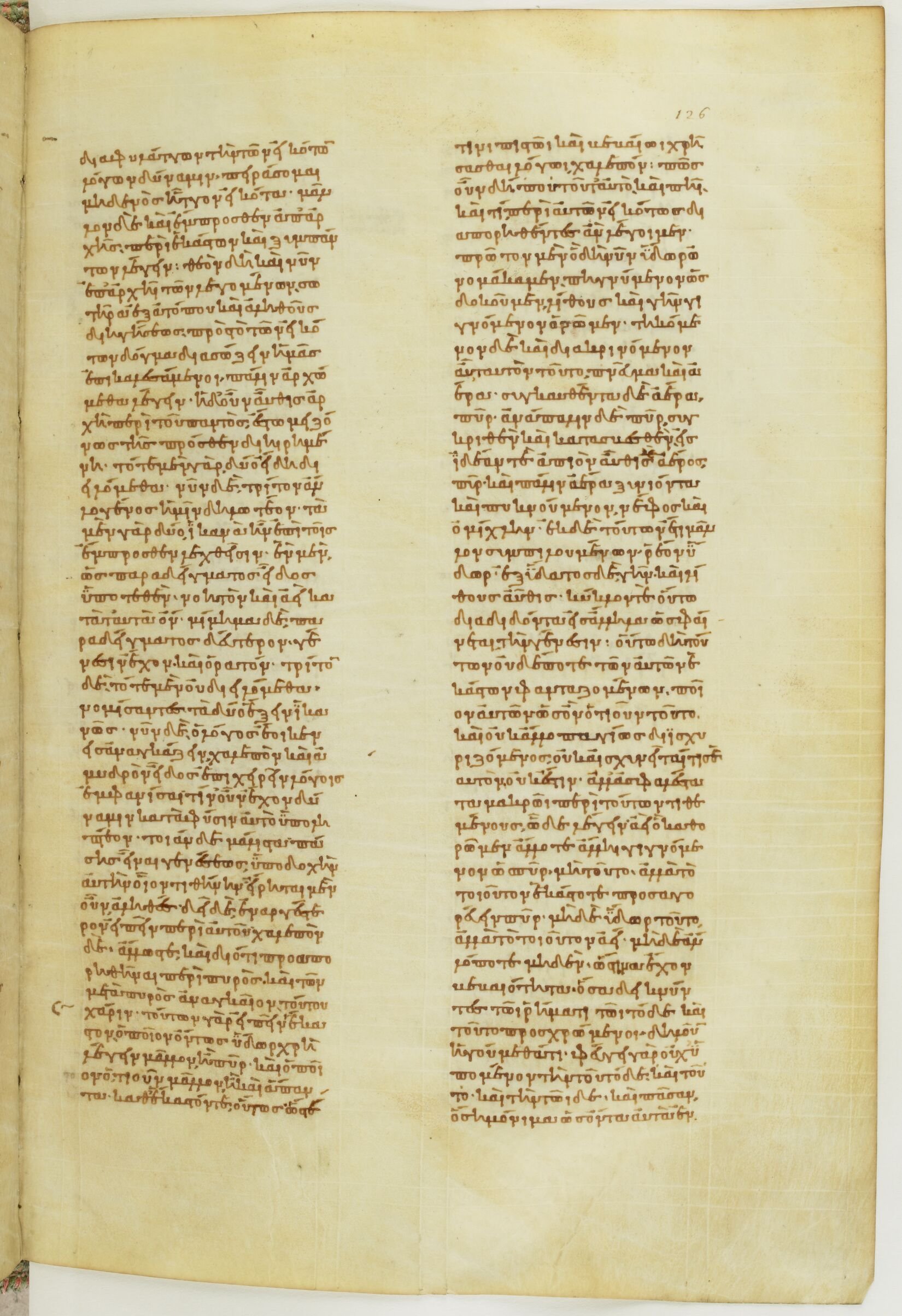
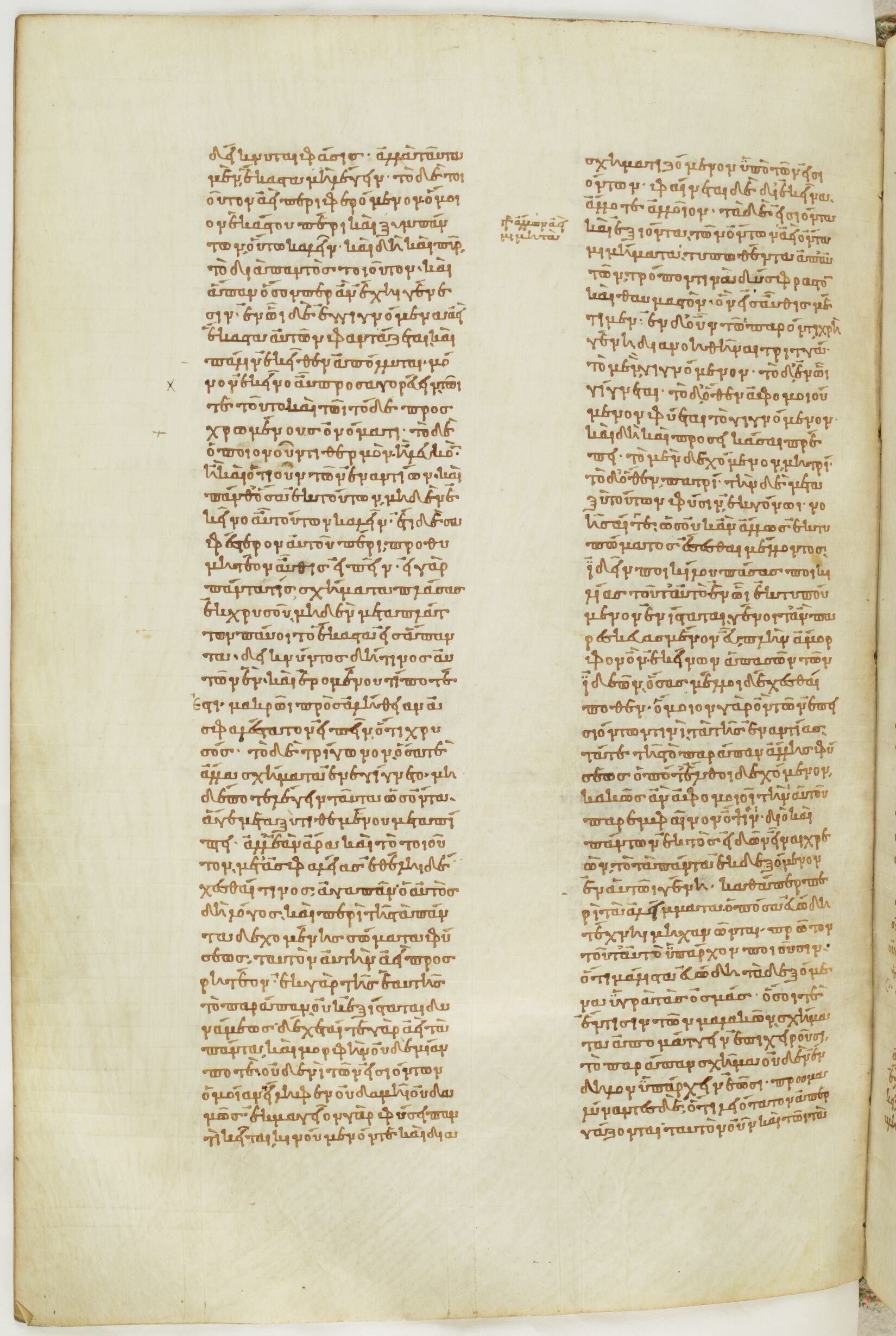
The manuscript is Paris, Bibliothèque nationale de France, grec 1807, known to editors as Plato A. It was copied in Constantinople around 850-875 by the scribe of the so-called philosophical collection, and is the oldest surviving medieval manuscript of the Timaeus and Critias (tetralogies VIII-IX: Clitophon, Republic, Timaeus, Critias, Minos, Laws, Epinomis, Letters). Each page has two columns of 44 lines. The Timaeus fills fol. 114r-144v and the Critias fol. 145r-151r.
On the manuscript this page of text runs over fol. 126r col. a to fol. 126v col. a. Each section below is linked to the folio side(s) that carry it. The mapping comes from reading the first words of every column on the images and finding them in Burnet's text: fol. 126r col. a begins ‹διαφυλάττων, τὴν τῶν εἰκότων λόγων δύναμιν› (Tim. 48d); fol. 126r col. b begins ‹τινὶ πιστῷ καὶ βεβαίῳ χρήσασθαι λόγῳ› (Tim. 49b); fol. 126v col. a begins ‹-δείκνυται φάσις. ἀλλὰ ταῦτα μὲν ἕκαστα› (Tim. 49e).
The Greek is John Burnet's critical text (Oxford, 1902), not a transcription of this manuscript; the scribe's spelling, accents and occasional readings differ from it. The English is R. G. Bury's Loeb translation (1929).
How was this verified? (Provenance)
Where on the image
Tim. 49a stands in Paris gr. 1807, fol. 126r col. a. Checked on the image (column openings read on the BnF photographs and found in Burnet's text, quoted in Burnet's spelling): fol. 126r col. a begins ‹διαφυλάττων, τὴν τῶν εἰκότων λόγων δύναμιν› (Tim. 48d).
παραδείγματος δεύτερον, γένεσιν ἔχον καὶ ὁρατόν. τρίτον δὲ τότε μὲν οὐ διειλόμεθα, νομίσαντες τὰ δύο ἕξειν ἱκανῶς· νῦν δὲ ὁ λόγος ἔοικεν εἰσαναγκάζειν χαλεπὸν καὶ ἀμυδρὸν εἶδος ἐπιχειρεῖν λόγοις ἐμφανίσαι. τίνʼ οὖν ἔχον δύναμιν καὶ φύσιν αὐτὸ ὑποληπτέον; τοιάνδε μάλιστα· πάσης εἶναι γενέσεως ὑποδοχὴν αὐτὴν οἷον τιθήνην. εἴρηται μὲν οὖν τἀληθές, δεῖ δὲ ἐναργέστερον εἰπεῖν περὶ αὐτοῦ, χαλεπὸν
and the second as the model’s Copy, subject to becoming and visible. A third kind we did not at that time distinguish, considering that those two were sufficient; but now the argument seems to compel us to try to reveal by words a Form that is baffling and obscure. What essential property, then, are we to conceive it to possess? This in particular,—that it should be the receptacle, and as it were the nurse, of all Becoming. Yet true though this statement is, we must needs describe it more plainly.
Where on the image
Tim. 49b stands in Paris gr. 1807, fol. 126r col. a to fol. 126r col. b. Checked on the image (column openings read on the BnF photographs and found in Burnet's text, quoted in Burnet's spelling): fol. 126r col. a begins ‹διαφυλάττων, τὴν τῶν εἰκότων λόγων δύναμιν› (Tim. 48d); fol. 126r col. b begins ‹τινὶ πιστῷ καὶ βεβαίῳ χρήσασθαι λόγῳ› (Tim. 49b).
δὲ ἄλλως τε καὶ διότι προαπορηθῆναι περὶ πυρὸς καὶ τῶν μετὰ πυρὸς ἀναγκαῖον τούτου χάριν· τούτων γὰρ εἰπεῖν ἕκαστον ὁποῖον ὄντως ὕδωρ χρὴ λέγειν μᾶλλον ἢ πῦρ, καὶ ὁποῖον ὁτιοῦν μᾶλλον ἢ καὶ ἅπαντα καθʼ ἕκαστόν τε, οὕτως ὥστε τινὶ πιστῷ καὶ βεβαίῳ χρήσασθαι λόγῳ, χαλεπόν. πῶς οὖν δὴ τοῦτʼ αὐτὸ καὶ πῇ καὶ τί περὶ αὐτῶν εἰκότως διαπορηθέντες ἂν λέγοιμεν; πρῶτον μέν, ὃ δὴ νῦν ὕδωρ ὠνομάκαμεν, πηγνύμενον ὡς δοκοῦμεν λίθους καὶ γῆν γιγνόμενον
That, however, is a difficult task, especially because it is necessary, for its sake, to discuss first the problem of fire and its fellow elements. For in regard to these it is hard to say which particular element we ought really to term water rather than fire, and which we ought to term any one element rather than each and all of them, while still employing a terminology that is reliable and stable. How, then, shall we handle this problem, and what likely solution can we offer? First of all, we see that which we now call water becoming by condensation,
Where on the image
Tim. 49c stands in Paris gr. 1807, fol. 126r col. b. Checked on the image (column openings read on the BnF photographs and found in Burnet's text, quoted in Burnet's spelling): fol. 126r col. b begins ‹τινὶ πιστῷ καὶ βεβαίῳ χρήσασθαι λόγῳ› (Tim. 49b).
ὁρῶμεν, τηκόμενον δὲ καὶ διακρινόμενον αὖ ταὐτὸν τοῦτο πνεῦμα καὶ ἀέρα, συγκαυθέντα δὲ ἀέρα πῦρ, ἀνάπαλιν δὲ συγκριθὲν καὶ κατασβεσθὲν εἰς ἰδέαν τε ἀπιὸν αὖθις ἀέρος πῦρ, καὶ πάλιν ἀέρα συνιόντα καὶ πυκνούμενον νέφος καὶ ὁμίχλην, ἐκ δὲ τούτων ἔτι μᾶλλον συμπιλουμένων ῥέον ὕδωρ, ἐξ ὕδατος δὲ γῆν καὶ λίθους αὖθις, κύκλον τε οὕτω διαδιδόντα εἰς ἄλληλα, ὡς φαίνεται, τὴν γένεσιν. οὕτω δὴ τούτων οὐδέποτε
as we believe, stones and earth; and again, this same substance, by dissolving and dilating, becoming breath and air; and air through combustion becoming fire; and conversely, fire when contracted and quenched returning back to the form of air and air once more uniting and condensing into cloud and mist; and issuing from these, when still further compressed, flowing water; and from water earth and stones again: thus we see the elements passing on to one another, as it would seem,
Where on the image
Tim. 49d stands in Paris gr. 1807, fol. 126r col. b. Checked on the image (column openings read on the BnF photographs and found in Burnet's text, quoted in Burnet's spelling): fol. 126r col. b begins ‹τινὶ πιστῷ καὶ βεβαίῳ χρήσασθαι λόγῳ› (Tim. 49b).
τῶν αὐτῶν ἑκάστων φανταζομένων, ποῖον αὐτῶν ὡς ὂν ὁτιοῦν τοῦτο καὶ οὐκ ἄλλο παγίως διισχυριζόμενος οὐκ αἰσχυνεῖταί τις ἑαυτόν; οὐκ ἔστιν, ἀλλʼ ἀσφαλέστατα μακρῷ περὶ τούτων τιθεμένους ὧδε λέγειν· ἀεὶ ὃ καθορῶμεν ἄλλοτε ἄλλῃ γιγνόμενον, ὡς πῦρ, μὴ τοῦτο ἀλλὰ τὸ τοιοῦτον ἑκάστοτε προσαγορεύειν πῦρ, μηδὲ ὕδωρ τοῦτο ἀλλὰ τὸ τοιοῦτον ἀεί, μηδὲ ἄλλο ποτὲ μηδὲν ὥς τινα ἔχον βεβαιότητα, ὅσα
in an unbroken circle the gift of birth. Accordingly, since no one of these ever remains identical in appearance, which of them shall a man definitely affirm to be any one particular element and no other without incurring ridicule? None such exists. On the contrary, by far the safest plan in treating of these elements is to proceed thus: Whatsoever object we perceive to be constantly changing from one state to another, like fire, that object, be it fire, we must never describe as this but as suchlike, nor should we ever call water this but suchlike nor should we describe any other element, as though it possessed stability,
Where on the image
Tim. 49e stands in Paris gr. 1807, fol. 126r col. b to fol. 126v col. a. Checked on the image (column openings read on the BnF photographs and found in Burnet's text, quoted in Burnet's spelling): fol. 126r col. b begins ‹τινὶ πιστῷ καὶ βεβαίῳ χρήσασθαι λόγῳ› (Tim. 49b); fol. 126v col. a begins ‹-δείκνυται φάσις. ἀλλὰ ταῦτα μὲν ἕκαστα› (Tim. 49e).
δεικνύντες τῷ ῥήματι τῷ τόδε καὶ τοῦτο προσχρώμενοι δηλοῦν ἡγούμεθά τι· φεύγει γὰρ οὐχ ὑπομένον τὴν τοῦ τόδε καὶ τοῦτο καὶ τὴν τῷδε καὶ πᾶσαν ὅση μόνιμα ὡς ὄντα αὐτὰ ἐνδείκνυται φάσις. ἀλλὰ ταῦτα μὲν ἕκαστα μὴ λέγειν, τὸ δὲ τοιοῦτον ἀεὶ περιφερόμενον ὅμοιον ἑκάστου πέρι καὶ συμπάντων οὕτω καλεῖν, καὶ δὴ καὶ πῦρ τὸ διὰ παντὸς τοιοῦτον, καὶ ἅπαν ὅσονπερ ἂν ἔχῃ γένεσιν·
ἐν ᾧ δὲ ἐγγιγνόμενα ἀεὶ ἕκαστα αὐτῶν φαντάζεται καὶ πάλιν ἐκεῖθεν ἀπόλλυται,
of all those which we indicate by using the terms this and that and suppose ourselves to refer to a definite object. For such an object shuns and eludes the names this and that and every name which indicates that they are stable. Thus we must not call the several elements these, but in regard to each of them and all together we must apply the term suchlike to represent what is always circling round: thus we shall call that which is constantly suchlike by the name of fire, and so with everything else that is generated.
But that wherein they are always, in appearance,
Notes
- Greek: John Burnet, Platonis Opera IV (Oxford, 1902), via Perseus canonical-greekLit; Burnet's text is a critical edition, so its wording can differ from the manuscript shown.
- English: R. G. Bury, Plato IX (Loeb Classical Library, 1929), via Perseus. Bury's footnotes are not reproduced. Quotation marks stand where Perseus marks quoted speech.
- Stephanus sections (a-e) are those of the 1578 Stephanus edition as given by Burnet and Bury; Bury's section breaks can fall a few words away from Burnet's because English word order differs.
Cite
Sources
- Source: Paris, BnF grec 1807 (Plato A, c. 850-875) fol. 126r-126v via BnF IIIF + Burnet's Greek (Perseus) + R. G. Bury's English (Loeb 1929, Perseus) (holding institution)
- Critical edition: Burnet, Platonis Opera IV (1902), via Perseus
← previous · → next · v cycle view · l back to library