Plato, Timaeus 50a-50e: the receptacle compared to gold that takes every shape
Introduction
Stephanus page 50 of Plato's Timaeus (50a-50e): the receptacle compared to gold that takes every shape.
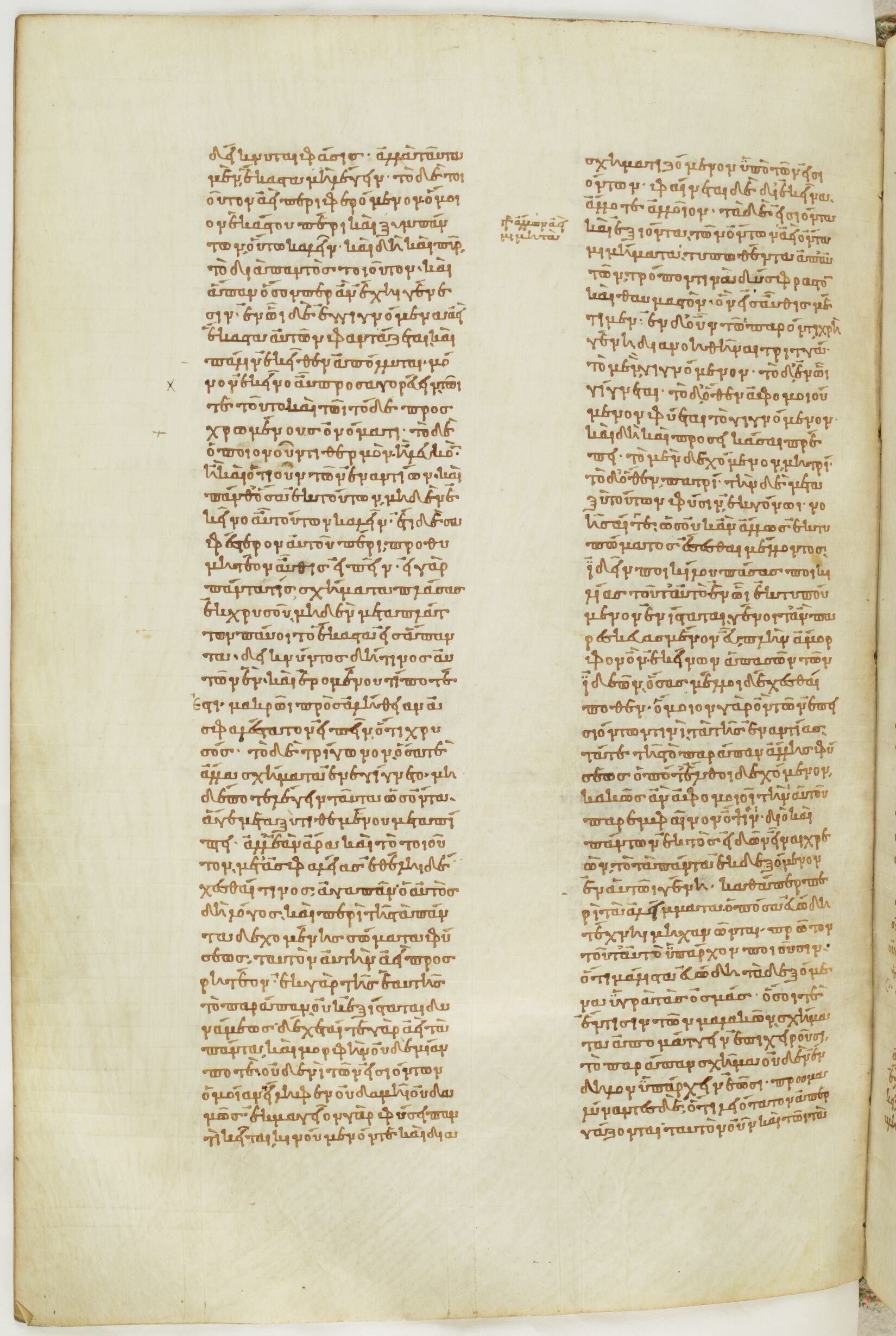
The manuscript is Paris, Bibliothèque nationale de France, grec 1807, known to editors as Plato A. It was copied in Constantinople around 850-875 by the scribe of the so-called philosophical collection, and is the oldest surviving medieval manuscript of the Timaeus and Critias (tetralogies VIII-IX: Clitophon, Republic, Timaeus, Critias, Minos, Laws, Epinomis, Letters). Each page has two columns of 44 lines. The Timaeus fills fol. 114r-144v and the Critias fol. 145r-151r.
On the manuscript this page of text runs over fol. 126v col. a to fol. 126v col. b. Each section below is linked to the folio side(s) that carry it. The mapping comes from reading the first words of every column on the images and finding them in Burnet's text: fol. 126v col. a begins ‹-δείκνυται φάσις. ἀλλὰ ταῦτα μὲν ἕκαστα› (Tim. 49e); fol. 126v col. b begins ‹-σχηματιζόμενον ὑπὸ τῶν εἰσιόντων, φαίνεται δὲ› (Tim. 50c).
The Greek is John Burnet's critical text (Oxford, 1902), not a transcription of this manuscript; the scribe's spelling, accents and occasional readings differ from it. The English is R. G. Bury's Loeb translation (1929).
How was this verified? (Provenance)
Where on the image
Tim. 50a stands in Paris gr. 1807, fol. 126v col. a. Checked on the image (column openings read on the BnF photographs and found in Burnet's text, quoted in Burnet's spelling): fol. 126v col. a begins ‹-δείκνυται φάσις. ἀλλὰ ταῦτα μὲν ἕκαστα› (Tim. 49e).
μόνον ἐκεῖνο αὖ προσαγορεύειν τῷ τε τοῦτο καὶ τῷ τόδε προσχρωμένους ὀνόματι, τὸ δὲ ὁποιονοῦν τι, θερμὸν ἢ λευκὸν ἢ καὶ ὁτιοῦν τῶν ἐναντίων, καὶ πάνθʼ ὅσα ἐκ τούτων, μηδὲν ἐκεῖνο αὖ τούτων καλεῖν. ἔτι δὲ σαφέστερον αὐτοῦ πέρι προθυμητέον αὖθις εἰπεῖν. εἰ γὰρ πάντα τις σχήματα πλάσας ἐκ χρυσοῦ μηδὲν μεταπλάττων παύοιτο ἕκαστα εἰς ἅπαντα, δεικνύντος δή τινος αὐτῶν ἓν καὶ ἐρομένου
coming severally into existence, and wherefrom in turn they perish, in describing that and that alone should we employ the terms this and that; whereas, in describing what is suchlike—hot, for instance, or white, or any of the opposite qualities, or any compounds thereof—we ought never to apply to it any of these terms. But we must bestir ourselves to explain this matter again yet more clearly. Now imagine that a man were to model all possible figures out of gold, and were then to proceed without cessation to remodel each of these into every other, then, if someone were to point to one of the figures and ask what it is,
Where on the image
Tim. 50b stands in Paris gr. 1807, fol. 126v col. a. Checked on the image (column openings read on the BnF photographs and found in Burnet's text, quoted in Burnet's spelling): fol. 126v col. a begins ‹-δείκνυται φάσις. ἀλλὰ ταῦτα μὲν ἕκαστα› (Tim. 49e).
τί ποτʼ ἐστί, μακρῷ πρὸς ἀλήθειαν ἀσφαλέστατον εἰπεῖν ὅτι χρυσός, τὸ δὲ τρίγωνον ὅσα τε ἄλλα σχήματα ἐνεγίγνετο, μηδέποτε λέγειν ταῦτα ὡς ὄντα, ἅ γε μεταξὺ τιθεμένου μεταπίπτει, ἀλλʼ ἐὰν ἄρα καὶ τὸ τοιοῦτον μετʼ ἀσφαλείας ἐθέλῃ δέχεσθαί τινος, ἀγαπᾶν. ὁ αὐτὸς δὴ λόγος καὶ περὶ τῆς τὰ πάντα δεχομένης σώματα φύσεως. ταὐτὸν αὐτὴν ἀεὶ προσρητέον· ἐκ γὰρ τῆς ἑαυτῆς τὸ παράπαν οὐκ ἐξίσταται δυνάμεως—δέχεταί τε γὰρ ἀεὶ τὰ πάντα, καὶ
by far the safest reply, in point of truth, would be that it is gold; but as for the triangle and all the other figures which were formed in it, one should never describe them as being seeing that they change even while one is mentioning them; rather one should be content if the figure admits of even the title suchlike being applied to it with any safety. And of the substance which receives all bodies
Where on the image
Tim. 50c stands in Paris gr. 1807, fol. 126v col. a to fol. 126v col. b. Checked on the image (column openings read on the BnF photographs and found in Burnet's text, quoted in Burnet's spelling): fol. 126v col. a begins ‹-δείκνυται φάσις. ἀλλὰ ταῦτα μὲν ἕκαστα› (Tim. 49e); fol. 126v col. b begins ‹-σχηματιζόμενον ὑπὸ τῶν εἰσιόντων, φαίνεται δὲ› (Tim. 50c).
μορφὴν οὐδεμίαν ποτὲ οὐδενὶ τῶν εἰσιόντων ὁμοίαν εἴληφεν οὐδαμῇ οὐδαμῶς· ἐκμαγεῖον γὰρ φύσει παντὶ κεῖται, κινούμενόν τε καὶ διασχηματιζόμενον ὑπὸ τῶν εἰσιόντων, φαίνεται δὲ διʼ ἐκεῖνα ἄλλοτε ἀλλοῖον—τὰ δὲ εἰσιόντα καὶ ἐξιόντα τῶν ὄντων ἀεὶ μιμήματα, τυπωθέντα ἀπʼ αὐτῶν τρόπον τινὰ δύσφραστον καὶ θαυμαστόν, ὃν εἰς αὖθις μέτιμεν. ἐν δʼ οὖν τῷ παρόντι χρὴ γένη διανοηθῆναι τριττά, τὸ μὲν
the same account must be given. It must be called always by the same name; for from its own proper quality it never departs at all for while it is always receiving all things, nowhere and in no wise does it assume any shape similar to any of the things that enter into it. For it is laid down by nature as a molding-stuff for everything, being moved and marked by the entering figures, and because of them it appears different at different times. And the figures that enter and depart are copies of those that are always existent, being stamped from them in a fashion marvellous and hard to describe, which we shall investigate hereafter. For the present, then, we must conceive of three kinds,—the Becoming, that Wherein it becomes, and the source Wherefrom the Becoming
Where on the image
Tim. 50d stands in Paris gr. 1807, fol. 126v col. b. Checked on the image (column openings read on the BnF photographs and found in Burnet's text, quoted in Burnet's spelling): fol. 126v col. b begins ‹-σχηματιζόμενον ὑπὸ τῶν εἰσιόντων, φαίνεται δὲ› (Tim. 50c).
γιγνόμενον, τὸ δʼ ἐν ᾧ γίγνεται, τὸ δʼ ὅθεν ἀφομοιούμενον φύεται τὸ γιγνόμενον. καὶ δὴ καὶ προσεικάσαι πρέπει τὸ μὲν δεχόμενον μητρί, τὸ δʼ ὅθεν πατρί, τὴν δὲ μεταξὺ τούτων φύσιν ἐκγόνῳ, νοῆσαί τε ὡς οὐκ ἂν ἄλλως, ἐκτυπώματος ἔσεσθαι μέλλοντος ἰδεῖν ποικίλου πάσας ποικιλίας, τοῦτʼ αὐτὸ ἐν ᾧ ἐκτυπούμενον ἐνίσταται γένοιτʼ ἂν παρεσκευασμένον εὖ, πλὴν ἄμορφον ὂν ἐκείνων ἁπασῶν τῶν ἰδεῶν ὅσας
is copied and produced. Moreover, it is proper to liken the Recipient to the Mother, the Source to the Father, and what is engendered between these two to the Offspring; and also to perceive that, if the stamped copy is to assume diverse appearances of all sorts, that substance wherein it is set and stamped could not possibly be suited to its purpose unless it were itself devoid of all those forms which it is about to receive from any quarter.
Where on the image
Tim. 50e stands in Paris gr. 1807, fol. 126v col. b. Checked on the image (column openings read on the BnF photographs and found in Burnet's text, quoted in Burnet's spelling): fol. 126v col. b begins ‹-σχηματιζόμενον ὑπὸ τῶν εἰσιόντων, φαίνεται δὲ› (Tim. 50c).
μέλλοι δέχεσθαί ποθεν. ὅμοιον γὰρ ὂν τῶν ἐπεισιόντων τινὶ τὰ τῆς ἐναντίας τά τε τῆς τὸ παράπαν ἄλλης φύσεως ὁπότʼ ἔλθοι δεχόμενον κακῶς ἂν ἀφομοιοῖ, τὴν αὑτοῦ παρεμφαῖνον ὄψιν. διὸ καὶ πάντων ἐκτὸς εἰδῶν εἶναι χρεὼν τὸ τὰ πάντα ἐκδεξόμενον ἐν αὑτῷ γένη, καθάπερ περὶ τὰ ἀλείμματα ὁπόσα εὐώδη τέχνῃ μηχανῶνται πρῶτον τοῦτʼ αὐτὸ ὑπάρχον, ποιοῦσιν ὅτι μάλιστα ἀώδη τὰ δεξόμενα ὑγρὰ τὰς ὀσμάς· ὅσοι τε ἔν τισιν τῶν μαλακῶν σχήματα ἀπομάττειν ἐπιχειροῦσι, τὸ παράπαν σχῆμα οὐδὲν ἔνδηλον ὑπάρχειν ἐῶσι, προομαλύναντες δὲ ὅτι λειότατον ἀπεργάζονται.
For were it similar to any of the entering forms, on receiving forms of an opposite or wholly different kind, as they arrived, it would copy them badly, through obtruding its own visible shape. Wherefore it is right that the substance which is to receive within itself all the kinds should be void of all forms; just as with all fragrant ointments, men bring about this condition by artistic contrivance and make the liquids which are to receive the odors as odorless as possible; and all who essay to mold figures in any soft material utterly refuse to allow any previous figure to remain visible therein, and begin by making it even and as smooth as possible before they execute the work.
Notes
- Greek: John Burnet, Platonis Opera IV (Oxford, 1902), via Perseus canonical-greekLit; Burnet's text is a critical edition, so its wording can differ from the manuscript shown.
- English: R. G. Bury, Plato IX (Loeb Classical Library, 1929), via Perseus. Bury's footnotes are not reproduced. Quotation marks stand where Perseus marks quoted speech.
- Stephanus sections (a-e) are those of the 1578 Stephanus edition as given by Burnet and Bury; Bury's section breaks can fall a few words away from Burnet's because English word order differs.
Cite
Sources
- Source: Paris, BnF grec 1807 (Plato A, c. 850-875) fol. 126v via BnF IIIF + Burnet's Greek (Perseus) + R. G. Bury's English (Loeb 1929, Perseus) (holding institution)
- Critical edition: Burnet, Platonis Opera IV (1902), via Perseus
← previous · → next · v cycle view · l back to library