Plato, Timaeus 51a-51e: is there a Form of fire? reason and true opinion
Introduction
Stephanus page 51 of Plato's Timaeus (51a-51e): is there a Form of fire? reason and true opinion.
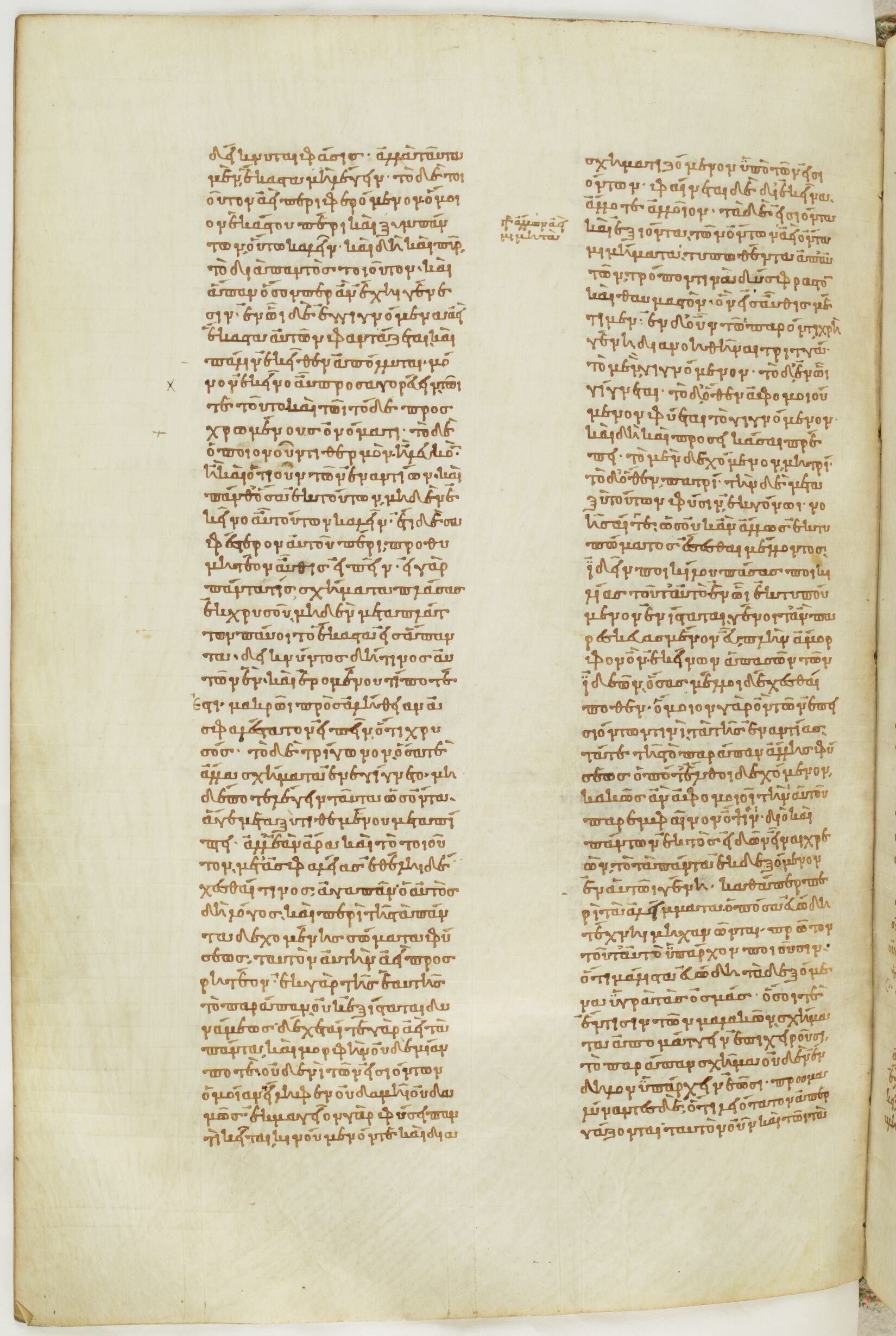
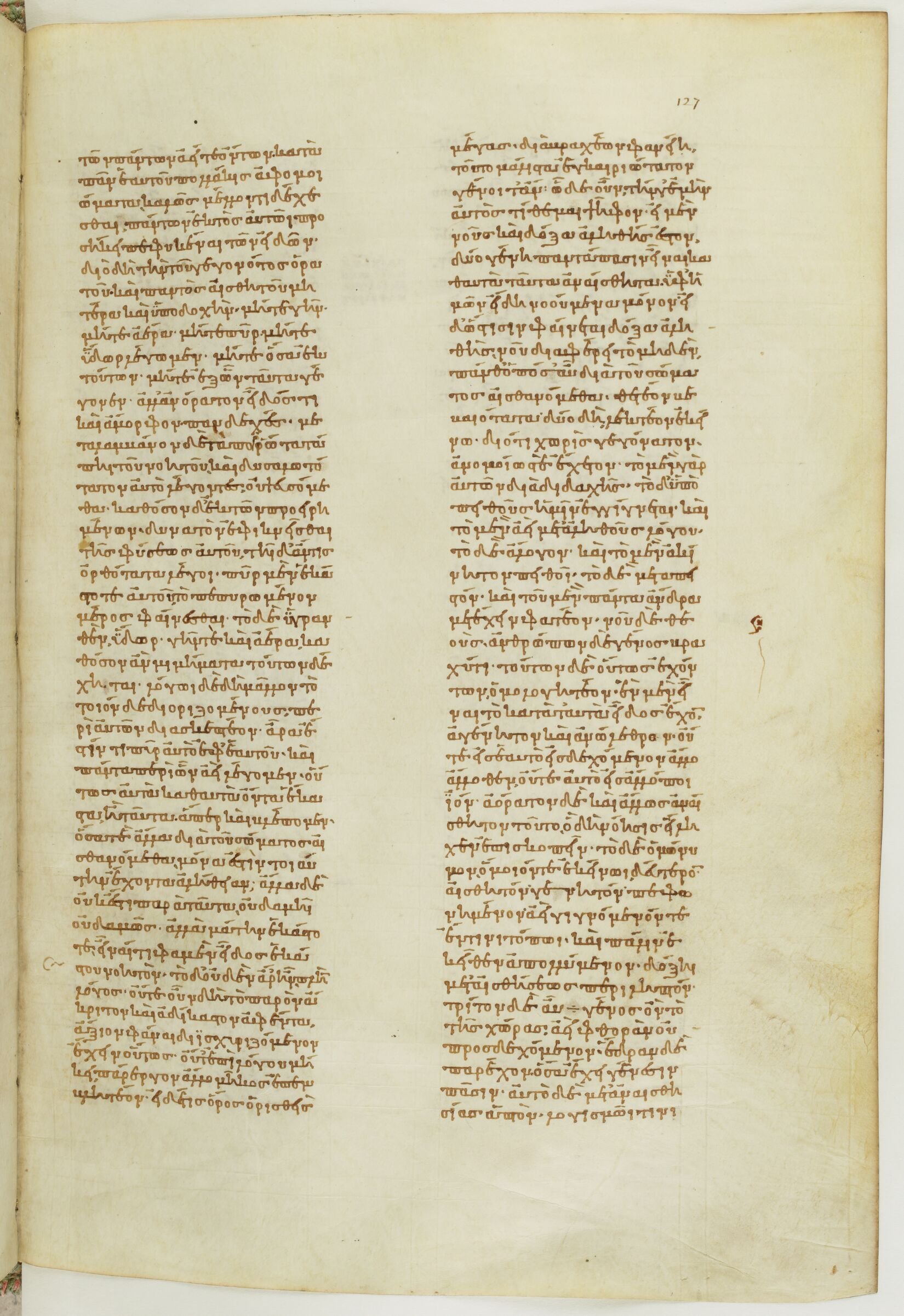
The manuscript is Paris, Bibliothèque nationale de France, grec 1807, known to editors as Plato A. It was copied in Constantinople around 850-875 by the scribe of the so-called philosophical collection, and is the oldest surviving medieval manuscript of the Timaeus and Critias (tetralogies VIII-IX: Clitophon, Republic, Timaeus, Critias, Minos, Laws, Epinomis, Letters). Each page has two columns of 44 lines. The Timaeus fills fol. 114r-144v and the Critias fol. 145r-151r.
On the manuscript this page of text runs over fol. 126v col. b to fol. 127r col. b. Each section below is linked to the folio side(s) that carry it. The mapping comes from reading the first words of every column on the images and finding them in Burnet's text: fol. 126v col. b begins ‹-σχηματιζόμενον ὑπὸ τῶν εἰσιόντων, φαίνεται δὲ› (Tim. 50c); fol. 127r col. a begins ‹τῶν πάντων ἀεί τε ὄντων κατὰ› (Tim. 51a); fol. 127r col. b begins ‹μέγας διὰ βραχέων φανείη, τοῦτο μάλιστα› (Tim. 51d).
The Greek is John Burnet's critical text (Oxford, 1902), not a transcription of this manuscript; the scribe's spelling, accents and occasional readings differ from it. The English is R. G. Bury's Loeb translation (1929).
How was this verified? (Provenance)
Where on the image
Tim. 51a stands in Paris gr. 1807, fol. 126v col. b to fol. 127r col. a. Checked on the image (column openings read on the BnF photographs and found in Burnet's text, quoted in Burnet's spelling): fol. 126v col. b begins ‹-σχηματιζόμενον ὑπὸ τῶν εἰσιόντων, φαίνεται δὲ› (Tim. 50c); fol. 127r col. a begins ‹τῶν πάντων ἀεί τε ὄντων κατὰ› (Tim. 51a).
ταὐτὸν οὖν καὶ τῷ τὰ τῶν πάντων ἀεί τε ὄντων κατὰ πᾶν ἑαυτοῦ πολλάκις ἀφομοιώματα καλῶς μέλλοντι δέχεσθαι πάντων ἐκτὸς αὐτῷ προσήκει πεφυκέναι τῶν εἰδῶν. διὸ δὴ τὴν τοῦ γεγονότος ὁρατοῦ καὶ πάντως αἰσθητοῦ μητέρα καὶ ὑποδοχὴν μήτε γῆν μήτε ἀέρα μήτε πῦρ μήτε ὕδωρ λέγωμεν, μήτε ὅσα ἐκ τούτων μήτε ἐξ ὧν ταῦτα γέγονεν· ἀλλʼ ἀνόρατον εἶδός τι καὶ ἄμορφον, πανδεχές, μεταλαμβάνον
So likewise it is right that the substance which is to be fitted to receive frequently over its whole extent the copies of all things intelligible and eternal should itself, of its own nature, be void of all the forms. Wherefore, let us not speak of her that is the Mother and Receptacle of this generated world, which is perceptible by sight and all the senses, by the name of earth or air or fire or water, or any aggregates or constituents thereof: rather, if we describe her as a Kind invisible and unshaped, all-receptive, and in some most perplexing and most baffling way partaking of the intelligible,
Where on the image
Tim. 51b stands in Paris gr. 1807, fol. 127r col. a. Checked on the image (column openings read on the BnF photographs and found in Burnet's text, quoted in Burnet's spelling): fol. 127r col. a begins ‹τῶν πάντων ἀεί τε ὄντων κατὰ› (Tim. 51a).
δὲ ἀπορώτατά πῃ τοῦ νοητοῦ καὶ δυσαλωτότατον αὐτὸ λέγοντες οὐ ψευσόμεθα. καθʼ ὅσον δʼ ἐκ τῶν προειρημένων δυνατὸν ἐφικνεῖσθαι τῆς φύσεως αὐτοῦ, τῇδʼ ἄν τις ὀρθότατα λέγοι· πῦρ μὲν ἑκάστοτε αὐτοῦ τὸ πεπυρωμένον μέρος φαίνεσθαι, τὸ δὲ ὑγρανθὲν ὕδωρ, γῆν τε καὶ ἀέρα καθʼ ὅσον ἂν μιμήματα τούτων δέχηται. λόγῳ δὲ δὴ μᾶλλον τὸ τοιόνδε διοριζομένους περὶ αὐτῶν διασκεπτέον· ἆρα ἔστιν τι πῦρ αὐτὸ ἐφʼ ἑαυτοῦ καὶ πάντα περὶ ὧν ἀεὶ λέγομεν οὕτως
we shall describe her truly. In so far as it is possible to arrive at the nature of this kind from the foregoing account, one may state it most correctly in this way. That part of it which is made fiery appears each time as fire, that which has been liquefied as water; and it appears as earth and air in so far as it receives copies of these. But let us investigate the matter by more exact reasoning, and consider this question. Does there exist any self-subsisting fire
Where on the image
Tim. 51c stands in Paris gr. 1807, fol. 127r col. a. Checked on the image (column openings read on the BnF photographs and found in Burnet's text, quoted in Burnet's spelling): fol. 127r col. a begins ‹τῶν πάντων ἀεί τε ὄντων κατὰ› (Tim. 51a).
αὐτὰ καθʼ αὑτὰ ὄντα ἕκαστα, ἢ ταῦτα ἅπερ καὶ βλέπομεν, ὅσα τε ἄλλα διὰ τοῦ σώματος αἰσθανόμεθα, μόνα ἐστὶν τοιαύτην ἔχοντα ἀλήθειαν, ἄλλα δὲ οὐκ ἔστι παρὰ ταῦτα οὐδαμῇ οὐδαμῶς, ἀλλὰ μάτην ἑκάστοτε εἶναί τί φαμεν εἶδος ἑκάστου νοητόν, τὸ δʼ οὐδὲν ἄρʼ ἦν πλὴν λόγος; οὔτε οὖν δὴ τὸ παρὸν ἄκριτον καὶ ἀδίκαστον ἀφέντα ἄξιον φάναι διισχυριζόμενον ἔχειν οὕτως, οὔτʼ ἐπὶ λόγου μήκει πάρεργον
or any of those other objects which we likewise term self-subsisting realities? Or is it only these things which we see, or otherwise perceive by means of bodily senses, that exist, possessed of sensible reality; beside which no other things exist anywhere or anyhow, and it is merely an idle assertion of ours that there always exists an intelligible Form of every object, whereas it is really nothing more than a verbal phrase? Now, on the one hand, it would be improper to dismiss the question before us without a trial and a verdict, and simply to asseverate that the fact is so; while, on the other hand, we ought not to burden a lengthy discourse with another subsidiary argument.
Where on the image
Tim. 51d stands in Paris gr. 1807, fol. 127r col. a to fol. 127r col. b. Checked on the image (column openings read on the BnF photographs and found in Burnet's text, quoted in Burnet's spelling): fol. 127r col. a begins ‹τῶν πάντων ἀεί τε ὄντων κατὰ› (Tim. 51a); fol. 127r col. b begins ‹μέγας διὰ βραχέων φανείη, τοῦτο μάλιστα› (Tim. 51d).
ἄλλο μῆκος ἐπεμβλητέον· εἰ δέ τις ὅρος ὁρισθεὶς μέγας διὰ βραχέων φανείη, τοῦτο μάλιστα ἐγκαιριώτατον γένοιτʼ ἄν. ὧδε οὖν τήν γʼ ἐμὴν αὐτὸς τίθεμαι ψῆφον. εἰ μὲν νοῦς καὶ δόξα ἀληθής ἐστον δύο γένη, παντάπασιν εἶναι καθʼ αὑτὰ ταῦτα, ἀναίσθητα ὑφʼ ἡμῶν εἴδη, νοούμενα μόνον· εἰ δʼ, ὥς τισιν φαίνεται, δόξα ἀληθὴς νοῦ διαφέρει τὸ μηδέν, πάνθʼ ὁπόσʼ αὖ διὰ τοῦ σώματος αἰσθανόμεθα θετέον βεβαιότατα.
If, however, it were possible to disclose briefly some main determining principle, that would best serve our purpose. This, then, is the view for which I, for my part, cast my vote. If Reason and True Opinion are two distinct Kinds, most certainly these self-subsisting Forms do exist, imperceptible by our senses, and objects of Reason only; whereas if, as appears to some, True Opinion differs in naught from Reason, then, on the contrary, all the things which we perceive by our bodily senses must be judged to be most stable.
Where on the image
Tim. 51e stands in Paris gr. 1807, fol. 127r col. b. Checked on the image (column openings read on the BnF photographs and found in Burnet's text, quoted in Burnet's spelling): fol. 127r col. b begins ‹μέγας διὰ βραχέων φανείη, τοῦτο μάλιστα› (Tim. 51d).
δύο δὴ λεκτέον ἐκείνω, διότι χωρὶς γεγόνατον ἀνομοίως τε ἔχετον. τὸ μὲν γὰρ αὐτῶν διὰ διδαχῆς, τὸ δʼ ὑπὸ πειθοῦς ἡμῖν ἐγγίγνεται· καὶ τὸ μὲν ἀεὶ μετʼ ἀληθοῦς λόγου, τὸ δὲ ἄλογον· καὶ τὸ μὲν ἀκίνητον πειθοῖ, τὸ δὲ μεταπειστόν· καὶ τοῦ μὲν πάντα ἄνδρα μετέχειν φατέον, νοῦ δὲ θεούς, ἀνθρώπων δὲ γένος βραχύ τι.
τούτων δὲ οὕτως ἐχόντων
Now these two Kinds must be declared to be two, because they have come into existence separately and are unlike in condition. For the one of them arises in us by teaching, the other by persuasion; and the one is always in company with true reasoning, whereas the other is irrational; and the one is immovable by persuasion, whereas the other is alterable by persuasion; and of the one we must assert that every man partakes, but of Reason only the gods and but a small class of men.
This being so, we must agree that One Kind
Notes
- Greek: John Burnet, Platonis Opera IV (Oxford, 1902), via Perseus canonical-greekLit; Burnet's text is a critical edition, so its wording can differ from the manuscript shown.
- English: R. G. Bury, Plato IX (Loeb Classical Library, 1929), via Perseus. Bury's footnotes are not reproduced. Quotation marks stand where Perseus marks quoted speech.
- Stephanus sections (a-e) are those of the 1578 Stephanus edition as given by Burnet and Bury; Bury's section breaks can fall a few words away from Burnet's because English word order differs.
Cite
Sources
- Source: Paris, BnF grec 1807 (Plato A, c. 850-875) fol. 126v-127r via BnF IIIF + Burnet's Greek (Perseus) + R. G. Bury's English (Loeb 1929, Perseus) (holding institution)
- Critical edition: Burnet, Platonis Opera IV (1902), via Perseus
← previous · → next · v cycle view · l back to library