Plato, Timaeus 52a-52e: Form, copy and space; the shaking of the receptacle
Introduction
Stephanus page 52 of Plato's Timaeus (52a-52e): Form, copy and space; the shaking of the receptacle.
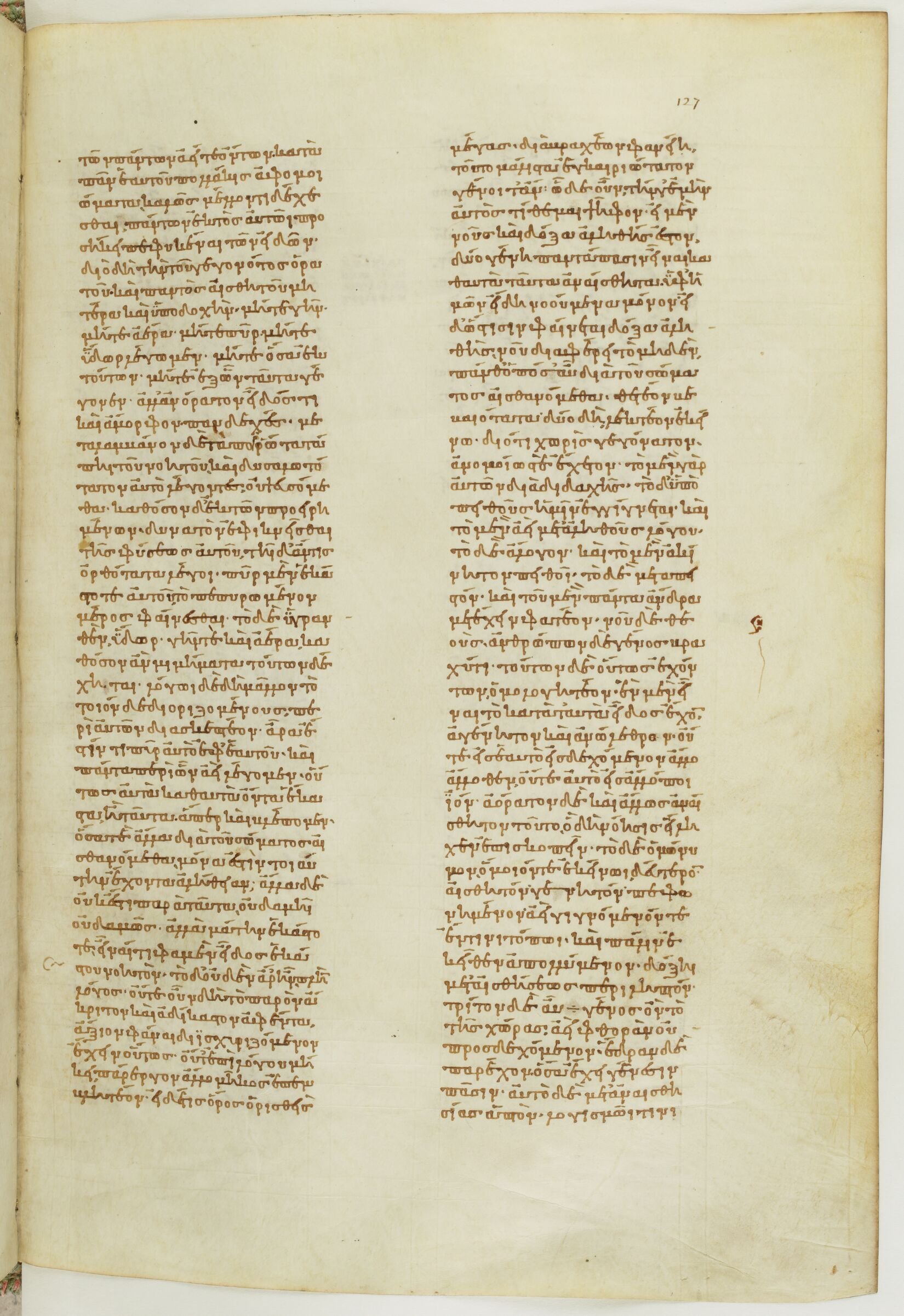
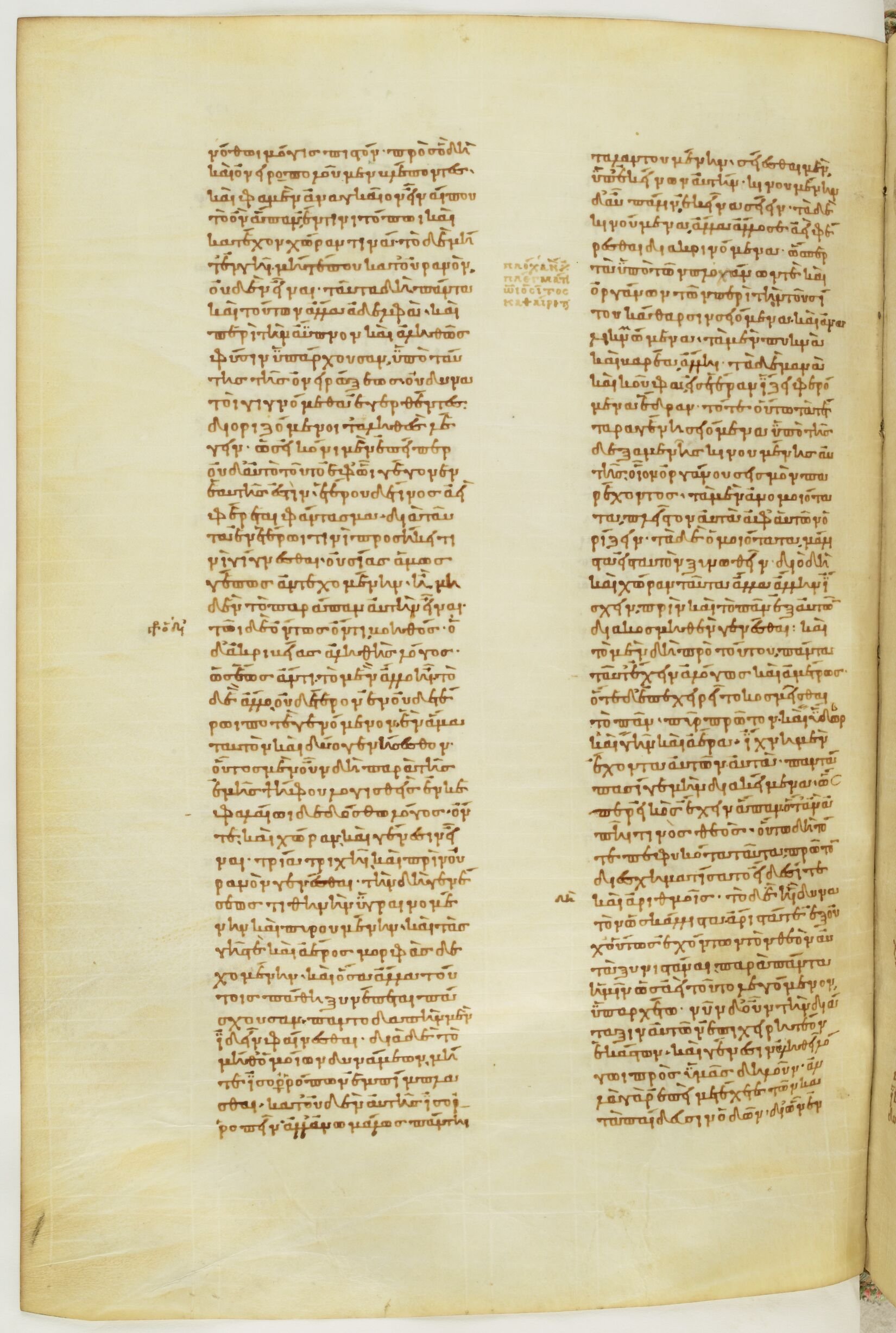
The manuscript is Paris, Bibliothèque nationale de France, grec 1807, known to editors as Plato A. It was copied in Constantinople around 850-875 by the scribe of the so-called philosophical collection, and is the oldest surviving medieval manuscript of the Timaeus and Critias (tetralogies VIII-IX: Clitophon, Republic, Timaeus, Critias, Minos, Laws, Epinomis, Letters). Each page has two columns of 44 lines. The Timaeus fills fol. 114r-144v and the Critias fol. 145r-151r.
On the manuscript this page of text runs over fol. 127r col. b to fol. 127v col. b. Each section below is linked to the folio side(s) that carry it. The mapping comes from reading the first words of every column on the images and finding them in Burnet's text: fol. 127r col. b begins ‹μέγας διὰ βραχέων φανείη, τοῦτο μάλιστα› (Tim. 51d); fol. 127v col. a begins ‹νόθῳ, μόγις πιστόν, πρὸς ὃ δὴ› (Tim. 52b); fol. 127v col. b begins ‹ταλαντουμένην σείεσθαι μὲν ὑπʼ ἐκείνων αὐτήν› (Tim. 52e).
The Greek is John Burnet's critical text (Oxford, 1902), not a transcription of this manuscript; the scribe's spelling, accents and occasional readings differ from it. The English is R. G. Bury's Loeb translation (1929).
How was this verified? (Provenance)
Where on the image
Tim. 52a stands in Paris gr. 1807, fol. 127r col. b. Checked on the image (column openings read on the BnF photographs and found in Burnet's text, quoted in Burnet's spelling): fol. 127r col. b begins ‹μέγας διὰ βραχέων φανείη, τοῦτο μάλιστα› (Tim. 51d).
ὁμολογητέον ἓν μὲν εἶναι τὸ κατὰ ταὐτὰ εἶδος ἔχον, ἀγέννητον καὶ ἀνώλεθρον, οὔτε εἰς ἑαυτὸ εἰσδεχόμενον ἄλλο ἄλλοθεν οὔτε αὐτὸ εἰς ἄλλο ποι ἰόν, ἀόρατον δὲ καὶ ἄλλως ἀναίσθητον, τοῦτο ὃ δὴ νόησις εἴληχεν ἐπισκοπεῖν· τὸ δὲ ὁμώνυμον ὅμοιόν τε ἐκείνῳ δεύτερον, αἰσθητόν, γεννητόν, πεφορημένον ἀεί, γιγνόμενόν τε ἔν τινι τόπῳ καὶ πάλιν ἐκεῖθεν ἀπολλύμενον, δόξῃ μετʼ αἰσθήσεως περιληπτόν· τρίτον δὲ αὖ γένος ὂν τὸ τῆς χώρας ἀεί, φθορὰν οὐ προσδεχόμενον,
is the self-identical Form, ungenerated and indestructible, neither receiving into itself any other from any quarter nor itself passing anywhither into another, invisible and in all ways imperceptible by sense, it being the object which it is the province of Reason to contemplate; and a second Kind is that which is named after the former and similar thereto, an object perceptible by sense, generated, ever carried about, becoming in a place and out of it again perishing, apprehensible by Opinion with the aid of Sensation; and a third Kind is ever-existing Place,
Where on the image
Tim. 52b stands in Paris gr. 1807, fol. 127r col. b to fol. 127v col. a. Checked on the image (column openings read on the BnF photographs and found in Burnet's text, quoted in Burnet's spelling): fol. 127r col. b begins ‹μέγας διὰ βραχέων φανείη, τοῦτο μάλιστα› (Tim. 51d); fol. 127v col. a begins ‹νόθῳ, μόγις πιστόν, πρὸς ὃ δὴ› (Tim. 52b).
ἕδραν δὲ παρέχον ὅσα ἔχει γένεσιν πᾶσιν, αὐτὸ δὲ μετʼ ἀναισθησίας ἁπτὸν λογισμῷ τινι νόθῳ, μόγις πιστόν, πρὸς ὃ δὴ καὶ ὀνειροπολοῦμεν βλέποντες καί φαμεν ἀναγκαῖον εἶναί που τὸ ὂν ἅπαν ἔν τινι τόπῳ καὶ κατέχον χώραν τινά, τὸ δὲ μήτʼ ἐν γῇ μήτε που κατʼ οὐρανὸν οὐδὲν εἶναι. ταῦτα δὴ πάντα καὶ τούτων ἄλλα ἀδελφὰ καὶ περὶ τὴν ἄυπνον καὶ ἀληθῶς φύσιν ὑπάρχουσαν ὑπὸ ταύτης τῆς ὀνειρώξεως
which admits not of destruction, and provides room for all things that have birth, itself being apprehensible by a kind of bastard reasoning by the aid of non-sensation, barely an object of belief; for when we regard this we dimly dream and affirm that it is somehow necessary that all that exists should exist in some spot and occupying some place, and that that which is neither on earth nor anywhere in the Heaven is nothing. So because of all these and other kindred notions, we are unable also on waking up to distinguish clearly the unsleeping and truly subsisting substance, owing to our dreamy condition,
Where on the image
Tim. 52c stands in Paris gr. 1807, fol. 127v col. a. Checked on the image (column openings read on the BnF photographs and found in Burnet's text, quoted in Burnet's spelling): fol. 127v col. a begins ‹νόθῳ, μόγις πιστόν, πρὸς ὃ δὴ› (Tim. 52b).
οὐ δυνατοὶ γιγνόμεθα ἐγερθέντες διοριζόμενοι τἀληθὲς λέγειν, ὡς εἰκόνι μέν, ἐπείπερ οὐδʼ αὐτὸ τοῦτο ἐφʼ ᾧ γέγονεν ἑαυτῆς ἐστιν, ἑτέρου δέ τινος ἀεὶ φέρεται φάντασμα, διὰ ταῦτα ἐν ἑτέρῳ προσήκει τινὶ γίγνεσθαι, οὐσίας ἁμωσγέπως ἀντεχομένην, ἢ μηδὲν τὸ παράπαν αὐτὴν εἶναι, τῷ δὲ ὄντως ὄντι βοηθὸς ὁ διʼ ἀκριβείας ἀληθὴς λόγος, ὡς ἕως ἄν τι τὸ μὲν ἄλλο ᾖ, τὸ δὲ ἄλλο, οὐδέτερον ἐν οὐδετέρῳ ποτὲ γενόμενον
or to state the truth—how that it belongs to a copy—seeing that it has not for its own even that substance for which it came into being, but fleets ever as a phantom of something else—to come into existence in some other thing, clinging to existence as best it may, on pain of being nothing at all; whereas to the aid of the really existent there comes the accurately true argument, that so long as one thing is one thing, and another something different, neither of the two will ever come to exist in the other so that the same thing becomes simultaneously
Where on the image
Tim. 52d stands in Paris gr. 1807, fol. 127v col. a. Checked on the image (column openings read on the BnF photographs and found in Burnet's text, quoted in Burnet's spelling): fol. 127v col. a begins ‹νόθῳ, μόγις πιστόν, πρὸς ὃ δὴ› (Tim. 52b).
ἓν ἅμα ταὐτὸν καὶ δύο γενήσεσθον. οὗτος μὲν οὖν δὴ παρὰ τῆς ἐμῆς ψήφου λογισθεὶς ἐν κεφαλαίῳ δεδόσθω λόγος, ὄν τε καὶ χώραν καὶ γένεσιν εἶναι, τρία τριχῇ, καὶ πρὶν οὐρανὸν γενέσθαι· τὴν δὲ δὴ γενέσεως τιθήνην ὑγραινομένην καὶ πυρουμένην καὶ τὰς γῆς τε καὶ ἀέρος μορφὰς δεχομένην, καὶ ὅσα ἄλλα τούτοις πάθη συνέπεται
both one and two. Let this, then, be, according to my verdict, a reasoned account of the matter summarily stated,—that Being and Place and Becoming were existing, three distinct things, even before the Heaven came into existence; and that the Nurse of Becoming, being liquefied and ignified and receiving also the forms of earth and of air, and submitting to all the other affections which accompany these,
Where on the image
Tim. 52e stands in Paris gr. 1807, fol. 127v col. a to fol. 127v col. b. Checked on the image (column openings read on the BnF photographs and found in Burnet's text, quoted in Burnet's spelling): fol. 127v col. a begins ‹νόθῳ, μόγις πιστόν, πρὸς ὃ δὴ› (Tim. 52b); fol. 127v col. b begins ‹ταλαντουμένην σείεσθαι μὲν ὑπʼ ἐκείνων αὐτήν› (Tim. 52e).
πάσχουσαν, παντοδαπὴν μὲν ἰδεῖν φαίνεσθαι, διὰ δὲ τὸ μήθʼ ὁμοίων δυνάμεων μήτε ἰσορρόπων ἐμπίμπλασθαι κατʼ οὐδὲν αὐτῆς ἰσορροπεῖν, ἀλλʼ ἀνωμάλως πάντῃ ταλαντουμένην σείεσθαι μὲν ὑπʼ ἐκείνων αὐτήν, κινουμένην δʼ αὖ πάλιν ἐκεῖνα σείειν·
τὰ δὲ κινούμενα ἄλλα ἄλλοσε ἀεὶ φέρεσθαι διακρινόμενα, ὥσπερ τὰ ὑπὸ τῶν πλοκάνων τε καὶ ὀργάνων τῶν περὶ τὴν τοῦ σίτου κάθαρσιν σειόμενα καὶ
exhibits every variety of appearance; but owing to being filled with potencies that are neither similar nor balanced, in no part of herself is she equally balanced, but sways unevenly in every part, and is herself shaken by these forms and shakes them in turn as she is moved.
And the forms, as they are moved, fly continually in various directions and are dissipated; just as the particles that are shaken and winnowed by the sieves and other instruments used for the cleansing of corn fall in one place if they are solid and heavy,
Notes
- Greek: John Burnet, Platonis Opera IV (Oxford, 1902), via Perseus canonical-greekLit; Burnet's text is a critical edition, so its wording can differ from the manuscript shown.
- English: R. G. Bury, Plato IX (Loeb Classical Library, 1929), via Perseus. Bury's footnotes are not reproduced. Quotation marks stand where Perseus marks quoted speech.
- Stephanus sections (a-e) are those of the 1578 Stephanus edition as given by Burnet and Bury; Bury's section breaks can fall a few words away from Burnet's because English word order differs.
Cite
Sources
- Source: Paris, BnF grec 1807 (Plato A, c. 850-875) fol. 127r-127v via BnF IIIF + Burnet's Greek (Perseus) + R. G. Bury's English (Loeb 1929, Perseus) (holding institution)
- Critical edition: Burnet, Platonis Opera IV (1902), via Perseus
← previous · → next · v cycle view · l back to library