Plato, Timaeus 53a-53e: the god gives the elements shapes; the two kinds of triangle
Introduction
Stephanus page 53 of Plato's Timaeus (53a-53e): the god gives the elements shapes; the two kinds of triangle.
The manuscript is Paris, Bibliothèque nationale de France, grec 1807, known to editors as Plato A. It was copied in Constantinople around 850-875 by the scribe of the so-called philosophical collection, and is the oldest surviving medieval manuscript of the Timaeus and Critias (tetralogies VIII-IX: Clitophon, Republic, Timaeus, Critias, Minos, Laws, Epinomis, Letters). Each page has two columns of 44 lines. The Timaeus fills fol. 114r-144v and the Critias fol. 145r-151r.
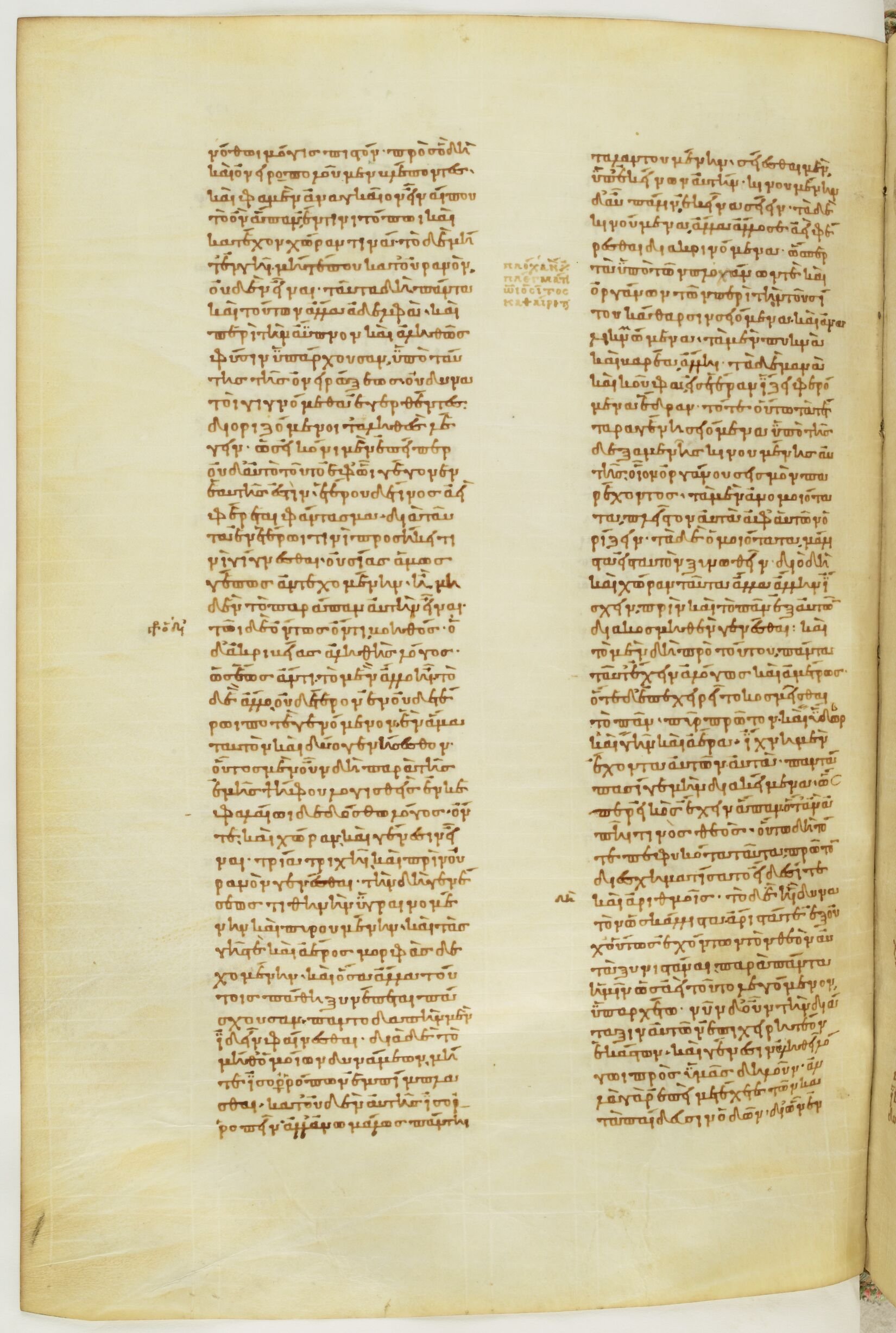
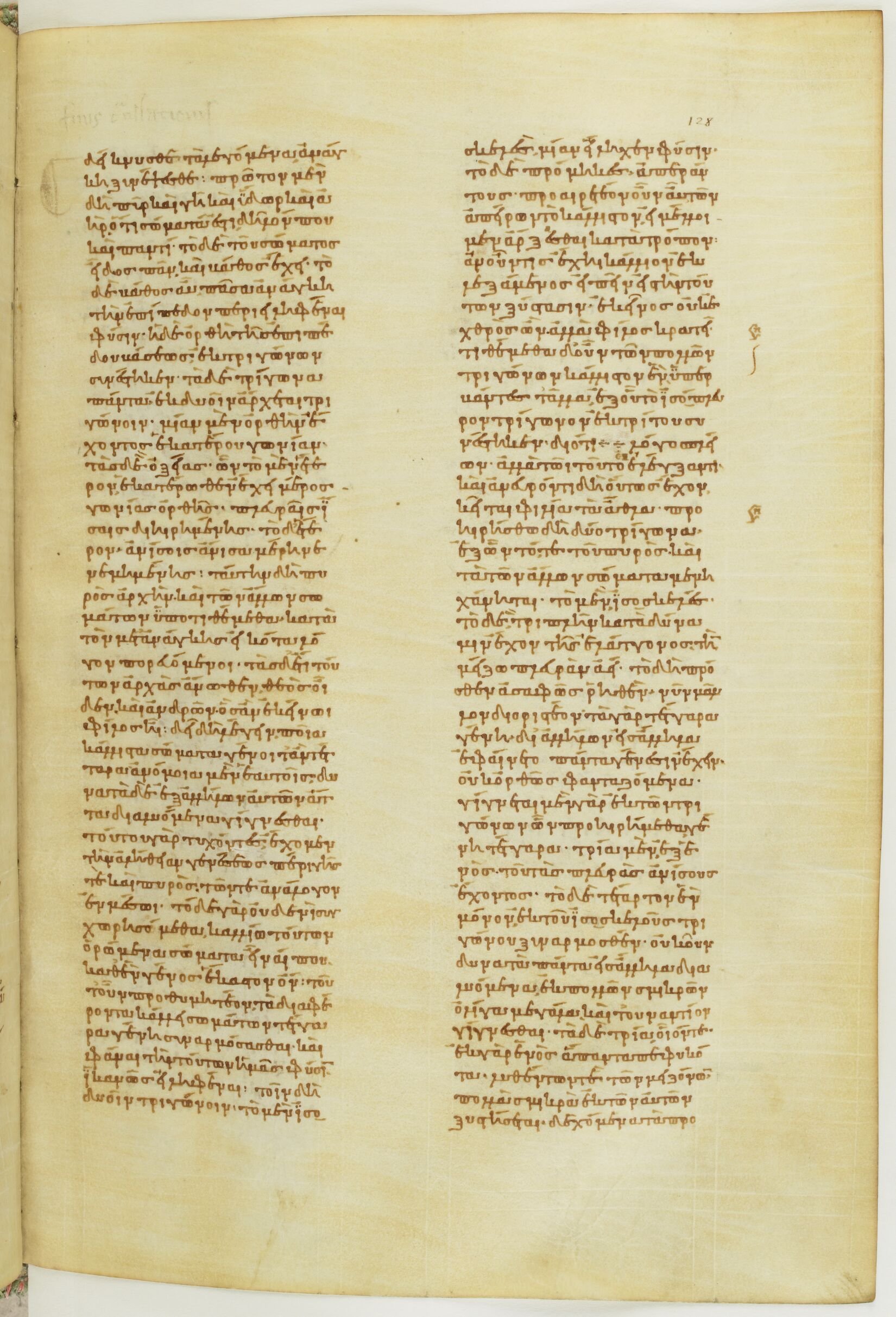
On the manuscript this page of text runs over fol. 127v col. b to fol. 128r col. a. Each section below is linked to the folio side(s) that carry it. The mapping comes from reading the first words of every column on the images and finding them in Burnet's text: fol. 127v col. b begins ‹ταλαντουμένην σείεσθαι μὲν ὑπʼ ἐκείνων αὐτήν› (Tim. 52e); fol. 128r col. a begins ‹διʼ ὧν ἐνδείκνυσθαι τὰ λεγόμενα ἀνάγκη› (Tim. 53c).
The Greek is John Burnet's critical text (Oxford, 1902), not a transcription of this manuscript; the scribe's spelling, accents and occasional readings differ from it. The English is R. G. Bury's Loeb translation (1929).
How was this verified? (Provenance)
Where on the image
Tim. 53a stands in Paris gr. 1807, fol. 127v col. b. Checked on the image (column openings read on the BnF photographs and found in Burnet's text, quoted in Burnet's spelling): fol. 127v col. b begins ‹ταλαντουμένην σείεσθαι μὲν ὑπʼ ἐκείνων αὐτήν› (Tim. 52e).
ἀνικμώμενα τὰ μὲν πυκνὰ καὶ βαρέα ἄλλῃ, τὰ δὲ μανὰ καὶ κοῦφα εἰς ἑτέραν ἵζει φερόμενα ἕδραν· τότε οὕτω τὰ τέτταρα γένη σειόμενα ὑπὸ τῆς δεξαμενῆς, κινουμένης αὐτῆς οἷον ὀργάνου σεισμὸν παρέχοντος, τὰ μὲν ἀνομοιότατα πλεῖστον αὐτὰ ἀφʼ αὑτῶν ὁρίζειν, τὰ δὲ ὁμοιότατα μάλιστα εἰς ταὐτὸν συνωθεῖν, διὸ δὴ καὶ χώραν ταῦτα ἄλλα ἄλλην ἴσχειν, πρὶν καὶ τὸ πᾶν ἐξ αὐτῶν διακοσμηθὲν γενέσθαι. καὶ τὸ μὲν δὴ πρὸ τούτου πάντα ταῦτʼ εἶχεν ἀλόγως καὶ ἀμέτρως·
but fly off and settle elsewhere if they are spongy and light. So it was also with the Four Kinds when shaken by the Recipient: her motion, like an instrument which causes shaking, was separating farthest from one another the dissimilar, and pushing most closely together the similar; wherefore also these Kinds occupied different places even before that the Universe was organized and generated out of them. Before that time, in truth, all these things were in a state devoid of reason or measure, but when the work of setting in order this Universe was being undertaken,
Where on the image
Tim. 53b stands in Paris gr. 1807, fol. 127v col. b. Checked on the image (column openings read on the BnF photographs and found in Burnet's text, quoted in Burnet's spelling): fol. 127v col. b begins ‹ταλαντουμένην σείεσθαι μὲν ὑπʼ ἐκείνων αὐτήν› (Tim. 52e).
ὅτε δʼ ἐπεχειρεῖτο κοσμεῖσθαι τὸ πᾶν, πῦρ πρῶτον καὶ ὕδωρ καὶ γῆν καὶ ἀέρα, ἴχνη μὲν ἔχοντα αὑτῶν ἄττα, παντάπασί γε μὴν διακείμενα ὥσπερ εἰκὸς ἔχειν ἅπαν ὅταν ἀπῇ τινος θεός, οὕτω δὴ τότε πεφυκότα ταῦτα πρῶτον διεσχηματίσατο εἴδεσί τε καὶ ἀριθμοῖς. τὸ δὲ ᾗ δυνατὸν ὡς κάλλιστα ἄριστά τε ἐξ οὐχ οὕτως ἐχόντων τὸν θεὸν αὐτὰ συνιστάναι, παρὰ πάντα ἡμῖν ὡς ἀεὶ τοῦτο λεγόμενον ὑπαρχέτω· νῦν δʼ οὖν τὴν διάταξιν αὐτῶν ἐπιχειρητέον ἑκάστων καὶ γένεσιν
fire and water and earth and air, although possessing some traces of their own nature, were yet so disposed as everything is likely to be in the absence of God; and inasmuch as this was then their natural condition, God began by first marking them out into shapes by means of forms and numbers. And that God constructed them, so far as He could, to be as fair and good as possible, whereas they had been otherwise,—this above all else must always be postulated in our account. Now, however, it is the disposition and origin
Where on the image
Tim. 53c stands in Paris gr. 1807, fol. 127v col. b to fol. 128r col. a. Checked on the image (column openings read on the BnF photographs and found in Burnet's text, quoted in Burnet's spelling): fol. 127v col. b begins ‹ταλαντουμένην σείεσθαι μὲν ὑπʼ ἐκείνων αὐτήν› (Tim. 52e); fol. 128r col. a begins ‹διʼ ὧν ἐνδείκνυσθαι τὰ λεγόμενα ἀνάγκη› (Tim. 53c).
ἀήθει λόγῳ πρὸς ὑμᾶς δηλοῦν, ἀλλὰ γὰρ ἐπεὶ μετέχετε τῶν κατὰ παίδευσιν ὁδῶν διʼ ὧν ἐνδείκνυσθαι τὰ λεγόμενα ἀνάγκη, συνέψεσθε. πρῶτον μὲν δὴ πῦρ καὶ γῆ καὶ ὕδωρ καὶ ἀὴρ ὅτι σώματά ἐστι, δῆλόν που καὶ παντί· τὸ δὲ τοῦ σώματος εἶδος πᾶν καὶ βάθος ἔχει. τὸ δὲ βάθος αὖ πᾶσα ἀνάγκη τὴν ἐπίπεδον περιειληφέναι φύσιν· ἡ δὲ ὀρθὴ τῆς ἐπιπέδου βάσεως ἐκ τριγώνων συνέστηκεν. τὰ δὲ τρίγωνα πάντα ἐκ δυοῖν ἄρχεται
of each of these Kinds which I must endeavor to explain to you in an exposition of an unusual type; yet, inasmuch as you have some acquaintance with the technical method which I must necessarily employ in my exposition, you will follow me. In the first place, then, it is plain I presume to everyone that fire and earth and water and air are solid bodies; and the form of a body, in every case, possesses depth also. Further, it is absolutely necessary that depth should be bounded by a plane surface; and the rectilinear plane is composed of triangles.
Where on the image
Tim. 53d stands in Paris gr. 1807, fol. 128r col. a. Checked on the image (column openings read on the BnF photographs and found in Burnet's text, quoted in Burnet's spelling): fol. 128r col. a begins ‹διʼ ὧν ἐνδείκνυσθαι τὰ λεγόμενα ἀνάγκη› (Tim. 53c).
τριγώνοιν, μίαν μὲν ὀρθὴν ἔχοντος ἑκατέρου γωνίαν, τὰς δὲ ὀξείας· ὧν τὸ μὲν ἕτερον ἑκατέρωθεν ἔχει μέρος γωνίας ὀρθῆς πλευραῖς ἴσαις διῃρημένης, τὸ δʼ ἕτερον ἀνίσοις ἄνισα μέρη νενεμημένης. ταύτην δὴ πυρὸς ἀρχὴν καὶ τῶν ἄλλων σωμάτων ὑποτιθέμεθα κατὰ τὸν μετʼ ἀνάγκης εἰκότα λόγον πορευόμενοι· τὰς δʼ ἔτι τούτων ἀρχὰς ἄνωθεν θεὸς οἶδεν καὶ ἀνδρῶν ὃς ἂν ἐκείνῳ φίλος ᾖ. δεῖ δὴ λέγειν ποῖα
Now all triangles derive their origin from two triangles, each having one angle right and the others acute; and the one of these triangles has on each side half a right angle marked off by equal sides, while the other has the right angle divided into unequal parts by unequal sides. These we lay down as the principles of fire and all the other bodies, proceeding according to a method in which the probable is combined with the necessary; but the principles which are still higher than these are known only to God and the man who is dear to God.
Where on the image
Tim. 53e stands in Paris gr. 1807, fol. 128r col. a. Checked on the image (column openings read on the BnF photographs and found in Burnet's text, quoted in Burnet's spelling): fol. 128r col. a begins ‹διʼ ὧν ἐνδείκνυσθαι τὰ λεγόμενα ἀνάγκη› (Tim. 53c).
κάλλιστα σώματα γένοιτʼ ἂν τέτταρα, ἀνόμοια μὲν ἑαυτοῖς, δυνατὰ δὲ ἐξ ἀλλήλων αὐτῶν ἄττα διαλυόμενα γίγνεσθαι· τούτου γὰρ τυχόντες ἔχομεν τὴν ἀλήθειαν γενέσεως πέρι γῆς τε καὶ πυρὸς τῶν τε ἀνὰ λόγον ἐν μέσῳ. τόδε γὰρ οὐδενὶ συγχωρησόμεθα, καλλίω τούτων ὁρώμενα σώματα εἶναί που καθʼ ἓν γένος ἕκαστον ὄν. τοῦτʼ οὖν προθυμητέον, τὰ διαφέροντα κάλλει σωμάτων τέτταρα γένη συναρμόσασθαι καὶ φάναι τὴν τούτων ἡμᾶς φύσιν ἱκανῶς εἰληφέναι.
We must now declare what will be the four fairest bodies, dissimilar to one another, but capable in part of being produced out of one another by means of dissolution; for if we succeed herein we shall grasp the truth concerning the generation of earth and fire and the mean proportionals. For to no one will we concede that fairer bodies than these, each distinct of its kind, are anywhere to be seen. Wherefore we must earnestly endeavor to frame together these four kinds of bodies which excel in beauty, and to maintain that we have apprehended
Notes
- Greek: John Burnet, Platonis Opera IV (Oxford, 1902), via Perseus canonical-greekLit; Burnet's text is a critical edition, so its wording can differ from the manuscript shown.
- English: R. G. Bury, Plato IX (Loeb Classical Library, 1929), via Perseus. Bury's footnotes are not reproduced. Quotation marks stand where Perseus marks quoted speech.
- Stephanus sections (a-e) are those of the 1578 Stephanus edition as given by Burnet and Bury; Bury's section breaks can fall a few words away from Burnet's because English word order differs.
Cite
Sources
- Source: Paris, BnF grec 1807 (Plato A, c. 850-875) fol. 127v-128r via BnF IIIF + Burnet's Greek (Perseus) + R. G. Bury's English (Loeb 1929, Perseus) (holding institution)
- Critical edition: Burnet, Platonis Opera IV (1902), via Perseus
← previous · → next · v cycle view · l back to library