Plato, Timaeus 54a-54e: the most beautiful triangles; the construction of the solids
Introduction
Stephanus page 54 of Plato's Timaeus (54a-54e): the most beautiful triangles; the construction of the solids.
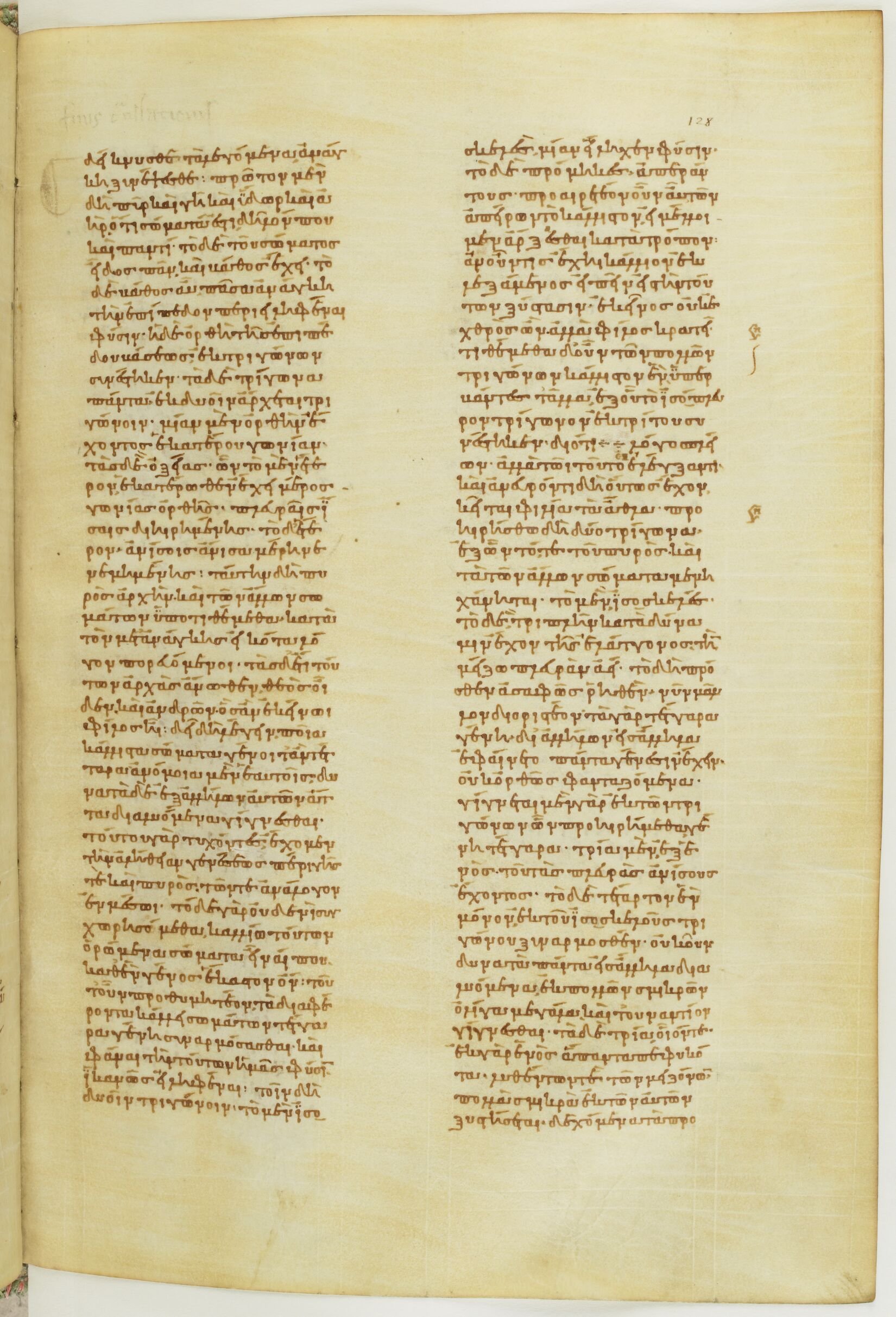
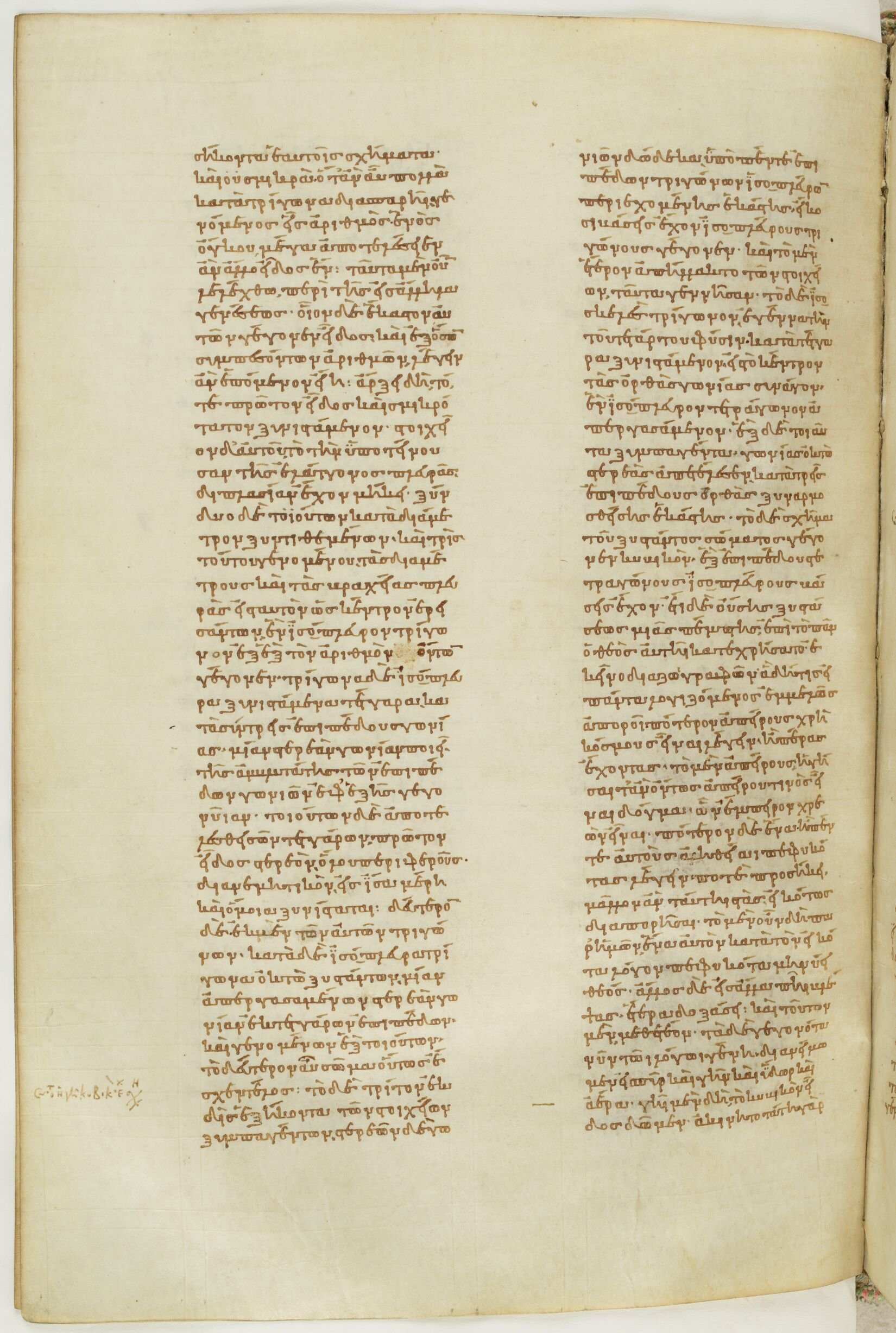
The manuscript is Paris, Bibliothèque nationale de France, grec 1807, known to editors as Plato A. It was copied in Constantinople around 850-875 by the scribe of the so-called philosophical collection, and is the oldest surviving medieval manuscript of the Timaeus and Critias (tetralogies VIII-IX: Clitophon, Republic, Timaeus, Critias, Minos, Laws, Epinomis, Letters). Each page has two columns of 44 lines. The Timaeus fills fol. 114r-144v and the Critias fol. 145r-151r.
On the manuscript this page of text runs over fol. 128r col. a to fol. 128v col. a. Each section below is linked to the folio side(s) that carry it. The mapping comes from reading the first words of every column on the images and finding them in Burnet's text: fol. 128r col. a begins ‹διʼ ὧν ἐνδείκνυσθαι τὰ λεγόμενα ἀνάγκη› (Tim. 53c); fol. 128r col. b begins ‹μίαν εἴληχεν φύσιν, τὸ δὲ πρόμηκες› (Tim. 54a); fol. 128v col. a begins ‹-σήκοντα ἑαυτοῖς σχήματα, καὶ σμικρὰ ὅταν› (Tim. 54c).
The Greek is John Burnet's critical text (Oxford, 1902), not a transcription of this manuscript; the scribe's spelling, accents and occasional readings differ from it. The English is R. G. Bury's Loeb translation (1929).
How was this verified? (Provenance)
Where on the image
Tim. 54a stands in Paris gr. 1807, fol. 128r col. a to fol. 128r col. b. Checked on the image (column openings read on the BnF photographs and found in Burnet's text, quoted in Burnet's spelling): fol. 128r col. a begins ‹διʼ ὧν ἐνδείκνυσθαι τὰ λεγόμενα ἀνάγκη› (Tim. 53c); fol. 128r col. b begins ‹μίαν εἴληχεν φύσιν, τὸ δὲ πρόμηκες› (Tim. 54a).
τοῖν δὴ δυοῖν τριγώνοιν τὸ μὲν ἰσοσκελὲς μίαν εἴληχεν φύσιν, τὸ δὲ πρόμηκες ἀπεράντους· προαιρετέον οὖν αὖ τῶν ἀπείρων τὸ κάλλιστον, εἰ μέλλομεν ἄρξεσθαι κατὰ τρόπον. ἂν οὖν τις ἔχῃ κάλλιον ἐκλεξάμενος εἰπεῖν εἰς τὴν τούτων σύστασιν, ἐκεῖνος οὐκ ἐχθρὸς ὢν ἀλλὰ φίλος κρατεῖ· τιθέμεθα δʼ οὖν τῶν πολλῶν τριγώνων κάλλιστον ἕν, ὑπερβάντες τἆλλα, ἐξ οὗ τὸ ἰσόπλευρον τρίγωνον ἐκ τρίτου συνέστηκεν.
their nature adequately.
Now of the two triangles, the isosceles possesses one single nature, but the scalene an infinite number; and of these infinite natures we must select the fairest, if we mean to make a suitable beginning. If, then, anyone can claim that he has chosen one that is fairer for the construction of these bodies, he, as friend rather than foe, is the victor. We, however, shall pass over all the rest and postulate as the fairest of the triangles that triangle out of which, when two are conjoined,
Where on the image
Tim. 54b stands in Paris gr. 1807, fol. 128r col. b. Checked on the image (column openings read on the BnF photographs and found in Burnet's text, quoted in Burnet's spelling): fol. 128r col. b begins ‹μίαν εἴληχεν φύσιν, τὸ δὲ πρόμηκες› (Tim. 54a).
διότι δέ, λόγος πλείων· ἀλλὰ τῷ τοῦτο ἐλέγξαντι καὶ ἀνευρόντι δὴ οὕτως ἔχον κεῖται φίλια τὰ ἆθλα. προῃρήσθω δὴ δύο τρίγωνα ἐξ ὧν τό τε τοῦ πυρὸς καὶ τὰ τῶν ἄλλων σώματα μεμηχάνηται, τὸ μὲν ἰσοσκελές, τὸ δὲ τριπλῆν κατὰ δύναμιν ἔχον τῆς ἐλάττονος τὴν μείζω πλευρὰν ἀεί. τὸ δὴ πρόσθεν ἀσαφῶς ῥηθὲν νῦν μᾶλλον διοριστέον. τὰ γὰρ τέτταρα γένη διʼ ἀλλήλων εἰς ἄλληλα ἐφαίνετο πάντα γένεσιν ἔχειν, οὐκ ὀρθῶς φανταζόμενα· γίγνεται μὲν γὰρ ἐκ
the equilateral triangle is constructed as a third. The reason why is a longer story; but should anyone refute us and discover that it is not so, we begrudge him not the prize. Accordingly, let these two triangles be selected as those wherefrom are contrived the bodies of fire and of the other elements,— one being the isosceles, and the other that which always has the square on its greater side three times the square on the lesser side. Moreover, a point about which our previous statement was obscure must now be defined more clearly. It appeared as if the four Kinds,
Where on the image
Tim. 54c stands in Paris gr. 1807, fol. 128r col. b to fol. 128v col. a. Checked on the image (column openings read on the BnF photographs and found in Burnet's text, quoted in Burnet's spelling): fol. 128r col. b begins ‹μίαν εἴληχεν φύσιν, τὸ δὲ πρόμηκες› (Tim. 54a); fol. 128v col. a begins ‹-σήκοντα ἑαυτοῖς σχήματα, καὶ σμικρὰ ὅταν› (Tim. 54c).
τῶν τριγώνων ὧν προῃρήμεθα γένη τέτταρα, τρία μὲν ἐξ ἑνὸς τοῦ τὰς πλευρὰς ἀνίσους ἔχοντος, τὸ δὲ τέταρτον ἓν μόνον ἐκ τοῦ ἰσοσκελοῦς τριγώνου συναρμοσθέν. οὔκουν δυνατὰ πάντα εἰς ἄλληλα διαλυόμενα ἐκ πολλῶν σμικρῶν ὀλίγα μεγάλα καὶ τοὐναντίον γίγνεσθαι, τὰ δὲ τρία οἷόν τε· ἐκ γὰρ ἑνὸς ἅπαντα πεφυκότα λυθέντων τε τῶν μειζόνων πολλὰ σμικρὰ ἐκ τῶν αὐτῶν συστήσεται, δεχόμενα τὰ προσήκοντα ἑαυτοῖς σχήματα, καὶ σμικρὰ ὅταν αὖ πολλὰ κατὰ
in being generated, all passed through one another into one another, but this appearance was deceptive. For out of the triangles which we have selected four Kinds are generated, three of them out of that one triangle which has its sides unequal, and the fourth Kind alone composed of the isosceles triangle. Consequently, they are not all capable of being dissolved into one another so as to form a few large bodies composed of many small ones, or the converse; but three of them do admit of this process. For these three are all naturally compounded of one triangle, so that when the larger bodies are dissolved many small ones will form themselves from these same bodies, receiving the shapes that befit them;
Where on the image
Tim. 54d stands in Paris gr. 1807, fol. 128v col. a. Checked on the image (column openings read on the BnF photographs and found in Burnet's text, quoted in Burnet's spelling): fol. 128v col. a begins ‹-σήκοντα ἑαυτοῖς σχήματα, καὶ σμικρὰ ὅταν› (Tim. 54c).
τὰ τρίγωνα διασπαρῇ, γενόμενος εἷς ἀριθμὸς ἑνὸς ὄγκου μέγα ἀποτελέσειεν ἂν ἄλλο εἶδος ἕν. ταῦτα μὲν οὖν λελέχθω περὶ τῆς εἰς ἄλληλα γενέσεως· οἷον δὲ ἕκαστον αὐτῶν γέγονεν εἶδος καὶ ἐξ ὅσων συμπεσόντων ἀριθμῶν, λέγειν ἂν ἑπόμενον εἴη. ἄρξει δὴ τό τε πρῶτον εἶδος καὶ σμικρότατον συνιστάμενον, στοιχεῖον δʼ αὐτοῦ τὸ τὴν ὑποτείνουσαν τῆς ἐλάττονος πλευρᾶς διπλασίαν ἔχον μήκει· σύνδυο δὲ τοιούτων κατὰ διάμετρον συντιθεμένων καὶ τρὶς τούτου
and conversely, when many small bodies are resolved into their triangles they will produce, when unified, one single large mass of another Kind. So let thus much be declared concerning their generation into one another. In the next place we have to explain the form in which each Kind has come to exist and the numbers from which it is compounded. First will come that form which is primary and has the smallest components, and the element thereof is that triangle which has its hypotenuse twice as long as its lesser side. And when a pair of such triangles are joined along the line of the hypotenuse, and this is done thrice, by drawing the hypotenuses
Where on the image
Tim. 54e stands in Paris gr. 1807, fol. 128v col. a. Checked on the image (column openings read on the BnF photographs and found in Burnet's text, quoted in Burnet's spelling): fol. 128v col. a begins ‹-σήκοντα ἑαυτοῖς σχήματα, καὶ σμικρὰ ὅταν› (Tim. 54c).
γενομένου, τὰς διαμέτρους καὶ τὰς βραχείας πλευρὰς εἰς ταὐτὸν ὡς κέντρον ἐρεισάντων, ἓν ἰσόπλευρον τρίγωνον ἐξ ἓξ τὸν ἀριθμὸν ὄντων γέγονεν.
τρίγωνα δὲ ἰσόπλευρα συνιστάμενα τέτταρα κατὰ σύντρεις ἐπιπέδους γωνίας μίαν στερεὰν
and the short sides together as to a center, there is produced from those triangles, six in number, one equilateral triangle.
And when four equilateral triangles are combined so that three plane angles
Notes
- Greek: John Burnet, Platonis Opera IV (Oxford, 1902), via Perseus canonical-greekLit; Burnet's text is a critical edition, so its wording can differ from the manuscript shown.
- English: R. G. Bury, Plato IX (Loeb Classical Library, 1929), via Perseus. Bury's footnotes are not reproduced. Quotation marks stand where Perseus marks quoted speech.
- Stephanus sections (a-e) are those of the 1578 Stephanus edition as given by Burnet and Bury; Bury's section breaks can fall a few words away from Burnet's because English word order differs.
Cite
Sources
- Source: Paris, BnF grec 1807 (Plato A, c. 850-875) fol. 128r-128v via BnF IIIF + Burnet's Greek (Perseus) + R. G. Bury's English (Loeb 1929, Perseus) (holding institution)
- Critical edition: Burnet, Platonis Opera IV (1902), via Perseus
← previous · → next · v cycle view · l back to library